- Logbook From Our MYA Correspondent

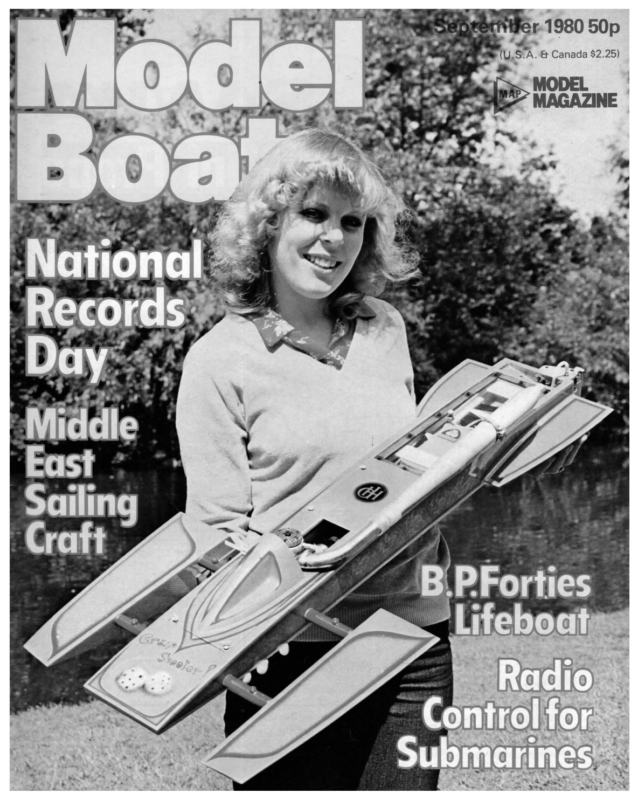
iBrerhier 1980 50p * 2 B (U.S.A. & Canada $2.25) East * Sailing Craft Lifeboatex 2 et“ per eS in S 2. we : cy .* ey – Fs i . pe = . ~. ba. ‘ ” i: : é : é fe. y # 0% i. :é i. _ : – . ey ‘ JL a = see t”% » *, WSS ‘ aie
LITTLE more information has been gleaned A about the EC12 class, adopted this year as an international one-design, from, strangely, a Swedish source. The imperial dimensions had been converted to metric, and are here converted back; of course, the hull is standard and the displacement should be, though a figure hasn’t yet come to notice. Perhaps a copy of the official rating will emerge from the IMYRU meet- Jib hoist max. il ing in Ottawa. The figures we have found were: 150cm (59.1in) L.o.a. 109cm (42.9in) L.w.|. max. 22cm (8.66in) Draught max. 183cm (72in) Main hoist max. 150cm (59.1in) 7790 sq. cm (1207.5 sq. in) Top suit max. 5650 sq. cm (875.75 sq. in) Storm suit It is understood that the beam is around 103in and this suggests a boat of about 20-22Ib displacement. From Our MYA Correspondent Multi-hulls Atthe IMYRU meeting, a proposal was being put forward by France for a new ‘CT’ class, covering any type of yacht having two or more distinct hulls immersed in water when floating at rest and actuated by the natural force of the wind on areal sail area not exceeding 1 sq. m (about 1550 sq. in). There are virtually no restrictions except that ballast or equipment may not be put on board or cast off during the course of a race, This is not to put down the French proposal; this type of craft does attract a great deal of interest, though a certain amount of this may be the armchair type, and anything which stimulates discussion may reveal new thoughts or ways of developing the hobby. It will be interesting to hear what follows from this proposal. except water. Sail area measurement is roughly on the lines of 10 raters, i.e. actual area is measured, and alternative sailplanes, other than smaller suits, are not allowed, but spinnakers are (length between clew and tack times length between head and clew or tack not to exceed 2 sq. m. The thoughts behind this proposition are that the growing use of radio aids modellers to keep abreast of full-size developments and possibly to attract new blood into the sport. Shifting ballast is a desirable inclusion to encourage new ideas and to achieve high speeds; there would have to be some modification to race procedures to accommodate the potential high speed ability. Itis suggested that a catamaran with 65in hulls and 1550 sq. in of sail, weighing about 11Ib with shifting ballast (radio plus weight) of, say, 3lb would be about right. Speculation on reaction to this proposition is idle, since the meeting at which it will be discussed falls between the preparation and publication of this particular issue, but it is possible that a request would be made for evidence that such a class would meet a demand, or that sufficient support is likely to make its introduction worth- The 8&ft catamaran mentioned below. Further details available upon receipt of sae to Model Boats offices. Over the last twenty years or so there have been quite a lot of non-club enthusiasts who have been attracted by multi-hulls, and several of them have reported their experiences in these pages. One which comes to mind was an 8ft design described in the May 1975 issue; beam was 4ft, sail area 1600 sq. in and weight about 30lb, including a fixed bulb keel on the centre section. In almost every case, difficulty in tacking has been encountered, plus a tendency to trip over the bowof the lee hull, flinging the boat round and sometimes causing a capsize. Stalling ona luff, followed by sailing astern, has also been fairly common. The thought of half a dozen six-footers negotiating the windward buoy simultaneously is a solemn one. South African Activity Durban club looks like being very busy next year, with the SA vane nationals at Easter, followed by their R/C nationals and a special national regatta at the SA Games, both vane and R/C, in May 1981, all to be held at Durban. The 1980 R/C Championships, held over four days at Easter this year in the Transvaal, attracted 15 R10Rs and 21 RMs and was sailed very successfully on the fleet system. Winners G. B: Mundy (R10R) and P. Marklew (RM) earned the right to represent their country at the World Championships in Ottawa. Badges Reaction to the new MYA cloth badges has been very favourable, and the even newer IMYRU one has also gone down well. The former is a black, blue and white disc about 3in diameter, the latter a 23 x 3%in red and white pennant with blue initials; both look very smart sewn on blazers, anoraks, caps etc. Price is £1 each including post (US $2.50 overseas) and they are available from the MYA Publications Secretary, Vic Smeed, PO Box 6, Rickmansworth, Herts WD3 4RE, remittances made out to MYA or, if IMYRU badges only are ordered, to the IMYRU. while. The French feeling that the model yachting world is fairly conservative is, to a certain extent, well based, but the conservation is more a reluctance to start new and unproven hares than a resistance to progress. Where there is a general feeling that something new is needed, it is reasonable to look for a lead to be given, but normally a new class would be promoted nationally, and only when it was seen to have support and to attract the interest of other nationals would it be proposed for international adoption. In England, there have been two fairly inten- sive and sustained attempts to introduce multihulls, the Metropolitan and Southern District’s 36in class and the Birkenhead club’s 48in class. Both attracted some attention and races were held, but both faded away. Admittedly this was in the immediately pre-radio days, but if anything catamarans and trimarans are easier to sail with vane than with radio and can certainly A possible R/C novelty event! See opposite page for further details. achieve the same sort of exciting speeds. 574 Model Boats
R/C Novelty Events A fun event which might be worth trying could be called ‘Scoop’. It is envisaged that pairs of RMs could compete, each pair being linked by, say 12ft of thread tied between their mast bases. The thread would carry blocks of scrap foam polystyrene, both for visibility and to keep it slightly above water level. Probably two pairs at a time would be enough, and on the start signal half a dozen weighted balloons would be released from the windward bank; the weights are to keep the balloons slightly immersed and prevent them blowing downwind too fast (they could equally be beach balls or polystyrene foam blocks). The object is to capture them in the bight of thread between the yachts, either one at atime or, if they don’t escape the thread, in convenient groups. The thread will, of course, break rather than damage a yacht, and the necessity of keeping the yachts sailing close together is excellent training for depth perception, boat control and other racing requirements. If the thread is just strong enough to snub the boats gently, keeping together should not be too difficult. Normal rules would apply as far as possible, eg if two pairs of boats are heading for the last balloon on port and starboard tacks, the former would have to give way. Perhaps one of each pair could be captain and decide courses and tactics, and there could be some skill in slowing a faster boat down (by slacking luff tensions or otherwise spoiling the set ofthe sails or ?) to keep a pair together; how to slow a boat offers lessons on howtotrim to go faster, so that such an event could help some skippers in conventional races as well as causing a lot of fun. Another, simpler idea might be a semi-relay race between teams of three boats, A,B,C and X, Y,Z. A &X start a normal course together, B and Y when their respective team mate has cleared the windward buoy. C and Z can start either when A and X clear the second buoy, or when B and Y clear the windward one; probably the latter would be best. All boats sail one lap, and the race is won when either C or Z crosses the finish line. Each team should be a mixture of ability, and it would be up to the team skipper to decide whether to use his fastest boat first or last. Boats would be in the water ready to start, and judging a start position against the preceding boat’s distance from the buoy would call for accuracy in assessing speeds etc. at different distances. The second and third boats waiting might be able to out-manoeuvre their opposite numbers by taking right of way at a crucial moment, thus sharpening appreciation of starting techniques and training skippers to take in more than one situation at a time. The method of running such events bears only a little similarity to conventional racing, but their object is to spend an amusing hour or two while becoming more familiar with one’s boat and improving sailing knowledge and ability. Something of the same sort occurs in flying training; aerobatics have little application in normal flying, but they teach a pilot confidence and familarity and allow him to cope with things which might happen. ‘Recovery from an unusual position’ was one object, and although a yacht is unlikely to fall out of a cloud unexpectedly upside down, the same sort of principle is relevant. Events such as those suggested make a change from straight racing but have ‘unconscious’ training value and could give a lot of fun and a chance to shine to skippers who tend to be regular tail-enders; as such they help to knit a club more closely together. * September 1980 VMIPBA News from Jim King ITH the advent of September the season is approaching its traditional end, however tradition nowadays seems to go overboard and whereas in the past, autumn and winter months were periods to spend in the workshop, for many clubs today there is much activity at the lake. Perhaps because of the weather we experi- ence when summer seems to get colder and the winter is oft blessed with good days it is as well we make use of every opportunity to enjoy our hobby when we can. In all but the Scottish area there are major regattas each weekend during the month and all categories of power boating are catered for with perhaps the hydroplane enthusiasts having to do the most travelling if they are to enjoy a run each weekend, except for the first date, 7th September. The month contains, unusually, events running over two days — the first on the 13th-14th September is of course the Inter-Area Challenge Match for the ‘Westbury’ Trophy and since | have already made much mention of this in the past maybe it only needs this final reminder to draw additional interest to the event — Cotswold’s Water at South Cerney is the venue. The other meeting catering for most classes of boats — straight course, tethered hydroplanes, radio control and particularly, steam, is the ‘Anniversary Regatta’ of the Welwyn Garden City SME on 20th-21st at Stanborough Lakes, Welwyn Garden City. The lakes complex is adjacent to the south-bound carriageway of the A1(M) at Welwyn Garden and the lake used is the model boating lake, not the large one many remember from the 1975 Naviga Championships. With the need for more time on the water being expressed by many boaters, particularly in competition, the advent of more two day events should be welcomed and supported. Having picked out two day events let me go back in time order to mention some national and regattas and return to the 7th for the National Multi-race Championships which are being held this year in the Midland Region at the well known Witton Lakes venue. By this time all the contenders will be known and will without doubt number many who have competed in this championship in the past, but like all such competitions we look forward to noting the success fo the newcomers, for it is the appearance of new faces that keeps competitions alive. One section that has shown a healthy increase in interest over recent years is that of the electric multi racer. | was made well aware of this on a recent visit to Brean whena perusal of the types of boats going to that venue showed the electric multi-racer to be well to the fore in growth and it would look like something in the region of 40 boats of that type will be taken down for the period. With a demonstration run at Rotterdam to expand the international interest it could well be that these new classes will more than fulfil the expectations of those who have been the most enthusiastic proselytizers of the cult. It might be worth reminding you that there is an Electric Club Regatta on the 7th at Redhouse Park, Birmingham, for those who havea particular interest in electric functional craft. Followers of the straight course boat on that day will no doubt find their way to the Prince of Wales Pond on Blackheath for that club’s event for functional and scale straight-running boats. Another section of the model power boating world that has found many new participants in area 575