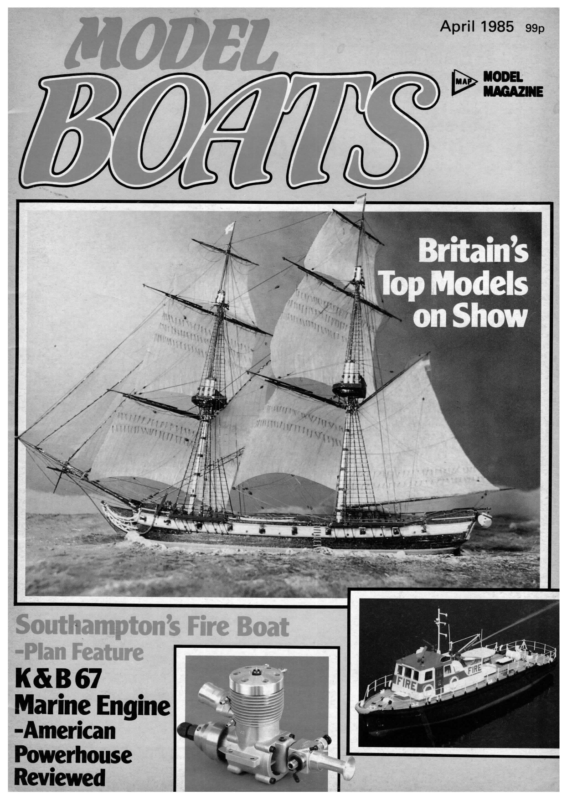
- Starting In Sail Vic Smeed discusses the prime mover – wind
- Logbook Model Yachting News from Vic Smeed

April 1985 7 . K&B67 Marine Engine -American Powerhouse Reviewed , 99p MODEL MAGAZINE
tis understandable that the owner of a power boat is interested in his engine and the fuel that goes into it; even if he doesn’t go into thermodynamics or whatever he has some idea of what fuel mixes provide most power for short runs, or best results for prolonged runs, and matters such as cooling, lubrication, engine life etc. In exactly the same way the yacht owner who has a grasp of sail dynamics and, more particularly, the ‘fuel’ used — wind — is likely to get better performance from his model. Invisible power Wind is, of course, invisible and may seem rather a nebulous subject to tackle. However, the effects of wind are easy to see and are very positive, and since its behaviour is generally much the same as other fluids, observation (at secondhand) is possible. Observation — noticing — is the major part of studying wind and using it to the best advantage, and it is no coincidence that the top skippers are always aware of what the wind is doing and the local tricks itis getting up to. Temperature variations are the major factor in creating wind. The sun’s rays pass through air without affecting it (except possibly minutely if there is, say, a lot of dust in the air), and it is heat reflected or conducted from the ground which warms air. If there are significant variations in terrain, some air gets warmer and therefore rises, requiring other air to flow sideways to fill the hole it would otherwise leave. This may bea local effect — a tin roof, or a road, or a field of ripe wheat next to grassland — or on acontinental scale: the Indian Ocean monsoons are caused by temperature changes hundreds of miles away in the Fig. 1 & Himalayas. An air mass warmed above the surrounding air will rise, creating a low pressure area, and vice versa. Replacement air will flow into the low pressure area from areas of higher pressure, but because of the earth’s rotation and items such as At first sight this lake appears to be free from any surroundings which may influence sailing conditions, however the deceptive sloping bank and the trees and bus shelter lead to dead and turbulent areas of wind flow. saturation point and condenses out to become cloud. There is another factor which should be mentioned. Air over water and over land picks up different amounts of moisture and air near the polesis, not unexpectedly, quitea bit cooler than air near the tropics. We thus get four types of air mass — tropical maritime, tropical continental, polar maritime and polar continental — and where these masses mix, as might happen if a low pressure area forms near the junction of two air masses, considerable instability and more extreme conditions will be likely. Britain lies at a major junction of the four types of air mass, which is why its weatheris so variable or, if you prefer, this is the basic explanation for ‘Fleetwood conditions’! With this knowledge it is possible to see why model yachtsmen in the centre of a large land mass experience relatively light winds and stable conditions, or why, in other words, an American or Hungarian yachtsman can get away with only one suit of sails. Even near the coast in many latitudes one normal suit and one ‘storm suit’ will probably cope with almost all conditions, although there may occasionally be unusual weather such as was experienced in Vienna during part of last year’s Naviga championships. The foregoing is not necessarily of major importance to the average model yachtsman, although knowing something Fig. 2 geostrophic force (which we need not go into!) the flow is not direct but rotational. This is why the direction of the wind can tell us something about the weather. In the northern hemisphere the winds round a low pressure area (a cyclone, though not necessarily a concentrated one!) are anticlockwise, so if you stand with your back to the wind the low pressure area will be on your left. This, incidentally, translates to airscrews as “if you’re flying with starboard drift, you are heading into deteriorating weather.” The reason for this is that as air is rising in a low pressure area, its moisture content reaches 210 MODEL BOATS
of how major air movements arise may help to understand the influences on local conditions. More immediate weather changes may arise from frontal systems, which are formed in the air masses rotating about (usually) low pressure systems. Air movement is not a tidy, constant speed matter and as air masses rotate they are likely to pick up or lose heat, or draw in cooler or warmer flows from adjacent masses. As the air moves inward any cool area begins to slide under warmer air or warm air catching up cooler rides over it, resulting in the formation of a cold or warm front. Either way the warmer air moves higher, producing cloud; often there may be a noticeable change of wind direction either side of the front. Fronts vary from as little as 10 to 300 miles in width, and may pass over in half an hour or take all day, depending on speed of travel and extent of pressure differential. With a very active front, especially one in which cumulonimbus clouds are developing, local winds can change dramatically in direction and strength in a matter of a minute or two. Local activity Local thermal activity Fig. 2, can produce sudden wind changes, especially in slight breezes. A factory or built-up area windward of a lake can heat the air above it until a large bubble of warm air exists and a slight disturbance will cause the bubble to break away and rise. Air rushes in to fill the present for most of the time, even at night when cooling rates on the ground vary. Wind shadows can havea more direct effect in that they are formed downwind of any topographical feature such as a clump of bushes at the lakeside. In light conditions they can easily be seen, since the water surface in them will be still as against the slight ruffling or popple ofthe surface exposed to the moving air. Avoiding getting in the lee of high banks, buildings or trees is common sense and not difficult with radio yachts, but it is possible to be caught out with vane or other free sailing models. Study a smooth but reasonably fast- moving stream and you can learn a lot which can be applied to air movement. Note in particular the quiet and reasonably eddy-free pockets which are the equivalent of wind shadows, especially their extent and how their boundaries relate to the obstruction causing them. Although as mentioned wind shadows are easily spotted in light conditions, above perhaps 3-4mph, the water surface will be ruffled all over and the shadow extent will not be so simple to see; you need to know where it is likely to be and how close you can sail to it. Local knowledge, so often a factor in racing on some lakes, is no more than an awareness of where wind shadows and flirts will be found when the water surface doesn’t reveal them. will see the downstream deflection change direction and extent in time with the pulses. Remember that water is nearly 800 times denser than air and has correspondingly greater inertia. Since the wind ‘pulses’ continually in strength and direction, if you know where such a deflection may occur and can spot its variations either by catspaws on the water or a tell-tale ribbon on the mast-head, it is possible to ‘work the puffs’ and manoeuvre into an advantageous position ahead and to windward of an opponent who is less observant. The classic example of wind bends occur, once again, at Fleetwood, Fig. 5. Air funnelling under the bridge at one end of the lake fans out along a considerable length of the lake, or an offshore wind vacant space and this may meana complete reversal of the wind direction over the lake for a minute or two. Cloud shadows can set off thermals, which also frequently form in wind shadows, i.e. sheltered areas where a pocket of air may remain undisturbed by the general breeze, getting warmer until it suddenly breaks away. These thermal incidents are more noticeable on a calm day, but happen even funnels up the roads inland and makes a series of fans and in these conditions it is of little use to rely on a flag or wind indicator at one point as providing a reliable guide to the wind direction and strength all over the lake. Turbulence Not far removed from wind flirts and bends are areas of turbulence. These occur on the boundaries of wind shadows and downwind of narrow obstructions or narrow gaps in wide obstructions. Again, 5 ine. paca = Zee aioe The infamous bridge at Fleetwood which leads to the well-known funelling conditions at this famous lake. in wind, when the effect may be to ‘bend’ the wind for a short period. Since they occur Flirts wonder that the wind is never constant in Well, these are wind bends which may be semi-permanent or only arise in gusts. Look at a small rock sticking up in your stream during most of the daylight hours it is no direction and strength for more than a minute or two at a time. It used to be thought that thermal currents or bubbles only occurred on warm, sunny days, but it is now realised that vertical instability is APRIL 1985 and you may see a deflection of the current which extends a foot or two downstream of the rock. Stick a hand in above the rock and ‘pulse’ the water striking the rock and you look at the eddies and whirls downstream of any obstructions in your stream and imagine similar flow disruption occurring in the air downwind of a tree or shed on the lake bank. The distance affected is related to the wind speed and its condition when it strikes the obstruction (it may already be rolling from another obstruction further upwind) and of course the size of the obstruction. However, although the stream gives a good indication of horizontal turbulence (i.e. that seen looking down on it) it is not able to show the extent of vertical turbulence which is likely in a moving airstream. A long, low obstacle such as a hedge or a raised bank upwind of the water will produce little horizontal turbulence but vertical disturbance, as the air rolls over it and continues rolling for a considerable distance, will be severe. The immediate and 211
and it would therefore seem that having a low foot to the mainsail is on the whole disadvantageous. Variations in wind strength — puffs or gusts are rarely pheugoidal but tend to come in at an angle to the general direction. Frequently the angle is similar over a period of an hour or two, and the puffs are often consistently spaced. If an approximate time interval can be noted, the direction and time of the next puff or gust can be anticipated and an eye kept open for the first signs of its approach. By having the yacht ready to turn at the first obvious effect will be no steady wind in the immediate lee of the obstruction and this is usually visible, even in quite high winds, by a relatively calm water surface close to the bank. Many people assume that as soon as ripples or waves appear the wind is back to normal, especially if they are on the downwind bank and can feel it on their faces, but in fact the wind will still be rolling for a considerable distance, depending on its original strength and the height (and shape) of the obstacle. A yacht sailing close to the line where the waves begin will be in pretty dirty air and is unlikely to sail as fast as a similar yacht sailing in a similar course nearer the lee bank. If two of you are having an hour’s general sailing you could do worse than to explore the wind effects arising from this and other obstructions. Next time there is a race with a similar wind direction you will then know where to place your yacht to minimise turbulence effects. Wind Gradient There is one wind effect which we have mentioned before which should be included, and that is wind gradient or surface effect. Wind close to the ground or water surface encounters friction created by its passage over grass, waves and so on and it is therefore slowed. Considered in layers a few inches thick, the bottom layer is almost stopped and this in turn slows by friction the layer above, which again slows the one above, and so on. On an average grassy field the true windspeed of, say a 5-6mph breeze would not be felt below perhaps 4ft. and over water below probably 2),-3ft. This is one reason why larger models sail better than small models, in general, and why high aspect ratio sails give more drive — more of the sail area in either case is exposed to the true wind strength. This particular point leads toa thought on sails. Inrules such as the‘A’ the jib areais calculated as 85 per cent of the foretriangle area — that is, the area bounded by the mast, jibstay and deck — irrespective of the actual size of the jib. It therefore pays to use as much of the fore-triangle as possible which is why such jibs virtually brush the deck. However, extending the mainsail as low as is practical confers no advantage as far as measurement is concerned and except in very light airs when the yacht is barely heeled, wind gradient is slight and surface level turbulence very small, it confers no sailing advantage. It reduces the height of the centre of effort and hence slightly lowers the heeling moment, but when it is windy enough for this to be significant the foot of the sail is blanked by the high side of the hull, wind gradient is more noticeable and turbulence is likely to affect the bottom foot or so of the airstream. More of the sail area is affected by foul air intimation, rather than waiting for it to hit the boat, a good skipper can gain several feet on his opponents in a race. When sailing, always try to establish a point towards the horizon from which the mean wind appears to be blowing to the position of the observer. Try to assess how far and at what intervals the wind is swinging away from the mean line and return periodically to the same position to make a check on any changes which may be occurring. Similarly, try to establish a reference regarding mean strength, so that you will be aware of the first signs of the wind lessening or strengthening, veering or backing. All other things being equal, the skipper who notices changes first isina strong position to pick up a few points (or the converse, in radio racing!), as was stated at the outset, it is no coincidence that consistently winning skippers are those who, however casual they may seem, are keeping a shrewd eye on what is happening to the wind and can also read what it is doing on the lake. None of this seems quite so simple as making sure that enough of the right fuel has been put in a power boat’s tank, but it is just as vital and witha little practice becomes second nature. Of course, successful application of what you observe is a matter of knowing your yacht thoroughly and doing the right thing with it, but that perhaps is something for another time. Note the completely dead area to the right of the railway embankment, made even worse during the brief periods when the trains are passing by. MODEL BOATS 212
R emarks about the dangers of over- complicating rules, made in this column a couple of issues ago, seem to have touched a few chords, mostly harmonious but one or two dissonant. The odd ’phone call and letter (‘It needed saying’, “The bit about interest shrivelling when the rulemakers move in is so right” and so on) seemed to add up to general agreement, and not only from non-competitors. There was, however, disagreement from one or two keen racers, though not so directly expressed. We understand that one or two overseas readers interpreted the comments as expressing the official M.Y.A. attitude, and if you haven’t read the column much before, and it is in any event in a foreign language, such a misapprehension is understandable, although we do try to stress that the opinions expressed are individual. There isn’t anything official about this column (although we do receive minutes of M.Y.A. meetings) which has the primary purpose of endeavouring to communicate generally what is going on in both the M.Y.A. and the I.M.Y.R.U., as far as information received permits. If model boating enthusiasts who are not club members are never told what is happening they are likely to think that nothing is and and a result remain non-club members, which is a pity both for them and for organised model yachting. A secondary purpose is to air the views, as far as possible, of ordinary club members, as far as can be done from information received (which is almost non-existant!) conversations and what feedback can be gleaned. In any amateur body, from a local angling society to the A.A.A. there are always keen and/or competitive people who are prepared, or in a position, to spend a lot of time on the organisational side, and without them very little would probably be done. They are prepared to attend meetings, drum up officials for events, investigate new places to operate and so on, and naturally they are elected to run things. Some are keen and efficient competitors, others are relatively inactive competitively but enjoy the administrative side of things. Both types are differént from the average club member and frequently fail to understand the average member’s viewpoint; there is a growing tendency to show impatience with Mr. Average for not being as keen or able to devote as much time to his hobby as they can. What is sometimes overlooked is that they are elected to run things, not to introduce swingeing changes which leave Mr. Average feeling out of touch and out of date. Obviously changes are sometimes necessary or desirable, but if they are to be sweeping they need to be ‘sold’ to the membership or APRIL 1985 alienation and loss of interest can result. People on the whole are pretty reactionary and like to continue in the way to which they have been accustomed unless some cogent and convincing reasons for change can be demonstrated to them. In the model yachting world we’ve had a fair number of changes in the last ten years or so. In particular radio has brought in a lot of newcomers (i.e. people who weren’t model yachtsmen ten years ago) many of whom are accustomed to full-size practice and who — in the view of Mr. Average — seek to impose such practices on models, a course which Mr. Average thinks makes model yachting unduly complicated and, because of the plethora of rules, unduly contentious. Rather than attend district or national meetings to express his opinion (which he may well feel is shouting into wind anyway) he will opt out and continue to enjoy sailing his existing models in the way he always has. Eventually he may feel that it isn’t worth paying an M.Y.A. affiliation fee because the Association doesn’t cater for him. Such members — and it is the writer’s belief that they comprise by far the majority — enjoy a bash round the buoys against clubmates on a Sunday morning, with only a minimum of rules to observe. Who cares if they touch a buoy as long as they’re the right side of it, or if they bounce off another yacht as long as it wasn’t deliberate and no damage results? They don’t feel they are second-class citizens or getting less enjoyment out of sailing because they think that, e.g. rule 33(b) is ludicrous. At the highest levels such rules are doubtless essential, but should the whole effort of the Association be directed only at the few races and few skippers at this level? Competition, it is always said, improves the breed. Well, most of theimprovements in the last dozen years seem to have increased the expense more than anything else, and attempts to limit expense have provoked considerable argument. Performance has no doubt improved, but only marginally in comparison with cost, and most skippers would have been just as happy without carbon fibre or Kevlar and the like. Everyone enjoys the ‘fun races’ organised by most clubs on a one-day-a-year basis, when even the oldest yacht in the club stands a chance of winning. Wouldn’t it be worth trying something other than plain racing now and then? A possibility would be a ‘fastest round the lake’, passing between a few buoys moored 10ft. out from the bank, classes for (say) up to 24, 30, 35 and 50in. l.o.a. and draw for order of sailing so that there could be some luck element with the wind. Could be radio and/or vane, allcomers. Some people might even build a special oat and, with publicity, non-members could be tempted to bring their boats along. The local interest in races in East Anglia and the Shetlands, none of which owes anything to the M.Y.A., is considerable. There could even be a class for 575 boats. Surely it is not beyond our wit to devise some form of competition other than conventional racing? Something which involved Mr. Average and made him want to have a go because he’d enjoy it? More than half the affiliated clubs take no part in present activities but because they are not heard from doesn’t mean that they wouldn’t be if something sufficiently attractive was programmed. What we have continually harped on is that racing to full-size rules is not, as is thought by the very keen, the be-all and endall of model yachting, and to adopt the attitude ‘They must learn therules’ is to turn off the majority of the model yachtsmen without whose affiliation fees the Association could not continue. Assuming they were sufficiently attracted to join in the first place, of course… + Dick Priest We very much regret to record the death in December of B. H. Priest, M.I.Mar.E., one of the model yachting giants of the 1950s and co-author with John Lewis of the classic 1965 book Model Racing Yachts. Dick wasa full-size helmsman of no mean ability, especially in Dragons, and after ten years or so at sea as a marine engineer took employment soon after World War II in a Mersey- side ship repair yard; he became closely involved with Birkenhead club and, in particular, the late Jim Edwards, at this time. With the Edwards-designed Torcello, Dick placed 3rd in the 1949 A Championships and set off on a series of A designs which were to win eight championships between 1952 and 1969, three skippered by the designer. Of these the Highlander design with four wins (’57, ’61, 63 and ’69) is the most famous and is still in use in the RA class today. He also won the 10r nationals and produced three M designs which were enormously successful. Dick readily admitted that he was not a natural skipper, but his engineering training, insistence on perfection of the smallest detail and painstaking tuning and trimming produced a consistency of performance which was a model to other skippers. His designs were not always conventional for their time, but were widely built and throughout the ’50s and early ’60s there were few A or M events in which two or three of the top six places were not from his board. He returned to full-size racing from the mid-60s, though kept in touch with the model side; his last model activities were a design for the 12m ‘Project Acorn’ trials and a follow-up design incorporating lessons learned in the 1981 Trials. He was a major influence on the post-war model yachting scene and his place in history is assured. Change of address Please note that the address of Chris Jackson, M.Y.A. Vice-Chairman, Publications Secretary and editor of ‘Model Yachting News’ is now 33 Yorke Gardens, Reigate, Surrey, RH2 9HQ. 213
he 1984 Model Yachting Association Champions Cup was held over the weekend of October 20th-21st. The host club, they must be gluttons for punishment, was again the Leicestershire Model Yacht Club. Unlike 1983, however, the venue for theevent was not their familiar water at Loughborough. In order to avoid problems with weed, suffered more or less silently by a few at the previous meeting, the chosen water was a worked out gravel pit midway between Leicester and Loughborough. The lake, known as the Wanlip Education Sailing Water, provided an excellent setting for a true meeting of the mighty. Short on facilities, although a friendly pub was onlya couple of hundred metres away, that America’s Cup Races which are always a series of races between two boats, the series being planned so that each skipper meets every other on a one-to-one basis the same number of times. Because of the formidable number of races involved with the 19 who accepted the invitation to compete, everybody only sailed against everyone else once. There was therefore no chance for revenge as in the 1983 event. In theory the tactics employed for match racing are much different to those which would be used when sailing in a fleet. This seemed to be ignored by most of those competing. Nearly always the skippers had their boats close to the start line ready for the signal, whereupon they would set offin great Left: Tim Fuller leads the fleet away for the penultimate race which he won. Above: winner Torvald Klem contemplates the trophy as he delivers his ‘thank you’ speech. necessity for sailing was in abundance. There was no doubt about it, the Leicester Club had laid on a plentiful supply of wind: some would probably argue that they went over the top! Despite weather forecasts of showers, the sun shone almost all the time out ofa mostly clear blue sky — rightintothe YA Champions Cup 1984 eyes of the skippers! Many will ask, “how does onegainentry to this auspicious body of model yachtsmen?” The answer is easy, although notsoeasy to put into practice. All one has to dois to finish Ist, 2nd or 8rd in an MYA District Championship for the Radio Marblehead Class. Alternatively entry can be gained by finishing in the top ten at the National Championships. There now, there’s nothing Mike Kemp reports on last season’s intriguing struggle for the honour of top yachtsman to it, is there? Succeeding thus gets one an invitation to have a bash at the other top skippers around the country: and did they do some bashing this year! More of that later. Seriously though, watching the cream of the British Model Yachting scene is certainly an education and could make the ‘ordinary’ skipper feel quite inadequate. Saturday = 342 : 342/72 = 171 £9.” 18 This bit of mathematics determined how many races there were planned to be in the first part of this year’s Champions Cup. As has become usual for this end of season event the first day of the two is set aside for Match Racing. This is a form of racing not often seen in the Radio Control Model Yachting world. It is almost entirely the realm of the Vane or Free sailing branch ofthe sport. Itis of course known world wide through the 214 haste; each trying tosimply outsail the other, rather than try to force an error. Such errors, or rule infringements, when they did occur resulted in instant disqualification for the guilty party. Thereafter, provided that the remaining boat successfully negotiated the course to the finish, the ‘innocent’ party gained an instant win. It may bea reflection on the course that was set but the boat which reached the first mark in the lead almost always won the race. There were cases where a yacht came from behind to win but theseinstances amounted toonlya small percentage of the 171 — yes one hundred and seventy one — races in this series. Presiding over this hectic activity of boats being launched, started, followed, finished and retrieved was the Officer of the Day, Russell Potts. Each skipper received, before the event, a clear set of sailing instructions. In these Russell laid down the procedures that he intended adopting to try and get through all the necessary races. Observations A key part of the organisation was that each of the match races would be watched and followed by an observer. The observers were drawn from the Leicester Club and were four in number. A simple calculation shows that each observer, except one, observed 43 races. Now during eachrace theskippers and the observer walked from thestart lineon the left hand side of the foreshore to the right hand side of the course. They walked back to the left hand side to watch the end of the run, the reach and the start of the final beat. They then proceeded to the right hand side for the MODEL BOATS
rigging failure; that was on the Sea Urchin being sailed by Derek Priestley. The boat was retrieved and Derek was ableto quite quickly re-rig and continue with his series of races. There were no other serious rigging failures although one or two suffered from water getting at the radio gear. Among those having to switch to reserve receivers were Torvald Klem and Tony Owens. Alec Cheetham had a funny feeling that his Sea Horse was not going quite where he wanted it to during one race. ‘When the yacht was retrieved it became obvious why, his rudder had slipped away, leaving just a bent piece of Left: Mark Hammond’s Deception on starboard tack with a low down suit of sails. Below: the same boat on port tack. was busy sailing his new boat, the Sea Scorpion, into seventh equal spot at the end of the match racing. Towards the end of heat four Roger Stollery met Torvald Klem: Roger got clean away and looked secure to become the first skipper of the day to beat the defending Champions Cup holder. Then there was an incident that is likely to be brought up time and time again when the ‘swing rig’ is discussed. Roger was only three or four boat lengths from the finish and tacking to cross well ahead; his yacht went ahead to wind, stalled and stayed that way! No matter which way Roger turned the hull the rig stayed head to wind, could this be the achilles heel of the swing rig? Only time will tell; but, even if this was the first time that such an occurrence has afflicted the craft, it was finish: at this point the observer took his score card to the score keeping team further over to the right hand side of the sailing zone and returned to the OOD at the start line. If a fair estimate of the distance from one side of the lake to the other is 70 metres, then during each race an observer walked 280 metres. It takes only a little more calculator work to find that each observer walked a shade over 12Km or nearly seven and a half miles during the match racing. Who says that model yachting is a lazy person’s sport! On Sunday at least three of the four observers were back for some more; though Sunday was a relatively easy day. Well done the Observers! The Racing The wind on Saturday was really quite at times, nearly all day it was blowing from the West at around 12 to 16 miles per hour, that’s force four. At times, however, it gusted up to around 24mph, that’s force five or six. The result was that much of the sailing during the match races was carried out using C rigs of one form or another. Quite a few skippers resorted to lower than normal mainsails producing vicious definitely not the best time. Never one to let such an opportunity be wasted Torvald swept through to win. Ironically his only defeat in a match race was by the other version of the swing rigged yachts present, sailed by Graham Bantock. Graham also beat Roger when the two varieties of plug in and pivot rigged boats met. The third similarly equipped craft present was sailed by Roger’s son Peter who obviously was having some difficulty mastering the art of match racing, only managing to beat Norman Curtis, Alec Cheetham and Alf Tebbutt. A nice touch, but a super piece ot one-upmanship, was when the Stollery family met. Shortly after the start of this race Peter, perhaps blinded by the sun, got a little too Norman Hatfield’s Shogun /eads Derek Priestley’s Ecky Thump III onto the /ast leg of their match race. brass rod. Suitably equipped with a spare Alec went on to win five out of his first nine races, a feat rewarded with a kiss from ‘the missus’. Alec also buttonholed Squire Kay (Sea Horse designer and supplier) about the allegedly faulty, and missing, rudder. Squire some quite abnormal looking Marbleheads with masthead rigs. Despite the strength of the wind and the gusts there was only one close to the foreshore and went aground. Dad waded out to relaunch son’s. boat and then went on to soundly beat his offspring in the race. Isn’t there something in the rules about touching an opponent’s yacht? Left: a contrast of low rigs as the Hatfield/ Priestley battle continues: Norman won this one. Above: the duel continues: notice the Sea Urchin’s cut down mainsail, giving a masthead rig- normally forbidden on Marbleheads. APRIL 1985 There were a few occasions when one skipper managed to catch his opponent on the wrong tack. One such incident saw Alec Cheetham dispose of John Stone in a Port/Starboard meeting. Later on, however, Alec himself was sent back to the bank early by Mark Hammond who wrong tacked the Doncaster skipper during the 30 second countdown. The Andrews family of David and Elizabeth were beaten soundly as a result ofa clash between two adjacent races. 215
that, Norman did just the same thing once last year. Anyway, our intrepid MYA Chaixman, suitably equipped with thigh length waders, trudged around to where Shogun had cometo rest against the bank. Boldly stepping where no Chairman had trod before, Norman suddenly realised that the bank was steeper than expected when his waders filled with water! He was not alone in getting wet feet however: later on John Brooks was seen to kneel down on the landing stage to retrieve his yacht. As he did so water gushed from his wellies: whether this had anything todo with John’s eventual retirement from the Match Racing I am not sure. Whatever the reason John did not feel well enough to carry on and complete his set of races, although he did eventually have a go at the Fleet schedule of racing on Sunday. Meanwhile Sailmaker Graham Bantock seemed completely oblivious to the water as he walkedin and out clad in what appeared to be a completely wrong side of the starboard end buoy. A protest was made and ameeting took place to resolve the situation. There were one or two other protests, all of which resulted in meetings and further delays. Another of the OOD’s announcements to get misunderstood related to the end of sailing for Saturday. At the end of heat 16 Russell announced that he would cease the proceedings at the end of heat 17. Three skippers however, Alec Cheetham Derek Priestley and Tim Fuller thought that he meant he had stopped the racing at the time of the announcement; they wasted no timein packing up and retiring tothe comfort of their ‘digs’ for the night. Despite all this, racing actually stopped at the target time of 5.30pm to be resumed on Sunday morning. normal pair of shoes, socks and trousers. Perhaps he thought he was walking on the Left: Robert Smith, uncharacteristically down in the finishing order, retrieves his Sea Horse /ate on Sunday when the wind dropped. Right: Tony Owens tries to resolve his keel retention problem (see text). Notice the uncluttered deck layout. Elizabeth was having quite a battle with Norman Curtis, both yachts were on the last leg approaching the finish when they ran into the race that had just started between David and Norman Hatfield. Now theracing rules state thatany yachtsracing must abide by the right of way restrictions, no matter which race they are in. This gave rise to a situation where Elizabeth had to take avoiding action allowing Norman C. to get away and win: meanwhile David was also disadvantaged to the point where he was forced to retire, allowing Norman H. to win. Diversions Lunch on both days was taken in the nearby*public house where a very palatable Squire Kay gets his Sea Scorpion 3434 around the first mark ahead of Robert Smith’s Sea Horse 3503. The smooth water belies the strength of that wind. Right: Oliver Lee’s Trapper 3530 and John Stones Deception 3467 set off on their match race. Oliver won this one. array of hot food was made available. Suitably refreshed and relieved the assembled body returned to the fray: a seemingly endless routine broken only by the occasional crystal change and an even rarer water, being the supplier of the majority of Norman Hatfield confidently launched his One or two skippers either did not hear the OOD’s announcement or did not fully understand it. The result was that at least one lost his race by virtue of starting on the the sails in use at the meeting. There was a delay in the proceedings at _ three o’clock on Saturday. The cause Such d. around fluctuate wind sail change as the routine seems to highlight some of the more was an adjustment to the start line to tryand remove some of the bias brought about by a amusing, to the onlookers anyway, happenings. Incidents like the time when slow shifting of the mean wind direction. green Japanese design only to see it sail away completely out of control; he had forgotten to switch on the receiver. Funny 216 Sunday The second day of the meeting dawned bright and sunny once again, but with a much reduced supply of wind. The direction was nearer to South West and the strength was down to around5 or6 mph. This brought out the taller suits, some going to ‘working’ rigs and others debating whether to put on the really high aspect ratio sails. Among the first to arrive and get his boat set up was MODEL BOATS
In addition to moving the line Roger also managed to temporarily lose the oars of the dinghy, all of which added to the delay. As the wind was still only a breeze and time was marching on the course was a rather short affair. There wasashort dash to windward to round the original first mark to port: this was followed by a triangle, all to port, with the finish across Saturday’s finish line. The Sunday match race finish had been a very short affair well out in the lake. Five past Squire Kay, designer of three of the eleven different designs represented, concentrates. Tony Owens from Danson. Tony had had a fairly uneventful Saturday and was lying in around sixth place. He was to discover something puzzling about his Trapper, indeed something that in retrospect was slightly hair raising. When assembling the keel into the hull Tony found that although the retaining screw appeared to betightened, the fin assembly kept falling out. Closer examination revealed that the screw was too short and was only holding on about one of its threads. During the week prior to the racing he had inadvertently exchanged the retaining screws of his two keels. Fortunately the spare was buried in the back of his car and produced the correct screw. Tony had been blissfully unaware of all this on Saturday when that short screw had withstood all the battering of the strong winds. It was Russell’s intention to receommence the match racing at 9.30 am on Sunday. Unfortunately, because of the change of wind and things hemissed that by about half an hour. Racing then began at the much more civilised hour often after thecourse had been relaid. Whilst the sun was undoubtedly welcome, I guess most of the skippers were wishing that it would shine from somewhere else. From some points on the bank the far start mark was invisible. As there had been some multiple misunderstanding over the OOD’s closing announcement on Saturday, Russell wisely took the view that there may just have been some ambiguity about it. Consequently he decreed that the three missed races from heat 17 would berun atthe end of the match racing after heat 19. Apart from a few more ‘incidents’ where races were lost due to rule infringements there was little further excitement until the end of thematch session. This was when in his very last race and in full view of everyone, including son Brian who had come down especially to watch, Alec Cheetham mad an almighty muck up of his sailing. The Schedule After a short break which saw Dave Andrews rowing around the lake repositioning the marks ready for the schedule of fleet sailing the second half of the competition commenced. There was a further delay after the skippers’ briefing before the racing actually started. This was while Roger Stollery took to the boat tomovethestart line away from the bottom right hand corner of the lake. This was necessary to give sufficient manoeuvring room, otherwise the starts would have been best accomplished by what someone suggested might be a push from the bank. APRIL 1985 ci eleven saw the start of the first of 19 nineboat races. John Brooks returned to the fray, although a little subdued as shown by his placing of eighth in the first race. John was sailing the other Sea Scorpion and had a rather erratic day getting placed everywhere from last to second. The defending Champion, Torvald Klem, showed that he did not intend giving up without a fight and took the first race from Derek Priestley and Tony Owens. Mark Hammond took race two by the scruff of the neck and led from start to finish. Behind him, however, things changed about a bit. Alec Cheetham followed Mark off the line but had been passed by John Brooks, Robert Smith and Oliver Lee by the first mark. The second mark was reached in roughly the same order but by the time they rounded the third and turned for home John Brooks had been dropped from the leading group. When they got to the finish both Alec and Tony Owens had sneaked past John leaving him to finish in sixth place. Getting Physical Race three saw the start of the bumping that I hinted at early on. Dave Andrews, ever keen to be in front, was over the line at the start. Having purged himself of that error he was caught on port tack by Mark Hammond near the first mark. All remained peaceful until, with Squire Kay in the lead they turned for the finish. Dave Andrews, now in second place, was involved in an ‘incident’ with Tim Fuller who had climbed up from fifth at the start uf the last leg. the ensuing activity dropped Dave to fourth and Tim to sixth. Meanwhile Alec Cheetham had tried to slip by very close to the finish mark, unfortunately he got too close and rolled it: his clearance and re-rounding dropped him into last spot. Race four was a much cleaner affair with Tony Owens taking the start hotly pursued by Derek Priestley and Torvald. By the time they rounded the first mark Derek was in front and Dave Andrews had slipped into second place. Before the second mark Alec had also got by our Norwegian friend. On the last leg John Stone also managed it so leaving Torvald to finish in an uncharacteristic sixth place. The start of race five sawa bit of a bump between Elizabeth and Squire. Derek Priestley was the leader around the first but he was caught and passed by the two Scorpions around the second; the order around the third mark was that ofthe finish with another win for Squire and Derek holding off John Brooks. David Andrews did not get a look in this race staying in fourth from start to finish. Elizabeth, meanwhile, never recovered from her start penalties and brought up last place. Oliver Lee was in full control of race six although he had first Derek and then David snapping at his heels all the way to the finish. Race six was also the turn of Tony Owens to protest violently at being attacked from behind at the second mark. Tony had already gybed around the second mark and was on port reaching away from, but not clear of, the mark. At this point he was hit, on the inside, by at least one and possibly two other boats coming into the mark on starboard. Although the subsequent tangle delayed Tony’s progress somewhat he was eventually awarded the position that he occupied at the time of theincident. At about this time Norman Hatfield was heard to comment that the sun was so low in the sky that seeing that mark was becoming very difficult. Race eight was undoubtedly the highlight of the meeting for one young man. Peter Stollery got to the first mark in the lead and then proceeded to hold off the repeated challenge of Torvald, whilst Oliver Lee held on in third waiting for one or other of the leading pair to make a mistake. There wasa small cheer when Peter finished. Race nine looked as if it might be a good race between Mr. Klem and Mrs Andrews. Elizabeth, however, was caught on port at the first mark by TK and never really recovered, seeing Tim Fuller, Peter Stollery, Alec Cheetham and John Brooks go by her. Alec overtook Peter on the last leg and looked set to get past Tim but the latter wrong tacked Alec just before the finish and held on to second place. As the afternoon wore on the wind started to fluctuate to the point where some people thought about changing sails. Others did more than just think about it; one was Mark Hammond who decided to attempt it between races nine and ten. Perhaps it was his eighth place in race nine that prompted the flurry of activity around Mark’s Deception. With only seconds to spare the craft was re-launched ready for the count down to race ten. This was led from the start by Mr. Klem with Squire Kay and David Andrews battling close behind. Squire got to the first mark just ahead of David and that’s the way it stayed until the finish. Mark Hammond’s efforts between races bore some fruit as he had a good race with Graham Bantock and came in fifth behind the East Anglian sailmaker. The next race was an even better affair for Mark as he set off in close company with Norman Hatfield, Squire and Tim went on the wrong side close together until the last mark when both Squire and Time went on the wrong side leaving Mark to come in ahead of Norman. The aggravation at the last mark between Time and Squire allowed Derek Priestley through into third ahead of Tony Owens, John Brooks and Roger Stollery. Squire eventually got very close to the Starboard end finishing mark and was eventually credited with a sixth place as compensation for his impedance by Tim. Roger Stollery obviously enjoys the sailing.
Le ae The wind shifted at the start of race twelve and only one person seemed to notice it. Torvald Klem set off on his by now usual Starboard tack start to be followed by a port beat into the first mark. The rest of the fleet followed him, with one exception: Tony Owens set off to port then tacked onto starboard to approach the mark with right of way over the whole fleet. This turned out to be a master stroke to give him a lead which he successfully defended all the way to the finish despite some powerful sailing by the inevitable Mr. Klem. Race 13 saw everyone trying to emulate Tony’s route in the previous race. Consequently Norman Hatfield set off in front followed by Graham Bantock. As the tacking for the first mark started they collided as did John Stone and the finish. Behind them it was all happening: at the second mark Derek Priestley luffed violently from an inside overlap position to hit John Stone and forcing Mark Hammond to take violent avoiding action. The resulting confusion and gyration of boats served Derek’s cause very well as he came home in fifth position behind Robert Smith and ahead of Peter Stollery. John and Mark, meanwhile, had to be content with seventh and eighth respectively. Race 17 turned out to be a Norman Hatfield benefit. Squire Kay led Norman and Elizabeth into the first mark from a single port tack beat. Both Squire and Elizabeth hit the mark and had to re-round it leaving Norman to sail comfortably home in first place. Roger Stollery also got it all wrong around the first mark and came home eighth. Derek Priestley and Alf Tebbutt start leaving Squire and Torvald, also © involved in a start line incident, sailing in circles. Tony Owens had a start he will probably want to forget and sailed last into the second mark, literally; he hit it. Torvald Klem and Squire Kay collided at the last mark causing the retirement of Squire’s Scorpion. Torvald then sailed to the wrong side of the finish mark to come in last. Thus Tony Owens made up a place and Alf | Tebbutt rejoiced in his highest place of the meeting, sixth. Who won the last race of the 1984 Champions Cup? That honour went to Roger Stollery who managed to stay ahead of a fast finishing David Andrews followed by Tim Fuller and Robert Smith. As the skippers packed away their craft and made ready to go home the long suffering scoring squad of Louise Smith, Tony Drury, Dennis Nixon and Andrews the younger sprang into action to compute the final placings. The eventual totals were based on percentage scores from each of the _ | two sections being averaged to find an eventual placing order. From an outsider’s point of view this method, though different from the system used in 1983, still overwhelmingly favoured a good match race position. This year, the winner of the second section, David Andrews, who was in seventh equal place after the match racing actually fared worse than his counterpart in 1983. Coincidentally the fleet winner in ’83 was also seventh equal after the match racing. Barry Jackson, not competing this year, did manage to climb up to fifth overall last year: David managed to stay exactly where he was, in seventh place overall! It would appear that the majority of the Sunday’s activity served merely as a tie breaker for the match racing. The first eight places overall are in exactly the same order, taking the tie breaker into account, as they were at 10.30 am on Sunday. Still I guess © they enjoyed the rest of the day’s sailing. ee Tim Fuller. As the pack tried to settle down to some serious and separated sailing Graham Bantock emerged as the front runner followed by Woodley member stormed away in the lead closely followed by Graham and Roger. They stayed that way to Mast ram and jib twitching trickery on Tim Fuller’s magenta coloured craft from Sweden. All photos by the author. Norman Curtis. John Brooks also managed to stay clean and took up third spot. Norman Hatfield had another collision which he acknowledged by doing two penalty turns, then hit the finishing mark so had to reround that. After the race it was adjudged that Norman should have ‘done a turn’ or two as a result of the first collision and was finally credited with eleven points for a disqualification. This obviously awakened the fighting spirit in Norman for he won his two remaining races, 15 and 17. Race 14 saw some more bumping, protesting and eventual disqualifications. The race winner was Roger Stollery although the first boat home was Mr. Klem again, subsequently disqualified. John Stone, Graham Bantock, Elizabeth Andrews, Mark Hammond, Squire Kay and Alec Cheetham were the officially ordered finishers with Norman Curtis also being disqualified. Alec got a good start in race 15 and got to the first mark first, only one problem, he hit it! While rerounding he ran into the rest of the fleet and hit one of them as well; in this situation Alec had no rights of way so gyrated for a couple of turns and set off for the second mark in seventh place. Meanwhile John Brooks took over the lead and held it until just before the line when Norman Hatfield, determined to avenge his disqualification, sneaked through to win. As the time came to start race 16 the start line had been moved to try and induce a bit more tacking on the first beat. This revised line obviously suited David Andrews who 218 managed to get their mastheads hooked at the second mark: Derek was eventually credited with a fifth place for this race. Meanwhile Squire had been quietly making up for his mistake at the first and got ahead of Norman Curtis to finish second; Elizabeth, however, was not quite so effective remaining in seventh place. Peter Stollery and Oliver Lee had an uneventful race to finish fourth and fifth respectively. By now the clouds were arriving and the wind was picking up causing a lot of sail changing activity on the bank. The eighteenth race at last saw Tim Fuller come home first from a good port tack start. He was nearly caught by Squire Kay but Squire touched masts with Oliver Lee who, in company with Tony Owens, had swept through the field to almost catch the leaders. The delay to Oliver allowed Tony to finish second whilst the penalty turns dropped Squire to fifth spot behind Alec and ahead of John Stone. The penultimate race was alsoa Talking of results, perhaps I ought to 7 mention that Torvald Klem, that tall guy | from Norway who always seems to be able to see the start line, retained his hold on the MYA Champions Cup. Derek Priestley, OOD for the next ‘Worlds’, came in second and Mark Hammond, eighth last year, was third. The prizes were presented by the OOD and now MYA General Secretary, Russell Potts. In his acceptance speech the winner, Vice Chairman of the International Model Yacht Racing Union, thanked everyone for their efforts in making the event a pleasur- able meeting. He also issued a mild rebuke over what he must have considered as slackness in the operation by reminding us that this country is soon to host a World class event, and things will have to be a bit different! I am not too sure to what he was referring, perhaps it was all those protest hearings that soaked up the time. Results first for poor Alf Tebbutt who by now must have been feeling really outclassed. Alf had gamely sailed through the whole meeting winning only two match races, against Norman Curtis and Robert Smith, and finishing last in every fleet schedule race so far. In race eighteen he took advantage of some uncharacteristic sailing by Graham Bantock to finish eighth. The last race of the day was full of incidents. Elizabeth and David Andrews got together with Squire Kay to hook up and cause a restart. Roger Stollery and Robert Smith got away in front from the second O/A Place 1st Competitor O/A Match Fleet Place 1st Place 2nd T. Klem Yage 16.63 2nd_ OD. Priestley 26.4 2nd= 4th 3rd M. Hammond 28.98 2nd= 6th 4th G. Bantock 32.36 2nd= 10th 5th 6th N. Hatfield 34.08 34.68 5th T. Owens 6th 9th 3rd 7th D. Andrews 34.91 7th= 1st 8th S. Kay 39.66 7th= 5th 9th T. Fuller 44.36 10th= 7th 10th 11th 12th R. Stollery O. Lee £. Andrews 48.02 48.38 8th 50.23 10th= 12th= Tth= 13th J. Stone 52.31 12th= 15th 16th A. Cheetham P. Stollery 61.99 63.40 14th= 17th 14th R. Smith 56.03 12th 16th= 15th 14th= 11th 16th= 13th 17th N. Curtis 66.56 16th 18th 18th J. Brooks 72.36 19th 14th 19th A. Tebbutt 81.66 18th 19th