- SAILING FOR STARTERS Chris Jackson answers some basic questions for newcomers to model yachting and surveys what Is currently available
- CURVED AIR With Model Yachting Association General Secretary Russell Potts.

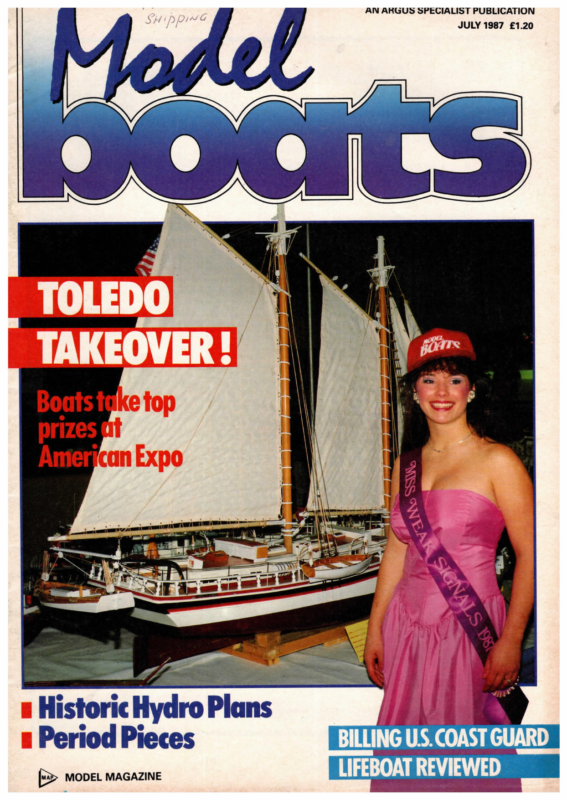
AN AKGUS SPECIALIST PUBLICATION JULY 1987 £1.20 Boats tc prizes § Historic Hydro Plans Period Pieces MODEL MAGAZINE
SAILING FOR STA Introduction More and more interest is being created in the use of radio-controlled model yachts, and anyone on the receiving end of enquiries soon gets a good idea of the most frequent questions and over a time collects a great deal of background information on the answers too! This article is an attempt to provide a general introduction for the newcomer with a bias toward the smaller and less expensive end of the market, which has obvious attractions for anyone wanting to try out their interest without perhaps risking too much of their hard-earned cash. Working from the assumption that the reader has no practical knowledge or experience of model yacht buildings, the first thing to do is to sort out the basic categories of boat, their relative merits and disadvantages, and then to go on to describe in a little detail a selection of available kits within the ranges, and discuss the radio requirements related to each size and category. Defining one’s objectives Time spent thinking through the following questions is not a waste of effort, as I have over the years seen more money and time thrown away by selection of the wrong design for the wrong useage than for any other reason. Let’s consider a few absolutely basic questions: 1. Where do you expect to sail the boat? On salt water or fresh, inland duckpond or large lake, in light winds or strong, for simple pleasure sailing or with a view to competition at club level? 2. Do you have existing radio gear, servos, etc., which you need to use to keep the cost within your spending limits? Are these suitable for model yachts, tough enough to take the wear, waterproof or not? 370 Chris Jackson answers some basic questions for newcomers to model yachting and surveys what Is currently available 3. Is there any existing local interest, and should you check with a local club to see if they sail and if so, what design or class? 4. Is transport a problem, as this affects the choice of size of boat, and you may need to check if the boat dismantles quickly and easily to stow on a bike, or in the boot of a car? 5. Is your main interest in speed and performance, or in reproducing in model size a replica of a full-size boat, in turn a modern rigged vessel or a more nostalgic boat. And will such a prototype be a reasonable performer at the scale you choose on the local lake? 6. How much time or effort do you want to give to building the boat, as distinct from sailing it? Do you like building hulls, or would you prefer to buy the basic boat, and have only to fit out the rig and install the radio gear? Most of you will have read the letters from newcomers to model aircraft flying asking a magazine for plans of a Spitfire for multi-channel radio and full retracting undercarriage, and the reply from the Editor suggesting a single channel trainer as a better bet to avoid immediate financial disaster! The same basic rule applies to model yachts even if they do sink with a bit more grace and with the possibility of a recovery intact even if waterlogged! As a general rule of thumb, a standard Bermuda rigged modern style hull is by far the safest bet for a guarantee of MODEL BOATS
reasonable performance, with the addition of a deep keel of unscale proportions more akin to the well-known Marblehead class boats used widely for racing in many waves! As you get to bigger hulls it becomes necessary to govern sail area, depth of keel, weight, and material costs to control development, and in the UK the obvious existing class is the 36in. restricted class run by the MYA. The main features of the 36in. class are a hullsize of 36x11x9ins., all-up weight limit of 12]b. and maximum two-channel radio. You can only use wood or metal for spars and mast, but sail area is as much as you can use. As a result the class tends to have lots of sailsuits for different winds, and associated costs. Metrification has brought with it the thought of a one-metre boat, and the world bodies NAVIGA and IMYRU are intent on developing a class of this size. Already in the USA the class is showing great potential and indeed the NAVIGA rule has been based on the original American specification. This rule restricts mast height and sail area, maximum three suits of sails, minimum hull weight to stop hi-tech expensive hull materials being used, and several designs have begun to appear in existing MYA clubs. In the UK with an established fleet of 36in. boats there may be less enthusiasm for a new metre class, but worldwide, it looks set to become a standard for both performance and semi-scale sailing boats! countries. There is no way I can answer directly the questions I pose above, but what I can do is to offer some general advice and leave the final decision to you. What Size? For many years now the Model Yacht Association has quite correctly put forward the view that a boat of less than 36in. in length cannot be expected to cope with the wide range of weather conditions which afflict the British Isles, and still give a competition performance. Unfortunately this has led to a degree of lack of interest in the developing kit market where people such as the innovative Harvey Middleton have gone down to first 575mm and now 590mm hull length and provided a cheap boat which TERS Some available kits gives a lot of Sunday Morning sailors at small lakes a great deal of fun, and allows the use of standard servos for winch as well as rudder. Such boats give great value for money and offer a good starting point for a first boat. Having done a bit of research into the present retail market for boat kits, I have selected a number of items to give a Radio and Winches Can I use my existing car or aircraft servos in a boat? Almost the first question for many modellers. As a rule of thumb the ordinary servo will work a rudder on any boat up to 1 metre long with no problem, provided it is kept clear of water! There is a standard waterproof servo in the Futaba range, the $129, and this costs around £25.00 from any model shop. Winch servos have always been a problem for competition yachts, but for boats with less than 600sq.in. sail area it is quite possible to get away with a normal servo in moderate winds, and there is no problem in using them for the smaller boats. Futaba list a servo with a moving arm, model number FP-S25, and this was last quoted to me at £37.00. The makers state that two servos should be used for ‘M’ class boats, which have 800sq.in. of sail split between main and jib so clearly it will handle a smaller rig with no problem. Century Systems have been offering a servo based on SLM mechanics, but when I checked in mid-March the new owners of the firm told me they had withdrawn this item from their catalogue for the time being to modify the electronic circuit. This servo is more bulky than a standard servo, but not expensive by comparison with the Futaba standard winch which was for many years the only decent winch on the retail market. This is still available, priced around £65.00 and too large really for boats under 36ins. Multiplex and Sanwa also list winches in their catalogue and if you search around you may find a shop which stocks JULY 1987 Heading is a gaggle of 575s at a recent National Championship for the class. Opposite middle: Robbe’s Skandia and bottom: Alternative Yachts’ Rebel shows its deck moulding to advantage; nice scale lines, strong grp hull. Top: Wedico’s Saudade and above: the Cup-racer poses next to the Optimist kit, still in its neat plastic container. R/C transmitter gives size clue. them, but for top performance you will have to go to a specialist such as Barry Jackson (Ashton Models) or David Andrews (Whirlwind) who supply most of the UK competition fleets with their world-class products. : How many radio channels do you need? Really only two, one for rudder and the other for one winch driving to both of the sails synchronously. This means that you can use the cheapest form of two-channel R/C gear and is one of the key factors in keeping costs down. Using 27MHz for ‘land’ based users, and split as well as full colour crystals, it is quite normal to sail 10/12 boats at a time! Class Rules Most of the boats below 24in. length seem to perform sufficiently similarly that it is possible to sail them in one fleet and do without any close rules. A club at Leicester has a mixed fleet of 575’s, 590’s, Cup-racers and one-offs and all give a good account of themselves in average wind conditions, with one or other responding to lighter or heavier wind or choice of size and type. No doubt there are others I have missed, and there are some I have deliberately omitted, but from this list you ought to be able to find one to suit your pocket and get you on the water without too much delay. For convenience I have listed them in order of length, and also indicated the name of the distributors who supply them to your local model shop so you can find one even if it is not a stock item!! 575 The first design by Harvey Middleton, and since taken over by Lesro Ltd. this boat has been the starting point for many an existing regatta sailor. With a semiscale cabin moulding and excellent general detailing the boat appeals to many scale modellers as a second string for fun regattas and is readily available through a well organised manufacturer. Kit price is £33.21, for which you get everything except ballast, radio and paint. Distributor: Lesro Models and via your local model shop. Optimist I have to say that this shape of boat is an acquired taste, but a quarter-scale version of the dinghy which is used worldwide for teenage sailing regattas seems to be a good place to start! The kit is in wood, with a metal centreboard which can be removed for storage, and single channel radio for rudder only control is intended by the manufacturers, hidden in the rear buoyancy casing. With a retail price of only £31.80, it might appeal also as a club fun-building project, with all builders starting on equal terms! Wide beam gives plenty of buoyancy for its short length of only 575mm and there is only one sail to make! The kit contains 371 |
ype of Middleton Challenge shows what a good everything you need to finish the boat, even the varnish, and a novel sail construction using glued plastic strips to edge reinforce the sail-cloth. Sail control via a second channel would be no problem using a lever arm on a standard servo. Made in Germany by Wedico, distributed in UK by Modelmakers Ltd. of Haslemere, Bucks. 590 The current Harvey Middleton offering, based on experience with his earlier 575, and now with a model type full depth keel and stern-mounted rudder. A full review of this kit appeared in the March/ April issue of R/C Boat Modeller, and I sailed that prototype on quite a large lake without problems. Another very complete kit, with basic mouldings in high impact styrene, and a standard suit of sails. Extras available include a tall suit of sails for light weather, but otherwise you get all you need, except adhesives in the box. Made in Leicester by HFM Marine, and sold’to model shops, it retails at £34.95 inc. vat. Trimaran The same length as the 500, and from the same source, this remarkably pretty boat is based on a full-size 60ft. oceangoing yacht, and with a weighted centreboard to stop the capsize problem which afflicts multi-hulls of all sizes. Not recommended for a first boat, if only because you have to build three hulls, it has a lot to commend it to the fun-sailing fraternity, and two or three on a small lake, would provide quite a crowdpulling spectacle. HFM Marine manufacture, and the retail price is again £34.95 inc. vat. Cup-racer 12 metre Quite a different approach in this Japanese kit, which is presented in almost ready-to-sail form, with radio and servos fitted, only needing a minimum of work to assemble the rig and insert batteries before sailing. Much higher price than the first three boats, but value for money if you add in the R/C costs. If you are starting from a position of no existing R/C experience, for example a big boat sailor, then the package will be most attractive. OO Made in Japan, and supplied with three suits of Mylar sails in the kit, as well as radio, servos, even marker buoys for the course, all in a polystyrene box. No major UK distributor as yet, but I can supply at £129.00 incl. post from my address, 33 Yorke Gardens, Reigate. RH2 9HQ. Rebel Based on the full-size /,-ton IOR class, and carrying around 225sq.in. of sail on a 25in. overall length, and once again can use a standard servo for the sailwinch. A moulded coach-roof and hull in GRP give 372 Left: close-up of first protot fleet of One Metre boats builder can achieve from a simple basic kit. Above: used by sailing school for off-duty fun, somewhere in the South of France. basic hull, or have a complete kit of parts, a scale appearance, with a deep fin keel to even a ready-made boat, and there has d. windwar to provide stability and grip been a constant policy of development by The kit contains a hull and deck in white, owner Frank Parsons to ensure his and the keel is pre-ballasted to avoid one s give good performance and value product job. d awkwar sometimes Kit price is £225.00 for the lot, money. for pack, e complet Price is £115.41 for a including one set of sails, but as for the excluding only the radio gear, and can be Pronto above, you must expect to add ordered direct from the makers. Par, other sets of differing size if you want to Way, r Polgove 30 Yachts, Alternative Cornwall. race seriously. Challenge ’87 Hants. industrious Mr. Middleton, and based on the now well-known America’s Cup 12m Skandia Nylet Ltd., P.O. Box 7, Fordingbridge, The latest prototype from the class. Moulded once again in styrene, and a do-it-yourself kit aimed at the slightly more experienced modeller. The kit is still being finalised as I write this areticle, but will contain deck mouldings, hull, sailcloth, mast, and three alternative keel formers to allow the builder to select his or her choice! A standard servo will once again be OK for the winch, and the ‘deluxe’ kit will also have in it, servo tray mouldings. Provisional price around £30.00 for the basic kit, which will be available to your local model shop by the time you read this, via HFM Marine of course. Collie A more traditional look to this boat, but with main components in hi-impact plastic, and sold as a ‘Quickie’ kit. A very pleasing line to the hull, reminiscent of many a day-sailing yacht one sees moored in coastal creeks and waters, with a keel of adequate depth to give stability on sheltered water. The manufacturers indicate only rudder control, but at 710mm long, this boat will also take a standard servo to give sail control, something which improves performance out of all recognition, and is well worth the extra effort. Graupner make this boat, and Ripmax distribute in UK. Price £39.95 plus £7.95 (fittings kit). Pronto This is an out-an-out racing boat made in small numbers by Oliver Lee, a wellknown designer of full-size keel-boats, and combines elegant lines with high performance. Price of the kit excluding radio is £175.00, including one set of sails, and ready-made and finished £225.00. You won’t find these in the local shop, if only because there is usually a delivery delay of 6/8 weeks, but you are getting a state of the art racing boat capable of national championship performance. Contact Oliver Lee, Old Maltings Quay, Burnham On Crouch, Essex. Sprint Another 36in. class boat, this time from Nylet Ltd., who have for some years provided newcomers with a good start in competition sailing. You can start from a I have only seen a picture of this boat, because at the time I enquired of the UK trade distributors Amerang Ltd., they didn’t have any kits in the country, but at one metre long long this is on the face of it a boat that may be a candidate for use in the new one-metre class, as well as for fun sailing. The Robbe brochure gives an all-up weight of 3.75kg (8.25lb.) and a keel weight of 2.2kg (4.8lb.) which certainly suggests a practical design, but of course the maximum depth of keel in the onemetre class is 360mm from the bottom of the hull, so you should check this before jumping in with an order. Price seems to be around £140.00 retail, and Amerang Ltd., told me they were importing a large consignment in April, so you should be able to get hold of one via your local model shop. Saudade My final selection and the one I would like in my Christmas stocking! Based on a Sparkman and Stephens 1973 Admiral’s Cup boat of the same name, this kit combines a good size suitable for most wind and water conditions with the scale looks of a ‘real’ racing yacht. The only pity is that, at 1,125mm long, it is fractionally over the metre standard, but at club level or asa one-design it would be a fine choice of kit. Price for a boat with GRP hull is £192.00 and all items needed to finish the boat are included, although you will need to allow for the purchase of a winch as at this size a standard servo is definitely beyond its safe operating limits. Wedico make this one, and UK distribution is via Modelmakers, Haslemere, Bucks. to your local model shop. Almost certainly I will have omitted a kit from somewhere about which I know nothing and with the Editor’s permission I would invite any aggrieved manufacturers to let me have details of their products for inclusion in a follow-up article in a future issue! My address for brickbats or bouquets is 33 Yorke Gardens, Reigate. RH2 9HQ, and if you have difficulty in getting any of the items I discuss, send a stamped-addressed envelope to me, and I will do my best to help. MODEL BOATS
Curved Air length does not include any movable rudder or any bowsprit. 3. Hull shell, deck, and hull and deck reinforcement shall be paper, tissue, card, With Model Yachting Association General Secretary Russell Potts >—” AAI Sutton A38 Litchfield Walsall A34 Stafford W’hampton a= West Bromwich a @ 47 Expressway Dudley &. r aE: tun el y*aeCircle Nf eae A457 wf e wee: Vie, 3 A456 Sell y Hy Oak SS Bournville ty’ A) FOOTBRIDGE C; $ Io = Voley e Ao / Corteridae as 4 a oL) @ C. Longbridge a Alvechurch vechure’! ur Worcester % fA S icTop aos, Bromsgrove Vintage Day 14 June at Bournville This edition should just reach you before you make a final decision to come to Bournville for the second of our vintage days, so I thought it would be helpful to include a copy of the club’s map of how to find them. If you need further help in locating the water, ring Bournville Sailing Captain, Bill Green on 021-705-4478. Paper Boat Competition s ~ %, a Cr a 4 [| Northfield bie} By SS a Kings Norton Bristol Rd. Station & eee Vv s\\e gourn’ etc. 6. A minimum of 50p shall be collected by the organisers from each entry, to be donated to the Royal National Lifeboat Institution. rion — aa : d. 5. Minimum course length shall be approximately 75 yards. The winning boat shall be the first that completes the course, regardless of collision, retrimming, Nuneaton Tamworth 5 Me material. Any paint, glue or resin may be used for assembly or waterproofing. 4. The boat shall only be propelled by the force of the wind upon the sails. Aston ee Vi A452 gummed paper or any other paper 4, @ Sent R. “ % fy TMs Vintage Group The Vintage group of the MYA, announced in the May issue, has begun to take off. As I write, only a few weeks after the initial announcement, membership stands at about a dozen andis still rising fast. I hope to do some more recruiting at Bournville on Vintage Day. When membership has stabilised. I will see about circulating a membership list, and giving the members a chance to tell me what they want the group to do for them. You don’t have to wait to be asked, of course. Bright ideas, particularly if they are backed up by offers to do some of the work involved, are always welcome. History Many people, well some people, have been asking when there will be something to see as a result of the work I have been doing on the history of the sport. First fruits are to be found in an article of about 10,000 words on the social background of and social tensions between model yachtsmen in the 19th century. This will, I hope, appear in the British Journal of Sports History, but not too many model yachtsmen will have easy access to this obscure publication. Offprints are available in return for a cheque for £2 made out to R. R. Potts. Among the additional attractions, as well as the old steamers that I hope Basil Harley will be bringing to the Vintage day, the Bournville club are going to run a paper boat competition to the ‘Yachting Monthly’ rules, which are set out below. This is an event that has been running for several years at the Benfleet Yacht Club in Essex and has recently gone national in an attempt to boost the takings for the RNLI. Entries will be accepted on the day. High tech. solutions to the problem are in order, provided that the basic material is paper. TEST (Tissue Left and below, a pre 1939 Marblehead discovered in Australia. The vane gear is a later addition, but even so, is ofa 1930’s design, rather than post war. Photos: Russell Potts. Epoxy Saturation Technique) exponents can now show their skills, preparatory to designing their world championship RM in tissue paper. ‘Yachting World’ Paper Boat Race Rules 1. Hull overall length shall not exceed 12ins. 2. Hull measurement shall be from the fore side of the stem to the after side of the stern, parallel to the waterline. Hull JULY 1987 381
More from Australia Continuing the saga of the antipodean tour, we come to Adelaide, where I had no model yachting activity lined up. It was meant to be a quiet Christmas with friends, but I thought that it would do no harm to ring the one number I had just to pass on the season’s greetings. This led me to a hectic tour on the afternoon of 1-Metre There is concern in some areas of the sport over the increasing arms race in the Boxing Day in the hands of Alan Dawson, a Fleetwood exile. Model sailing in the Adelaide area seems to have been quite lively in the late 1960’s, with up to a dozen vane ‘A’ boats turning out regularly on a cut-off of the Torrens river at Glenelg, and 36’s and ‘M’s also being sailed. The local club at the time was the South Australia Model Ship and Power Boat Club and was the founding organisation of the Australian MYA. The current club, the S. Australia Radio Yacht Society was founded in 1973 and after a hiatus in 1974, when they had trouble over finding a suitable water, have sailed on the West Lakes, with a fleet of Radio Marblehead class and the consequent cost of remaining competitive at the very top of the fleet. IMYRU’s decision not to recognise the Olympic 1-m class with the Rule in its present form has not deterred some from starting work on providing the means of getting started in this slightly smaller and (currently) cheaper class. I understand that hulls are, or shortly will be, available from both Bob Underwood and from Chris Jackson. If a satisfactory cleaning up of the Rule can be arranged to ensure that the class remains cheap and simple, I think this could be a competitor to the RM for those who want to sail at club level, and are not interested in the high cost, high technology and high ‘aggro’ sailing that is becoming the norm at the top of the RM class. The full rule in its present form is set out in the current ‘MYN’ (No. 28) together with an enthusiastic letter from Eric Shaw on the experiments that the Setley club have been making with the about 10 RA’s, mainly to Adrian Brewer designs and 14 RM’s, which are a more varied bunch. Most of these are to Australian designs. Ron Attard’s Maltese Falcon design from Victoria is favoured and is thought to be faster than Tasmanian designs that are also sailed in South Australia. class. 6-Metre Above Alan Dawson’s RA to Adrian Brewer’s Trident design. Photos: Alan Dawson. Bottom, general view of lake at Pizzey Park, site of the Australian Nationals. Photo: Russell Potts. Another class that may become a competitor to the RM is the Radio 6-m, which is just beginning to take off. The first major meeting for the class will be held at Bournville later this year and there is interest in it in the Birmingham area, in the West country and among an as yet unaffiliated club in Ulster. There Graham Bantock has asked me to remind clubs that the MYA has a collection of good quality display and modern designs are becoming available and the possibility of converting existing vane boats gives a chance of a competitive result in the same way as it properly engineered system of mountings, are also boats in Scotland. All these could be added to quite quickly, now that hulls does in the ‘A’ Class. A point for budding 6-m designers and owners. The 6-m Rule is a full-size Rule and is formidably complex. Ian Taylor, the MYA Racing Secretary and a 6-m enthusiast of long-standing, has prepared a child’s guide to the Rule, which itself runs to several pages of close print, but it is a great help if you want to understand the way the Rule works, rather than just put a boat together from a kit and hope that it will measure when you have finished. You should also know that the IMYRU Technical Committee have recently made a ruling on the validity of boats that are so designed that the aft girth measurement point does not fall on the hull or fin. Such boats are illegal. Ask your club Secretary for a sight of Acquaint 3/87; this has the full text of the ruling, which has the force of an amendment to the Rule until such time as the Permanent Committee has a chance to look at it at their next meeting, which will take place during the RM European Championships in Holland in July. 382 In the course of a very busy afternoon, I saw both the present sailing site and the rather sadly neglected venue where vane sailing used to take place. As well as a look at Alan’s boats, I was taken to visit John Pollnitz, one of his club-mates. John was able to pull out of the garage a selection of boats that I hadn’t expected to Exhibition Material material, in a matching set, including basic information on the recognised classes, ‘How to get started’ and other text panels and a number of very good photo enlargements. All this comes with a adaptable to both wall and free-standing installations. This is a good way of bringing the message and some background information to spectators at major events or at local exhibitions. The whole or part of the kit is available to clubs at no charge. Commercial organisations may also borrow the material, provided they have adequate insurance and they are prepared to make a contribution to MYA funds. Contact Graham for more details and to make arrangements to borrow it. see on the far side of the Equator, including a Stan Witty Golden Archer Marblehead from the 1960’s and a John Lewis ‘A’ boat of slightly later vintage to the Kubernetes design, with a displacement in the 70-pound range. Perhaps because I sail a light-weight ‘A’, that barely reaches 40 pounds, I have always stood in some awe of the generation who grappled with the really heavyweight ‘A’s of the late 60’s and early 70’s. They were giants in those days, and I don’t mean just the boats. This example had been converted to radio and sailed with some success at local club level. Among the boats that came out of that almost inexhaustible store were an earlier vane ‘M’, possibly a Priest Witch or Witchcraft, whose details I didn’t get, and and ‘M’ that clearly dated from the very early days of the class, built for Braine steering and now sporting a non-tacking vane, very much in the style used by Sam
not really enough officials at any one time to give the quality and quantity of observer coverage I would have looked for in a meeting of this standard; the protest committee, when required, was drawn Berge on his ‘A’ boats in the late 1930’s. She had been picked up on a visit to Victoria, but there were no details of her history or exactly when she had been built. I would think that she is very likely from before 1939, as the vane gear details were published in ‘Marine Models’ at that time and hardly referred to again as the self-tacking vane was developed in the USA during the war. I was pleased to have had this opportunity to see these boats and particularly grateful to Alan and John, who gave up part of their Christmas break to look after me. from the competitors. RA Australian Nationals, Gold Coast Then on to Surfer’s Paradise, on Queensland’s Gold Coast. This is a highly commercialised holiday area which has many elements of Blackpool transposed to the tropics, but as it has all happened in the last twenty years, the predominant building style is the Miami concrete highrise apartment block. Not a place I would have chosen for a ten-day stay, but ona lake behind the developed strip that runs twenty miles or so down the coast the Queensland MB Association were running the Australian National Championships and the World’s for the EC-12. I had contracted to sail in the RM and R10r events, using borrowed boats. I had decided against venturing into the unknown with an EC-12, even though it would have given me another five days sailing, and with hindsight, I’m sure I was right. The organisation managed to combine a sufficient level of efficiency with a great air of relaxation and the atmosphere was much like a club open meeting. The whole set-up was influenced by the truly enormous distances involved in Australia. The local club, Gold Coast, though having an excellent water, are very small, and the organisation was taken on by the Queensland MBA, based in Brisbane, Top left, the Bone sailedin the RM event by Russell Potts. Top right and above, it rained very hand, albeit briefly, and blew well for part of the time. Below, winners line-up for RM; left to right. Shepherd, McLoughlin, Brown. Photos: Russell Potts. Another effect of distance is that the RA Championship, which was held over a single day before I arrived, consisted of one boat from Victoria, where the class is strong, and four local boats, three of which had been built specially for the event and which were not fully tuned. They were no match for David Thatcher’s boat to Adrian Brewer’s Foxy Loxy design. The three new Queensland boats were all to a new Brewer design of very short waterline of about 48ins. and only 24lbs. displacement. This does not seem to have been the answer on the day, when winds of up to 15Kt were experienced. Whether so extreme a boat has a future in the class will have to be tested in a wider range of conditions and after the boats have been fully tuned. One effect of requiring all classes to be run together in the Nationals sequence is to give an incentive to build up a fleet in all classes in all states. If the RA class sticks in Queensland, we should have some data shortly on whether or not this can be the way forward with the RA. some 90km to the north. This meant that all or nearly all the organisers were, like the competitors, living in holiday flats or hotels. The entry was relatively small and most came from the home state; even so, those who had travelled from Townsville and Cairns in the north of the State had driven 700 and 1,000 miles respectively. Apart from the Tasmanians, the out-ofstate entries had generally not come as far. There were no entries from either South or Western Australia. There were JULY 1987 383
who won by a comfortable margin from Russell McLoughlin and Laurie Prest. David Coode was fourth and Ian HullBrown fifth. The winning boat was an old, not to say battered looking MkI Huff’n’Puff, with rigging that looked as though it was all going to fall down at the first opportunity. A similar boat won the 1985 Nationals when they were held in Tasmania. Russell McLoughin’s boat was a MkIII Huff’n’Puff, which is quite a different shape from the MkI and much more rounded forward. Other boats included a number of Maltese Falcon and Bone. RM The entry here was 23, including David Coode and myself from UK and three boats from New Zealand sailed by Ian Hull-Brown, Paul Chisholm and Bruce Edgar. Ian was sailing a Logic in Kevlar that he had acquired from Canadian Alan Gardner when Alan visited Wellington shortly before Ian left for the meeting. I think that he felt he would have done better to hang on to his RM 1000. I saw and sailed this boat when I was in Wellington and it is a very well prepared example of the design. Paul and David EC-12 As I wasn’t sailing in these events. I can’t pretend to give a full account of them, but I did watch one of the days of the Australian Nationals. I found that all my deeply irrational prejudices against the class were borne out by what I saw. The wind was flukey and very patchy. As it had come round to blow over the stand of pines that fringed one side of the lake, one buoy was in a flat spot while the next was exposed to intermittent gusts that laid the boats flat when they were caught in them. The boats are not, in my view really suitable for serious racing and most skippers had real used Geoff Draper’s RM 1000. Bruce was sailing a NZ design Frenzy, intended like Ian’s Logic to suit the light weather that was.-expected. So far as I was concerned, the whole thing was quite clearly an Aussie plot from start to finish. The boat I was lent was a Bone, another light weather boat, and had been set up by Bruce Sorenson to be a light wind flyer. Needless to say, the first day of the event dawned blowy, a good working suit breeze, with some boats going into second suits at times. My boat had only a top suit and a second top suit, so I struggled to go upwind and careered down again more by luck than judgement. I wasn’t alone in this, as a number of the other skippers were without a full range of suits. My most spectacular broaches always seemed to occur just when I was about to round the lee mark and in front of a pack of boats that I had managed to catch on the down-wind leg. “Can’t understand it,” they said, “it hasn’t blown as hard as this in twenty years.” I sucked my teeth and wished it was my own boat. At least I could have taken a pair of scissors to the sails. That wasn’t all. The radio got damp and two races went down the tube that way. Then, to the great glee Top and above, two beautifully finished boats, both by NZ builder Paul Chisholm. Below left, David Thatcher, winner ofthe 10-revent, receives his trophy. Below right, Cherry Blossom to the Ron Attard design Maltese Falcon, sailed in the RM event by David Burns. Photos: Russell Potts. of all present, came the race when I confidently sailed someone else’s boat for nearly two complete legs of the course. Gritting my teeth and being polite about all the backchat, I pressed on. Then the mast fell off. I always have had a down on deck stepped masts, but there was no need for them to take their revenge just now. Tom Porter did a fast job of rerigging her and I didn’t lose more than the race in which the disaster occurred. Even so, I was way down the fleet and a mite disgruntled. Better luck next time, if thought, and took in some very fine sailing by Dave Shepherd of Tasmania, difficulty in controlling them at one stage or another of the course. More important, for a class that purports to be a one design, was the fact that the boats quite patently were not the same and there were quite wide variations in structure and other aspects. The Rule was called on at various stages of the meeting and I had occasion to look at it seriously for the first time. It could be described, without much exaggeration, as a collection of loopholes loosely strung together with woolly phrases. It is not too surprising that there were widely variant interpretations of the sail measurement rule and that the UK entrants came out with sails with three separate cutting lines marked on them at the head to be adjusted to whatever the local interpretation of the Rule was to be. The Australian report on the national event comments that the long drawn and embarrassing conflict over measurement that had to be resolved could have been avoided if pre measurement had been adopted. Well yes, but in a one design class there shouldn’t be any scope for ‘interpretation’ of the Rule in the first place. Opposite page. David Thatcher’s 10-r to a Ray Eades’ design, and bottom, Paul Chisholm’s EC-12, KZ 7, gets the core sample treatment from regatta secretary David Black. Ph otos: Russell Potts. \\ 384 MODEL BOATS
In the National event David Shepherd won both the fleet racing and the match racing segments, though it should be recorded that David Burns from Canberra was the winner on the water until he was measured out after the sailing was over. In the World’s, the field was strengthened by the addition of John Cleave who came out from the UK specifically to defend his title. In the fleet racing that determined the World Championship he was soundly beaten by David Shepherd (again!). In the match racing series that followed. John had his revenge and took the trophy from David. It was a pity that none of the American skippers who originated and nurtured the class could make the trip, asa Model Yachting Fixture List June 7th 7th 7th 7th 7th (R)(L) 7th 14th 14th 14th 14th 21st World Championship that attracts no support from the country with the most boats in the class is a bit thin. That said, the Australians have put a lot of effort into the development of the class locally and there is no doubt that the new World champion is a worthy winner and a sailor of a very high standard. His performance in the RM bore this out and in collecting one of his prizes he remarked in passing that back home in Tas, he never won Eastern District Championship Northern District Championship Taplin Challenge Model Boats Trophy =Whirlwind Trophy Approved Electronics Trophy Little Portugal Cup Met. & Southern District Championship Crusader Shield Vintage Sail Regatta Northern District Championship bases R36r Dovercourt 36r _— Birkenhead Poole RA RM RM RM A R10r RM RM Chiltern Leicester Ashton Fleetwood Gosport Crusader Bournville Doncaster & Northern Team Championship anything. The problems of distance really area 21st 21st 21st 21st 21st 21st 27th Met. & Southern District Championship S. Western District Championship Midland District Championship Eastern District Championship RM RM RM RM M A A Clapham Cheltenham Dovecote Chelmsford 27th (L) 28th 27/28th Gilbert Cup Midland District Championship MYA National Championship 6m 6m R10r Birmingham Birmingham Woodspring 5th 5th 5th (L) 12th (L) 12th (L) 12th 12th Met. & Southern District Championship Tamplin Cup Avocet Trophy Open Event Open Event Holland Jones Trophy Thornhill Trophy RM Ri0Or RM RM RM R10r_ RM Woodley Gosport Kings Lynn Torbay Chichester Poole Leicester 12th Northern District Championship RA Birkenhead Andrews Memorial Trophy Nyria Cup Northern District Championship & Northern Team Championship pain for the Australians, who have several skippers of world class, but find it difficult to get all their own top people together in one place, let alone to bring the rest in the world to their competitions. July 12th 19th 19th 19th 19th 19th 26th 26th (L) 26th 26th Midland District Championship & Northern Team Championship Met. & Southern District Championship Dennis Nixon Trophy. (4) Open Event Mayoral Cup Armonol Trophy Forest Gate Cup Littlejohn Cup Parks Committee Cup Windsor Cup R10-r The 10-r event attracted only 12 entrants. All the boats were of Australian design as David Coode was sailing his Brewer Graffiti and I was sailing a boat to the local Commando design. Bruce Sorensen and I had put my radio into his boat at about 00.30 on New Year’s Day following an enjoyable evening, and he had said he would see that my transmitter was charged up for the start of the race on the 5th. When we started racing, it soon became clear that he had forgotten. Like I said, just an Aussie plot. Or a New Year resolution that went the way of all such resolutions. The wind was light and very flukey, with boats regularly going from tack to tack as they went to windward without any change in heading. There were long hang ups at the windward mark as everyone waited for a wind, any wind, to get us round it and away again. The heat was blistering and the light intensely bright, so I was not too unhappy JULY 1987 : Association M Birkenhead Gosport Fleetwood Bournville A RM RM A R36r 36r 36r Gosport Leicester Crawley Fleetwood Ashton Eastbourne MYSA A RM Birkenhead Fleetwood when following a fairly heavy thump, the fin dropped out of my boat into 30 feet of water and I was able to spend the rest of the day in the shade chatting to people and not having to pretend I was enjoying my sailing. The eventual winner was David Thatcher from Victoria, sailing a very light design by Ray Eades that had the legs of most of the other boats in the conditions. Second was David Burns sailing a Fisher Jelly Baby. Let no-one think that because I didn’t do very well with my sailing, that I didn’t enjoy my time at the Australian Nationals. The people couldn’t have been kinder and they all went out of their way to be helpful. Despite everything that went wrong for me on the water, I strongly recommend a trip if you get the chance. You may not win, you will enjoy yourself and you will meet a great bunch of people. Contact address: R. R. Potts, 8 Sherard Road, London SE9 6EP. Tel: 01-850-6805. 385