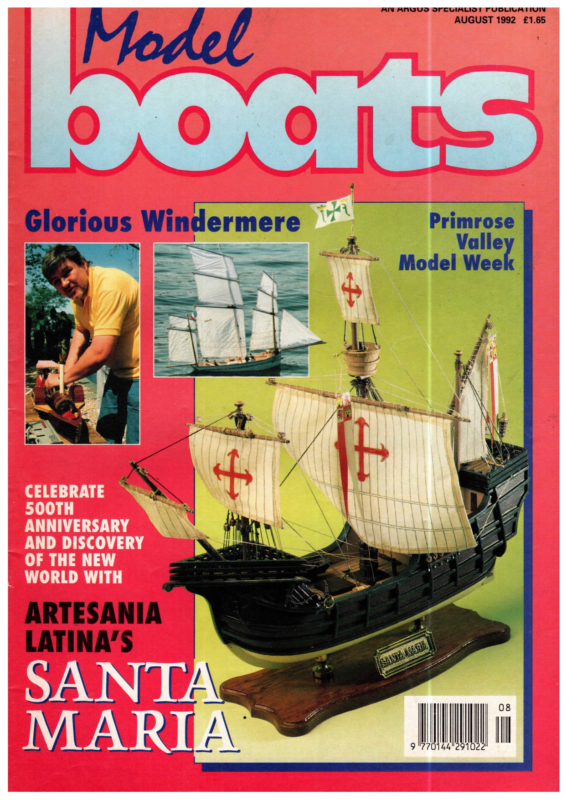
- August 1992 CURVED AIR Russell Potts and the Vintage Scene
- Sail to Win Part twelve of Nick Weall’s course to improve your sailing — including an in-depth discussion — to be concluded next month — on his new yacht
- MYA National ‘M’ Champs A photo report of the Fleetwood hosted event, which took place over the May Bank Holiday Weekend, by M.D. Critchlow

AN ANGUS OFECVUIALIO! FUBLIVALIVIN AUGUST 1992 Glorious Windermere Vi | 7 | – : Primrose Valle Model Wee ARTESANIA LATINA’S HIN £1.65
Russell Potts and the Vintage Scene competently and he has been nagging me for a radio boat for a little while now. I had taken only one radio boat with me, also a Choppa. I wrote about this conversion some years ago and long term readers will remember that the boat is very small, painted black and has a swing rig. I found that the boat sails well and is fully controllable while it is close enough to see clearly what it is doing. It is very sensitive to the rudder and needs the very slightest of stick movements to keep it under control. Once it was on the other side of the pond, it was almost impossible to keep An American radio ‘A’ yacht dating from the late 1950’s. it going, because once it was stalled out, it was too difficult to decide what the right adjustment was to get it back on track. So it was not the ideal boat for a beginner, let alone one as enthusiastic and (so far) as totally inexperienced as Alex. It very ; , rans is currently being restored by Rod Vintage Day At Bournville 26 April The Vintage day which was held at Bournville towards the end of April was not terribly well attended. The weather to the south of Birmingham was poor and many of the VG members from this part of the country area decided against making the trip. I was in the Midlands anyway that weekend, so I went, expecting it to be cold windy and wet. Windy it certainly was, by the modest standards that operate at Bournville, and not particularly warm, but it was dry except for a couple of very brief showers. The small turnout meant that were no new models on view, which is just as well as my camera decided to run out of battery power the previous evening. Those of us who made the trip had a good day, with plenty of wind to keep quickly emerged that he couldn’t manage the delicate rudder movements that were needed and that he found it very hard to ‘read’ the position of the sails on a swing rigged boat, a type which he had not seen before. Possibly it was expecting altogether too much of a five year old, but my teaching technique has always been to assume that motivation is the critical factor in learning anything and if someone wants to master something they can, given sufficient encouragement and time. Later on he persuaded Basil Harley to let him have a go with Kate, which is a conventionally rigged, long keel design and much less sensitive to the rudder. With this style of boat, he managed a lot better, so perhaps this is another reason for putting radio into older styles of boat as training vehicles for the young and otherwise inexperienced. An Early Radio Controlled ‘A’ Boat Because I know that you prefer your information decorated with pictures, I shall now let you see some photos that Rod Carr has sent me of an American ‘A’ boat that was several times radio ‘A’ Champion in the late 1950’s. I have unfortunately mislaid the accompanying letter, so the detail is from memory and not to be taken as gospel. She was a joint project of three members of the Seattle club who were also employees at the Boeing aircraft plant. The hull is pretty advanced for the period, particularly the form of the fin and bulb, which was not seen on the average run of ‘A’ boats until some time later. Because the boat was designed before the general availability of multi-channel radio gear, the radio installation is of some interest; the rudder was controlled from a shore based transmitter and was a simple sequence device, giving left-centre-rightcentre-left as the button was operated. To assist the skipper there was a small ‘flag’ mounted on the stern of the boat, which showed the current rudder position. The sail trim was not controlled from the shore, but from a hull mounted vane, which sensed the wind direction relative to the hull and adjusted the sheets to give the appropriate sail setting. The theory was that you pointed the boat in the direction you wanted to go with the rudder and the on board system then gave you the optimal sail trim for that course. This sounds pretty good in theory but its real effectiveness would depend on the sensitivity and speed of operation of the adjustment gear. If not both well made and powerful, I would expect it to be a everything moving and a sufficient number of boats operating to retain the interest of the spectators. I had taken a number of small boats, all of which I have written about before, so I won’t go into detail about them. The interest of the day for me was to see how my grandson Alex (now just over five) got on with his first experience of radio control. He has had a freesailing Choppa for several years and manages that quite 24 The rudder was controlled from a shore based transmitter and was sequential. The flag showed the current rudder position. Photos: Rod Carr. MODEL BOATS
Those of you whose appetite has been whetted by this glimpse of the heroic days of radio control may wish to know that I am writing an article on radio control before 1939 (and indeed, before 1914) which will appear in Radio Control Boat Modeller to supplement the material they suggests that the purpose of so long and relatively light a spar was to allow the rig are currently carrying on the early days of commercial radio. the boat was overpowered would be very desirable. The only way to be sure that this is how it worked would be to sail the boat for some time and see what happened. Which is why I regard the antique trade’s interest in vintage yachts as a very mixed blessing. It increases the number of Some Vintage Models In New York The increasing collectability of vintage models is reflected in a larger number of dealers who are taking an interest in them. When Graham Bantock was in the US earlier in the year he spent some time in New York and visited an up market gallery, which specialised in transport models. The photos show two models that to twist and depower in a gust. This not a description or an explanation that I have come across in my reading elsewhere, but given the very large rig and its height, some automatic means of spilling air when people who are aware of their existence and pushes up the value of good examples, which is a good thing for those of us who started collecting a little before the field, but it means that very few boats that enter the antique trade will ever see water A 10-rater from the early years of the century, with a weighted rudder and tall gaff rig, in the same ; gallery. A pond yacht built in England in 1920, possibly a 10- or 8-metre. pretty in-exact, but even so, it was probably as good as most of us can manage in terms of sail trim on a boat that is moving fast and is some distance from us. Rod intends to restore the boat and sail her in local RA competitions, but he doesn’t say whether he is going to use the original sail trim system. That would be an interesting experiment. Combined with a modern proportional rudder system, it might be as competitive as anything else we currently have. Photographed in a gallery in New York by Graham Bantock originated, according to the gallery, in the UK. The first is a long keel, bermuda rigged model that was built in 1920 by a Maurice Swan, while he was a schoolboy at Beaumont College. It looks to me as though it was built to, or very much influenced by, the first International Rule: The hull form is entirely typical of the sort of thing that 12-m models under the Rule, but the whole thing looks from the photo to be a bit small for a 12-m. Possibly a reduced scale model, or an 8- or 10-m, of which there were a few at this period. The fittings, which include a nicely made Braine gear, are of high quality and are probably of commercial origin. _ The other English boat is rather earlier in date and is a 10-rater; the steering gear is a simple weighted rudder. It looks as though the rudder that is fitted is solid lead, so it is the heaviest of the set that would originally have been used. The rig and the general style of the boat suggest that she dates from the early years of the century and she still has her spar box with a range of rigs. The gallery description calls the long curved gaff a ‘whip gaff and AUGUST 1992 A full shot of the 10-rater, photographed by Graham Bantock in a New York gallery which specialised in transport models.
—” again. My own interest in these boats is essentially that of a historian; the evidence regret the increasing commercial interest in the sort of models that I want to see put back on the water and used. il SLA that can be extracted from them is much greater and more useful if they can be sailed, so on balance I suppose that I Contact Addresses — Old Boat Queries: Russell Potts, 8 Sherard Road, London SE9 6EP Tel: 081 850 6805. Vintage Model Yacht Group: Richard Howlett, 3 Maudlin’s Green, St. Katherine by Tower, London E1 Tel: 071 480 5288. MYA Matters: Jim Wheildon, 50 Elmgrove Road, Harrow, Middx., HA1 2HQ Tel: 081 861 3207. Help! Can You Identify This Scene? Finally this month a couple of snapshots that, from internal evidence, date from before, but probably only shortly before, 1914. The clothes that the skippers and spectators are wearing set the date fairly closely, and the relatively large number of women and children suggests that the club had turned out specially for the photo session. The boats are a mixed bag, but the larger ones are big enough to be 10-raters * or just possibly some sort of metre-Rule boat. The smaller boats are probably commercial toys of the period; one of these in the far distance has what appears to be a bermuda rig, but is more likely to be a gunter rigged boat. Though a certain amount can be deduced from the photos themselves, it isn’t possible to say where the photos were taken. 26 The lake is quite small and looks very like the sort of thing that a local authority might have built towards the end of the last century, after the 1881 Local Government Act had authorised local authorities to spend up to the product of a penny rate annually on the provision of public open spaces. Many boating lakes and ponds were funded under this clause, but the provision was patchy, because not all local councils made use of their new powers and not all those who did chose to incorporate water in their new parks. The small size of the trees round the lake suggests that the whole ensemble had been created relatively shortly before the photos were taken; the buildings in the background are a mixed bag, including both houses and what looks like some sort of industrial buildings in the centre. All of what can be seen looks to have been built in the latter part of the 19th century. There is a notice on the far bank that (if we could read it) would probably tell us at once the name of the local authority and the fact that all sorts of enjoyable activities are forbidden by bye laws. Our best bet for a positive identification looks to be the steps down from the upper level, which are fairly distinctive. So if any reader can help out by telling us where the photo was taken, please get in touch. MODEL BOATS
A mid deck shot of Beau de Cologne. Jib sheet pulley attached to line running off same winch as clew hooks, allowing an adjustable slot as well as camber twist in sails. Part twelve of Nick Weall’s course to improve your sailing — including an in-depth discussion — to be concluded next month — on his new yacht his is the twelfth and final article in my second series of yacht racing tactics. I consider that by nowI provided sufficient ° information to enable anyone to accumulate enough theoretical knowledge so as to be in position to climb to the top of their local club and beyond. Practice The one thing that you can never gain from reading about yacht sailing and racing tactics is practice. Practice is without doubt the key to success. As I recently heard Nigel Mansell say – “You do not win Grand Prix races by concentrating on how to drive your car. That has to be 28 automatic to allow yourself time to concentrate on tactics.” Exactly the same conditions apply to yacht racing as you enter open races and above. You must have all of your basic sailing skills finely developed if you wish to in contention. You need all of your concentration to be applied to constantly evaluating your yacht’s position relative to the rest of the racing fleet. You need to be especially aware of what all the yachts that are in contention for first place are doing. From the moment you place your yacht on the water at the start of a day’s racing you need to be acutely aware of the real direction of the wind and its strength. If your yacht is heeling too much to windward – are you really using the best set of sails for the conditions? By the time of the first start, you ought to have a good idea of which end of the start you wish to start from, or whether in fact you’d rather cover your options by starting at speed somewhere near the middle of the line. Different yachts often require different tactics to be applied in identical conditions. This takes us straight back to practice and getting to know your yacht and its preferences in all conditions. It may be obvious, but this all takes time. Club races are ideal for acquiring this sort of experience. You need time to gain experience in all strengths of wind and water conditions, including the gusty or fickle winds that occasionally plague us. You need to learn just how tight your yacht can turn at the windward mark and at congested spots on the water. You have to learn that it will turn more easily if you let the sails out to maintain drive as you turn off the windor the opposite if coming up into the wind. These are all things that no amount of reading will solve. The best advice I can offer is a lot of practice with a little reading now and then. It most certainly pays to reread your books from time to time. You will be surprised at the amount of useful information you have missed in previous readings of the same material. I do not intend to write any more articles on tactics now for quite sometime. The final set of articles which might be described as a Master Class Series have yet to be written and might be too specialist for most readers. I personally need more time now to develop my own skills in any case, before I am in a position to pass more information down the line. MODEL BOATS
Satisfaction The one point I would like to get across to all my readers is the tremendous satisfaction and enjoyment there is to be gained from radio controlled model yachting. Whilst it is not as physically demanding as the majority of sports, the intellectual demands are legion. For many years I have played chess, at club, county might just as well trail around the country entering model yacht open meetings and enjoy far more races per day that you ever can in the full sized world. Within the model yacht racing world in this country we are very lucky. We now have two classes that can provide top class racing at a variety of venues. The Marblehead class in my opinion still provides the most demanding fleet racing and tournament levels. On occasions a yacht race in my mind equates with a rather fluid chess game froma tactical point of view. There are a myriad of options to choose many times through the game. Often several of those options might lead to promising attacks or to the successful gaining of positions. whilst the majority of the options lose material or positional advantages. In both yacht racing and chess you are constantly trying Elitism to outsmart your opponents. In both games you often are lucky enough to be given second or even third chances. The winner though is usually the person who made the least number of mistakes. The differences Some people have the odd notion, that we ought to keep the top skippers out of the One Metre class, so as to give the others a chance! I cannot think of a better way to stunt the development of a class. going, coupled with the most interesting options in boat development. The One Metre class is still rapidly developing into a more affordable class that provides close exciting racing. A lot of the established ‘names’ are now actively competing in this class, which in my opinion can only be good for the class. v oak % eal A Clew hooks on each boom are movable up and down the length of the boom to allow for different sized sails. Clew hook has a spigot that drives through a locator in this plastic retainer that resembles a bowsie. Clew hook has line attached running through centre of each boom and over pulley at outer end of each boom to hook, and to winch on deck, providing on-the-water adjustment for camber. though are you can go cross eyed staring at a chess board for hours on end, whereas with model yachting you are outside enjoying the elements and panoramic views of constant action. When the sun is out and there is a bit of a breeze, there are few better ways of enjoying the water than model yacht racing. I used to do masses of windsurfing and in fact in my mind that is the ultimate enjoyment for me on the water in a force six plus. That is the problem though, the wind just does not blow often enough stronger than force five. The chances of it actually doing so at the weekend when you can use it are even more remote. That is why I deserted windsurfing for model ~ yacht racing. As to full sized yacht racing or dinghy racing, it is simply too cold in this country for too much of the year. There is alse far too much fragmentation of classes and clubs in the full sized world. It is very difficult to find a class that both interests you and allows you to race it competitively at a local club. You end up having to trail around the country again to open meetings. If one is going to do that, you AUGUST 1992 Competition is all about winners. Taking it to its natural conclusion – a National Championship is all about beating the best in the land. How else could you possibly call yourself a National Champion and feel proud of the achievement? The majority of us who are lucky enough to have others better than ourselves ought to be eternally grateful that we have people to aim at and to try and beat. We have so much more to enjoy than the poor lonely soul at the top of the heap, who can only fight very hard to prevent everyone else beating him. Tiers There most certainly is a case for the introduction of tiers within the metre fleet. Perhaps an independent class association ought to be set up and different levels of competition introduced. At present the levels of competition are: (1) the internal club race which is most certainly a restricted race in so much as you have to be a member of the organising club in order to participate; (2) the open club race. This as the name suggests is open to anyone who is a member of the MYA and who holds a current measurement certificate; (3) District events. These are events that should be restricted to entries only from MYA members that are members of a club within the district. It does not however always work that way, with districts sometimes allowing entries from anywhere; (4) Ranking Races and Nationals. Both of these are in effect just open races with bigger stakes. Perhaps some sort of league could be formed, say having Novice, Intermediate and Senior levels. All events would be ranked and a certain number promoted or relegated each year. This system might give more people something tangible to aim for and a greater sense of achievement. Whether or not there are enough keen skippers to support such a system is another matter entirely. As is the not inconsequential fact, that such a system would require yet more unpaid enthusiastic officials to run it. All things are possible, but they all rely upon one common factor – that is the grass root membership gathering itself together and Y Knurled knob near front of jib boom controls the device that acts as kicking strap to adjust and hold twist in jib. Every quarter of a turn is marked with coloured strips. Boom also marked in four places adjacent to knob. This makes it very easy to exactly set turns for each particular sail suit. Knob at front of swivel device also needs to be adjusted for each sail suit.
actually doing something about the things they collectively might like to see introduced for their class of yacht. MYA and Membership Much the same might be said about the grass root membership of the MYA. The MYA exists for all of its members and most certainly would love to do the very best for all of its members. Unfortunately the vast majority of its membership say nothing, which tends to suggest that the MYA does a first class job. Why then are there so many clubs that do not bother to join the MYA? Presumably those clubs which either do not join the MYA or withdraw from the MYA feel that it does not do anything for them and thus begrudge them the annual membership fee. This is a great pity, because the MYA has a lot to offer its members. To be precise it can offer its members whatever those members expect it to offer – provided that they let the administration officers of the MYA know what it is that they can do to improve things, so as to satisfy all clubs. The MYA goes to great lengths to ensure that there are District Councillors the length and breadth of the Country to communicate with all members or prospective member clubs. Please talk to your District Councillor or to any Officer of the MYA and let them know whatever it is that the MYA does not do that you would like it to do. Any association can only be as ’ good as its members help it to be and the most basic requirement is communication. Beau de Cologne Now for the remainder of this article I am covering the first four months of the life of my new Marblehead named Beau de Cologne. I have mentioned this boat in the past few articles, but for those first time readers of my articles, Beau de Cologne is a Skapel design of Marblehead. Designed by Janus Walicki of Hamburg, he also built the entire boat and all of its three rigs for me. I had seen the design in action under the expert control of Janus at the 1990 World Championships held at Fleetwood and at the 1991 European Championships held in Hanko, Finland. On both occasions, I had been most impressed by its relative speed to other top class designs. The day after the European Championships, whilst still in Hanko, I had the opportunity to talk to Janus at some length with the help of my friend Klaus Shroeder translating the difficult bits of English into German. (And the easy bits too, come to think of it!) I became even more impressed with the technical solutions Janus employs to certain problems. A major point was that his boat is dry! So dry in fact that Janus takes the cover off his winches to save weight! The rudder simply plugs in and out of a socket and is thus removable. This is a very important factor if you wish to transport your model all over the World. Naturally the fin is removable too. The winches are removable extremely quickly. Which of course means less downtime in the event of a problem occurring whilst racing. Then there are the additional features. The ability to adjust the camber, twist and slot with just one extra channel is a major advantage. The unique ‘Butterfly’ device, that allows one to put the jib across to the opposite side to the main easily whilst on the run, is superbly designed with economy of control being paramount. Then there is the radial mounting for the jib boom, and the carbon fibre booms with the brilliant kicker control incorporated within each boom. The carbon fibre groovy mast section that is mounted so as the mast rotates is yet another outstanding solution of a problem. All of these major features can have a slight effect upon the overall performance of a yacht in the right hands. It has to be said that they can have a more confusing effect in uneducated hands and that there is a lot to be said for keeping a yacht design and control systems as simply as possible. I believe that Janus has achieved the impossible. His yacht is simple to control, once you have got the hang of it and once you remember to use all the additional control settings in the appropriate conditions. I am very very pleased with the yacht. I am still, even after four months, learning how to get the best from the yacht. I think in fact it will take me the best part of this year for me to develop the full potential of my partnership with the yacht. The yacht including all of its three rigs and electrics, cost me more than I have ever before spent on a model yacht. It is relatively expensive, even if compared to a Bantock boat, all up and made by the master himself. But to put it all into proportion, by the time I had sold off my old yacht, the investment was no more than the cost of a new set of golf clubs and a year’s membership to a golf club. It certainly cost less that the marina costs for a thirty foot yacht. Model yacht racing is my principal hobby/sport and I now own a yacht that has a much better potential than I can currently employ to best advantage. It gained me sixth place at the Northern Ranking Race this May and forth place in the fleet racing at the Race of Champions. In the right conditions it has the potential to win any event. As usual the yacht is limited by the person controlling it! I am still guilty of getting tangled up in all sorts of incidents where I should know better. Even when you are in the right, it does not pay to get involved. At the same time, you cannot afford to give away an inch in certain situations or you will find half the fleet sails by before you can blink. Anyway there now follows a diary of the notes I made over all the first couple of months of racing Beau de Cologne. You will understand that over January and February there is in fact little going on of major importance. This is an advantage as regards having little pressure on one to do well, but a disadvantage in so much as there are not many opportunities to pace yourself against the best around. Record of Beau de Cologne’s Performance Oliver Lee January 1992 Winds light to whisper light. Settings: A Rig; Rigging slack; Jib set back mounting 4; Slot as per Janusz; Camber large; Twist reasonable. Problems: I had broken the butterfly sheet unknowingly the night before whilst weighing the yacht. Performance: First few races very good, I was always in the top three. I was guilty of trying to sail too close to the wind, which does not give the boat its best potential speed. It was often gaining distance on the offwind reach. As the wind became less, the problem of having slightly too much tension in the butterfly sheet became apparent, the main not being as free as it ought to be to swing. Also the jib is inclined not to push through to its new camber after tacking. A lighter material would solve this. (I found out subsequently that having the whole rig slacker, with the mast jack lower, would have solved the problem.) It was only the next day that I realised that the butterfly sheet was too tight. Final positions: Roger Stollery first, Mike Kemp second (No Secret) and self third. Ian Cole, Chris Dicks and Phil Playle amongst those beaten. Sunday 12th January at Gosport Winds again very light. Settings: A Rig; 4th Hole; jib back; rigging number of turns. To front is Adjustable mast foot also has line painted on it to easily record themain when activated. The line ‘butterfly’ device that kicks jib out to opposite side of yacht to the and information as to the linkage running from main boom to the ‘butterfly’ provides mechanical main boom’s actual position. 30 very slack; Camber 12mm plus; slot jib one hole more than Janusz on the jib. Performance: Kept up with 88 (my old yacht, a Bantock Enigma) on the beat or even slightly better, but off the wind 88 was better. I suspect the slot adjustment was the problem, since it was slightly difficult to keep the jib fully working on MODEL BOATS
the reach especially. Sunday 19th January 1992 at Gosport Wind was North Westerly light to moderate. Settings: I tried the A rig mounted on its forward mounting and hole number 1. The jib hook was in the rearmost hole of the forward set on the boom. The sails were set with a little more twist in the jib than the main and sufficient drive was apparent throughout the day. The slot setting was both on the yellow spots (Janusz’s settings.) As recommended the best speed was obtained by sailing slightly off the wind with the camber setting in its mid position. I had set the cambers as usual so as the tight in position had just a little belly in the jib and as little as possible in the main. The amount of twist in the main was quite tight although I cannot remember if I set such twist in the mid position of the camber adjuster or the tight position. (I must remember to set the twist in the mid position, bearing in mind that in the tight position the twist will be slightly reduced. It is worth experimenting further with approaching the run by a series of gybes, sailing broad reaches rather than running. Apart from that I must practice further getting the most out of the yacht in terms of speed whilst being able to pinch to windward as well, so as to be able to hold my own against high sailing yachts. I notice that I still am not making the best of mark rounding; it is quite easy to loose at lot of speed when changing direction. It may be that I am tempted to give the yacht too much rudder. It is also quite possible to kill the yacht’s speed by tacking too quickly, the yacht almost leaping out of the water at one stage. The yacht can produce a quite awesome turn of speed on occasions. At present I am guilty of not being able to hold the speed on for any great length of time. This is an exciting responsive beast of a yacht that demands to be sailed on all points of the wind rather than left to its own devices. On the Friday evening I had painted graduation marks on the transmitter lever ball for the winch channel. I put on nine lines and numbered the same. I then — measured the angle that the main set at for each of the nine lines and painted those settings also on the transmitter. This became then an easy way for me to check the sail settings when the yacht was a distance away from my control position. The yacht was clearly the fastest yacht on the water this Sunday. We had 88, 90 (Lindsey’s old Hush Hush design, another from the Bantock stable) and Derrick’s 71 another Hush Hush to measure it, plus a few No Secrets. Sunday 26th January . Gosport had lost its water during the week. The Council had drained out so as to do maintenance work. Poole had suffered the same fate’and Eastleigh was frozen over. Chichester seemed the favourite place to go. Derrick was also going and Tommy Lance senior. We meet them there plus Chichester members to find the lake half frozen over. The scale modellers were breaking the ice around their little area so as to be able to-use it. There was a large triangular area free in the middle of the lake, plus the jetty areas were free of ice. So instead of standing around looking at it we launched our boats and sailed. The weather was beautiful, a nice sunny day with a light North Easterly blowing. AUGUST 1992 Another view of the ‘butterfly device showing the control lines that activate it running up and through a pulley. These are pulled and activated by the continuous loop system that sheets the sails in and out. As it slightly overruns the fully sheeted out position, a knot in the loop engages a slider that puts tension on the ‘butterfly’ via the lines. After a bit of sailing around, Derrick and I took out the rowing boat and broke up the ice around three of the marks so as some racing could take place. The ice was around 5 – 10mm thick and was quite easily broken. We would row into the ice using the rowing boat as an ice breaker. When we became trapped as we did every time, we would use the oars to break up the surrounding ice before swinging around and out into open water. After half an hour’s efforts we were ready to sail. I had the tall suit up with the jib in its forward mounting. As usual the boat was gaining places easily on the beat, but off the wind I had more trouble. The course meant that the distant mark was a long way offshore. The course to that mark was a broad reach or a run. It was on the broad reach that I had most trouble. To be fair to the boat this is always my worst point of sailing, as I very often do not get the sails set at the correct angle quickly enough. It would seem worth investigating further sailing a little higher at the start of the reach to gain full speed before falling off slightly for the mark. On the starboard rounding course we were sailing this made tactical sense. During the course of the day the line from the butterfly apparatus to the main boom broke on the starboard side. I would guess that this was a result of the strain imposed upon that line the day I tried weighing the boat from the mast stub! (It came out giving the said lines a sharp strain.) The pity of this is that itis a repair job best done by Janusz. On the 9th February it is the Old Dutch Regatta and I just hope we can resolve the problem by then. Not so much because the boat needs this facility to win, but so as it looks its best as everyone inspects it. The overall results of our day’s sailing at Chichester again plainly showed Beau de Cologne to be superior to all other boats there, although Tommy Lance gave it a good run for its money. Lindsey is also coming to terms with Miss Q and had a good day. Sunday 2nd February We had checked the previous day that the main water at Eastleigh was clear of ice, so we felt fairly confident that some sort of racing might be available. We had arranged to meet Peter Wiles who was keen to try out his new Bob Sterne yacht out against some real competition. This new design is very narrow and deep. It has the same sort of section as Peter Stollery’s new boat. By ten o’clock we were all rigged up and ready to go, quite a few other people turned up including of course some of the Eastleigh Club members. By half past ten we were all drifting around in the very light wind; a sort of Westerly, it hunted all around the place, moving well through ninety degrees at times. It was bitterly cold which tended to numb the mind a little or at least that is my excuse. I had the boat set up on the rear most jib setting with position number four on the luff hook. I had put a lot of belly in the jib and not quite so much in the main. In retrospect I did not put enough twist into either the main or the jib. This made it hard for the jib and the main on occasions to move through easily when tacking. I certainly missed the ability to use the butterfly which as you may recall has a line broken on it at present. I had little difficulty in keeping up or overtaking the remainder of the fleet, but Peter’s new boat was another story. I did not make very good starts so usually was in the position of trying to catch it up. To be fair in every race I gained distance with Peter’s yacht often though then throwing away the distance gained by misreading the off wind legs. It was only at the end of the morning’s sailing that I realised that I ought to have put more twist in the sails. If this had been a serious meeting, that would have been a major blunder that would have had me in second position to Peter. I feel however quite confident that if I had had the yacht set up to its optimum and concentrated on my starts a little better I would have given Peter a hard run for his money. As it is I shall have a chance to sail seriously against the yacht next Sunday at the first proper meeting for some time – the Old Dutch at Swanley. Chris Jackson will be sailing Peter’s yacht and it would be nice to give him a hard time. A little more wind and it will not be a problem in any event. Of course it never pays to give away too much to a potential competitor and only time will tell my readers, should I decide to publish this, what I was really up to at Eastleigh. 31
A photo report of the Fleetwood hosted event, which took place over the May Bank Holiday Weekend, > by M.D. Critchlow Photo 1, Mark Dicks (K3733/, Clapham, won the title with a score of 118.0 points. Photo 2, Peter Maskell of Leeds & Bradford finished in second place with 107.0 points despite being in bad health. Photo 3, Bernie McNulty and Dave Potter (left), from Birkenhead, take on Ray Baker from Gosport. Bernie and Dave finished third with 106 points. Ray was placed 22nd. Photo 4, Martin Dovey (left K4624) gives Mark Dicks (right K3733) a hard time on the beat. Martin finished 4th with 101
points. Photo 5, Derek Priestley (foreground) and Richard Young, both from Fleetwood, get ready for a run. Derek was placed 7th and Richard had to settle for 34th or last. Photo 6, Martin Kinder from Bournville poles off his boat, Martin finished 8th. Photo 7, Bill Green (left) from Bournville and Martin Roberts from Birkenhead. Bill was 23rd and Martin 8th. Photo 8, K4241 skippered by Mike Harris and Nigel Sharp’s Mrald. On the bank is Roger Clark.