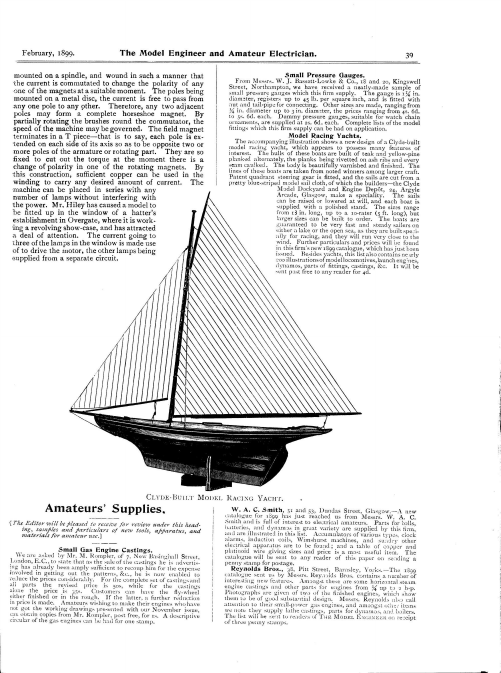
- Model Yachting Supplement. In introducing to our readers this Model Yachting Supplement, we are making an experiment, the success of which depends almost entirely on the way in which our efforts are supported by those for whom we are endeavouring to cater in this section of our journal.
- Doing of the Clubs
- How to Build a Model 10-Rater Cutter Yacht
- Racing Reports
- Our Model Yachting Prize Competition

Introduction
This is the first of a series of articles the intention of which will be to cover, as comprehensively as possible, all aspects of vane steering as applied to steering sailing yachts and in particular model yachts. It is very evident to the author from the questions he is asked at the pondside by free-lance skippers unattached to a club and just enjoying their sailing, and the more sophisticated talk in the clubhouse, that great interest is shown in the vane gear and that it still holds mysteries to many. It will be the intention to resolve these both for the novice and the more experienced. So many of the complications of the gears used by racing skippers are just devices to meet racing regulations without being impeded, or at a disadvantage, that attention will be paid to the simpler devices which can adequately meet the sailing requirements of the free-lance skipper, as well. as invariably being easier to construct and therefore within the ability of many more enthusiasts. It must however be said that there is much more fun and satisfaction for even the lone sailer if he has a gear capable of executing the more complicated manoeuvres.
There are many controversial matters and opinions on getting the best both out of a boat and its steering gear. So far as practicable these will be given so that the reader may be led to try methods for himself, even if the author’s own opinions are not expressed.
Later in the series designs will be given as well as considerations affecting design to enable and encourage the reader to experiment for himself. We must first, however, turn our attention to more mundane things. It is apparent that many do not realize that a yacht sails, or should sail, primarily on the set of its sails and that the steering gear is an adjunct: very necessary on some points of sailing but still an adjunct.
This leads us to the first instructive section under the title of Know the Parts , in which the various parts of the hull and rigging are described.
Know the Parts
Before trying to sail a boat it is worth while knowing the names of the various parts and what they are for. The front end of the boat is called the bow (pronounced bough) and the back end is the stern (pronounced stern, not starn). Looking forward towards the bow the left hand side is called the Port side while the other is the Starboard. The cords or wires holding the mast in place are called the standing-rigging. The main ones, from the hounds where the jib sail is attached to the foreside of the mast (about three-quarters of the way up from the deck), to the sides of the boat are called the shrouds. Their point of attachment to the sides should be behind the mast by about one sixth the width of the boat. These should be very strong to stop the mast giving in a sideways direction under wind pressure. That from the bow to the foreside of the mast, to where the jib is fixed, or to the top of the mast, is the forestay. That running from the top of the mast aft to the deck is the back stay. With vane steering this stay is invariably split about a quarter of the way up from the deck and secured on the port and starboard sides so that it clears the end of the main boom and also the vane gear. It is desirable to strut the mast above the hounds with jumper stays. A worthwhile refinement is to fit running back stays; these come from the mast at the point of attachment of the shrouds and jibsail and terminate on the side decks behind the shrouds on runners so that they can be pulled tight backwards or slacked off against the shrouds when not required, a point which will be dealt with in due course. Fig. 1 shows the points already detailed.
This may seem a strange introduction to Vane Gears for All , but if you think so. then these introductory pages are just for you. The availability of the correct standing rigging and its correct use will make the world of difference to how your boat will sail.
The cords which hoist or hold up the sails are halliards, while those which adjust the swing of the foot or base of the sails are the sheets. These working cords (ropes in full size) are called the running rigging.
For the sails, the Bermudian sloop rig is now so universally used in model racing yachts that that will be the only one we will consider. This rig consists of two triangular sails. That before (in front of) the The mast is called the jib and that behind, the main. The jib on its forward edge the luff is attached to the jibstay. The head or peak of it is secured to the mast by the jib halliard which is adjustable to enable the tension of the luff to be varied. The bottom edge of the sail is called the foot. The forward corner of it is the tack while the back corner, the clew. The tack and clew are usually attached to the jib boom. This is usually made of wood in circular oval, or rectangular cross-section. Where a radial jib-boom is used the tack is attached to the jib stay and the clew to the end of the radial jib. Both these arrangements are shown in Fig. 2. The position of the clew on the end of the boom should also be adjustable as shown.
‘There are theoretical advantages in using a radial jib which will be described in the next section, but the practical difficulties of a really satisfactory radial jib limit their effective use to the expert modelmaker and skipper. A simple jib boom is shown in Fig. 2 where the jib boom is hooked to the jib rack on the deck from a point (preferably adjustable) near the forward end of the boom. The after edge of the sail the leach is slightly curved, and may have battens small slips of wood in pockets to hold out the curve. The threads of the weave of the cloth must run parallel to a line drawn from the head to the clew. The mainsail is attached at its head to the mast by an adjustable halliard as for the jib. The forward edge of the main sail the luff lies against the mast and is attached to it either by hooks to a jack line secured down the back side of the mast, or is laced to the mast with a continuous fine cord passed round the mast and through eyelets in the luff of the sail. The author favours the latter method and finds it takes no longer to change to a different suit of sails than with hooks and the jack line.
The tack of the sail is secured to the mast immediately above the main boom either by hooking to a suitable screweye or a small tie. The boom is again made of wood and is attached to the mast at the design height above the deck by a universal joint known as a gooseneck which enables the boom to swing horizontally and let its after end lift. The clew of the sai1 is attached to the after end of the boom and, as for the jib, should be adjustable. The leach of the mainsail is invariably curved, at least in the top suit of sails, and has battens fitted to hold out the curve. This curve is called the roach, it improves the appearance of the sail and gives additional unmeasured sail area in the racing classes. For this reason the length and number of the battens permitted is given in The class rating rules. At the head of the sail a headboard is fitted made of light metal, bone or plastic. This helps to distribute the strain at the top of the sail and enables the sail to set better. The rating rules again specify the limiting sizes because of the way the sail areas are measured. (:Clearly these restrictions do not apply to boats not in a rated class and these devices should be used in these cases lor appearances’ sake and the normal benefits obtained.
An essential main boom fitment for really effective sailing is the kicking strap. This is an adjustable cord or wire from the base of the mast where it passes through the deck and directly below the gooseneck to the underside of the main boom making approximately a 60/30 deg. triangle. These various points are Illustrated in Fig. 2.
Finally a word about the sheets. These adjust the angle the boom and sail make to the axis of the boat. Since this must be varied for the course being sailed, as will be described later, they must be easily adjusted. Bowsies, which are rings of bone or plastic, sliding on jack lines tight cords stretched along the booms are used for this. Fig. 3 shows a typical rigging of a sheet. Two are required on the main boom and one or preferably two on the jib boom. The jib sheet is attached to the deck, either to a central eye, which is quite adequate for a radial jib boom, or to a horse, which is preferable for the type of boom recommended as shown in Fig. 2. The attachment of the main sheets, one of which is called the beating sheet and the other the running sheet, will be described when we deal with sail setting.
We saw in the introduction and rigging for plain sailing the various parts of the standing and running rigging. We can now turn to sail setting and at least start some sailing. Before we do, however let us just go back a moment and see that our standing rigging on which much of the performance of our boat depends is set up correctly. This is done because if you are going to get your boat to sail well you must get into the habit of continually doing this. Racing skippers do it during a race, not only just before the start.
Start by seeing that the shrouds are reasonably taut and hold the mast upright, relative to the hull in a sideways direction. This is best done with the hull on a stand, either on a table if your boat is small or on the floor if it is one of the larger classes and sizes. If you tighten the shrouds too much you will bend or distort the mast between the hounds and the deck and this is to be avoided as much as having them so that the mast can wave about. Now adjust the backstay so that the mast leans backwards slightly, say I in. for each 2 ft. of mast above the deck, this is called the rake. Finally tighten the forestay until it just holds the mast from being pushed backwards. Now take the boat off its stand and lay it on its side look down the mast from its top and you should see a fairly straight mast if not look round to see which part of the standing rigging needs adjusting to make it so. It may be that the forestay only comes up to the hounds and that the backstay is bending the top of the mast backwards from this point, particularly if the mast is light in construction. This can be corrected by fitting jumper stays which is their real purpose. It is easy to see that a main sail with a straight luff can never be properly set on a mast bending, as distinct from leaning backwards.
Fig. 4 shows the details of the jib sail. First notice the way of the cloth in the cut. It is important that the leach is parallel to the selvedge of the material. Do not think that the seam on the leach wil1 give adequate strength on crosscut material because it will not. The roach on the jib is quite small about 4 in. per foot run. Now look at the jib stay and note this is independent of the jib halyard or uphaul and has its own adjustment bowsie a flat one is most suitable. This separate adjustment enables the lift of the jib boom to be controlled. By putting this bowsie near the bottom it will not be confused with the bowsie near the top used for the setting of the luff of the jib which is the next point to note. Look now to the clew of the sail and see the simple means that can be adopted to set the foot of the sail. Arrange things so that the clew can be hauled back practically to the end of the boom, since the jib must be set so that the sail just clears the mast in swinging from side to side and a long unused end of the boom does not allow this. Part of the metal top to an old fountain pen or lipstick holder will be found useful material to fashion a neat strong end to the boom. The horse, where one is fitted, should allow a boom movement of no more than 12 deg. each side of the centre line of the boat. This is about the angle for a close beat (see later) and enables the clew to be held down fairly tight, i.e., the horse aids the tension on the jib stay.
Summing up the fitting of the jib we have (1) The way or weave of the sailcloth must be parallel to the free edge (leach); (2) The jib stay must be really tight, (3) The jib boom is hooked to the jib rack on the deck so that its end just clears the mast in swinging from port to starboard. The use of the other hook positions will be discussed in sail trimming.
Before finally leaving the jib it is appropriate to say a few words about radial jibs as mentioned earlier. Looking at the jib arrangement just discussed, two disadvantageous features should be mentioned. The first is that to hold the clew of the sail down the boom is used as a lever with the jib hook as fulcrum and the jib stay pulling on one side of it. Thus, when the jib is set for beating at, say, an angle of 15 deg. to the axis of the boat, the luff of the sail moves slightly to windward and the plane of the sails is no longer on the axis of the boat but slightly to windward at the bow, i.e., the hull is pushed slightly to leeward for a given sail setting relative to the wind. Theoretically then the boat will not sail quite as close to the wind as if the luff of the jib is anchored to the centre line of the boat which it is with the radial jib. Experience shows that this is only marginal. The other disadvantage is that, because the tack and clew of the sail are secured to the two ends of a continuous boom, the flow or bagginess of the sail is final for all angles of sail setting unless one is constantly adjusting the clew. It is generally advantageous to have little flow in the beating or close hauled condition and quite a bit of flow in the reaching/’running courses (see later for explanation of courses) and this the radial jib automatically gives. If you want to experiment with a radial jib these are the design points to watch: (1) See that the post on which the radial jib is mounted points towards the hounds, i.e., it is not parallel to the jib stay but is at a slightly steeper angle, and is strong. Since it may be desirable to move it nearer the mast when using the smallest suit of sails a base like a mast slide is a useful foundation. (2) That it is as tall as the sail plan will allow so that the stresses caused by the wind pressure on the sail transmitted at the clew will not cause binding. This is the greatest difficulty to overcome in obtaining a satisfactory radial jib. (3) The kicking strap which controls the lift of the boom must be of metal throughout and the bottle screw strong as the tension in this link in a strong wind can be very considerable. (4) The distance of the radial jib post behind the jib stay is a matter of opinion but about I in. per 10 in. of the foot of the sail is a good starting point.
Now let us turn to the main sail, also depicted in Fig. 4. First note that the cloth runs from the head or peak of the sail to the clew, not parallel to the mast. The latter is the commonest fault noticed with novice made sails, and their baggy leaches can be seen right across the pond. The tack of the sail is hooked immediately over the gooseneck or tied to it. The clew is secured to the end of the boom in an adjustable manner similar to that of the jib. The roach of the mainsail is usually limited by the rating rule giving a limit to the length of battens permitted. Practical considerations limit the roach to 40 to 45 per cent of the length of batten permitted. Where, as a novice, you are not limited by rating rules, again I in. per 2 ft. run gives a nice appearance, and you may wish to experiment with fully battened sails. Whether the luff of the sail is cut precisely straight or has a slightly outward or inward bow or curve depends on both the sail material and what you want the sail for. With the currently fashionable varnished nylon, varnished Terylene, and P.V.C. on Terylene materials, cut the luff straight. If you are using cloth an inward curve enables the sail to be trimmed flatter for heavy weather while an outward curve gives a baggy sail, more suitable for light weather. Clearly the straight cut is a compromise if you are only going to afford one top suit. The degree of curve could be say 1/8 in. per 2 ft. run of luff.
The luff is secured to the mast either by dress hooks to a jack line attached to the mast or lacing through eyelets (now obtainable with pressing pliers, quite cheaply from Woolworths). Both methods are illustrated in Fig. 4. The luff is hauled tight with a halyard and bowsie from the head and secured to the mast about the hounds. It should be only tight enough to prevent bagging down the mast, not stretched. This will of course vary slightly according to the strength of the wind.
The attachment of the beating and running sheets to the deck will vary according to the type of steering gear used and will be described when we come to steering gears. In the meantime it is sufficient to say that where a horse is used it should be no longer than necessary to give a 12 deg. movement of the boom either side of the centre line of the boat. A kicking strap is essential for good sail trimming and it must be strong. Stainless steel wire or a cycle spoke with a good bottle screw is ideal. In its tightest adjustment it should hold the boom from lifting to the same extent as the beating sheet pulled home although this tightness is used more on the run when the boom is let well out and the kicking strap prevents the boom lifting and the sail bellying out forward of the mast. In the beating adjustment the kicking strap is eased slightly from this adjustment allowing the tension to come on the beating sheet, but more of that anon.
We can now turn to sail setting and trimming. As was mentioned earlier the course a boat sails should be primarily determined by the set of the sails. Fig. 5 can be called a sail setting compass and is worthwhile copying and carrying with you until practice has committed it to memory. By placing it on the ground or holding it in the hand with the wind arrow on it pointing in the direction in which the wind is blowing one can see the sail settings required for any practical course from the point at which one is standing. Let us however explain the chart in more detail. The single arrow shows the assumed direction of the wind, while between the two circles are a series of yacht hulls pointing in different directions relative to the wind. Superimposed on these are curved solid lines representing the jib and mainsail with their angles relative to the axis of the boat, for the boat can sail in the direction it is pointing relative to the wind, as shown by the wind arrow. On courses on which a spinnaker can be set this is shown dotted for both boom and sail. Note how on the broad reach and free reach it is a Hat spinnaker almost like a genoa jib set inside the jib, while on the running courses a balloon spinnaker outside (in front of) the jib is carried. Note also how the spinnaker boom is always a little more forward than the line of the main boom extended forward. The short straight solid line near the stern of the boat shows vane angles and will be referred to later in discussing vane steering. Round the outside of the double circle are given the names of various courses, those on the right hand side being Port tacks or courses while those on the left are Starboard. These titles are obtained from whichever side of the boat the wind is coming from.
A final note before leaving sail setting and trimming, which it must be realised has been only briefly summarised in these notes, is that while the angle to which the booms are trimmed for a particular course is as per the chart, their flatness or bagginess is adjusted according to the wind strength for optimum performance. In fresh to strong winds, i.e. those making the boat heel to the deck edge on a beat, the sails are trimmed on the flat side by having the clew pulled well back and the kicking strap, on the main boom, on the tight side, while the jib boom hook is moved back as far as possible using a hole on the jib rack on the deck which just permits the boom to clear the mast. Of course if you have a mainsail cut with an inward bow on the luff you use this as well. In lighter airs, flow is given to the sails by freeing off the clews of both sails, easing the kicking strap and having the jib boom hooked from a point nearer the tack of the sail. The point of hooking to the deck must be again chosen so that the boom just clears the mast. In between these limits there are quite a variety of adjustments which experience will soon show when to use as long as you realise why adjustment is provided.
Our attention can now be directed to helm or rudder requirements in a theoretical way; the practical aspects will be covered in the sections on steering gears. Good model yachts have been renowned for their balance. This is a complicated subject and one beyond the intention of these articles so we must be satisfied with a thumb nail definition. It is the design property by which as the heel of the boat varies in varying wind strengths as it is sailing it maintains its trim and holds to the same course. Assuming we have a well designed balanced hull it is necessary to have the sail plan that is the jib and mainsail attached, as described before, to the mast correctly situated over the hull. This is usually achieved by being able to move the mast slightly in a fore and aft direction while maintaining its rake. Then with the sails set for a close beat (see chart) the boat will sail a steady course at about 30 deg. to the wind. This should be tried with the rudder held firmly central. If the mast is in the correct position it will do so. If it sails up into the wind sails-flapping, the mast is too far back, while if it bears away as if on a free beat or even a close reach, then the mast, i.e., sail plan, is too far forward. In either case the mast should be moved to correct it. Having found this position it will be found that the courses from a close beat round to almost a full reach can be sailed by purely setting the sails according to the chart. These are the courses on which the whole of the jib sail and the whole of the mainsail can see or feel the wind unimpeded. As soon as the wind is striking the sail plan from abaft the beam then the mainsail shades the jib to a lesser or greater extent and the driving force on the sails is no longer balanced. The pressure on the jib is lowered and the unbalance tends to move the bow of the boat round to head into the wind; it is from this point that helm is needed to counteract the unbalance and to do so the rudder blade needs to go to leeward, i.e., to the side of the boat that the booms are. This is called weather helm, since if there were a tiller projecting forward of the rudder post as on a manned craft it would be pulled over to the weather side of the boat to give this movement to the rudder blade. The angle of movement needed is only small and increases slightly as you move towards a full run. The carrying of a spinnaker reduces or eliminates the need to carry helm because it corrects the unbalance of the sail p]an. It is seen then that the spinnaker has two very beneficial effects. (1) It reduces or eliminates the drag caused by helm. (2) It adds more driving force in the nature of square inches of sail. The use of a rudder to turn corners as in a full sized craft does not normally arise in models, although it will be seen later that it can be used for guying and gybing. This simple explanation of the need and use of the rudder with model yachts will suffice for the moment.
Having described the engine of our model yacht (the sails) and its relation to the body (the hull) at some length, we can now turn our attention to steering it. It may be of some advantage here to record, or re-record, some history.
Model yachting has been an organised hobby, sport and recreation for over a hundred years. A few years ago one of the London clubs celebrated its centenary and others in the area are over 75 years old. The boats themselves have evolved almost out of recognition in this time, as well as the method of steering them, as we shall see.
Before 1900 it would appear that two basic types of’ steering were in common use apart from the semi-fixed rudder which is unfortunately still seen on some shop models and can only lead to frustration and disappointment to their purchaser. These were the weighted rudder and reversed tiller. A weighted rudder is illustrated in Fig. 6. Old books and articles show refinements to vary the position of the weight and therefore its effectiveness. From what was said in the last section on the need for a central rudder it will be appreciated that a balanced boat heels most on those courses (beating and reaching) when helm is least needed or not at all. By current experience and theory a weighted rudder is therefore almost useless. No doubt at the time the sail plans of the craft were set sufficiently far back to cause the boat to head to the wind and the rudder would correct this. The successful model yachtsman was the one who could best get equilibrium and balance of the forces. Having written that, one realises how true it is even today, but in a quite different set of conditions. Unfortunately one still sees weighted rudders on quite expensive commercial products, while devices which are much more effective could be incorporated at relatively little extra cost.
The reversed tiller illustrated in Fig. 7 as the other type of steering of the time did offer more sensible control and as a really simple device for the novice, without aspirations to funny tricks, will still permit course sailing, i.e., the boat going where you want it to, as distinct from going where it wants to. With this plan, the mast position should be placed to give good beating courses without helm and with the beating sheet connected to a horse. When the desired course is a reach or run the beating sheet is detached from the horse and hooked up on the boom and the running sheet connected to the reversed tiller comes into play. Its effectiveness is determined by the point of connection to the tiller and the strength of the centring line. Note how the centring line is not pulling on the rudder post which could cause binding, but its action is obtained by passing it through a hole or eye. This feature will be found to be used whenever a strong pull could be exerted by the centring line.
In about 1904 Mr. G. Braine invented the Braine steering gear which held sway in this country till after the second world war and is still found in diminishing numbers in organised racing. It is interesting to record that the parts of the original gear are still displayed on a board in the clubhouse of the Model Yacht Sailing Association, Kensington Palace Gardens. Fig. 8 shows the final development of the Braine gear with main and jib lines and separate port and starboard stops and tension adjusters. Its enormous advantage over its predecessor was that its action on port and starboard tacks could be controlled separately and precisely. For best performance a balanced hull with the sail plan set over the hull for good beating without helm was called for. For beating courses the main and jib sheets were hooked to horses and for reaching and running, to the lines connected to the quadrant. Only top class racing boats worried about the jib lines to the quadrant but in the hands of the expert they would play a valuable part.
We can now turn to vane steering gears. In spite of what has already been said, it is recorded that the idea of vane steering was first put forward by Nathaniel Herreshoff in the late 1800s in one form, from a burgee flying at the mast head, and secondly in the currently more conventional position near the rudder post. Somehow it never caught on and it was not until Iverson and Berge experimented in the early 1930s, with a non-self-tacking vane on the lines suggested nearly 40 years before, that any practical interest was shown. From what is now known about vane steering one can be amazed that 40 years should elapse between the conception and the first real practical application, and it is worth postulating a reason. Look at any old books and photographs published before 1930 and you soon see that design was still in the era of the gaff rigged sail plan where the jib extended forward of the bows on a bowsprit and the main boom projected well aft over the stern, there just was nowhere to mount a vane and it had to wait till the advent of the Bermudian sloop rig with its tall efficient jib and mainsail which are short on the foot and are now almost universal. The problem of carrying a vane and adequate sail still tends to persist in the 36 in. restricted class. Fig. 9 shows the kind of illustration one sees of the early vane in which the feather holder could be lifted and popped into a selected hole on the scale. The realisation of the need for a counter-balance to the feather came later, as well as the friction movement which gives infinite positioning as distinct from the series of holes. The entry by Sam Berge of Norway of a boat with a vane gear in the International races held in 1935 caused a rage of controversy in the very conservative cloisters of the model yachting fraternity as to whether such a device was within the spirit of the sport or a means of obtaining unmeasured sail area. In this atmosphere little progress was made in this country before the second world war, and it was left to the Americans to develop the device while we were otherwise occupied. Fig. 10 shows a simple non-tacking but balanced gear with friction gnp for the feather. This is simple and will give plain Course sailing as adequately as the most complicated gear. Its relation to the self-tacking gears we now come to is somewhat parallel to that of the reversed tiller and the fully fledged Braine gear. A world of difference, but the simple gear is within the constructional ability of many a novice and will give good plain sailing, although it is always very gratifying to be able to emulate the manoeuvres of the racing skipper even if you are not racing.
It will have been appreciated by now that the next step in development was the self-tacking vane gear, and it is this self-tacking feature which creates the constructional problem rather than utilisation. The self-tacking feature-and other refinements are needed to meet two basic requirements: (1) Racing rules on tacking whereby, if the boat is turned by pole from one tack to the other, touching only the hull with the pole, it may be done without stopping, (2) Varying guying conditions (these will be described in the next section).
Articles published shortly after the war show clearly three basic types of self-tacking vane gears that had been developed in the States during the war and had got their designers’ names tacked o ‘, i.e., the Lassel type, Ballantyne type and Fisher type. In fact it could be said that American designers were keen to publish their ideas and get their name attached as with the Braine gear. These three types are still in very general use and their design points are described below. Before doing so however, mention must be made of a fourth type of self-tacking vane developed in this country in the 1950s and described by the author under the title A Moving Carriage Vane Gear in the February 1961 Model Maker and now being used in ever increasing numbers. It is unfortunate that this has not the designer’s name attached as for the earlier types, but this must be put down to the reticence of the British model yachtsman who had a hand in it and so far as the author is aware there was more than one.
THE basic details of the four types of vane will now be described. It may involve jargon that may not be immediately understood but the terms will become clear in the next section, dealing with sailing with a vane gear. Dimensioned constructional details will follow that.
Fig. 11 shows the basic Lassel type gear which is characterised by the fact that the feather, whether the gear is fixed or broken for self-tack purposes is carried on the main vane pintle. This means that the same scale can be used to compare the feather angles in the two conditions. Theoretically the gear cannot be balanced perfectly for both the fixed and broken conditions without altering the position of the counter-balance weight, but the out of balance encountered practically is probably so small as not to be noticeable. When broken lee helm is positive while weather helm is dependent on the weights of the feather and counterweight being on one side of the vane pintle brought about by the heel of the boat and a certain amount of locking action of the pin in the slot of the linkage. If the latter is too pronounced there is a prospect that the gear will fail to self-tack when the boat is put about. (Something we have already experienced with this type of gear.) Because the weather helm is not positive it is preferable to use this gear with the sail plan on a balanced hull set for neutral helm on the beating course which is when the gear is likely to be broken , i.e., the same sail plan setting as for a Braine gear with possibly a very slight setting back of the mast.
Fig. 12 shows a basic Ballantyne gear where the characteristic is the tacking motion being given by two equal sized gears set equidistant about the main vane pintle. This gear is readily balanced in both the fixed and broken conditions. Like the Lassel it gives positive lee helm when broken and weather helm is entirely dependent on the angle of the heel of the boat when beating and the fact that both the feather and the counterweight are on the leeward side of the main pintle in this condition. Because there is no additional locking action of a toggle linkage it pays to have the feather and counterweight on the heavy side with this type of gear and have the mast position set for neutral helm on the beat. Should the mast be back from this position which would demand some weather helm there is a prospect that due to the speed of the boat through the water the pressure on the rudder may take control over the gear with the effect that the boat is driven up into irons when the boat becomes more upright and the gear is even less effective. This gear by its nature gives less trouble in failing to tack when the boat is put about.
The Fisher gear, Fig. 13, has a similar configuration to the Ballantyne except that the tack motion is obtained by a pin and slot linkage which is so proportioned that a degree of locking takes place in the broken condition. This gear again is easily balanced for the fixed and broken condition. Because of the slight locking action it is suitable to apply a small amount of weather helm and since this is of some advantage, as will be discussed in the following section, the mast can be set back from the truly neutral position. Observation shows that at the present time there are probably more of this type of gear is use than any other, perhaps because many have been produced commercially and it is also the easiest tacking gear to make for oneself.
The fourth type of self-tacking gear the moving carriage is illustrated in Fig. 14. It is the most complicated and probably has too many parts to make it a commercial proposition at a price that can be afforded, although it should not be beyond many model yachtsmen with some metal model-making experience.
The self-tack motion is controlled by lines from the main boom and therefore is very reliable. As long as there is wind in the mainsail it gives positive weather and lee helm. It is very easily balanced. These are its attractive points. In addition insofar as guying is ever a reliable or unreliable manoeuvre, its action in this respect is as satisfactory as any. The tacking action is attained by a sun and planet motion of two gears which may be equal or have some other ratio which will be discussed in giving constructional details later.
What does Automatic Steering do for you?
We have now covered general sail trimming and sailing practice, we have also given some brief idea of the various types of steering systems that have been used and in particular, various kinds of Vane gears. It now seems time to ask the question at the head of this section and answer it, particularly as so many people are not conscious of the right answer.
The answer so many would give is that it makes the boat go where you trim it nominally from A to B. This may be the skipper’s hope. The right answer, and one that must really be absorbed, to avoid frequent frustration, is that a yacht with sails and automatic steering correctly set on a straight course will sail at a constant angle to the wind. If the wind is constant in direction, then a fine course should be sailed and the boat should go just where you want it. It is seldom that we have true winds on our model yachting ponds and lakes and therefore the courses sailed will deviate according to the flukes in the wind. Very often these show a sufficiently constant pattern that use can be made of them and this all adds to the interest of model yacht racing, although such conditions usually favour the local skippers. Readers of Francis Chichester’s single handed voyages when he has used vane steering will be aware that he records on more than one occasion waking after a kip to find he was on his way home again because of a 180 deg. wind shift, and that in mid Atlantic. Racing skippers are also not inexperienced in this phenomenon. We mention this because they supposedly know what they are doing. The less experienced think that their steering gear is not working properly and this is our reason for stressing just what automatic can do for you, and in a sense what it cannot.
Braine and self-tacking vane steering gears, besides steering on a defined course relative to the wind (which if the sails are correctly set should give optimum speed and therefore the fastest time from A to B ) are able to do three other things. (1) Guy. (2) Gybe; and (3) Tack by pole or hand without carrying out any adjustments. We see that four new terms have been mentioned and a little explanation would not be out of place. The first is the self-tacking vane. The Lassel, Ballantyne, Fishcr and moving carriage gears briefly described in the last issue are all self-tacking. If you look at the steering compass (Fig. 5 in the February issue) you will see that when on a close port tack the vane feather makes an angle of 30 odd degrees to starboard relative to the axis of the boat. When on the starboard tack the feather requires to be at a similar angle, but on the port side. The non-self-tacking gear, Fig. 10, would require this movement of the feather to be carried out manually when the boat came to the bank and you wished to change it on to the opposite tack. Fig. 15 shows two boats in these positions just before coming to the bank and just after leaving. The self-tacking vane gear enables the feather to do this change of approximately 65 deg. automatically as the boat is tacked (turned on to the new or opposite tack) by pole or by hand. We thus see that we have not only defined (1) self-tacking gear but also tacking (4).
Now for (2) Guying. Guying is the ability to make the boat intentionally change tack when away from the side of the lake. Where this takes place not far from the side from which it has left it is called a short guy and when a long way away, frequently nearly the other side of the lake. it is a long guy . How these are affected as well as those between will be dealt with later when we discuss the types of vane gears in more detail, but here the purpose of guying will be explained. Guying has two uses, the first is in racing where on the majority of waters it must be considered a vital necessity. Fig. 16 shows a fairly ideally proportioned lake for racing and the course taken by a boat with the wind in the direction shown. From this it will be seen that if a plain tack was made from position X , the course followed would be the dotted one to Y and then after changing tack once again to Z , whereas by quickly setting a short. guy at X the course would be that of the solid line to W over the finishing line after a relatively few yards. If the course had brought the boat to Xl then a longer guy to Wl would still be better than to Yl and Zl . The other use of the guy is when sailing alone on a largish water and the wind is fairly straight down the length of it, effective long guys save a lot of walking or running round the water and add considerably to the enjoyment. The long guy also comes to its own in racing where the water is wide such as the Round Pond Kensington Gardens, London. It is recognised here that when the wind is down the pond guying is the quicker way to get to the finishing line than tacking as would be done on a narrower water.
Now we come to the third term, Gybing. It would be more correct to say the facility that the gear gives is the return or correcting gybe. These conditions arise with the wind behind the boat, i.e., on the run, with the main boom well out over the side of the boat. If, due to over-steering or a fluke puff of wind, the boom and main sail are blown to the opposite side, it is said to have gybed. Unless the wind was previously dead behind the boat there will be a deviation of course as shown in Fig. 17. What we want our automatic steering gear to do is to turn the boat back again to course and get the sail back on to its proper side and driving again, i.e., it is a re.urn or correcting gybe. This then is what our gear can do for us, as we shall see when describing the gears in more detail.
How the Vane Steering Gear Works
As was said in the earlier brief section on the different types of vane gears, the balanced non-self-tacking gear can be used for all plain courses. Because of the simplicity of this gear we will use it to describe how the gear works on all straightforward courses. Fig. 18a and b show a side view (in section) and a plan view of the gear simply shown earlier as Fig. 10. Now is the time to describe the parts in more detail. (a) is the rudder post which is surmounted by a simple quadrant (b) with a slotted tail and a forward projection used for a balancing weight, a matter which will be discussed under balance later on. Note that the tail projects backwards almost to the pintle (c) on which the vane swings. (d) is a tube with a point bearing in the top and mounting the scale (e). A forward arm (f) carries the pin (g) which engages in the slot of the quadrant tail. It is useful to be able to adjust the pin position and this accounts for the three holes shown. A short arm projects aft. The small downward bent portion has a small hole through which the light centring elastic (h) passes. Finally we have the vane arm (i) carrying the feather (j) at one end and the counterbalance weight (k) at the other. This arm fits over the tube (d) on which it can be turned either clockwise or anticlockwise through a full 360 deg. Screws (1) enable it to be made friction tight so that it can be turned by hand to a chosen scale position, it will be too stiff for the wind on the feather to do so.
The simple gear described by Mr. Draper in the November 1964 M.M. shows how the pin and slot motion can be replaced by gears which give a constant angular motion between the vane and rudder movement. The restriction of the tooth by tooth adjustment can be overcome by the friction drive of the vane arm as described above.
Fig. 19 enables us to take the first simple step in understanding the vane action. It shows a boat with sails and vane set approximately for a close beat on the starboard tack. The vane is shown flying like a weathercock in the wind; this, as we shall see later is not strictly accurate, but for the first step it facilitates the simple explanation. Consider that the boat is sailing happily on the course shown, sails full and drawing and the rudder neutral. A wind shift comes along so that the wind now comes from Wl, shown dotted. It now strikes the starboard face of the feather which will turn clockwise. Through the pin and slot or gear motion the rudder will turn anticlockwise and the boat be steered so that it resumes a course at the original angle to the wind. Note that this is what we said an automatic gear does. As the boat turns from its original direction to its new one the wind pressure on the vane eases until the feather is once again flying in the wind and we have equilibrium. If the wind had moved the other way the wind would have struck the feather on the port side and the movements would have been, vane: anticlockwise and rudder: clockwise. The course would again have been corrected to the same angle to the new wind. If now it was not the wind that shifted but rather that the boat fell away from the wind, the gear will try to steer the boat back on course relative to the wind. This condition arises when the sails are not set at the optimum angle for the course being dictated by the vane angle setting. Similarly if the sails are too tightly set the boat sails up into the wind on the sails and the vane tries to hold it off, not really sailing at all. This emphasises that to sail well the sail and vane angles must be in harmony. Now turn to the sailing compass, Fig 5, and apply the above wind of course shifts and see that each time the vane always moves the rudder the right way to correct the course.
Before considering the self-tacking gear and the question of balance, we must consider WINDS, real and apparent.
Winds, Real and Apparent
The real or true wind is that indicated by a weather cock in a high unobstructed position. To appreciate more readily an apparent wind when we come to it, it is worth pointing out that the true wind is observed from a stationary point. It will be clear from this that when you are at the pond side trimming your boat it is the true wind you feel in your face or on your side or behind you. The feather of your vane gear, which flies like a weathercock, is on a moving point when the boat is sailing and operates to the apparent wind. To appreciate the difference between true and apparent winds carry out the following experiment. Stand in an open space, holding a small flag, and turn so that the wind is coming directly to one’s side. The flag will flutter directly across from, say, left to right. Now walk briskly or run forward. The flag now feels the apparent wind and no longer flies directly across but as if the wind is coming from somewhere in front. This is a product of your motion and that of the true wind. The effect on the feather of a boat in motion is just the same. The effect can be resolved by triangles of forces , in which, if the wind speed is reversed and plotted at the appropriate angle relative to the boat speed plotted in its actual direction, the line joining the outer ends of these lines will be in the direction of the apparent wind and of a length proportional to its strength.
Fig. 20 illustrates the apparent winds for a number of starboard courses, The wind has been taken as 10 m.p.h. The boat speeds have been varied according to the probable speeds on the various courses, 11 m.p.h. on a close beat, 2 m.p.h. on a close reach, and 3 m.p.h. on the broad reach and running courses. Strictly speaking boat speeds should be in knots, that is nautical m.p.h., but it is certain you will appreciate working in m.p.h with which the majority of us are much more familiar. One thing to observe particularly about the direction of all the apparent winds is that they appear to come from closer to the direction the boat is sailing than the true wind you feel when trimming the boat from a stationary position at the pond side. An allowance based on experience must be made for this.
No doubt you will wish to draw for yourself more apparent winds in other directions and with different wind and boat speeds. Two points must be made; (1) as wind speeds rise you have to reduce sail so boat speeds do not go up on that account, and (2) the maximum speed a boat hull can be driven through the water in a non-planing condition is related to its water line length. The formula that enables this to be calculated is V = X VL where V is the velocity (speed) in knots, L is water line length in feet and X is a factor. It is an empirical formula, that is one based on observed performances and the factor X varies for different hull shapes. That for typical racing yachts is 1.6. Applying this to model yachts it gives a maximum speed of 3 m.p.h. for 36 in. class boats with a 35 in waterline, 3.5 m.p.h. for Marbleheads with a 50 in. waterline (which nowadays is often met) and 3.75 m.p.h. for a 10 Rater with a 56 in. waterline. From this you will realise that your model seldom goes as fast as you think it does.
Other Factors in Trimming the Feather
Having seen how one must estimate what the apparent wind will be in trimming the feather, attention must be drawn to two other factors The first is perfectly straightforward the second, in a degree controversial. In dealing with plain sailing it was pointed out that with a balanced boat on beating trims no helm was needed but, as the course being sailed moves from a broad reach to a run, the mainsail shades the jib from the wind and this unbalances the forces on the sail plan and, without some weather helm, the boat would turn towards the wind. Now this helm is to be given by the vane gear. Anyone who has steered a full-size craft, even a dinghy, knows that some force has to be used to hold the rudder against the slipstream of the water in which it is moving. In the case of our model yacht the water pressure is transmitted back as a force to the feather, and to hold the rudder at an angle against the water flow requires an equal and opposite force to be applied by the feather. One thing that must be appreciated is that a vane feather flying freely in the wind, i.e., the wind is flowing equally on each side of it, can exert no force at all. For the feather to be able to exert a force on the rudder it must be set at an angle to the wind so that the wind is hitting one side of it suction will be created on the other and these two effects will enable the feather to transmit a force to hold the rudder against the water.
The interesting and convenient thing about the angular movement which must be applied to the feather to create these conditions is that it is towards the position of the true wind when you, and the boat, are stationary at the pondside in the process of trimming This is a bit of luck, but remember it only applies on courses from a broad reach to a run without a spinnaker. Now for the factor which is a little more controversial, and this applies as much on beating courses as on the run. So far in discussing boat sailing we have talked of and assumed that we were dealing with a balanced hull with a sail plan placed over it so that on beating trims no helm was needed. This in turn means that the rudder can be wobbling slightly in the slip stream and that the feather is doing the same on deck. This fluttering is undesirable and it alm.ost certainly means that the boat has to deviate more from the wind before the helm can take effective control, than if the feather and rudder were biting ever so slightly at the wind and water while on the desired course. This same condition can be experienced on full sized craft, though seldom are they so well balanced, and skippers will tell you that the boat with the wobbly rudder lacks drive and a degree of control. It is not unusual therefore for the sail plan, of even well balanced boats by design, to be moved backwards a small amount increasing the rake of the mast may be sufficient. The effect of this is to give the boat a slight (and it must only be slight) tendency to head into the wind on the sails alone This requires offsetting by the slightest amount of weather helm. Here again it is a coincidence that the feather movement to give this is towards the true wind position, and this of course applies on all points of sailing. It is sufficient to terminate this discussion by saying start your vane trims by letting the feather fly to the true wind when trimming with the rudder neutral (central), and the deviations from this that you must allow (for the factors above mentioned) will come to you quickly with experience. Neverthe1ess it is nice to know what you are doing and why you are doing it.
Balance has so far been quoted and defined as it applies to a hull. We must now consider it in respect of steering gears and it is convenient to do so relative to the simple gear we have so far used as our illustration. How it affects the more complicated gears will be covered as they are dealt with. Two things must be clear to all who have read so far: (1) that there is not a great deal of power in a vane gear and (2) that it is intended to work on wind direction relative to the boat’s course and not other forces.
Item I should be taken care of by using an adequate size gear with an appropriate size and shape of rudder and ensuring that al I parts move very freely. The latter point cannot be emphasised too much. A little slap or backlash is much more to be preferred than the smallest amount of binding or stiffness. This applies to the rudder as much as it does to the gear it is all part of the steering mechanism of the boat.
Item 2 is taken care of by balancing.
Balancing the steering mechanism is therefore the exercise of removing as far as possible other forces which would detract from the efficient operation of the steering.
Turn once again to Fig. 18. In your mind take the vane off its pintle, just leaving the rudder and its slotted arm in position. Still h1 your mind place the boat in a bath of water. Heel it to port or starboard. If the rudder is made of wood it will try to float upwards, while the slotted arm on the top of the rudder post will try to force it downwards. The forward projecting arm is there to enable small weights (a brass nut and bolt and some washers) to be fitted to balance the rudder and arm so that when the boat heels when it is sailing, unwanted helm is not going to be applied. If your rudder is made of metal. change it for a wooden one as the weight necessary to balance it as described above will add too much unwanted weight to your boat. These ideas are best thought about in your mind before applying them to your own boat. The next step is to turn thc rudder to one side so that just the tube and scale of thc vane itself can be put on the pintle and they will swing clear of the tail, i.c., we have taken off the feather and counterbalance arm. Heel the boat and the pin arm will almost certainly rotate downwards. This piece of the mechanism should also be balanced by small weights on the opposite side. When this is done the rudder can be centred and the pin engaged in the slot. The combined mechanism will now be unaffected by heeling. These parts, it will be realised, have a relatively small rotational movement when h1 action, but their position relative to the axis of the boat when heeling (of which a boat does a great deal when sailing), is very critical from the point of giving false helm, which can so easily be in opposition to the small forces for which we are looking to the feather.
The feather and counterweight assembly on thc other hand can be turned to any angle through 36() deg. For this reason they must be balanced on their own. To do this attach them temporarily to a rod of the same diameter as the tube and rest the assembly on knife edges as shown in Fig. 21. The counterweight should preferably be about the same weight as the feather. This can most easily be tested on a letter balance. The counterweight is then adjusted with the feather properly set till the assembly will stay in any position it is put. It is then balanced. You will note the comment with the feather properly set . Some feather mountings automatically set the position (angle to the vertical when on the boat) while on others you have to guess the set, usually the leading edge vertical. It will bc apparent from the above that if the feather setting is moved the balance will be destroyed.
The feather assembly can now be put on the tube and the whole gear is balanced, i.e., the boat can heel when it is sailing and the gear will have no gravitational or flotation vices. Mention must finally be made of the centring elastic and then VOU fellows with a simple gear like that used in the description can go sailing. The centring line, like a feather flying neutral in the wind, exerts no force while it is central, it only does so when the assembly to which it is attached moves it off centre. Since it is usually the wind on the feather that usually does this and we have already said we are short of power you might ask why put an elastic to oppose it? A fair question and a fair reply would be that if we could have no friction at all in our gear then the slightest movement of the boat in the water would align the rudder to neutral, and the gear on deck. when the light airs leave the boat. But because there is always some friction, sufficient elastic centring effort should be available to centralise the gear under these conditions. To meet this it is sufficient to use the lightest of shirring elastic.
The centring line is also useful when the wind is particularly fluky and a free gear would be spinning a boat all over the place following the flukes. To be able to alter the tension of the centring line under these conditions and improve apparent performance under such difficult conditions is well worth while. You must realise that it is being achieved by partly neutralising the normal efficacy of the steering.
Self’ Tacking Gears
Having mastered the non-self-tacking gear, attention can now be directed to the self-tacking vane gears. It has already been explained that the self-tacking gear primarily does two things (a) to change the vane angle from one tack to the other when the boat is put about without the gear being touched (see Fig. 15). This is most important since it is the racing rule which permits change of tack by Poling” which stipulates that the lee bow before the tack and the lee steri1 after the tack are the only parts permitted to be touched if the boat is to be tacked without losing way and not stopped for a retrim. (b) Guying. This was described and illustrated in Fig. 16. You can guy with a non-self-tacking gear of the type used to introduce vane gears, but the action of the boat will be so violent, unless there is practically no wind, that it will almost turn a full semicircle hI its own length. This is useful sometimes, but not often.
Two terms of jargon have already been used with respect to thc self-tacking gear, namely fixed and broken , and now is the time to define them. A self-tacking gear is spoken of as fixed when it is adjusted to be working as a non-self-tacking gear, that is it is moved by hand to any working point of the scale to determine the course to be sailed and it remains fixed at that setting. A self-tacking gear is said to be broken when the self-tacking action is in operation and it will move from the setting required for one tack to that required by the other automatically as the hull of the boat is turned through the eye of the wind. Since this facility is only used on close beats the adjustment provided is invariably only over the angle to do this, i.e., not more than 4() deg. each side of centre. The angle required on each side of the centre line should be the same for a well built hull (symmetrical) even if the hull form is badly balanced. It is usual nevertheless to have independent adjustment for the angles of the self-tacking on either side as we shall see in examining designs. Since hull designs only show the details of one side, lack of symmetry in the hull performance can only be in the building unless thc sails and deck gear are one-sided, so if you find you need different vane angles for the two close beating tacks look to your standing rigging as described at the beginning of the series. You can do nothing to your hull but put up with it, or scrap it, if it has been built one-sided.
Self Tacking Gear Designs
The designs will be examined in the order h1 which they were introduced in the earlier articles, so first we will deal with the Lassel gear. This gear was quoted as historically one of the earliest self-tacking gears that became at all popular. Today one seldom sees a Lassel type gear in this country and this is probably because its disadvantages outweigh its advantages and also that the design of self-tacking vane gears has in any case progressed. In the study of vane gears it offers some advantages for the purpose of discussion even if they point to mainly what not to do. The Lassel gear is included here for these reasons. Fig. 22 a, b, and c show an elevation in partial section, a plan, and a straight line diagram for studying its balance as we shall see.
You will immediately recognise thc fundamental parts; the rudder post with quadrant and tail , the main pintle, the central vane tube with its scale and forward projection carrying the pin for engaging in the slot of the quadrant tail. The feather and its counterweight are also easily recognisecl. You will see that the counterweight is supported on point bearings while the feather is supported on a pintle on the main tube or stem and is connected to the counterweight assembly by a pin and slot motion. With the locking catch in the up position the feather and counterweight assemblies are locked in line on the carriage that carries the counterweight assembly. This carriage is friction mounted on the main tube or stem and therefore the locked assemblies can be turned to any scale position just as in a non-self-tacking vane gear. This is known as the fixed condition. To balance the gear it can be treated just as the non-self-tacking gear previously described starting with the rudder and quadrant, then the central tube, scale and pin arm, with the feather and counterweight assemblies together on a r od before fitting to the central tube.
With the feather and counterweight assemblies in a fore and aft setting, the feather being aft, in the back of the scale. This locks the carriage in thc same fore and aft setting every time you set the gear h1 this way and is clearly an advantage. The action of switching the locking catch from the top position to the lower one has released the lock between thc feather and counterweight assemblies which are now free to move from one side to the other, but note both are on one side, either the port or starboard, at on time. If you heel the boat to starboard as if the wind was b10wing over the port side both thc counterweight and the feather fall to the starboard side, which if you look back at Fig. 15 is where the feather is required to be. Heeling the boat to port, thc counterweight and feather fall over to the port side, which looking at Fig. IS is where the feather is required to be on the starboard tack. The self-tacking gear is said to be broken in this condition. With the Lassel type gear the feather assembly pivots on the central tube and therefore the scale can be used to see the angle the feather moves to on the two tacks in both the fixed and broken conditions another advantage of the Lassel design. The angle can be adjusted independently for the two tacks by thc tack adjusting screws which as you will see act as stops on to the frame of the counterweight assembly. Frequently in this type of gear the mounting of the adjusting screws was made to move backwards and forwards as a whole so adjusting the port and starboard tacks simultaneously once any slight differences h1 thc requirements between the two tacks have been established.
The Lassel type gear has, as mentioned, among its other features a simultaneous adjustment of port and starboard tacks, and Fig. 23 shows this in detail. Note that with this gear the carriage is locked in the fore and aft position when the gear is broken .
We can now look at the question of balance in the broken condition and for this Fig. 24 will be useful. This figure shows the ideal condition in a single line form where the weight or mass of the feather is the same as that of its counterweight and they have both moved through an equal angle of say 35 deg. Their leverages are therefore equa1 and the gear is balanced, in that there is no unbalance of gravitational forces to give the rudder a bias. The forces or moments are each equal to the radial distance to the centre of gravity of the mass times cosine 35 times the mass. Since we have made the masses the same and the radii then all is well. Now look at Fig. 22c which is the configuration applying to the Lassel gear in the broken condition. Here if the masses of the feather and counterweight are the same and say the radius of the feather is 3 in., then for balance in the fixed condition the counterweight would also be on a radius of 3 in. This radius is however made up of two parts, say I a in. each. which come into play when the gear is broken. Tile moments of the feather and counterweight are then mass of feather times 3 (inches) times cosine 35 while that of the counterweight is mass of counterweight (the same as the feather) times (I a times cosine 35 plus I’.). Cosine 35 is .813 so that we see the feather moment is 2.43M while that of the counterweight is 2.72M giving a considerable bias in favour of the counterweight which in turn will give weather helm, i.e., if the gear is balanced in the fixed condition it will tend to steer it off the wind in the broken condition. To those not so mathematically minded, Fig. 22c is drawn to scale or you can draw it out to a larger scale in which it can be seen that the line of action of the counterweight is farther from the central pintle and will therefore exert the greater force. This inability to balance the Lassel type gear in the two conditions without adjusting it, is undoubtedly its greatest fault.
Looking at Fig. 22c again you will see an arrow pointing at the face of the feather. This is the face of the feather that will feel the wind if the boat. when sailing, tends to fall off the wind. Wind on this side of the feather gives lee helm to steer the boat up into the wind and we say it gives this positively because the pressure on the pin and slot movement to the counterweight is locking them harder together.
If the wind strikes the other side of the feather due to the boat or wind heading, then the force on the feather will try to unlock the pin in the slot. The power of the gear to give weather helm is therefore not so great. This characteristic is minimised by two devices in the design. The first is shown in Fig. 25 which shows how the pin and slot motion is proportioned so that the tendency to unlock under pressure is minimised. This requires a slightly greater angle of movement of the counterweight which in the case of the Lassel type gear helps towards balance. The other device is the Guying elastic. This is terminated so that the pull in the non-guying setting goes over the dead centre and therefore helps to hold the pin against the end of the slot. This must not be overdone or the gear will fail to flop over when the boat is tacked. With the guy setting arm in the vertical (neutral) position the force applied to the motion tends to hold the gear to whichever tack it is on.
Now to Explain Guying
If the guy setting arm is pushed over to a horizontal position, say on the starboard side, the elastic will pull the feather and counterweight arms on to the starboard side. If the counterweight is manually moved over to the port side (the feather will automatically follow due to the pin and slot linkage) it will bc noticed that the elastic is not now taken over a dead centre and on releasing the hold on the counterweight both arms spring back to the starboard side. To sail the boat now with this setting of the guy it will be found that the performance on the port tack is quite normal because the arms are held over to the starboard side as required. When the boat on coming to the bank is turned, new forces affect the gear; firstly the heel of the boat on the new tack gives a gravitational force to the counterweight to swing it to the port side, aided by the weight of the feather which in turn also has the wind on it now to blow it over to the port side, and opposing these movements is the guying elastic trying to spring both arms back to starboard as was described a little earlier. What in fact happens depends on the strength (I) of the elastic, (2) that of the wind, which heels the boat, and the angle to the wind to which the boat is turned. If the elastic is very strong it will hold the feather and counterweight arms against the other forces and the wind on the feather will cause so much helm to be given that the boat will quickly spin round back on to the port tack hardly a guy at all, but one that must be classed as a short guy. If the elastic is weak then the gravitational forces created by the heel of the boat and the wind pressure on the feather will be such that the boat will sail to the other side of the pond on the starboard tack unless there is a complete lull in the wind when all the heel comes off the boat and this boat motion coupled with the elastic tension will swing the arms over to starboard and the next little breeze will quickly bring the boat round on to the port tack. This would be a long guy. A little thought will show that the restoring power of the elastic guy can also be varied by the position of the guy setting arm between the horizontal and vertical positions. The ideal adjustment is such that with the arm horizontal a shortish guy is executed when the boat is only turned just through the eye of the wind. It will then be found that by turning it further you will execute a longer guy, and that movement of the arm nearer to the vertical will continue to lengthen the guy. Finally it must be emphasised that long guys largely depend on a lull in the wind or sailing into a calmer patch. The latter can very often be operated with great consistency.
Guying has been gone into in some detail here because this same form of guy is common also to the next two gears to be described.
Since the opportunity was taken to discuss guying at some length before describing the design principles of the second type of self-tacking gear, so will we digress to Gybing, again for the reason that one arrangement in the author’s opinion can be applied fairly universally.
The vane mechanism itself is ineffective to correct a gybe for two reasons. The first is that it has least power on a running course. Reference back to the article on apparent winds shows that the force of the apparent wind is least on a ful1 run, because it is that of the true wind speed less the boat speed. The second and more important is that the feather is in one of two ineffective positions to generate power to effect a gybe, (a) if a spinnaker is being carried the: feather will be very close to the ful1 forward position and there is not likely to be sufficient deviation from course to generate any side pressure on the feather. The second case (b) is perhaps more interesting. It is that when running without a spinnaker, as explained: earlier on sail trimming, when the wind comes from abaft the beam the mainsail shades the jib and it is necessary to apply weather helm to balance the boat. Again as was explained earlier, to generate a force to operate the rudder against the flow of the water it is necessary to offset the feather to present a face to the apparent wind. Fig. 26a shows the settings of the sails and feather relative to the wind on such a running course before a gybe. Fig. 26b shows the situation when the gybe has taken place in which it is immediately seen that the offset to the feather required on the original course and tack now weakens the power of the feather and leaves the boat sailing nearer a reach on the new tack. In fact for the vane to be at ail effective a vane motion similar to the self-tack on the beat would be required, hi which with the change of tack there is an appreciable change of the angle of the feather. No doubt this could be engineered but would be a further complication to the gear when there is a much simpler and neater solution which, having shown in what respects the vane fails, we shall now describe.
The method recommended by the author and seen to be applied by the majority of racing skippers is really using the gybing half of the Braine steering gear and not using the steering half . It wil1 have been noted on the various figures of gears so far illustrated that a quadrant on the r udder post has been shown. Fig. 27 shows in plan view the features of the running sheets with the gybing condition. The running sheet is double from the bowsie on the boom to the two sheet hooks. The form the sheet hook takes is illustrated in the inset to the diagram and this shape is used to facilitate changing its position quickly and at the same time give a secure hold to the horizontal working pull. Having the sheet double all the way from the bowsie avoids knots negotiating the metal ring on the boom at the point the sheets leave the boom, and sticking just when you are in a hurry. The two halves of the sheet must both be the same length.
On the deck forward of the quadrant is the sheet anchor plate or plates. The alternatives are shown in Fig. 27. A little geometry comes into the placing of this plate or plates. It is as follows: The working sheet, or half if you wish to look at it that way, is hooked into the anchor plate, while the other half is hooked into the quadrant. Now, if the bowsie on the boom is moved to a position so that the boom on the working side (pulling on the working sheet) is at an angle of say 70 deg. to the axis of the boat, then when we move the boom to the opposite side the gybing sheet, being anchored to the quadrant which is further away, wil1 be pulled tight when the boom is only 40 or 50 deg. over the gybing action, which as was explained in an earlier article, is a correcting action, starts early and is much more powerful and effective. Nevertheless, if the plates are put too far forward of the quadrant it may be found that the pull remains on the working sheet and is never transferred to the gybing sheet. You must experiment a little with positioning the plates before fixing them, but now you know the angles of the boom to work to it wil1 not be found difficult.
The position of the screw eyes or pulleys marked A in the drawing are also important. They should be as wide apart as possible, just inside the gunwales and in such a position that the metal ring on the boom through which the running sheet passes wil1 pass over them as the boom swings across from port to starboard. In turn this ring should be somewhere between half and two thirds the length of the boom from the gooseneck. These features are illustrated in Fig. 27. It may have seemed a long exposition on
these proportions but the author is only too aware that while the racing skipper has found these proportions by his experience or from his club mates. the boats of unattached novices display the fixings at all the wrong places, perhaps the most common fault being the placing of the deck eyes or pulleys much too close to the centre line. The above comment of course is a good recommendation for the unattached to join a club if there is one near.
Now to finalise and describe the gybh1g operation in detail. Fig 27 shows all the adjustments for a run on the starboard tack, in which the working sheet passes through the eye on the starboard side of the deck and thence to the port side hole on the centre anchor plate or the port anchor plate. The gybing sheet passes through the eye on the port side of the deck and thence across the deck and is hooked into the outer hole on the starboard side of the quadrant. With the boom holding the working sheet tight the gybing sheet will be slack. Should the boom go over to starboard in the course of sailing as depicted in 26b, the power of the wind in the wrong side of the sail is transferred to the rudder as a very strong pull on the gybing sheet and the helm given causes the boat to turn sharply to starboard to a sufficient extent to get the wind once more to the starboard side of the sail and blow the boom over to port. The strain is once more taken by the working sheet and the gybing sheet goes slack. The course followed is illustrated in Fig. 26c, in which it will be seen that, while under the action of the gybe. the course of the boat is much overcorrected to ensure that the boom returns to the right side and the true course is quickly restored under the control of the vane. Clearly if thc wind is slightly from the port side all the settings are on the opposite side, a mirror image in fact.
Now when do you put these settings on your boat? While on some waters the wind is so true that the local boys never need them, these conditions are the exception rather than the rule. It is therefore advisable to put them on for all courses with the wind withh1 30 deg. of either side of dead astern whether carrying a spinnaker or not. It should become a habit and if treated in this way it only takes a moment nothing like so long as reading all these words to explain it!
The Ballantyne Self-Tacking Gear
Fig. 12 gave a simple impression of this type of gear. Fig. 28 gives an exploded view in much more detail as this gear after 20 years is worthy of detailed description. Mr. Priest’s Highlander gear described in the December 1962 Model Maker is his modern development of the type and is available from the Model Maker Plans Service. We are here, however, concerned with principles and designs more within the capacity of the novice.
The parts must now be becoming familiar. A is the rudder post surmounted by the quadrant and slotted tail. B the vane pintle, C the tubular stem carrying the main scale and pin arm to engage in the tiller slot. D is the main body, vertically through the centre is a clearance hole to take the tubular stem and a friction hold is obtained with a tapered cotter. On each side of the body is a pintle, one for the vane assembly E and the other for the counterweight assembly F . The brackets on the front and back are for securing the top plate G which prevents the vane and counterweight assemblies being lifted off and the gears disengaging and gives a platform for a small scale to read the tack angle and mounting the locking lever and guying arm. The vane and counterweight assemblies are fairly self explanatory, they both have tubes with conical top bearings which sit on the body side pintles. Care must be taken to ensure that the gear segments are mounted so that with the appropriate teeth engaged the vane and counterweight arms are in line. Similar construction should be used for both so that their weights are the same which enables the weights of the vane and counterweight to be the same for balance.
To facilitate making your first gear of this type, use gear wheels of r4 in. or 4 in. pitch circle diameter (they must be identical), and make the body side pintles I in. long. The other dimensions are easily worked out from these basic ones.
The two great advantages of the Ballantyne type of gear are (I) the simplicity of balancing the gear by basic construction and (2) the fact that the gears ensure that the angular movement of both the vane and counterweight is the same, which combined with equal weights and spacing of their pintles from the main vane pintle all facilitate balancing, and balance.
The main disadvantage of this design is that the gear linkage between the vane and counterweight arms gives no locking movement whatsoever when the gear is in the broken condition. As with the Lassel gear lee is positive by the wind driving the arm against the stop. To obtain the best performance with the Ballantyne gear the sail plan must have the mast in the balanced position or very slightly forward (see the March M.M.) and the gear tack angle adjusted very close to 30 deg. Careful adjustment of the guying elastic as described for the Lassel gear also helps considerably with the performance of this gear.
Sailing on any course, gybing with the gear fixed and guying with it broken will all be clear by following the general details in the earlier articles.
The Fisher gear is the next to be described; Fig. 13 gave a simplified illustration and. again, because it is a gear in very common use, we give an exploded diagram to enable you more readily to make one yourself.
The Fisher gear is in some respects a mixture of the Lassel and Ballantyne gears in that it uses the pin and slot motion of the Lassel and the three pintle balanced assembly of the Ballantyne. It is probably the most extensively used type of gear, but this may well be due to it being, so far a.s the author is aware the only gear that has been produced commercially in this country. The number of model yachtsmen who are also model engineers is limited, but one hopes that this present series will encourage more to have a go .
Fig. 29 shows the author’s concept of the Fisher gear in exploded form. Fig. 30 shows the more conventional form that has been available commercially for some years. Both the forms and their operation will be described. The similarity of many of the features of Fig. 29 to those of Fig. 28 will be immediately seen. The quadrant with the slotted tail on the rudder post, main pintle, centre tube with scale and the main body with its side pintles are the same except that the side brackets to hold the top plate are better set near the side pintles as shown so that they do not impede the pin and slot motion.
There is of course no reason why four side brackets as shown here should not be used with the Ballantyne gear. We then come to the vane and counterweight assemblies with the pin and slot motion characteristic of the Fisher gear. The top plate arrangement of Fig. 29 enables a scale showing the broken vane angle to be readily observed, it also allows for the use of a guying/locking elastic as was described for the Lassel and Ballantyne gears The locking lever or slide as illustrated can also be placed in this very convenient operating position. It will be realised that for commercial production it would involve more fiddly bits in both manufacture and assembly and no doubt these factors have influenced the very streamlined model of Fig. 30. The method of preventing the vane and counterweight assemblies of Fig. 30 type lifting off in the absence of a top plate should be noted.
The fundamental operation of the Fisher gear is, however, the same whichever model is considered.
Like the Lassel and Ballantyne gears, the Fisher gives positive l.ee helm by the pin being driven to the end of the slot. Weather helm is not positive, although as described with the Lassel gear, some slight locking action can be obtained with the pin in the slot. This is where some further action can be obtained from the tension of the guying elastic in the neutral or guying position of the Fig. 29 type. It is again necessary with this gear to sail with the sail plan very close to the balanced position, as would be the case for the Braine gear. The guying arrangements for the Fig. 30 design usually consist of two separate guy elastics, one on each side. The arrangements of these are legion and that illustrated using a cross bar on the body to sliders on the counterweight arm is only representative. The action of bringing a guy into operation is seldom as convenient as the arrangement shown in Fig. 29.
For new readers it is worth reiterating and illustrating the proportions for the pin and slot arms. These are shown in Fig. 31. Essentially the angle of the vane arm is required to be adjustable between 30 and 35 deg. and the counterweight arm to be as close as possible to that of the vane arm for any particular setting, without adjustments to both the slot length and the pin arm length, which is not very convenient. The proportions must be a compromise. Note that the pin is on the counterweight assembly and the slot on that of the vane. If they were the other way round there would be no locking action at all since wind pressures on the vane would merely cause the pin to move in the slot.
To obtain adjustment of the vane angle in the broken condition, side adjusting screws on the top plate, as used for the Ballantyne gear, can be used. This is good since it is both precise and enables slightly differing adjustments for the two tacks. The alternative is to make the pin adjustable in a slot in its mounting arm. Two alternative forms are illustrated. The simple commercial type is a plain clamping screw, but with this it is difficult to obtain precise adjustments. The second is more complex, in which the pin position is adjusted by a screw thread feed adjustment which can be really precise. The latter in practice is worth the additional trouble to make, since to be able to adjust the vane angles critically can make all the difference between the boat flying on a course and just sailing there.
Sailing with the Fisher gear is so similar to that with a Lassel or a Ballantyne that only a brief resume is necessary.
When sailing on a close beat (see Fig. 5) particularly if a change of tack or a guy will be required before the course is completed, sail with the gear broken . That is with the body in the fore and aft position and the locking lever freeing the pin and slot motion. The tack screws or pin setting should have been adjusted in tuning up, before any racing was commenced. It is good practice always to sail close beats with the vane in the broken condition as this ensures that this adjustment is always available, and should there be a wind shift while on a course you are all set for a tack or, with the flick of the guy arm, a guy. All other courses should be sailed with the gear fixed, and the body turned to the appropriate angle. Avoid any temptation to adjust the tacking screws from their optimum setting for a close beat, to sail a course not so close. The settings for a close beat are critical and are worth preserving when once found. Nevertheless, experience may show that slight adjustments are required for a close beat in different wind strengths. If required, these are likely to be a slightly closer vane angle in light weather and a slightly greater angle in heavy weather. Quite apart from hull design the rake of the mast can give rise to these variations. It is worth while trying varying the rake of the mast to reduce as much as possible the need to vary the vane angle for different weather conditions since such adjustments and their restoration later can so easily lose adjustment and know its optimum setting, one of the troubles about vane steering is that the approximate setting of a vane makes the boat behave so relatively well that too many don’t bother to seek the most out of it.
Before leaving this gear a few ideas on dimensions will be helpful. While the pattern follows the Ballantyne gear in many details, the replacement of the gear linkage, with its relatively close spacing, by the pin and slot motion calls for a greater spacing between the side pintles on the main body. A minimum spacing of 2 in. between these side pintles is desirable and for 10 Rater and A class 2 1/2 in. would be better. For gears on all but a 36 in. class boat the centre of gravity of the vane and counterweight should be 32 in. to 4t in. from the centre pintle, according to the size of the boat. Vane feather sizes will be discussed in a subsequent section. Full use should be made of the space between the side pintles for the pin and slot motion, since the larger it is the more precisely in general it can be adjusted.
Balance is easily achieved since the vane and counterweight assemblies are so similar in size and construction and the vane and counterweight should be made the same weight, so that their centres of gravity can be equally spaced from the centre pintle. This leads one to point out that it is worth making a couple of vane feathers while you have the gear in pieces and the scales handy, since it is not really good enough to use any old feather if you expect to get the most out of your gear, whatever type it may be.
The fourth and last type of gear to be described is the moving carriage gear. This gear as distinct from the previous ones is of British origin and of a later date. In the author’s opinion it has much to commend it. It has the following attributes: (1) It is easily balanced. (2) It gives positive helm to Lee and Weather. (3) It is positive in tacking. (4) Its angles of self tack can be adjusted precisely and independently for the two tacks. (5) Its guying action is as good as any. (6) It is robust. That is enough.
The whole principle of operation is entirely different from any of the others and since the author is aware that it presents difficulty to some potential users, it will be described from first principles. To an engineer it is a sun and planet motion, so to start with let us place two pennies on the table side by side, heads facing the same way, in the position of the circles in Fig. 32(a). Holding the left hand one still, with a finger of the left hand carefully roll the right hand one round the stationary one to the position shown in Fig. 32(b) and then on to the position shown in Fig. 32(c) and notice the position of the head. By the time is has got to Fig. 32(b) the head is upsidedown, i.e., it has rotated 180 deg. while moving through 90 deg. relative to the stationary penny and by the position of Fig. 32(c) the head is upright once again, i.e., it has turned through 360 deg. while rolling 180 deg round the stationary penny. Turning now to Fig. 33 the pennies have been replaced by identical gears and the means of rotating the moving gear is supplied by mounting it on an arm, or carriage as we call it, pivoting round the shaft of the first gear. The latter gear is called the SUN wheel and the moving one the PLANET. Moving the carriage either clockwise or anticlockwise while holding the sun wheel will cause the moving gear the planet, to behave just as the coin did. The gear will turn through twice the angle that the carriage moves through. Now we couple the sun wheel to a rudder which, for a start, is held central relative to the axis of the boat, and we mount a vane feather and counterweight on the planet gear, in line with the carriage and the gears and the rudder. This is illustrated in Fig. 34. Consider for a moment that the rudder is fixed in line with the skeg and we move the carriage through 15 deg. to one side. The vane will move through 30 deg. Just what we want for our self tack motion. If the carriage is moved iS deg. in the other direction the vane moves 30 deg. in that direction. Now think of the carriage being temporarily secured in the 15 deg. position and free the rudder, any movement of the vane will be transmitted through the gears tO the rudder as a positive drive either to LEE or WEATHER. That is just how the moving carriage gear works. To give the carriage the required movement it is coupled through a cord bridle to the main boom, and to adjust the vane angle on the tacks adjustable stops are put on each side of the carriage to determine and limit its angular motion.
Fig. 35 shows the details of a practical design based on these principles. A moving carriage vane gear was first described by the author in the Model Maker, February 1961, and let it be said that there is nothing wrong with that design the present one is merely a variation on the theme, just as one gets variations with the other forms of gears. Turning to the parts as coded in Fig. 35 A is the rudder post with quadrant for gybing just as with the previous types of gears described, B is the main pintle on which the gear is mounted, C is the carriage which fits on the main pintle. It consists of a tube H which is a reasonable fit on to the pintle and has in its top a conical bearing. Carefully spaced a pitch diameter of the gears away from the centre of the tube is the pintle D to carry the planet wheel E . This wheel is fixed to a tube K with a top conical bearing. The scale is clamped to this tube to permit final adjustment for fore and aft alignment when the gear is fitted to the boat. The vane and counterweight assembly also fits on tube K with an adjustable clamp which permits it to be adjusted for correct frictional movement when the gear is being used in the fixed condition. The sun wheel F carries the arm G . This combination is made a nice clearance fit on tube H . The arm is designed at the gear end to cover the gear teeth so that it will prevent the tube, on which the planet wheel and vane are mounted, lifting off when in use. It also acts as a limiting stop. The sun wheel is in turn prevented from lifting off by the collar above, secured by a grub screw. The cross arm J used for giving the tacking motion is secured to the carriage at the pivoting point. The gear motion is transmitted to the rudder via a push pull rod attached to the arm on the sun wheel at one end to the quadrant at the other. The angle of movement of the carriage when in the broken or self tack condition is determined by the two stops which are on the threaded rod attached to the carriage. They catch on a stop on the main base. At the other end of the main base is a scale for observing the angle of the carriage this is half the vane angle as will be apparent from the introductory remarks. The locking catch is also at the back end of the base in the form of a slider which, in the forward position, engages the tail pointer of the carriage. The vane and counterweight assembly will be clear from the figure. It has centrally a friction grip on the tube to enable it to be positioned at any angle while gripping enough not to change angle with wind forces. Fig. 36 is a plan view showing how the bridle of Terylene cord connects the heating sheet from the boom to the tacking bar on the gear. It also shows the guys which will be described in the operation of the gear.
Having now described the parts we turn to the alignment on a boat. The fact that a push pull rod is used to transmit the vane movement to the rudder permits much greater flexibility in positioning the vane gear relative to the rudder post compared with the pin and slot motion usual with other gears. Thus on 36 in. R and Marbleheads where the rudder may be very near the transom the gear may be mounted less than an inch away, while on a 10 R or A class the opportunity can be taken to place the gear well aft of the rudder post so clearing the vane from the slipstream of the mainsail. A gear using equal sized gear wheels has been illustrated and the author would recommend this 1:1 ratio, having experimented with different ratios up to 3:1 (the larger gear being the sun wheel and the smaller one the planet. He is however aware that others find satisfaction with a higher ratio than 1:1. When using the 1:1 it is recommended that the distance of the point of attachment of the push pull rod to the quadrant from the rudder post is one and a half times the length of the operating arm on the gear. This has practically the same effect as a 11: I gear ratio with equal spacings for the push pull rod. If you have more than one position on the quadrant you can find what suits your boat and gear best. Having decided where you wish to place the gear, the length of push pull rod can be measured from the point on the quadrant you are going to use (with the quadrant and rudder neutral) to the pivot on the gear arm held at right angles to the centre line of the boat (if the alternative positions on the quadrant are on an arc from this point then you can effectively alter your ratios without any other adjustment). It will then be found that the range of angular movement of the gear arm will give adequate rudder movement, more than is available with a pin and slot motion. This angular movement is limited in one direction by the arm striking the back tube and in the other direction by the gear end of the arm stopping against the teeth of the planet wheel.
Having fitted the right length of push pull rod and secured the base of the gear to the deck with the locking catch in the locked position the scale should now be adjusted so that the 0 deg. marking is aft and the 180 deg. forward relative to the axis of the boat. With the rudder held central, unlock the catch and see that the vane moves to twice the angle as indicated on the carriage scale as the carriage is moved from the central position first to starboard and then to port. Adjust the carriage movement to 16 or 17 deg. on each side by turning the stops.
Our attention can now. be directed to the bridle whicl1 gives thc tack motio’1, thc guys and the centering line. First the bridle. This should be of nylon or terylene so as not to be affected in length by being wet or dry. It requires to have just a degree of’ slackness about it so that when the boom is moving over and pulling there is no binding at the eyes or pulleys. Three methods are illustrated. (a) in Fig. 36 where the beating sheet is hooked to a cord link to an eye on the centre line of the boat and the two halves of’ the bridle come from the top of the link. (b) Fig. 37a where a horse (possibly existing) i s used and the two halves of the bridle are anchored to the runner, and (c) Fig. 37b where a pfah1 bridle is used and the length carefully adjusted, with the kicking strap to the boom tight so that it has just thc right amount of slack The latter is the simplest but has the disadvantage that it is so easy to adjust the kicking strap for some other purpose and then find that the bridle is binding. The author would therefore recommend (a) or (b)
Thc guys arc simply light elastic bands connected at one and to the cross arm of the gear and at the other to bowsies on side jack lines, so positioned that there need be no pull on the elastic i.e. it is out of action, or when moved forward there can be considerable pull, i.e the guy is in action. Both are out of action on plain tacking.
With this type of car the author recommends a centering line to a forward tail on the quadrant, so that if the wind fails the rudder is centralised immediately. With the earlier types of gears described it has been desirable to apply the centering action to the gear body because of the pin and slot linkage to the rudder, but that limitation does not apply to the push-pull arrangement. This centering elastic should be shirring elastic, nothing heavier, it only has to centre the rudder when thc wind fails and anything stronger means that the vane has to continually waste steering power fighting this elastic.
Now to using the gear Let us start with any plain course. In these cases the carriage is locked and thc vane set to the angle for the course see Fig 5. Either thc beating sheet or running sheet is used as appropriate. The gear will transmit positive lee or weather helm. Gybing lines should be set as described in an earlier section if the course is anywhere near a run.
For a close beat where a tack or a guy may be required the vane counterweight assembly is set fore and aft over the scale (VANE aft) and the carriage released by sliding thc lock back out of engagement. If the carriage tacking stops have been set as described earlier thc gear is all set for port or starboard tacks with both guys slack, and for turning from one tack to the other. If one is sailing on the port tack, i.e.wind over thc port side, and on turning the boat to starboard when it comes to shore, wishes it to guy back to port tack then the starboard guy is tightened hard for a short guy and less so for a long guy and depending on the strength of the wind. Clearly for a guy from starboard tack to port tack the other guy is used. When sailing with the gear broken the wind in the mainsail holds the carriage firmly against its stops and LEE or WEATHER helm is applied positively as was the case with the gear fixed. There is nothing more to it. It is as simple as that
The influence of vane gears on yacht designs
Before commenting on design features of vane gears in general, to facilitate your own experimentation we will devote a short section to the influence of the introduction of vane gears on yacht design and hull design in particular. As was mentioned earlier, the practical application of vane steering gears had to wait many years because of the gaff rig sail plan and the short waterline, large sail plan, designs that were usual. The Bermudian rig gradually became more popular in the 1 920’s. We should therefore look at designs of that period. Here again the form of steering then used by model yachtsmen, the Braine gear, had been in use many years to influence hull designs. These may be described as hulls of good balance since the gear was not normally used on the beat and designs having a large lateral plane, particularly in the fin and skeg, were usual. This feature was necessary to counter the power of the Braine steering on other than the beating course. To this end, also, the rudders were long horizontally and shallow. If they had been otherwise, a puff of wind would have turned the boat off course. The shape of the rudder and the slipstream of the water past it smoothed out irregularities, but the large lateral plane and long solid skeg made the boat sluggish to turn. These features are illustrated in Fig. 38. These were the conditions when the vane was introduced. It took a long time for designers and skippers to realise that radical changes had to be made to designs to meet the requirements of the new gear. Many a vane has been thrown in the pond, to the author’s knowledge, in disgust at its inadequate performance, when, in fact, it was the hull design that was unsuitable. Many old boats are performing wonderfully well today, having been modified by cutting away the centre of the skeg, deepening it, and fitting a tall slim rudder as shown in Fig. 39. Note the forward angle of the skeg. It took some courage for a skipper of the old school to modify a good boat. by the old standards, to this extent to prove that it would perform still better with a vane gear on it, but it just had to be done to get the best out of the new gear. If your boat has these old features don’t be afraid to tackle the job, it wil1 be well worth while. One reason that these old boats still put up such a good performance when modified is that the hull in other respects was so beautifully balanced.
The vane gear operates on all courses and operates on wind direction and not strength. It is capable of exerting a much smaller force, relative to the Braine, and consequently a much more tender hull design is required. This is done by having a much smaller fin. In fact this is reduced as much as one dares without losing too much by drift on beating and reaching courses. The skeg is cut away from behind the fin, which gives a freer flow for the water to get away when driving on the beat well heeled, but a small skeg is positioned immediately in front of the rudder, serving to part the water and give it directional flow about the rudder as well as providing the rudder base bearing. Since a rudder and skeg combination well aft will give a good turning moment for little force, it is now usual to place the rudder as far aft as the water line of the design will permit. Because hull balance with a continually effective steering gear is not so important, and so many full sized craft are clearly unbalanced, there seems a current tendency to pay less attention to this feature than was so necessary in the past; only time will tell whether this radical change has been justified. Since a balanced rudder (without a skeg in front) should theoretically require a smaller controlling force for the same turning moment on the hull there would appear to be scope for experimentation here. The author is aware of one such successful design, but the same designer failed to achieve a satisfactory performance on other boats, so while there is a field for experiment it is not an easy one.
The high aspect ratio Bermudian rig sail plan has been developed concurrently with vane steering and while perhaps not directly related to the introduction of vane gears, the new lateral planes of hulls, tall sail plans and vane gears are interrelated or interdependent.
Design features of vane gears
This section is one of odds and ends, hints and tips. It is in no particular order since as the author sees it there is nothing particular to give it order.
Perhaps what you have been hoping for are some ideas on vane sizes, that is, the feather, more than the gear itself. One might expect that its size would bear some relationship to the rudder it has to operate. This is undoubtedly so, but the ratio of areas can vary quite widely and is influenced by the length of the arm carrying the vane and the proportions of the rudder, rather than its area. A tall narrow rudder will operate effectively from a relatively small vane on a long arm or a larger vane on a shorter arm. The rudder size has almost certainly been given by the designer of the hull. Starting from there it is suggested that with a long arm, a vane of six times the area of that of the rudder would be about right while on a shorter arm, eight times would be required. What is a short arm and what is a long arm? For a 36 in., 22 in. would be short, 3′ in. long. Marblehead 3 in. short, 4 in. long. 10 rater 32 in. short, 5 in. long. A Class 4 in, short 6 in. long.
The vane or feather should be made of obeche, 3/32 in. thick for the smaller ones and 1/8 in. for the larger. With the thicker material some aerofoil shaping can be given, while for the thinner material remove the square edges. As to the shape of the vane, one has only to look at those at a Championship match to realise that either it doesn’t matter a great deal, or we haven’t yet settled what is the right shape. On the average a six to one ratio of height to width is of the right order and a little shaping can be done to make it aesthetically more pleasing. It is much more important to have a balanced vane/ counterweight combination than some mathematically calculated vane size. It was stressed in earlier sections the importance of being able to set the vane (feather) in the balanced position. This is stressed again now. The author is in favour of using a feather with a straight vertical front edge and shaping the aft part if you wish. Suggestions are given in Fig. 40 The vertical front edge is believed to create a good low pressure area on the lee side and this, together with the direct pressure on the windward side, gives a good operating torque. The vertical forward edge also enables one to see at a glance if the feather is in the correct position for balance. It will be noticed that the boxkite and aeroplane side vent types are included. These are seen perhaps as experimental types, too liable to damage in a collision for everybody’s fancy but as types which are effective they should be recorded. Their purpose is to reduce weight by more effective form, so if you are going to experiment bear in mind that the size (total area of surface) should be less than the conventional feather for the same power.
A note now on pin and slot motions. It was mentioned in an earlier section and must be reiterated here that whenever a pin and slot motion is used the pin must be on the driving member, thus when it is used between the vane gear and the rudder the pin is on the vane gear and the slot is on the rudder (quadrant). When used between the feather and the counterweight the pin is on the counterweight side since it is the counterweight moving over under gravitational force that moves the gear over from one tack to the other.
Pintles and bearings deserve special mention because the free operation of any gear is almost certainly dependent on its bearing surfaces. Pintles can be divided into three classes. Vertical with the point upwards on which something is hung , vertical with the point downwards which is supporting something, and pintles with a point at both ends supported usually between conical cups. The former two both require a second bearing surface which is usually a bush or sleeve bearing. Bush or sleeve bearings are types where there are parallel surfaces in contact.
In the author’s opinion they can be put in the following order of preference: (1) The vertical pintle with the point upwards, with a smal1 area of bush bearing near the base. The taller the pintle and the greater the distance between the point and the bush at the base the better, Fig. 41a. (2) The double pointed pintle, operating between conical cups whose distance apart can be precisely adjusted, Fig. 41b. (3) Carefully proportioned bush or sleeve bearings Fig. 41c and (4) The vertical pintle point downwards Fig 41d. This is the last because of the relatively high bearing, point X . A glance at the illustrations of the gears described wil1 show the situations in which the various forms are used. Top and bottom pintles are definitely recommended for rudders.
A word now on fits . This is an engineering term relating to the closeness with which the parts fit together. Let it be emphasised that for satisfactory vane gear operation under al1 conditions especially after a few dippings in salt water a slack fit must be used. The author is aware of numerous precision engineer-made gears that gummed up very quickly in the above mentioned conditions because water is not a good lubricant. It is also particularly important, if you are going to have your gear plated after completion, that adequate allowance be made for the thickness of plating. If you are going to sail frequently in salt water it is wel1 worth while having your gear chrome plated. In other circumstances it is nice but rather expensive to have done.
Free movement of the gear under al1 conditions is of paramount importance. It should be such that wafting a newspaper six feet away will. cause it to operate. This means clearance fits not only on pintles and bearings but also on pins in slots and the meshing of gears. These features will show up on the bench as backlash or slap in the overall movement. While this should not be excessive, it is of no detriment when of the appropriate order, since when sailing and this is important the gear should be set to be giving a minute amount of helm and therefore the slap is taken up. Additional wind pressure in the same direction is against a firm motion and in the other direction the removal of that small amount of helm immediately starts the correcting movement. It should be appreciated that the wind moves constantly more degrees than the slack of your mechanism if it is of the right order. Watch the weathercock on a tall building. The author passes daily the London weather centre and watches their weathercock, and its gyrations are amazing. Where possible avoid side pulls on bearings. The centering line is a particular case where the elastic can pass through a hole in the member being centred, whether it be a tail on the gear or quadrant, and side pull practically eliminated.
Gears (of the toothed variety) when you use them, should be of the best cut teeth you can readily lay your hands on, although Meccano gears have been used and proved adequate. Avoid meshing them too tight a bit of sand or grit can play havoc with their performance in those circumstances. For guys and centering lines, shirring elastic, obtainable at Woolworths or any haberdashery store, is recommended. It can be obtained in more than one thickness and the textile covering preserves the elastic well. Otherwise, use elastic bands which are very cheap. Some people use fine stainless steel springs, and these are excellent until they are accidentally overstretched when you are in much more trouble than if you carry a packet of elastic bands.
Hard brass is recommended for the construction of vane gear mechanisms. A look round the curtain rail counter at Woolworths will furnish quite a variety of pieces. Hard soldering, using Johnson Matthey Easyflo flux and No. 2 solder with a Davi-Jet obtainable at about 5s. from any good tool shop, will give a most robust job and with a little practice, is not difficult. Parts screwed together and then soft soldered is a second best, while soft soldering only can hardly be recommended at all, particularly if salt water is to be encountered. Too often has the author seen soft soldering let down a skipper at a crucial moment in a race. One sees other materials used in the construction of gears such as Perspex, Formica, Tufnol, and aluminium. Because they are not so strong as hard brass, greater cross sections of material are necessary for adequate strength which makes the gear more bulky and it is not so easy to get robust joints. The author has tried most with varying degrees of success but today favours brass.