- Model Yachtsman – Female. By C.O. Brook. The challenges faced by early women in model yachting ranged from navigating deeply ingrained social prejudices to the physical rigors of handling massive, professional-grade equipment.
- Social Prejudice and “The Kitchen” Stereotype.
- Institutional Opposition
- Physical Demands of the Equipment
- Harsh Conditions and Resilience
- Technical Skepticism

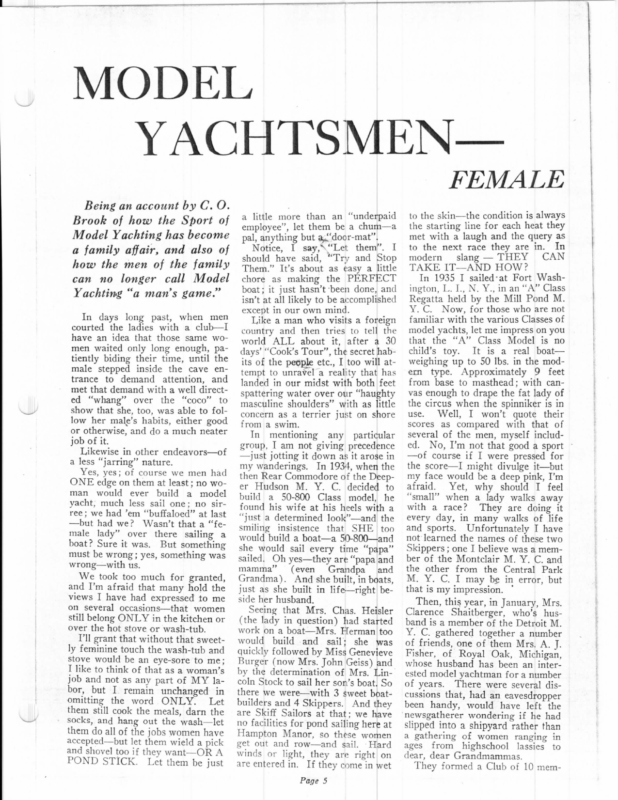
MODEL _— YACHTSMEN— FEMALE Being an account by C. O. Brook of how the Sport of Model Yachting has become a family affair, and also of how the men of the family can no longer call Model Yachting “a man’s game.” In days long past, when men courted the ladies with a club—I have an idea that those same women waited only long enough, patiently biding their time, until the male stepped inside the cave entrance to demand attention, and met that demand with a well direct- ed “whang” over the “coco” to show that she, too, was able to follow her male’s habits, either good or otherwise, and do a much neater job of it. Likewise in other endeavors—of a less “jarring” nature. Yes, yes; of course we men had ONE edge on them at least; no woman would ever build a model yacht, much less sail one; no sirree; we had ’em “buffaloed” at last —but had we? Wasn’t that a “female lady” over there sailing a boat? Sure it was. But something must be wrong; yes, something was wrong—with us. We took too much for granted, and I’m afraid that many hold the views I have had expressed to me on several occasions—that women still belong ONLY in the kitchen or over the hot stove or wash-tub. I’ll grant that without that sweetly feminine touch the wash-tub and stove would be an eye-sore to me; I like to think of that as a woman’s job and not as any part of MY labor, but I remain unchanged in omitting the word ONLY. Let them still cook the meals, darn the socks, and hang out the wash—let them do all of the jobs women have accepted—but let them wield a pick and shovel too if they want—OR A POND STICK. Let them be just a little more than an “underpaid employee”, let them be a chum—a pal, anything but a.\‘door-mat”, Notice, I say,\“Let them’. I should have said, “Try and Stop Them.” It’s about as easy a little chore as making the PERFECT boat; it just hasn’t ‘been done, and isn’t at all likely to be accomplished except in our own mind. Like a man who visits a foreign to the skin—the condition is always the starting line for each heat they met with a laugh and the query as to the next race they are in. In modern slang — THEY CAN TAKE IT—AND HOW? In 1935 I sailed-at Fort Washington, L. I., N. Y., in an “A” Class Regatta held by the Mill Pond M. —just jotting it down as it arose in my wanderings. In 1934, when the Y.C. Now, for those who are not familiar with the various Classes of model yachts, let me impress on you that the “A” Class Model is no child’s toy. It is a real boat— weighing up to 50 Ibs. in the modern type. Approximately 9 feet from base to masthead; with canvas enough to drape the fat lady of the circus when the spinniker is in use. Well, I won’t quote their scores aS compared with that of several of the men, myself included. No, I’m not that good a sport ~ —of course if I were pressed for the score—I might divulge it—but er Hudson M. Y. afraid. country and then tries to tell the world ALL about it, after a 30 days’ “Cook’s Tour”, the secret habits of the people etc., I too will at- tempt to unravel a reality that has landed in our midst with both feet spattering water over our “haughty masculine shoulders” with as little concern as a terrier just on shore from a swim. In mentioning any particular group, I am not giving precedence then Rear Commodore of the Deep- C. decided to build a 50-800 Class model, he found his wife at his heels with a “just a determined look”—and the smiling insistence that SHE too would build a boat—a 50-800—and she would sail every time “papa” sailed. Oh yes—they are “papa and mamma” Grandma). (even Grandpa and And she built, in boats, just as she built in life—right be- side her husband, Seeing that Mrs, Chas. Heisler (the lady in question) had started work on a boat—Mrs. Elerman too would build and sail; she was quickly followed by Miss Genevieve Burger (now Mrs. John Geiss) and by the determination of Mrs. Lincoln Stock to sail her son’s boat, So there we were—with 3 sweet boatbuilders and 4 Skippers. And they are Skiff Sailors at that; we have no facilities for pond sailing here at Hampton Manor, so these women get out and row—and sail. Hard winds or light, they are right on are entered in. If they come in wet Page 5 my face would be a deep pink, I’m Yet, why should I feel “small” when a lady walks away with a race? They are doing it every day, in many walks of life and sports. Unfortunately I have not learned the names of these two Skippers ; one I believe was a member of the Montclair M. Y. C. and the other from the Central Park M. Y. C. I may be in error, but that is my impression. ‘ Then, this year, in January, Mrs. Clarence Shaitberger, who’s husband is a member of the Detroit M. Y. C. gathered together a number of friends, one of them Mrs, A. J. Fisher, of Royal Oak, Michigan, whose husband has been an interested model yachtman for a number of years. There were several discussions that, had an eavesdropper been handy, would have left the newsgatherer wondering if he had slipped into a shipyard rather than a gathering of women ranging in ages from highschool lassies to dear, dear Grandmammas. They formed a Club of 10 mem-
EtFAARED Cf PAIL E il we eF A 48eee . I. Mrs. A, J. Thomas Bryant Fisher (foreground) (foreground) and Mrs. and Mrs. D. M. Johnson; Detroit Women’s M.Y.C. C, Shaitberger, Detroit Women’s M.Y.C. 3. (1 to 2. r) Mrs. Vice- Commodore, Mrs, C. Shaitberger. Skipper Miss Helen Zirbel. Skipper, Mrs. Thomas Bryant. Skipper Mrs. D, M. Johnson, Commodore, Mrs, A. J. Fisher. Judge, Mrs. Van Cuelebrout. Skipper, Mrs. Cahs Hands. 4. Miss Helen Zirbel (foreground) and Mrs, Phyllis Cuider, Secy-Treas. Detroit Women’s M.Y.C. 5. Mrs. John Geiss, Deeper Hudson M.Y.C. Hudson M.Y.C. Mrs. Herman Graffunder. M.Y.C. & Mrs. Wm. 7. Mrs Harris, South Jersey M.Y.C. J. Frech, South Jersey M.Y.C, Page ¢ Chas 9. 6. Commodore Heisler Sr. (l to r) Mrs, (Auxiliary) Deeper Treasurer, William Deeper Malacrea Hudson and Mrs.
MODEL CRAFTSMAN, The Home Mechanic’s Magazine for January, 11 MAARPED 6 number than many of the male- And I believe I am safe in say- ing they are the only ALL Women’s Model Yacht Club) in_the World. Doubtless, other Clubs ot. the rigging of slacks and what-n st ude pro the bt, dou t She is, withou for Commodore, but, with the guard with all the pride of pioneers, ou mates—there was opposition—y bers and 7 boats, by far a greater Clubs could boast. ger, that winsome conceived the idea Model Yacht Club, Mrs, Shaitber little lady who of a Women’s was nominated ready smile so familiar to all her friends, she declined in favor of Mrs. A. J. Fisher, whose greater organizing experience would give the Club a firmer start. They now have 19 members and 10 boats—and hark ye! to the names of the craft; not such ordinary names as we men strut on our. ship-sides: but “Silver Heels” — “Patsy”’—‘“Duchess” — “Katydid-Mitzi” — “Miss De- AaRDREE A WFRAELER F ( CPAILE troit” — “Alma M” — “Rudoru”— “Trixie’—‘Undaunted II”—etc. ( 1937 Mrs. C. (Iona) Shaitberger is Vice Commodore; Mrs. John Filtz, is Rear Commodore, Chairman of I have Skipper and Club Member Simy? Wh met in many a day… full fled ged a is e —sh ugh along this line will follow in time, ple eno of the South Jersey Model but they have a distinction they will member I am sure. And in | mentioning “pride” brings me to another lady, whom I am extremely happy to number among my very real and close friends. There are 3 of them, all told, who are a part of the South —“The 3 Musketeers”—they are Mrs. W. Malacrea, whose husband is a member of the South Jersey Club along with the other women’s husbands—the others are Mrs. J. Frech, and Mrs. Wm. Harris; they opposition was overridden—t for plication of Mrs. Wm, Harris member than the sweet little mother of Bill Harris’ 4 youngsters. A woman as fine as women can be—asport, a perfect “gentleman.” Will ing, no matter what the task… nor the hours involved. It has been more or less amusing to me, and one reason why I often look at my friends in the sport with the sincerest affection—this “big boy” attitude of scoffing at “sister” and her desire to join the game—not a thing malicious—just the finest kind of enbarrassment; the kind that we find in the 16-year old “man” when his sister crowds among the gang—and his rather im- a boat; not in the Detroit Women’s M. Y. C. They also list 2 members as Scorekeeper and as Judge. That’s more than we think of doing in many cases. And a partial quote from a recent letter sounds real nautical—not the vain perious gruff way of telling her to “so on home” … scolding, yet proud of her and too shy to admit “i. But we have arrived at the point in Model Yachting where we have to accept the inevitable. The women are with us, and doubtless with us to stay. All arguments to the reaching of the tyro—with “‘we had 4 races before we started a series of ten races for the Club Trophy” —“ran off six—figuring our scores on the percentage basis’—also “we challenged the Tre-Pol-Pen M. Y. C. of Detroit—the score was 78 to 72 in favor of the Tre-Pol-Pen M. Y. C.”—and still again—“We will ber 1936, the weather far from mild—the water at a level where they had to flop on their ‘bilges’ to make an adjustment, and yet, you will notice the contagious smiles on their happy faces, not “stage” smiles, or “fixed” grins—real spontaneous giggles because they are enjoying every minute of it. hout oppositionists told me this wit the but , part my on ng citi soli any he ap- and ‘membership was put to a vote, fold the into pted acce Jersey M. Y. C. In sending me she was will never have a more their pictures, I notice on the re- That Club y nor enthusiastic verse of one, the penciled notation sincerely happ the Sailing Committee, and as per their records—‘“Acts as Mate’”— Miss Phyllis Guider is SecretaryTreasurer, and they have their Roster divided into 2 classes, namely—Skippers and Mates. Oh no, you don’t get by with the title of Skipper unless you own and sail join the M. Y. R. A. A. if they will So accept our application” what? Are they Skippers or not? And think of this—one of their members writes—“I have been married 26 years and sail every chance I get”… “regardless of the weather”. . . with proof by the photographs _ that accompanying they are able to stand the gaff— the pictures being taken in Novem- kind; “What do know—the usual etc we want women— , etc.” These Squanto II. Owned by Joe 3 acNeill, Springfield, Mass., M. Y. C. have families—as many of these One has a other women have. family that reads like a College year book—‘‘the oldest is a Soph; the next a Freshman—another one soon to go into the freshman Class—and Shirley, the youngest has the boat named after her’—another has children married—another nas a 5- year old boy who finds Mother a Pal at the Pond anytime he goes there. These women are judges and starters in many an inter-Club event—that is, two of them are— the third is the one I opened this paragraph about and got tangled in contrary,I feel it is the greatest factor in building the sport along the lines laid down in most of the copies of Constitutions and ByLaws I have seen, to wit: ‘to proencourage designing, mote and building and sailing of Model Yachts’ etc., and this must have been the thought behind the phrasing, truly to ENCOURAGE these things, and not merely to make a document carrying legal and technical sound. Those who have been fortunate enough to witness an inter-Club race, and especially a race of Divi- sional or National character will admit they would have difficulty in finding a more congenial group of people. Just the type of grown-ups and youngsters you would be content to know your boy or girl was with. Empahsis is laid on the (Continued on page 46)
MODEL CRAFTSMAN, The Home Mechanic’s Magazine for January, 1937 —FEMALE (Continued from page 6) word “sportsmanship” … There are frequent discussions that to some might sound quarrelsome. . these discussions are not a breach of sportsmanship, but rather a sim- ple difference of opinion in the in- terpretation of the rules, which through these discussions are gradually being ironed out and clarified so there will be a universal understanding of them. Unfortunately, not many of the male Skippers have realized the necessity of studying the rules, and _especially of subscribing to the variout publications that give space to the events. . . They seem unable to realize what they lose in the sport without this regular posting of news and the constant studying of a e rules, etc. And here again the women are possible material for guiding these Juniors in their desire to follow model yachting, and certainly no child can put it’s time to a more lucrative task; not in monetary gain, but in health, happiness and beauty of thought, for these little crafts are things of beauty when nicely made; whether on the water or in the attic. We men have simply got to awaken from our early Victorian dream of woman’s place, before we find ourselves jarred out of the oldfashioned idea that when the Hon- eymooning days have gore we can push the women where past genera- tions felt she belonged—back bent over a tub—one foot rocking a cradle, one hand cooking meals, so that when the “hairy masculine boss” steps in the door, he can find everything at his fingertips—where he can drop his clothes in the nearest corner for the “missus” to pick up and put where he can find them when he needs them again. Oh yes, ahead of us. . . in their willingness to acknowledge how little they know of the sport, and their anx- we have it coming—let’s take it like sportsmen, and remember that there iety to be able to meet, the men on a common ground, they secure a copy of the rules etc., and study them, getting their “heads togeth-er’ for the purpose, and asking questions of the men when they MARBLEHEAD MODEL is many a GENTLEMAN among the women of Model Yachting. YACHT CLUB NEWS come to a question to which they By Roy F. Clough do not find an answer. They seem to have a keener fore- sight than the men, and more confidence in the continuance of the sport; they are always planning far in advance of events and seasons, and I doubt if the men would continue in the sport under the same handicap that women enter it. I have plagued many of the women I have contacted in the sport about use of “pink ribbons on their masts, silken slacks and embroi- dered sails” . . . I too, had to jest at their ambitions—and find that I owe them an apology; their boats are clean, neat and have the same “boaty” look that any male Skip- per’s has… their dress is comfortable and sensible, and they sail with all the keen zest for the game that marks the sailing of the male Skippers. In the October issue of Moper CRAFTSMAN, those who read the article on forming a new Club, which was the result coming to me of on many inquiries the subject, will recall that I emphasized the neces- sity of an Auxiliary, althouch a few Clubs have a Junior Auxiliary, made up of boys and girls who have not reached maturity. With women sailors in your Club or Auxiliary, you have the finest Our first meeting of the year developed into quite an interesting affair. A revision of the by-laws was taken up to bring them more up to date. A committee was appointed to secure an option on a building at the pond for a clubhouse and arrangements made for the Chowder Race. The nomination Committee was also appointed to bring in a list of officers and committees for next year. Mr. Schaitberger of the De- troit M. Y. C. was a visitor at the meeting as a guest of John Black. After the meeting the entertain- ment committee furnished a buffet lunch. Bill Hoeg is certainly a fast worker. When he was asked at the meeting if he thought that he could get a good railroad stove through his office for the new clubhouse if we should decide to have one, he said that the order was already in. Ex. Commodore Barron tells me that he is going to build a new boat that is going to be different. He did not say whether it was to be different in looks or speed. Eddie is a fine workman and turns out some fine boats. Ex. Commodore Sweet, George Clive and Ex. Commodore Courttis are also going to build new an Navy Day with the fleet on re- view is nothing to the fleet review that Frank Courtis could put on. A member of the Marblehead club for 42 years he has every type of boat that has been sailed on Red’s Pond in that period. His boats, like an avalanche, are slowly filling his house. In a few years if he continues to build boats, Frank and his family will be living in one room with the doors barred to keep the oncoming horde from driving them from their last stronghold! The official racing of the Marblehead_M. Y. C. for 1936 ended with the Chowder Race. The score board shows that Alf Mattsson and Ed. Dixey were the outstanding boats for the season. Dixey showed the best in club racing with a total of 1148 points; Ed. Lakeman being second with 790 points. Mattsson’s boat has been very consistent in out of town racing. In the five inter-| club meets he was high in two, tied for high in one and was second in the other two. He was third boat at the Deeper Hudson Regatta and made the semi-finals against 80 of the best 50’s in the east at the Heisler Cup races. In the club racing he was second in the first series, sixth in the second and fifth in the third and then to make the season complete he won the Commodores Cup by Commodore Sweet, against twelve of the best boats in the club. A very fine record. The club has also done well this season having won the International Championship in Germany and then the New England Championship. Sid Doane won the Marquis Smith Ocean Race with a fine display of courage and perseverance. H-O LAYOUT CONTEST (Continued from page 45) In this layout is ample engine fa- cilities and there is a makeup yard for freight (two outside tracks in the yard) one storage track, three freight unloading tracks and a ca- boose spur. There is a passenger car storage track and in the engine yards there is a coal spur, coal station, ash pits, water main, turntable and repair track and five stall house. In the other station there is a siding and two spurs for business. The Main line has six facing or trailing switches so the operation of two or three trains at one time is possible and if sufficient skill is acquired I believe all four trains could be run two in each direction. There are three sources of revenue —that of Oil, Mill and Mine. aetna nce MODEL YACHTSMEN eens 46