
- Tuning and Trimming A Model Racing Yacht. By Walter K. Moss.
- Mr Moss discussed tuning and trimming model racing yachts, explaining that winning requires achieving mechanical balance between the sail’s center of effort and the hull’s lateral resistance, since there is no crew aboard. Key tuning principles include the “beating” test, adjusting the mast and jib to correct course issues like luffing or falling away, and understanding that a slight “flow” in the sail often increases speed. The article also touches on steering mechanisms like jib steering for close reaches and Braine gear for running, noting that controlling a downwind run is more difficult than a windward beat.

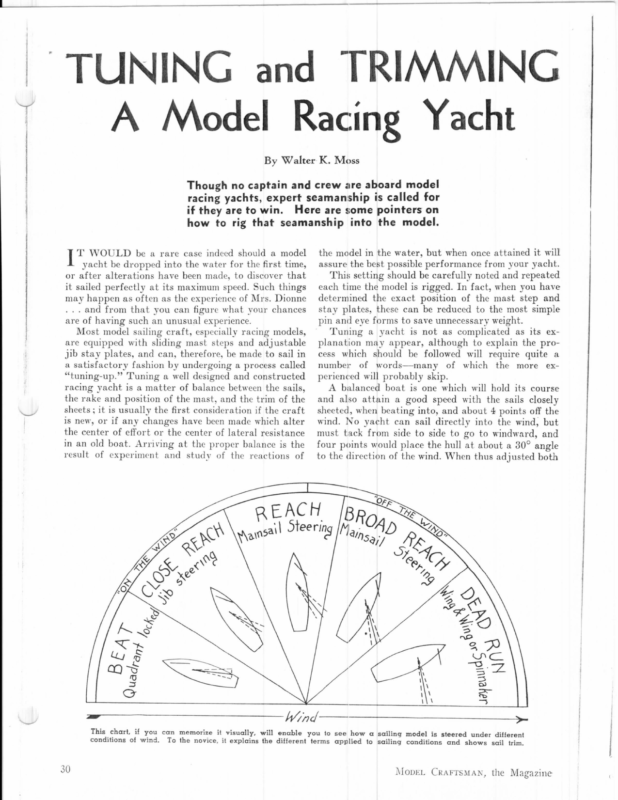
TUNING and TRIMMING A Model Racing Yacht By Walter K. Moss Though no captain and crew are aboard model racing yachts, expert seamanship is called for if they are to win. Here are some pointers on how to rig that seamanship into the model. T WOULD be a the model in the water, but when once attained it will assure the best possible performance from your yacht. rare case indeed should a model yacht be dropped into the water for the first time, or after alterations have been made, to discover that This setting should be carefully noted and repeated it sailed perfectly at its maximum speed. Such things each time the model is rigged. In fact, when you have may happen as often as the experience of Mrs. Dionne determined the exact position of the mast step and stay plates, these can be reduced to the most simple . and from that you can figure what your chances are of having such an unusual experience. Most model sailing craft, especially racing models, are equipped with sliding mast steps and adjustable jib stay plates, and can, therefore, be made to sail in pin and eye forms to save unnecessary weight. Tuning a yacht is not as complicated as its explanation may appear, although to explain the process which should be followed will require quite a a satisfactory fashion by undergoing a process called number “tuning-up.” Tuning a well designed and constructed perienced will probably skip. of words—many of which the more ex- racing yacht is a matter of balance between the sails, A balanced boat is one which will hold its course the rake and position of the mast, and the trim of the sheets; it is usually the first consideration if the craft and also attain a good speed with the sails closely sheeted, when beating into, and about 4 points off the is new, or if any changes have been made which alter wind. No yacht can sail directly into the wind, but must tack from side to side to go to windward, and four points would place the hull at about a 30° angle to the direction of the wind. When thus adjusted both the center of effort or the center of lateral resistance in an old boat. Arriving at the proper balance is the result of experiment 2 and study of the reactions of Wind This chart, if you can memorize it visually, will enable conditions of wind. > you to see how a sailing model is steered under different To the novice, it explains the different terms applied to sailing conditions and shows sail trim. MopeL CraFTsMAN, the Magazine
tacks should be accomplished at the same angle. changes made in sheeting the sails, and any reach or inch ahead of the estimated center of lateral resistance, adjust the sheets so that both the jib and mainsail are at a 15° angle with the center line on the deck, lock the rudder in its center position with the tension slides; place the craft in the water nosed into the wind, but with the sails filled and gently push it trols. As the sails are let further out it will be found that a course will be followed further off the wind, until finally it is necessary to help the craft with a “weather helm,” which will help hold the nose down wind. The beating sheet need be no longer than will permit adjustments to this point as the running lines If it falls away from the wind, move the mast fer- positions of the beating sheet bowser. on the boom sails begin to flap, move the mast ferrule forward. In making these changes be sure to adjust the stays the direction of the wind, you will be able to predetermine the probable course of your yacht by repeating Step the mast square with the deck and about one run by the same with the addition of the rudder con- away… NOW WATCH ITS ACTION! will now take over the job. If you have noted the rule aft on the step; if it heads into the wind and the calibrations for the various courses with relation to simultaneously—fore, aft and side—so as not to alter these settings. the rake of the mast in its new position. When the yacht holds the course indicated above, or approximately such a course, you have arrived at the proper balance with regard to the deck fittings. Should there be a slight tendency to luff at this stage, two further adjustments can be made: rake the mast. slightly (meaning to take up a bit on the back stay and let out a bit on the fore stay), or sheet the jib in at a little less angle than the mainsail. These procedures some- times produce an intermittent flutter in the leach of the mainsail, but it will promptly be pulled out and keep both sails working at their maximum capacity without perceptible change in the course of the yacht. Now is the time to experiment with tightened or Following the course of a yacht around half an orbit from a beat to a run you now arrive at a close reach, and many skippers prefer to use jib steering in this case as the strain is not great and lighter alterations are sufficient to hold the boat on its course. Hook the bridle to the jib sheet and play it out to the proper point for the desired course. In reaching, the jib functions as a propulsion unit as well as a bal- ancing unit. However, there is only a small range of directions on which their steering is effective, and as soon as the stem can no longer be held downwind, the boom running sheets will have to be brought into action and the jib sheet re-attached to the traveler. Do not attempt to operate the rudder with both the slackened sail surfaces and side stays. Some yachts perform better one way and some another, but in the majority of cases it will be found that a little flow in the sail—very little—will increase the speed over a jib and mainsail sheets simultaneously. With the quadrant centering line tautened only enough to pull the rudder square, place the running flat, tight surface. on their respective sides and adjust the tension slides If a boat goes to leeward (drifts sideways) on a beat it is because the lateral resistance is not sufficient to offset the side impulse of the sail plan. Ease away aft. Head the yacht on its proper course and with the the sheets until it is able to ge where it is pointing. Remember that the lateral resistance increases with the speed of the hull through the water, and that in heavier winds a yacht can be pointed much higher into the wind without “crabbing.” Any windward beat can now be accomplished by line hooks in the middle holes on the quadrant face to a position a little back of their full play fore and running line bowser, set the sails Just short of “spill- ing” the wind—and your craft is ready for a reach or a run. The writer has found this much more difficult to control than a beat, although fewer points result from such a leg won in a race. As a precaution, the idle sheet can be hooked far out on the quadrant to jibe the boat back on its course if the correct tension CONDENSED TRIMMING SUGGESTIONS GENERAL [tes quadrant square with tension slides BEATING lary sheet hooked to traveler ee that running sheets do not effect rudder LUFFS FALLS AWAY Move sail plan forward Rake mast slightly Take in jib slightly Move sail plan aft Square mast forward Let out jib slightly Move jib aft on plate Move jib forward on plate Hook on jib or running sheets and es tension slides back detach beating sheet from traveler, REACHING| Sheet hooks about middle of quad- Ease centering line Move sheet hooks outward {Move Sheet hooks outward | Set tension slides about 34 of the ON PUFES: Ease centering line way back on their full length of ON LULLS:) Move sheet hooks inward rant play | Hook idle sheet hook way out on quadrant of Mechanical Hobbies, September, Stiffen centering line Move sheet hooks inward {Tighten centering line oie for sheet hook alert os | when sails are filled and craft is Move tension slides aft RUNNING ~ headed on course Ease centering line agazine a tension slides forward 1937 Move sheet hook outward Move tension slides forward Tighten centering line | Move sheet hook inward 3I
settings have not been made and the boom flies over. new angle, only a semblance of balance is maintained Again the actions must be closely observed and ad- and adjustments are necessary to automatically over- justments made to counteract undesirable performances. Should a tendency be noted to head up into the come these discrepancies. This is where your individual ability as a skipper comes to the front . . ; if you hit on the ideal balance more often than you miss, wind, more leverage is necessary and the quadrant hook can be moved out a hole or so; if the tendency is to run further downwind, reduce the leverage by moving the hook toward the center. In a steady wind you’ll be an outstanding skipper. some point will be found at which will the rudder equalize action of the the puffs: move the quadrant action turning mainsail— and the course will he held. If the velocity of the wind was always the same it would be unnecessary to provide further adjustments; but as this is not the case, provision has been made to stiffen or ease the rubber tension by tightening or loosening the centering line, by changing the position of the quadrant hooks and by moving the tension slides forward and backward. Now, again—note the behavior of the craft. Does it drop to leeward, move the slides forward or tighten the tension of the hook out, ease the center- CHECKING —AND fatloontone { Hull { Spare parts | Sponge Mast adjusting bi-pod and model stand, polish, seat pad or blanket {bolt in place if detach- lable—seal against leaks create just condition the which L and necessitate several re-trims and the consequ ent waste of time. Again some combination of adjustments will be found at which the model can be made to hold a more or less steady course . Lulls and puffs in the wind are one of the most an- noying conditions with which the skippe r must contend, as they constantly alter the amount of “heel,” thereby encouraging a change in the course of the yacht. Correctly cut sails for a well design ed hull will go a long way toward offsetting this trouble , but no design has yet been created, and probab ly never will, in which the center of effort will consta ntly balance the center of lateral resistance under the many situations which develop during the course of a leg. With the lengthening of the water-line as the result of a puff, the lateral resistance increases and the prow up greater resistance proportionately, thereby increasing the tendency to luff. Although the center of effort in the sails has moved forwar d under the 32 frock ont slong ppare attach quadrant hooks |set tension slides on the other. The beating gye is always hooked on the weather in when this the maneuver craft leaves the shore and the jib is a three place slight traveler to help head the boat into the . at . wind. The yacht is released m off the wind and will gradually be pulled into a luff a] distance bank where the wind will catch it for the If it cornes about too quickly release the or if it fails to come about take in on the These adjustments are best determined a a on one tack, and lengthens some as this use hooked on the lee side of 5 ie check alignment ment, to them side adjust centering line ten- opposite longer ens the setting of the sails plate sion likewise have to be corrected sets correct 1s a_ accomplish beating gy c which short- strap oil will on necessary loosen when not in use may return it adjust tension at cleats isn’t way out on the pool, gybe, and affix fore, aft and side attach sheet to traveler Rudder purposes there is the matter of “looping” with which to become acquainted. This is generally used on pool racing where the craft is to be sent part To | Sahin luff Sails racing tack. in the When you have gained the “feel” of your yacht and the various adjust- square Anant with deck mount hole RIGGING we ments depends upon the rebut never be you balanced |advase mast rake [regulate kicking sponse, and at point The degree of the adjust- It mast advance or less instinctively, for Ditty box ………….. wore; conet”s oxen, flsi”s-s { Tools {step or ments can be made more | Sails . line tension slides. YOURSELF— Model yacht ………… 5 5 okt) 2 Bl ALA Se | Spars or ease the centering line. necessary ing THE YACHT EQUIPMENT: in going to the event remember the rubber; does it go to windward, move the slides back “heavy-handed.” . At this point it’s a matter of feel rather than instructions, but if the model has a tendency to luff on miscalculation will from of the p! longer leg. ra gye a bit, gye. pr fri by experi- nullify your efforts. A beating gye can also be used to advant age in a light wind when the sheets are closeh auled, and in this case should be put on the lee side. In the event that a puff turns the craft onto the other tack and off the course, the beating gye will functi on and return the model on its previous tack. Suggestions on the use of a spinnaker are given with hesitancy, inasmuch as considerable grief can be encountered unless it is properly handled under ideal conditions. In a steady wind it is invalu able on a run, but where the velocity varies it is quite liable to become fouled. This sail should be loosel y sheeted to permit bagginess and exert the lifting effect on the (Continued on page 51) Mopet CrarrsMan, the Magazine ha’ raj tio wil tro cal eas) jus Do two swit trac no ) If y pat)
Figure 3—The Short he wants. be made for quickly releasing it altogether should the yacht “get by the lee” (when the wind and the Fig. mainsail are on the same side of 4-A on page 59 the craft). A spinnaker can be set when the Now some real far- two-rail. Suppose you do go barging across a gap like that. At the moment you cross the gap you’ve a beastly short, wot?” And he hands in Fig. 3. A short, eh? Well, well, so he has. That’s why the staggered-gap system is suggested as Fig. 4 Wi ne Ser the mainsail and provision should wants a wye. He doesn’t say why. But I see his difficulty and it’s a good question. Fig. 4 shows what sighted Egg says, “But look here, old Fruit. A loco has more than one axle, doncha know, even in ‘ rigged on the opposite side from land, California, comes along and minute!), see Fig. 2-A. More Buts Problem stem which it develops. It is always Then one Mr. Wing, of Oak- it fool-proof? Referring again to ge 59. (No, now, not till you’ve /Momentary short QD Why Oh Wye? tion like that? How will we make Gap (Continued from page oH 59, Fig. 3-A. (Continued from page 33) are you going to do about a situa- oe: TUNING AND TRIMMING that? Well, I offer one on page TWO-RAIL ECHOES mere fool-proofing, not automatic train-control. But all is not lost, lad. Who sees a solution for wind is about 30° abaft the beam and should be well forward at this time: as the run becomes more of a “dead tail ender” and the boom ‘s eased out, the spinnaker aft-hault is pulled in, but never to the poin where it is exactly square with the shows how he can get it. hull (about one point ahead of the Mr. Wing, dern him, also wants beam should be the maximum). Of a crossing, as in Fig. 5. All right, course, the running sheets on the he shall have it. It’s no harder quadrant still control the course. than in three-rail, and if you are On a “dead run” without a spinready, see Fig. 5-A, page 61. naker, the jib is of little avail, but I have some more problems for ‘t can be hooked on to the bridle to the future. Send in yours, and we’ll correct the course if a hard puff see what can be done with them. should suddenly “head” the yacht And if you know of a better way cted by the wind cular riddles, as it will be affe Figure 5—The Crossing Problem of solving these parti send them in, and we’ll introduce before the mainsail functions, or (Continued on page 56) them to the gang. TERESTING! , EAZY-BILT —BUT IN ‘‘00’’ CAR KIT ! NEWEST SUPER- DETAILED _ Detailed to the last degree. The Ideal everyman’s kit. interesting because we have taken out the hesdaches and You’ll get work for you. a ‘factory finished”’ job. plenty o! fun building and Eazy-bilt but. still left the absorbing the result will be yet produced. Eazy-Bilt construction drawings and notes are the simplest putting the kits toillustrate ‘and briefly describe every step They They give you the factory short-cuts for turning out a fine job. Just look at the extra features that are embodied in these new Eazy-Bilt kits: Stamped brass sides with die impressed window frames—extra clean cast gether. and diaphragms—select white wood roof, precision milled—complete assembly material for fully equalized trucks (no dummy wheels on six wheel trucks)—wheels oxidized black and lacquered, ends—underfra erf me, steps, universal valve, made of turned brass and mounted on shouldered steel axles. These are only a except paint. few of the features of Eazv-Bilt. kits. Absolutely nothing else to buy. Everything is included trucks) ……-ceecenereecres $3.75 Eazy-Bilt 12 section Pullman (Six wheel With air-conditioned roof ie extra (six Eazy-Bilt Pennsy type combination passenger and baggage kit erases $3.75 sesesceeese nscnces wheel trucks), …cesseccedeeecccenenereseesere ….–.+eeeeeeeeeeeee $4.00 Eazy-Bilt. Pennsy type Diner (six wheel trucks) wheel trucks)……– $3.50 Eazy-Bilt Pennsy through service day coach (four you IMPORTANT: Although these kits are modeled after the Penn. RR may letter them for your own or numerous other roads. Kit. Send for Every man can build a first class model with an Eazy-Bilt on guaranteed or yours today and we’ll ship it by retura mail. money refunded. Largest OO line. Satisfacti Four years with satisfied customers. Above Prices Guaranteed For 30 Days Only NASON RAILWAYS, Post Office Box 9 – Dept. 9-C. Mt. Vernon, N. Y. When writing to advertisers please mention \oper CRAFTSMAN
A ONE FLY POWER ENGINE BUILD A (Continued from page 25) C HAMPION DETROIT NEWS together. The drawings show it to be 114” long, and 1” in dia- fillet is shown in the drawings. – tubing A piece of instrument serves as a steam line, or you can take the smallest size copper tub- MODEL TODAY Through the cooperation of Detroit News we are able_to give Model Champion 50-800 ing, such as is used for air gauges, and the like, and make it from that. The belled out ends were easily made by placing a flat sheet of REGULAR VALUE $2.50 der to i orde for $2.50, but in i would be selling i these blueprints i ly cei pastel yacht building and help more people to start this fascinati ing hobby we are offering these blueprints to Model Craftsman readers copper over a pipe end, and tap- > : t BELOW COST. SAVE ping gently with a ball pein ham- $2.00 mer until they were well dished. Firing is done by a small lamp Have fun building a model of the CHAMPION which took first, second and third prizes in the Traverse City, Michigan, races. Today by filling out this coupon and remitting 50c. Get your Blueprint which is made from a “Flat Fifty” cigarette tin—the southeast corner of it, about 1144” x 1144”. This THE MODEL CRAFTSMAN, DN 937 can be cut out with a pair of tin snips, and the other portion sol- 110 West 42nd St., New York, N. Y. I want to take advantage of your SPECIAL of the DETROIT NEWS Champion 50-800 blueprint. Here is my 5 O.0x grois INATHE sajeiaes © ereieiaiare saiewere s wrwteress & BEIeeIE~ CHE: < saiaisiew F alors FaTER a F Fue! Please rush 50c. can which is best for soldering in a THE MOST POPULAR SHIP at the ridiculously low price of 50c. you easily obtain by bending the copper around a broomstick. The lap 30-800 Craftsman readers full size blueprints of the famous diameter This meter. MIDWESTERN it by return mail. Midwestern dered. ROUTERS: 3 « seryeues weaves © noun oo ehyetonle ¢ oa 2 HRGEWOS © Hers gies BF © Z eed, DUALS F&F rhekue F Senedd 5 The filler cap on the boiler is an auto tire valve cap. The filler on the lamp is a piece of bow « 2 orend Are you a model yacht club member?........ A brass If so, give name and address of club......... wick is stuffed into the tube that is soldered into the cigarette portion, and this is done before the HO FREIGHT AND PASSENGER MECHANISMS Permanent 112 _W. 42nd ST. Magnet CRAFT Motor, INC, 30c metal for a pair Dreadnaught of box our car new or automobile the proper pressed positions. metal car These ends are the finest Also sup- available. plied with edges turned to go around corners of car and with proper rivet impressions along edge, at 50c per pair. Satisfaction or money refunded. Send 25c for on illustrated catalog. Refunded first order of $1.00 or more. A whole shop full of tools in sories. For home, shop or take to job. Plugs in any light socket AC or DC110 v. For 13,000 r. p. m. Get A Demonstration mS al ne pi Pepectores, foie} I 179 Howard St., San Francisco, Calif. aler: n $10.75 and up postpaid,3 Accessories Free. De Luxe A CRAFTSMAN Project Book Pleasure and P-ofit with a Han- Model $18.50, withoAc- 9 fee, Basyworklagpians forma: cessories. Catalog Free. projects 25c, stumps or coin, CHICAGO WHEEL & MFG. CO., !10! bp maa . “O” Cauge SIGNALS -—Our new line of 0 Gauge Signals now ready for delivery, both kits and finished models. 2 and 8 color light and position light Dwarfs, types. Prices models at for MODEL 292MC 00 kits $1.75. VAIL start Illustrated at $1, price RAILROAD AVE. DUNELLEN, GAUGE—“LIMCO” Our New vou ordered AAR TANK yours? CARS Get and list finished 3c. SHOP NEW PRODUCTS are going at fast. these low one Drilled and Machined Kit $4.60; Casting Kit lave prices. WESTERN COACH Casting $2.75. FRUIT EXPRESS BODY KITS $1.00 KIT, Die Cast with most minute details Kit, complete ............c cece eee $4.85 Enclose Stamp for l’rice List. LONG 148-25 ISLAND Hillside SCALE Ave., MODEL Jamaica, New CO. York St., Chicago pt. METAL SUPPLIES Modelmakers and Metal Artisans need Steel, Brass, Aluminum, Copper, Bronze and other metals. Furnished in many shapes and sizes at current prices and prompt shipment assured. For bulletin of prices and particulars of Metals, Model supplies, Shop tools, Power Machinery or other informatio n address tt JERSEY The Lubricate the engine with light machine oil. Do not leave the lamp under the boiler any longer than neces- one. Grinds, polishes, routs, drills, cuts, carves, sands, saws, sharpens, engraves. Uses 200 different acces- 10Day Money-Back Trial ROLLIN K. LOBAUGH The are of sheet brass, bent and dimensioned according to the drawing. pressed car ends. In addition to the usual corrugations have rows of scale rivet impressions in screw. raporize the alcohol, and produce a hot flame. The legs on the boiler DREADNAUGHT ENDS Send a saw cuts in the tube can be made after the wick is in. These cuts $3.50 STORES, for tube is finally soldered up. 8 coupled Consolidated Mechanisms—611%4” driverS.......... 0. ccc e cece cece ce ceccececcucecence $10.00 6 coupled Pacific Mechanisms—80” drivers ...........0 fcc ccc cee cee eeeeeeeeeeccee cencecec lee. Above mechanism insulated for two rail distribution HOBBY tapped “ 653 METAL SUPPLY COMPANY [Ith Ave. ICKEN jlave * * * *& * * New York CUSTOM BUILT Highest an quality enviable ten workmanship year and record for materials, Smooth quiet operation with long life, Exceptional hauling power, Finest type of detail painting and finish, Prices start at $125.— for finished models, Entirely hand made to your order, WHAT CAN WE BUILD FOR YOU? ICKEN MODEL LOCOMOTIVE co. Palisa des Park Est. 1927 N. TUNING AND TRIMMING (Continued from page 61) j weaken the pull of the running sheets by counter-acting. It is impossible to cover the multitude of situations which may encountered when sailing a be model yacht—each has its own necessarily be worked out by the skipper himself solution and must and the experience he has gained LOCOMOTIVES estabNshed sary to just get steam up. The engine will run for five minutes on stored up steam. from previous noting the ments, and voyages. re-actions Mentally to adjust- subsequently bearing them in mind when making changes, is the real J. secret to a successful ‘acing career. When writing to advertisers please mention Move. CRAFTSM AN