
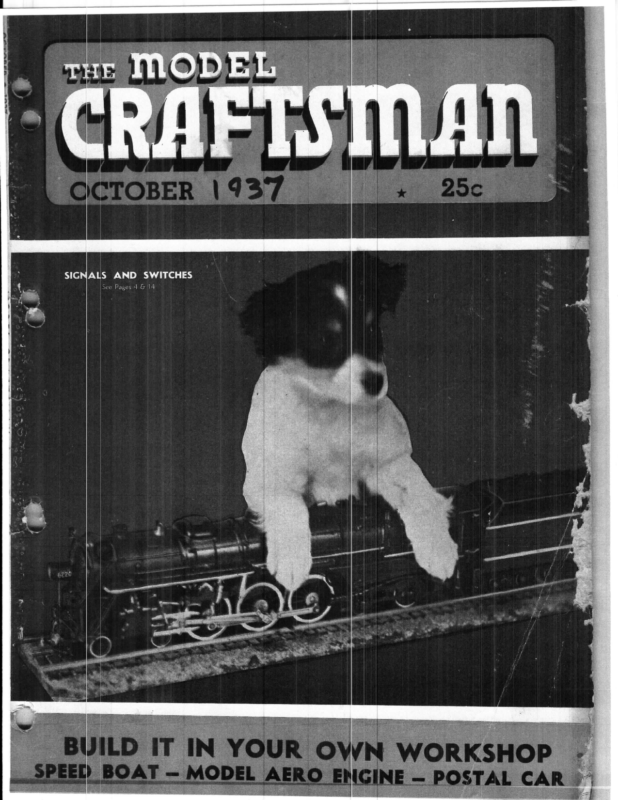
- Bermuda Sails for Miniature Racing Yachts. By W. K. Moss. The article details the importance of meticulously crafted sails for model racing yachts, specifically addressing the 50-800 (Marblehead) Class. He recommends using specific materials like Egyptian cotton or silk, adhering to strict size and hardware regulations for sail area, headboards, and battens, and carefully cutting and reinforcing the sail edges based on measurements from the assembled boat.

ALS AND SWITCHES See Pages 4 G 14
BERMUDA SAILS. ‘ i for Miniature Racing Yachts By Walter K. Moss No matter how good your model racing yacht, it cannot do its best without properly made sails. Here we tell you how to select the proper material, how to cut, hem and reinforce the sails for the popular 50-800 Class model yacht. HE novice approaches the subject of sail making for his model racing yacht with joyous abandon . because he has reached the final stage in the construction and rigging of his workmanship he is overanxious to sce it completed. Hurrying a bit, and with a casualness that little betokens his former meticulous care—he buys some cloth, most any kind, he re-examines the blue prints he has been following for measurements, and he proceeds with knife and shears, needle and thread, hooks and eyelets . . . and the results are generally pitiful. What might have been an outstanding racing contender becomes a mediocre sailing boat. To the experienced, the matter of sails is of prime importance. Their cutting and resultant power, their hems and reinforcements, their eventual shape and appearance, their hang, are all matters of serious portent. The sails alone provide the means of forward motion—every other factor is a deterrent to any kind of motion by your boat—and it is motion, and more motion, that we are seeking. Wardrobe Needed One suit of sails cannot, and will not, prove most satisfactory under every condition. If the builder does not intend to have several suits of sails for his boat, he had best consider the prevailing conditions where he expects to spend most of his sailing time— whether the winds are generally heavy or light—and cut accordingly. Slightly full or baggy sails, with the limit of sail area allowable, are called for in light conditions; fairly flat or tight sails, with a reduced area, for heavy wind conditions. How these two ends can be achieved will be taken up later. But, if you want to be prepared for every situation, plan to have at least three suits of sails and a spinnaker, and give the making of your sails as much attention as you’ve given to every other part of your boat. They ine himself to this class, but today, the writer will conf ls would apply to either the the construction detai ls as well, with International A or Inland Lakes mode ad Class the only minor variations. In the Marblehe combined es inch sail area is limited to 800 squareand the of ula for form ail, surface in the jib and mains arriving within this limit might be stated as follows: Restrictions the length of the luff mulof uct prod the Jib— tiplied by the shortest distance between the luff and the clew-—divided by two. Mainsail—Multiply the length of the luff by the shortest distance between the measuring mark at the the outer end of the boom and the mast, and dividesails two the of area product by two. If the total is less than 800 square inches they will be “in class.be” Two other restrictions are enforced and should observed by the sail-maker. Headboards should not exceed 34,” across the base and should not be sewed ‘1 such a manner as to stiffen the peak of the sails. Not more than four battens are allowed in the mainsail and these should not exceed 4 inches in length and should be equally spaced; not more than three battens are permissible in the jib and these should not exceed 2 inches in length and should also be equally spaced. Sails, complying with these require- ments will probably be acceptable to any “official measurer” unless more recent rules have been added since the preparation of this article. Selecting Material Of course, the first step is the selection of the material to be used. There are a number of excellent sail clothes on the market. True, they are a bit expensive, but the slight additional cost deserve it! will be repaid many times over when the right cloth is put to actual use. “Union silk,” “Balloon silk,” “Egyptian cotton,” costing about 90c a yard, is widely used as it holds its shape well, is tough, unshrinkable and being the most popular in the country material is called X.L.; it is patented The Marblehead, or 50-800, model of Mechanical Hobbies, October, 1937 light in weight. An excellent English 19
protract the leach of the sail. a a,Jeating Lin’ wwe t— Ce/Juloid Headboard t— Hem in Leach emma This can be done with strip of pliable wood, called a spline, held in the proper curve with metal weights or small sand bags. If a straight edge is laid between the two pencil spots, the proper curve outward will be the amount of the roach, as shown on the sail plan. This is usu- ally about two inches. The roach should be full and easy, to avoid sagging-in of the after edge of Jape Linen Batten Pocke/s ax 1—Head or Feoak 2-foreside or of 3-Tack Corner 4-Clew Corner 5-Leach or After Lage 6-Botfom or Foot your sails after they have been stretched from use. The cut of the leach in no way affects the flatness or bagginess of your sails. Allowing about three-eighths of an inch for hem- ming, outside the finished leach, draw a pencil line along the spline on the material. With the straightedge still in position between the eyelet marks, divide the leach into four or five (depending on whether three or four battens are to be used) equal sections. and spot these with pencil on the cloth. At each of these spots, and at right angles to your straight edge 7-Battens draw a line on the cloth extending from the leach inward for five inches. These lines are simply to be 6-feéenforcements used as guides when sewing on your batten pockets. Now from your mast and boom assembly take your 9-Froach two measurements along the mast and boom from the point of the tack eyelet to the point of the head and clew eyelets. Using two rulers, project this point onto The above drawing, not done to scale or measurement, shows how to get the most sail from the minimum material, and shows exactly where the hems, battens, and reinforcing tape are sewn and resembles a heavy grade of blue-print linen, in addition to the previously mentioned attributes it also has a smooth, non-resistant surface. A glossy, semitransparent, treated material similar to that being used for ladies’ rain-coats, aprons and shower bath curtains has also been experimented with, but it has been found that it is weakened wherever stitches are necessary and if used the stitches should be well lengthened out. The writer has heard of, but never seen, sails of a certain heavy grade of cellophane which have been cemented instead of sewed. For binding edges and batten pockets only pre-shrunk linen tape is advis- able, and never use anything other than silk thread, either for the machine or hand sewing. Celluloid or aluminum plates for the headboards, celluloid battens and non-rusting hooks and eyes are essential. Your best results will be achieved only by using the best materials. The Cutting Great care must be exercised in the cutting of the material, for on this depends the “flow” of your sails. Lay the cloth on a large flat surface such as a lino- leum floor, drawing board, or panel, and fix in place with thumb tacks—without stretching or wrinkles. About three inches in from the selvedge make two pencil marks the exact distance apart that the clew and head eyelets are to be spaced. This measurement should be taken from your assembled mast and boom on the hull as it assures you of thus getting the correct amount of lift at the outer end of the boom, which must clear the water and not “drag” when the boat heels in a blow. Now, between these two marks 20 your material from the two previously made pencil marks, and this will be the spot where your tack evelet will later be placed. The leading edge, or luff, and the bottom edge, or foot, of the mainsail will be bound with tape as will the luff of the jib. The leach or after edges of both sails and the foot of the jib will be hemmed. This method of handling should be borne in mind when cutting your cloth, as additional material must be left for sewing into the hem (about 3¢ of an inch for a 1% inch hem), and only 14 of an inch outside the eyelet points where binding is to be used. The jib is laid out in the same manner as was the mainsail. Refer to the drawing for suggestions as to how to get the most out of the least material. A flat mainsail can be achieved by cutting the cloth along a straight line on the luff and foot edges. The flow, or draught, will be increased as these lines are bowed outwards, or convexly. Both bows should be parabolic in character, the greatest bow being reached about two thirds the distance above the deck and about one-third the distance back from the mast. About 3/16” will provide a slight flow for most sizes of Marblehead sails. The Jib The jib is made flat by cutting the luff edge very slightly concave, the flow increasing as this edge is made flat or convex. Neither the cut of the foot or the leach on the jib will change the flow, inasmuch as these edges are merely hemmed and are not hooked on to your riggings except at the tack, clew and peak. Consequently they may be cut with a generous roach to prevent them from being pulled in to an unsightly concave line after they have been stretched. After you have carefully marked out the pencil lines along which you will cut, you will have to decide Mopbet CrarrsMan, the Magazine
Mainsail Peak Corner The celluloid headboare. is hand sewn to the hem in the peak of the sail, which in illustrated in the photo the and (left) drawing (right), with the cleating line in a5 cles ctth thy hI LE 41hty Mp ! Luff ‘ ) | nel i =- place through the headboard eyelet. en turn has been overlapped by the luff binding. Double stitching of the tape is Mainsail Tack Corner The center photo and drawing show how the luff binding tape overlaps the foot binding tape, and is folded under. Hook eyelets are riveted through both the tape and material between the lines of machine stitching. Where the tape is folded under, the stitching boxes and bisects the joint, giving better appearance and ———————E greater strength. Mainsail Clew Corner The bottom photo and drawing clearly illustrate how the foot tape overlaps the hem in the leach, anc is folded under into the crease, flush with the leach. The hooks are of the spread-eye type, and alternate first on one side and then on the other. The cleating cord through the clew eyelet. is knotted The reenforce- ment has three lines of stitching, and the edges are caught under the hem and tape. The batten pocket lays at right angles to the leach, and is also caught leach hem. of Mechanical Hobbies, October, 193 under the 21
Jib Peak Corner At the right and left are shown how the folded tape extends beyond the sail cloth and covering leach hem. Also note the luff rings and head eyelet, with cleating cord attached. an opening The batten pocket for celluloid in the) shows upper, outer edge. Foot of Jib The reenforcing tape, stitched on a straight line between the tack and the clew eyelets, is sewed over the leach hem and under the luff binding. The roach in the foot, and the fore-stay luff rings are shown, as is the angle of the batten pocket. Batten Focket hth Qpening leave a small unsewed section in the upper and outer edge of the batten pockets. This can be done by starting the sewing about the middle of the upper to remove the thumb tacks and follow the lines with a well sharpened pair of shears. Even though the edge of the tape and sewing toward the leach for a spline is used as a guide for the knife, the material short distance, then turn the sail under the needle and is occasionally pulled and you may cut small jags of retrace around the entire edge of the tape. Starting material away inadvertently. All cut edges deterabout 14” in from the leach, stitch on the reénforcemine the finished edges and so they must be as smooth ments as indicated in the accompanying drawing. and regular as possible. Now trim away the surplus reénforcing exactly along Having cut your material for both sails, the next the foot and luff of the mainsail and the luff of the step is to baste your batten pockets and corner re-. jib, but 14” in from the leach of the mainsail and the enforcements into place. Cut sections of 14” linen same at the foot of the jib. This will avoid bulkiness whether to use a razor blade or shears for the cutting. The writer has found it more convenient and accurate tape into lengths about 34” longer than the actual length of the celluloid battens, and iron under 14” at one end while pressing the balance flat. Baste these to your sails using the guide lines previously marked, with the folded-under end laying away from the leach, and the opposite end spaced only a 14” from the leach. Be sure that the batten pockets lay parallel with each other and at right angles to the warp of the cloth. If desired, reinforcing material can be applied in the clew and tack corners of the mainsail, and in the tack corner of the jib. The easiest method is to place a piece of waste material on those corners with the selvedge at a 45° angle with the foot, and covering the entire corner for about 2 inches. Without cutting away the surplus material, baste the re- inforcements in place. You can now proceed with the machine sewing of all these items onto the sails. To provide for inserting the celluloid battens, 22, at these places where the edges will be hemmed. Be sure that all batten pockets and reénforcements are sewed onto the same sides of the two sails. Hemming If your sewing machine has a narrow hemmer at- tachment, proceed to hem over the leach of the mainsail, and the leach and foot of the jib. An easy start can be made by twice folding under the peaks of the sails for about two inches along the leach and feeding this into the hemmer. For a neat job, make sure that the hem laps over the ends of the batten pockets and the edge of the reénforcements. As you are working along a parabolic curve, be especially careful and watchful. Maintain just sufficient pull on the material to keep it variations, folded under into the hemmer without As this requires a little practice it might be advisable to make your first attempts with a piece (Continued on page 60) MopeL CraFTsMAn, the Magazine
MODEL YACHTING It seems that us male modelers are at last getting some real competition Or perhaps it from the ladies. should hardly be called competition, for the entries of the Detroit The scores were as follows: Club Points Cadillac MYC 29 D. W. MYC 29 Leona Schaitberger D.W. MYC 27 Hazel Moncreiff D.W. MYC 26 Tre-Pol-Pen MYC 25 Cadillac MYC 22 Columbia MYC 18 Flora Fisher D.W. MYC 18 Helen Zirbel D.W. MYC 17 Catherine Hiltz D.W. MYC 16 Susie Bryant D.W. MYC 11 Det. MYC 11 Trelawney MYC 10 Trelawney MYC C. Ernst The total scores for the 8 men 3 Si Thomas Don Johnson Unnamed Wm. Topping “Silver Heels” “Gee” “Katydid” “Undaunted IT” “‘Susabel” Clarence Schaitberger “Security” Jack Rowe “Albratross”’ 130 points The total scores for the 7 women , 144 points Prizes were awarded to the highest score and the next highest man and high. est woman. Awards went to Archie Arroll, Si Thomas, and Doris Topping. The outstanding Class A model Yacht race it: Detroit this season, was sponsor- ed by the Detroit Yacht Club and under the management of Commodore Harry Miller, for the Aaron De Roy Memorial Trophy and was won by Warren Lee of Birmingham, Mich. The scores are as follows: Club Points Boat and Entrant “Rene IV” Warren Lee, “Comanche” Tre-Pol-Pen MYC 45 Detroit MYC 42 Don Steinbrecher 7. WW. j.” 28 Detroit MYC 28 Tre-Pol-Pen MYC 27 Geo. Steinbrecher, Sr. Detroit MYC 25 Thos. Bryant The wind was steady, southwesterly giving us a nice beat and run. Doris Topping tied with Archie Arroll for first place but lost to Arroll in Unnamed Gd. Rapids MYC “Detroiter” this race. The usual tournament system was abandoned and each woman was paired with a man. “Neptune” : “Rene IT” was sponsored by the D. W. MYC, when the women challenged 2 boats from each of the men’s clubs to race with them. There were 7 women against 8 men in “Hazel”’ Columbia MYCE 30 Joseph Greenberg A very interesting and unusual race “Patsy” 35 “Columbia” troit news: Doris Topping Clarence Schaitberger Detroit MYC ‘ “Aloha” Chas. De Long Gd. Rapids MYC 23 Tom Battenburg Gd. Rapids MYC 22 Columbia MYC 22 Ogden Park, MYC (Chi) 16 “Starlight” “Bertha I” Edwin Phillips “Dux’”’ Norman Lloyd “Marvey” Harry Miller (sailed by R. Rowe) Det. YC 15 The wind was light for the first three races, freshing in the early ajternoon. The races were straight beat and run until about 3 P. M. when the wind shifted and skippers changed from spinnakers to reaching jibs. All visiting yachtsmen and their mates, together with all officials, judges, scorers, were invited to the Detroit Yacht Club for lunch, Comm. H. A. Hackett and Rear Comm. Ed. Rippingale were called on by Comm. Harry Miller for brief talks. Carroll Sweet thanked the DYC on behalf of those being entertained for the courtesies shown. MID-WEST TRIALS The Mid-West trials were hel« at Belle Isle pool in wet and squally weather. The Greater Detroit MYC together with the Mid-West Committee conducted the race with Mr. Si Thomas, chairman of the GD MYC, acting as OOD. Saturday evening all visiting skippers and their mates were invited to dinner at: the Ca- sino, 61 sitting down to dinner. At the close of the race three beautiful prizes were award to the three highest, Following are the scores of the 6 highest who are eligible to enter the finals at Chicago: Club Points Boat and Entrant “Lucky Breeze” M. C. Meyers Grand Rapids MYC 75 Max Grabowski Det. MYC 71 Gilbert Lee Det. MYC 68 “Stel IT” “Typhoon IT’ “Schoolboy IT” Trelawney MYC 63 George Baron Ogden MYC (Chi) 59 Russell Rowe “Zip” 35 Carroll Sweet correspondent of the G. D. M. Y. A. tell us about it, and the other De- 36 MYC (Chi) bP] “Regret” Yachting Association. Suppose we let “Sindibad,”’ the new live wire Archie Arroll Ogden Park Charles Hands gatta they staged in competition with the Greater Detroit Model “Miss Detroit” Jas. McKinney “Lark IT” fair job of running away with a re- A new boat unnamed Cadillac MYC “ Women’s Model Yacht Club did a Boat and Entrant Archie Arroll “White Mist” ERRATA R. A. Hill, Secretary of the Detroit Society of Model En- gineers, is all het up over a typographical error on page 49 of the September issue. The C. C. displacement for Class B boats is 30 ec for single cylinder engines, not 39 as we had it. So sorry! “Pelican” Chi. MYC 59 L. E. Troeger Only one other correspondent got his stuff to us in time for this issue, but that other one, “Bo” Brown, sets an example for other club secre- taries to follow. DEEPER HUDSON M.Y.C. 5th REGATTA “We are, as a Club and individu- ally, grateful for the response of our many friends who made this event such an outstanding one. The at- tending labor to preparing a Regatta is assuredly worth all the worry it gives when so many fine people come to race or to watch. “Conditions were not too bad on Saturday, Aug. 7th, . . . the breezes were light, yet the Racing Committee, headed by Mr. Frank Goodwin of the Marblehead M. Y. C., were able to complete two rounds and start their third round before calling a halt at 5 p.m. “For the two days, a steady south wind prevailed. On Sunday it had freshened to about 5 knots and increased to 10 knots by noon time. Competition was so keen that no time was called for lunch period, skippers eating as they found time to go to the refreshment stand. “There were 45 entries, and 200 guests, in addition to the many local spectators, and I doubt if so much interest has been displayed in any previous event by those not directly associated with the sport. “Our Racing Committee, of which Chas. Heisler, Sr., is Chairman, deserve much praise for their splendid work, especially as only 4 entries had been received up to 8 days before the event was scheduled. There was not a hitch, not a protest, and only one resail, for the complete 5 rounds sailed and the additional race by the 3 top boats. “Who was tops? Well, our old friend Joe Weaver of the Central Park (N.Y.) M. Y. C. was one, with Charles Farley of the Boston (Mass.) M. Y. C. and Sven Pedersen of the Lynn, (Mass) M. Y. C. Excitement ran high as Joe took 4 firsts, and it only remained for J. Patey of Lynn M. Y. C. to knock down the top scores of the nine ties that seemed imminent . . . by defeating the top boats just when they needed the points, and with one or Monet CRAFTSMAN, the Magazine :i : : ; ‘ :
breeze, so he had to fight to get a start. Pedersen got the break by having a position that needed but two tacks to lay the first mark. Far- ley was in center position which is rarely good for any race. Pedersen’s position in no way detracts from his victory, since he not only placed first to win the second leg of the trophy, but won in the fast time of 6 m. 18s. over a course actually measured from start to finish as 1400 feet, which means at best no less than 1600 feet to sail. In all there were 11 prizes, one of which was for Ladies’ Free-For-All race and was won by Mrs. Albert Link of the South Jersey M. Y. C. “The Clubs entered were, Washington M. Y. C., Philadelphia M. Y. C., Red Bank M. Y. C., South Jersey M. Y. C., Warinanco M. Y. C., Jersey City M. Y. C., Staten Island M. Y. C., Clove Lake M. Y. C., Long Island M. Y. C., Central Park M. Y. C., Model Club of New York, Marblehead M. Y. C., Boston M. Y. C., Lynn M. Y. C., Worcester M. Y. C., as well as visitors from Buffalo and Binghamton, N. Y., a distance of 400 and 150 miles respectively. Dr. Alvin Carpenter of Binghamton and Burton Dezendorf of Buffalo, came to see how this much talked of event was handled. Dr. Carpenter was so impressed that he has returned home to build boats and organize a Club, and started by buying both book yachts and . Daniel’s Moore’s . . and Tucker’s book no less on than model 12 new- comers have entered the sport after witnessing the event. “Much of the credit for the success of our Regatta belongs to our Auxiliary. How these women, of ages ranging from 14 years to ages best left unmentioned, ever stood up under the rigors of the 2 weeks of preparation and the several days and nights clearing the ‘debris’ is a mystery. ‘Their arrangement of the banquet hall, with its tables a huge 100 foot burgee seating 200 model yachtsmen and their families—a stage arranged to show 5 800 Class models in a waves leaping of the 50- race high—and with a real house built at the rear to represent our much hoped for club-house, lighted and with flags flying—all in Somewhat far-fetched miniature. perhaps, but conveying a fine impression of a yacht race, with 112 YEARS=-NOT FOR A DAY made merry. “To the ladies of the local church fell the lot of cooking and serving a bountiful turkey dinner to these 200 hungry and smiling mouths. At such times when the orchestra encled a dance, impromptu ‘quartets’ with from 2 to 50 in the ‘quartet’ struck up in song over the broadcasting system installed for the purpose. Speakers at the “head” table made use of the “speaker” with weil timed speeches … brief and to the point, and from 6:30 p.m. until 1 a.m. Sun- ki PAG eS day, not a moment elapsed that there was not something going on. ‘Two local youngsters entertained with harmonica duets. Tex Foster of the Long Island M. Y. C. put on a fine exhibition of ‘Rope Swinging’ that drew endless applause. Two of our Auxiliary members did an extremely Take your choice—for mending, making and for all crafismanship. You’ll find this trio— bottle, tube and can —at practically all stores. pretty dance act. Models I Have Built— “All these things were unannounced . . . which made them more effective, everyone seemed in the mood for every bit of fun that came uf (LIQUIDGLUE —~ Cordon fitaut. Presenting a distinctive se- ries of out of the ordinary models. PRECISION SHAPED and OLLOWED whitewood up. “One highlight of the evening was Com- hulls, accurate full size modore, H. Graffunder, who had 30 of model fittings in brass, boxwood and made possible by our Past members of that family at the Banquet and dance. It was a ‘parade’ of the lovely old lady with her devoted family, and her pride was justifiable as was the devotion shown her. “Like all these events, only one bad feature made itself felt . . . the time for parting. None of the guests cared to leave, none of the host Club wanted them to go, and each staved for every possible moment, saving goodbyes many times which makes us realize that those in the sport whom we have met are our sincere friends. * * *# “Well, I see that John Black is Champion in the 50-800 Class, win- plans. Complete line white metal. Piss from $.75. Complete kits from $3.75. Send $.15 in coin or stamps for fully illustrated catalogue. THE MARINE MODEL COMPANY 174 Worth St., Dept. M, New York, N. Y. : HAMODSS Fool of 100! Uses A whole shop full of toolsin one. Grinds, polishes, routs, drills, cuts, carves, sands, saws, sharpens, engraves. Uses 200 different accessories. For home, shop or £ take to job. Plugsinany light socket oe iq DC110 For v. 13,000 r Get A Demonstration Better Jobs Tool Dealers or order on 10 Day Money-Back Trial. CRAFTSMAN Faster at Hardware, Dept. Stores, The. 75 and =e postpaid,3 Project Book thaHan- essories Free. DeLuxe @ Pleas dee,’ on iteeleratemaie ine woasi!ahh ae caoinsmee Model Accessories.$18.50″with6 Catalog Free. ning both the Eastern Trials and the CHICAGO WHEEL & MFG. CO., 10! W. monroe St.. Chicago National Championship event. John drove many miles out of his way to chat with me on his way to and from Chicago, Ill, where the National Races were held. John was 37 points above the runner-up. “It seems quite hard to put the ‘old-timer’ down. His victory means that John is the Ameriran choice to meet the European skippers at Boston in October. * & & BUILD THE i937 NATIONAL CHAMPION 50-800 MODEL YACHT Now is the time to start next year’s yacht model, CHEERIO | 50-800 was II this at special price year’s National Chant mpion Black. We can furnisn blueprints of icheario IT the designed, built of and $1.50. sailed With these Fittings for the best performance of your model. Send head today 50-800. for Cheerio IT the winning Marble- This model 16% Ibs. displacement. has 9%” beam and Our 44 page illustrated catalog listing construction sets and separate fittings for all popular models mailed on receipt of 15c, A. J. FISHER “Doc. Stout’s wife certainly is a Ship & Yacht Models whirlwind for working at these Re1002-4 Etowah Ave. Royal Oak, (Continued on page 52) ASS St OEE WS SE A of Mechanical Hobbies, October, 1937 plans we will gee a deck layout, plan of the masts and booms, showing where to place Fisher : Mich. be i Tenn yoiees Deere the Popular Mechanics Trophy. Weaver had the bad luck to place at the wrong end of the starting line to get under way because of the crowd and the bank blocking the GLUE FOR THE PUT only the three named were left. “Tt was a keen race, that final, for Club flags of Great Britain, Scandanavia and the United States adorning a part of the hall, pennants draped across the stage and the entrance . . . green and white crepe paper festoons forming a canopy under which the diners and dancers v two others who ‘pulled’ a similar feat, by the end of the 5th round
MODEL YACHTING (Continued from page 51 ) Every Month gattas—comes as a guest and pitches in to help the hosts do their work. 144 Pages Several others, both men and women, come to play and stay to work… for Railroad that’s real friendship. Hobbyists “One of the old timers, ‘Art’ Bras- RAILROAD MAGAZINE Feature Articles— Illustrated Technical, Historical, Personality Stuff. Many Photos and Specifications of Locomotives, Modern and Old-Time. De- Model Railroading A Live partment Conducted by David Marshall. Technical Questions Answered. The Best Rail Fiction and True Tales. The International ture Club Club) Engine (Railroad October Issue Now on Pic- Camera Sale—At News-stands, {5c, or Write 280 Broadway, New York City stries of bulletins models in 44” covering scale. Send 15 Cents for Bulletins in Special Folder ICKEN MODEL LOCOMOTIVE CO. PALISADES PARK (Est. 1927) N. J. HAVE YOU SOME SPARE ROOM A basement or work? We can casting garage where you can do licht offer you a profitable proposition Christmas Goods, 5 and 10c Novelties, Toy Autos, etc. for firm of many years standing. No experience necessary as we furnish full instructions with moulds. spare or full A rare opportunity to time to profitable work. deyote your METAL CAST PRODUCTS CO. DEPT. 16 1696 Boston Read New York, N. Y. big 64-page | MopEL BUILDERS | & catalog large stipplement Model (R.R., Racing Car) |HOME CRAFTSMEN saves money Ship, Kits, Gas and Supplies, and time in buying Steam Engine, Airplane, Accessories, Hard-to-get parts, skeet metals, rods, wires, bolts, screws, etc., etc. (all very fine sizes). Thousands of tiny items. Send 15e (coin) today for both copies (mone free). Supply limited, Act quick. Dealers: Write! CLEVELAND MODEL & SUPPLY CO., Inc. 4508-A2$ Lorain Ave. Cleveland, Ohio, U.S.A. The STAR ‘00° ATLANTIC Available in three popular low priced sets. In addition, for Oct. only, a FALL SPECIAL completely machined . .. with all soldering done for you. Easy built with simple tools. Detailed Catalog One Dime STAR-CONTINENTAL Box 20-C4 Ridgewood Sta. =p” IN MODELS Brooklyn, N. Y. CANADA MOTIVE and CAR KITS, “HO” PARTS Walthers Seale-Craf®. Westbrook, Auel, M.R.E., Mantua and etier leading makes. List 10 cents EY Hamilton, proves that he is 76 years younger than many of the ‘kids.’ He hops atop a 10-inch wide fountain and poses like a ‘flying God’ of mythical lore—simply refuses to grow up. And what a hard competitor to sail against, cool, smiling, uncomplaining at all times, he is usually at the top of the list. * *« Ladies Get a Kick: “When it comes to getting a real “kick” out of the sport, watch the women when they sail—end especially when they win. They are better than youngsters at a circus, making the air ring with their highSome of us pitched enthusiasm. men Skippers should try it. + “K, Lloyd of the South Jersey M. six suggested custom built locomotive models with details of the new master built high powered P.R.R. K4s Pacific of the last series at $98.50 and the Universal Diesel Locomotive at $42.00. All finished’ sington of the Clove Lake M. Y. C. * ICKEN | CATALOGUE Beautifully illustrated %* * * Canada Y. C. made a fast trip with his family to reach the Deeper Hudson Regatta just in time to rush to the banquet table. We knew Ken would not miss it. * * * “Our view of the future of the DYNAMOMETER CAR (Continued from page 39) a box car with sash windows and a cupola. Some other lines use old coaches, or, more commonly, specially-built steel cars of pas- senger car type, contaiming com- fortable living quarters for the crew as well as measuring instruments. I’ve made you several pro- totype sketches and you can doll up the outside of your car to suit yourself. My idea was that the dial, giv- ing the dynamometer reading, should be inside the cupola, so that when in use, the cupola roof could simply be removed and the reading obtained. The car should be of extra sturdy construction, the sides of good, solid cardboard, or well reinforced, to take all strains usually borne in part by a rigidly attached roof. The roof here has to be removable for its entire * length so you can get at the works for adjustments. Use regular car flooring from a model supply house. Life is too short to spend it hacking out floors from orange crates and other odd lumber. There’s nothing I begrudge the money for less than ready-cut car flooring. Cut- ting your own lengths is simple enough, of course. It’s the width . and thickness I’m speaking of. Draw-beam Slot In one end of the floor is a slot sport looks brighter every event we along the centerline, not long enough to interfere with mounting the truck, but running clear to the end. Through this the draw-beam Treasurer looks better than ever… will enter, and it must have room attend … new faces… and all the old ones . . . the same hearty smile and greeting … the reports of the MYRAA Secretary and of the the number of boats registered far exceeds anything of the past. And as I recently predicted, we have several plans of boats with the stemhead rounded off . . . copying “Mike” Vanderbilt’s Ranger, that half-million dollar toy that our esteemed friend ‘TOM’ Sopwith would like to “take for a ride.” And since it is ‘ANY PART OF THE BOAT’ over the line to finish, [ think I would rather add a 4 foot bowsprit than cut several inches off the bow. x + * “The visitors from the other side who are fortunate enough to come to America in October will certainly be in for a wonderful time . . . friends from all over the country will welcome them.” “Bo” Brown to swing freely fore and aft. The slot should have carefully smoothed sides so as not to inter- fere with the motion unduly by friction when the pull of the coupler is off center on curves. Another way to help this is to keep the overhang beyond the truck center at a minimum. The shorter the overhang the smaller the yaw on curves. I suggest the beam be made of sixteenth-inch brass rod, or buswire, or brass third rail from the dear, dead days beyond recall when we used third rail. It must be stiff enough not to give, yet easily workable, to shape it up in the first place. At the upper end, for a transverse horizontal pin for When writing to advertisers please mention MopeL CraFrsMAN
BERMUDA SAILS (Continued from page 22) of waste material before sewing your sails proper. Fold under the peak of the mainsail several times until it measures the same as the base of your headboard and stitch ” bi ree ery act pene sitting {sa nn omic ee re ae inns Bh an Se Sais) this hem down. We can now take up the binding. The tape for this should be 54” wide. If you are real cautious you will boil the tape in water for five minutes to induce shrinking, and when it has almost dried turn foot tape. This is necessary, since you have cut the foot with a generous roach and have already hemmed the edge. This tape should be 3¢” wide and ironed flat with a Attach the folded under end. folded end to the clew corner and baste the tape along the pencil line until you reach the luff, and again trim it flush. Now, starting with a folded under-end of the 54” tape, baste it to the luff until you reach the head. Here the tape projects under the ends for about one inch, and. then crease exactly in the middle for the full length of the tape with a hot iron, being careful above the peak and is folded under into the crease, as there will be no headboard. At this time you can machine sew the tape onto the sails, making sure that the thread tension not to scorch. Starting at the clew corner of your mainsail, tack the folded under end of the tape over the foot edge, with the end of the tape and the leach exactly meeting. Thumbtack the other end of the tape to your work bench somewhat beyond kling and that the stitches are not too large (about a No. 5 machine setting). Run a line of stitching along the inner edges of the tape and be sure that you are catching the tape laying beneath the sail material. Now run a second line of the tack of the sail and to your left. Now lay the foot edge of the sail into the ironed crease. By outer edges of the tape to take out any wrinkles and to provide a slightly pulling on the tape with your right hand which also holds the needle, and inserting the foot into the full depth of the crease with your left hand, you will find that you can baste from right to left without a great deal of difficulty. Be careful not to stretch the sail material while stretching the tape, or it will be puckered when machine sewed; and keep in mind at all times, the shape of your sail will be changed if you permit the edge to creep away from the full depth of the creased tape. When you come to the tack corner it is not necessary to fold the tape under, as the luff tape will cover this joint. Trim off the basted tape exactly even with the luff. Now, using the folded underend of the tape again, attach it to the tack corner over the foot tape and extending up the luff edge, and baste it just as you did the foot. When you reach the peak, the tape at this point should be folded under for an inch into the crease, and flush with the hem in the head of the mainsail. Reinforcing Tape Between the clew and the tack eyelets in the jib, draw a pencil line as a guide for the reinforcing 60 slightly is not so tight as to cause wrin- stitching about 1/16” from the strong binding for your hooks and eyes. As silk thread does not hold a knot long, it is advisable to put a drop of collodion on the last stitch wherever the sewing ends before cutting off the threads. The Final Touches Attach the headboard to the peak of your mainsail, using a cross hand stitch through the hem and the holes punched in the base of the headboard. Eyelets should be punched and riveted through the tape and sail materia] in the head of the jib and in the tack and clew of both sails. With a slip knot attach lengths of fish line, sufficiently long to be cleated to the mast, boom and jib-club, through all these eyelets, and gently but smoothly attach your sails to your rigging. When this has been done, you will be able to determine the right spots for the hooks between the jack-line screw eyes on the mast and boom, and spot them in pencil on the mainsail binding. The jib luff can be hanked to the forestay with metal rings, or hooks, as desired; and in either case they should be spaced at fovr inch intervals. Two types of hooks are available, one being a ladies’ dress hook which will have to be sewed onto the binding, the and other a spread-eye type that is fastened in place with small eyelets riveted through the material. In both cases the hook should loop over the edge of the binding so that the base is on the opposite side, and be attached alternately first on one side and then the other. Storm Sails Storm sails are made in the same manner. Usually they can be cut a little flatter, as the heavier winds in which they are used will provide ample draught. The sec- ond suit of sails can be reduced 10% and the third suit 20%, under your No. 1 suit, but you should assure yourself that the centers of effort in the various suits remain approximately the same to avoid materially altering the settings or controls of your yacht after making a change from one suit to another. “followreal the of One throughs” concerning your sails is their care after they have been constructed. Never stretch your sails onto your rigging, or leave them tightened into place when the boat is not in use. Loosen the corner lines whenever possible. Don’t expect your sails to function well until they have taken their natural shape through normal usage (usually after their third outing). It is always well to initiate them in moderate weather rather than a heavy breeze, and with the out-hauls not too tightly pulled. When stored they can be rolled up, keeping the leach edge rolled along itself. But never roll them unless they are thoroughly dry, and always dry a sail as soon as possible after a wetting. rolled sail may be wrapped A in paper to prevent dust soiling it. After sails have been used they become water-stained and smudged. It is not advisable to try will to improve their appearance by washing and ironing, or your introductory steps will have to be retraced to restore their maximum efficiency. Care in selection of material, care in cutting, care in sewing, and care in handling, are all pre- requisites to sails that will give you the most satisfaction. Remember, that after all, they are your boat’s only means of propulsion. Treat them accordingly.