- Model Yachting. By R. P. Dezendorf.
- National Championships (Boston, MA): Held Sept 2–4 at Storrow Lagoon with 17 entries. C. Farley of California won with 107 points, followed by S. Richards (105) and R. Ballantyne (105).
- Connecticut MYC Major Regatta: The host club abstained from entering to favor visitors. W. Perfect (Atlantic) took first place with 35 points.
- President’s Cup Regatta (Washington, D.C.): For the first time, this event included A-Class model yachts. J. J. Patrick’s Non I won with 51 points despite shifting winds caused by surrounding trees.
- Warinanco MYC Free-for-All: A “no-rules” regatta held Sept 17 where Long Island emerged as the unofficial winner.
- Technical Innovations
- Vane Steering & Sliding Rigs: A detailed report on the California boat’s use of a vane gear and chrome sliding rig noted its superiority in high winds (up to 35 mph), though it struggled in “dead spots” or light air.
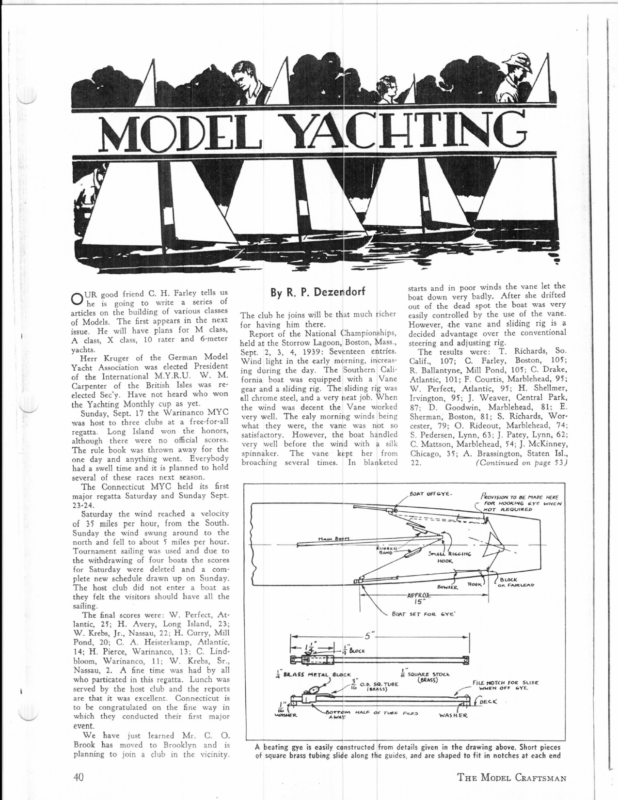
- The Beating Gye: The issue includes a technical guide and blueprints for a “Beating Gye” designed by T. Foster of the Long Island M.Y.C. The device uses square brass tubing and metal blocks to improve sail control.

7 ea ji v: MODEL YACLITING Sd 2 _ good friend C. H. Farley tells us is going to write a series of articles on the building of various classes of Models. The first appears in the next issue. He will have plans for M class, A class, X class, 10 rater and 6-meter yachts. Herr Kruger of the German Model Yacht Association was elected President of the International M.Y.R.U. W. M. Carpenter of the British Isles was reelected Sec’y. Have not heard who won the Yachting Monthly cup as yet. Sunday, Sept. 17 the Warinanco MYC was host to three clubs at a free-for-all regatta. Long Island won the honors, there although were no scores. official The rule book was thrown away for the one day and anything went. Everybody had a swell time and it is planned to hold several of these races next season. The Connecticut MYC held its ¥ =< starts and in poor winds the vane let the boat down very badly. After she drifted By R. P. Dezendorf out of the dead spot the boat was very easily controlled by the use of the vane. However, the vane and sliding rig is a decided advantage over the conventional The club he joins will be that much richer for having him there. Report of the National Championships, held at the Storrow Lagoon, Boston, Mass., 3, Sept. 2, steering and adjusting rig. 1939: Seventeen entries. 4, what satisfactory. very well were, the vane was not However, the boat before spinnaker. The broaching several the wind vane kept times. In a her from blanketed Chicago, 22. BOAT OFF GYE- ~ Saturday the wind reached a velocity Mau Boe north and fell to about 5 miles per hour. Tournament sailing was used and due to the withdrawing of four boats the scores for Saturday were deleted and a com- ae | Sano — z Kueéeer~ The final scores were: W. Perfect, Atlantic, 25; H. Avery, Long Island, 23; W. Krebs, Jr., Nassau, 22; H. Curry, Mill Pond, 20; C. A. Heisterkamp, Atlantic, Ie —- ee i = Connecticut is _—— Bowsie. 9| Hoow Brock OR FAIRLEAD APPROK- IS GYe 5° ~~ “ =f ----TT | ' a BRASS METAL, BLOCK SQ. TUBE ys 0.0.~"(eKass) a 1G reports to be congratulated on the fine way in which they conducted their first major i HERE WHEN > : —_ BoaT SET FoR |~e 6YE ~~] aA? Smatl RIGcinG HOOK \ sailing. HOOKING TM~- = IN _ t The host club did not enter a boat as they felt the visitors should have all the are that it was excellent. ae FOR NOT REQUIRED y >= So plete new schedule drawn up on Sunday. Lunch was ROVISION TO BE MADE =e “pos =a6 Sunday the wind swung around to the 14; H. Pierce, Warinanco, 13; C. Lindbloom, Warinanco, 11; W. Krebs, Sr., Nassau, 2. A fine time was had by all R 7 of 35 miles per hour, from the South. the 35; A. Brassington, Staten Isl., (Continued on page 53) first 23-24. served by the host club and So. 105; S. Pedersen, Lynn, 63; J. Patey, Lynn, 62; C. Mattson, Marblehead, 54; J. McKinney, silk major regatta Saturday and Sunday Sept. who particated in this regatta. Boston, Sherman, Boston, 81; S. Richards, Worcester, 79; O. Rideout, Marblehead, 74; so handled with Richards, R. Ballantyne, Mill Pond, 105; C. Drake, Atlantic, 101; F. Courtis, Marblehead, 95; W. Perfect, Atlantic, 95; H. Shellmer, Irvington, 95; J. Weaver, Central Park, 87: D. Goodwin, Marblehead, 81; E. sliding rig. The sliding rig was steel, and a very neat job. When was decent the Vane worked The ealy morning winds being they Farley, C. 107; Calif., ing during the day. The Southern California boat was equipped with a Vane gear and a all chrome the wind very well. T. results were: The Wind light in the early morning, increas- it Ne é WASHER. TOM Away. HALF BS SQUARE STOCK BRASS) 77 NOTCHOFFFORGYESLIDE FILEWHEN 4 . oP nee ikea ail f DECK WASHER event. We Brook have has planning 40 to just moved join a learned Mr. to Brooklyn club in the C. and O. is vicinity. A beating gye is easily constructed from details given in the drawing above. Short pieces of square brass tubing slide along the guides, and are shaped to fit in notches at each end Tse Mopert CraFrsMAN
size dimensions in order to reduce MODEL YACHTS the possibility of errors for those of us who 17/64” scale or some other scale besides 3”. (Continued from page 40) use A. W.. Rickenbach, Williamsport, Doesnt any model maker ever Pa. want some sort of freight locomotive to model? You have put a lot of passenger “locos” in the magazine the New York shire 2-8-4 prints are but let’s Central have one on 2-8-2 or a Berk- freight locomotive. The blue “perfect” and also let’s have some more rolling stock. 601-B Street, N.W., Ardmore, Oklahoma. about 3” scale plans for more Reading Camelback Locomotives? Edw. Brockway, W. Greely, Washington M.Y.C.; W. A. vice president, T. W. Houk, Seattle M.Y.C.:; secretary, C. W. Sweet, Marblehead M.Y.C.; treasurer, W. E. Topping, Detroit M.Y.C. Sunday, Sept. 17, an A Class regatta was held in Washington, D. C., as a part of the President’s Cup Regatta, which up until now has drawn only power boats. Edgar Sinder, How At the meeting of the Model Yacht Racing Association, Sept. 2nd, 1939, the following officers were elected: president, Wildwood, N. J. The wind light and favorable from the west, increasing to 10 miles per hour until it shifted to N. by W., fell to al- most nothing due to the trees around the lake. In spite of the reversable and shifting winds, a complete round was sailed, using a schedule for fifteen yachts, sailing three yachts to a heat, seven heats. Trophies were presented at the Corinthian Yacht Club, Washington, D. C. The following is the order of finish. J. J. Patrick, Non I, Washington, 51; T. E. Tate, Donna Too, Washington, 42; W. G. Bithell, Cornicopia, Boston, 40; O. B. Perkins, Cleo II, Baltimore, 39; A. W. Greely, Madam, Washington, 37; Thomas Moore, Dot, Washington, 36; J. J. Martin, Elwynne, Washington, 28; W. C. Schlaefer, Elwynne I, Washington, 28; A. J. Harwood, Rockaby, Baltimore, 23: I. Butler, Spray II, Baltimore, 20; 20; J. H. Coles, June, Baltimore, 15. Making a Beating Gye A new gye has been designed by our good friend, T. Foster of the Long Island He has given his permission to M.Y.C. (Continued on page 57) FIRST To build exclusively 4” scale equipment To design the most substantial and detailed passenger (From $7.00) car Kits available To supply super detail locomotive Kits (From $29.75) To design and stock the largest variety of individual locomotive parts on the market To design plug-in scale signals (Kits from $1.75) To supply catenary parts Models for television, Pullman car interiors, streamline locomotive, etc., built by us No new catalog yet. PRR S1 For supplement send self-addressed stamped envelope. 10th edition catalog complete 25c or see your dealer. AMERICAN MODEL RAILROAD COMPANY, INC. 30 AVON ROAD NEW ROCHELLE, N. Y. Twelve Years of Service to Model Railroaders Tacs CHRISTMAS… MEGOW MODEL KITS are ideal gifts. They have many construction advantages that en- able you to build models of outstanding beauty and performance… models with which you can go after those big CASH PRIZES Megow > will offer during the coming months. For pleasure and practical training nothing equals a Megow Model! See Megow Advertisement on Back Cover GAS POWERED MODEL Tell Them You Want a 7/7°” model! When writing to advertisers please mention Mone, Crarrsman for November, 1939 Vsqss (By mail, 20c postage) Send 5c for New Catalog of Model Airplanes, Ships and HO-Gauge Railroads 53
Above this there was a feeling that an electric driven steam type was a MODEL YACHTS (Continued from page 53) publish the plans. This gye has been in use during the past season and found to be very successful. make and install. It is very easy to The bill of materials is as follows, all brass: Two pieces }” square rod 5” long, two pieces 3/16” O. D. square tubing 1” long, two 3” metal blocks, several thick washers, two pieces 1/16” 1/16” wire 4” long, two 3” catalin round bowsers, two sheet two hooks, two small pieces sheet line rigging 24” long, hooks, two fair- leads. First take the square rod and file a notch about 3” from one end; this notch should be about 1/16” deep and tapering toward the other end as shown on the plan. Now cut another notch about 14” from the other end, tapering it the same way. Next take the two pieces of tube and cut the bottom out about 3”. File the sides down so you only leave the top for the 3”. Now bend the top at a slight angle about 3” back. This is to catch in the notches we filed in the rod. Bend the wire so it forms a “U” that will just fit across the tube. The blocks will fasten to the tube with this. Put the blocks on the wire and solder the wire on to the side of the tube so the block will swing free. If a 3” block is not available, a 4” block will do. Now put the tube on the rod and make sure it will slide freely. Solder the washers to the underside of the rod at each end. The underside will be the opposite to the one which we cut the notches. Drill the in finished gye with a No. 52 drill about ;” in from each end to take the screws to fasten to the deck. From the plan you see how the gye is fastened to the deck. This is made to work with a Braine Gear, but it has been successful on other types as well. will We gear are of experimenting the type that with was the used vane by S. Berge when he won the international A- class Championship, and found it is very successful in a run and beat. We are also experimenting with the type used on the Pacific Coast and will try to compare the two and give you the answer. be We have just heard the vane gear may purchased completely finished ready to install and that the gye shown in this article will be made by one of the model yacht supply houses. not disclosed. The prices were TINPLATE (Continued from page 33) size of equipment being lined up next to another. In those days model railroaders had such a able that variety of equipment almost any desired avail- type could be obtained. Of course there were some limitations. In the mid1920’s no one made an electric driven steam type locomotive except Ives (and Boucher for standard gauge). As a matter of fact no one missed them! At that time the vast majority of model railroaders preferred the electric types as many still do. cheat! This feeling was quite widespread, odd as it seems now. Quite logically however model railroaders said that a locomotive with an elec- tric type body should have an electric motor and a steam type body should house a working boiler and firebox. If that wasn’t possible a clockwork was permissible, but a steam type body with an electric mo- tor? It was bad taste they said. Look at the catalogs today! Remote control was another thing that aroused a great deal of comment when it first got its big push about 1925 and 1926. Today it is an accepted thing on even the cheapest trains. The early remote controls caused no end of trouble. Some makes reversed THE MARK OF DISTINCTION HO a foot or so before they would work. The units burnt out. The contacts burnt out or broke off. People couldn’t keep from sticking their fingers in to see what made them work! Many people said it was a novelty that would never take! For years the companies offered almost all of their locomotives both with and without remote control. Some locomotives didn’t even have hand reverses in S E E THESE PRODUCTS TODAY AT LEADING HOBBY back a dozen years ago. STORES, 12” SAMPLE TRACK KIT SPECIFY GAUGE SCOTCH PLAINS JERSEY MIDLIN MODELS NEW HEAR! — HEAR! Hear the new H&S Tenite Wheels! Hear the most realistic operation possible on a model railroad. They are tops in insulation for two-rail, and their quiet operation makes them tops for two or three rail. HO -O-0O0O ONLY TEN CENTS A PAIR Dealers: Don’t miss the opportunity of inyour sales with these guaranteed creasing chip-proof, Ives three. AF needed the locomo- tive to a short distance before the reverse could work. Dorfan’s polarized the motor and used direct current! No one ever did figure out how some of them worked! Most model railroaders cut out the seunits and break-proof wheels. H & § MODFL Dept. 7114 Julian Ave. does mind going back again, at least long enough to visit the Ives showroom once more and once more see the old models in the stores at Christmas. _When writing to advertisers please mention Mopet CRAFTSMAN for November, 1939 better $16.50. > Model | Moto-Tool Michigan work. home or time, shop… Grinds, !0-DAY Only $9.85 See Dre money-back Moto-Tools .. and Catalog 7 Racine, MI59-L, Dept. CO., MFG. trial. of too, equipment, combination offers DREMEL TRIAL. kits at Dealers or order direct on 10- day Wis. Model Railroaders! For the most complete line of HO – 00 Visit and O gauge cars and supplies. HOBBY LOBBY, Inc. 371 Main Street, opp. YMCA Hackensack, “WE HAVE THEM N. J. ALL!’ presents SHIPWAYS _ MODEL Vircinia Pilot Boat, BEE a of Norfolk, 1804, forerunner of the Baltimore clipper. 21” O.A., 19” het. 14” hull, glued up water and center lines, bandsawed. Complete kit, plans, materials, fittings, $5.95 postpaid. Plans & instructions 50c. trol your train would stop at the signal and then start up in reverse! If you used the signal you had to cut off the remote control unit! It was lots of fun! So was the whole hobby then. We CO. sharpens, drills, engraves, tool as used on precision jobs in factories. Speed 25,000 r.p.m. conserves cutters, does finer work. Has oil-less (oil sealed) bearingsy cooling fan, balanced armature, 110 v. AC-DC motor. 6 oz, Model 1 Moto-Tool, with chuck, %&” collet, cnly $9.85. Master Model 2, faster, heavier, more powerful, only You couldn’t use beth toIf you used the remote con- can look back now and criticize reverses and signals but we wouldn’t Detroit, Handiest tool in the win use daily, Saves operated their locomotives with a hand reverse. Lionel had their automatic train control out, then a couple of years later they brought out the sequence re- SUPPLY MCII 100° ONE Then we remember the trouble it caused. Every company had a different type. Lionel had two-position sequence, verse. gether. DEPARTMENT CIRCULAR Really satisfactory remote control reversing didn’t come along until about 1934. We look back now and remember we had something that was supposed to be a remote control away reverse AND OR WRITE DIRECT. those days! At least they didn’t keep reversing on every switch! quence OO (or worse, stalled) everytime they passed over a switch. Others required the locomotive to run run cAUGE Blueprints $1.00. 3c stamp for litera- ture. MODEL SHIPWAYS 499 Model DESIGNING . Broad Ave, Railroad – Leonia, J. Laboratories BUILDING INTRODUCTOKY N. – REPAIRING OFFERS 4″ Lionel Hudson Scale Model Locomotive, Insulated for 2-rail operation, | . READY TO RUN, $75.00 4 Glossy Prints, size 8×10, and authentic plans of the J. Bowker Locomotive—prototype in movie ‘‘Union Pacific’, %4” seale, All for $5.00 Let Us Know Your Wants BOX 123-A “WE K mw HOW” Ww JAMESTOWN, NEW YORK 37