
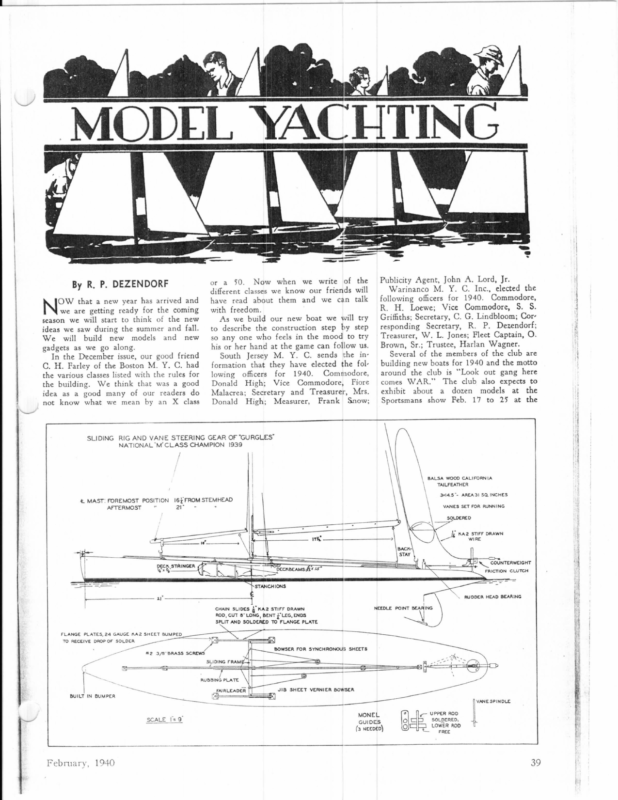
- Model Yachting. By R. P. Dezendorf.
- The Sliding Rig
- Materials: Stainless steel (KA2) preferred; brass or bronze as alternatives.
- Components:
- Main Sliding Rod: 32.5” long.
- Hardware: Chain slides, flanges, monel metal guides, and a rubbing plate to protect the deck.
- Functionality: The mast straddles the rod with a socket to prevent twisting; guides allow for sheet leading and back-stay hooks.Description of contents
- Why the Vane Steering Gear? By R. Thomkinson.
- Gurgles (1939 National M-Class Champion): Reference to its vane steering and sliding rig setup.
- The “California Feather”: A balsa wood vane designed for low friction; contrasted with the heavier Braine gear.
- Vane vs. Sheet-to-Tiller: Debate on efficiency; vanes excel in steady winds, while Braine gear remains popular in variable wind districts.

— By R. P. DEZENDORF OW that a new year has arrived and we are getting ready for the coming season we will start to think of the new ideas we saw during the summer and fall. We will build mew models and new Publicity Agent, John A. Lord, Jr. Warinanco M. Y. C. Inc., elected the following officers for 1940. Commodore, As we build our new boat we will try to describe the construction step by step so any one who feels in the mood to try his or her hand at the game can follow us. South Jersey M. Y. C. sends the information that they have elected the following officers for 1940. Commodore, Treasurer, W. L. Jones; Fleet Captain, O. Brown, Sr.; Trustee, Harlan Wagner. Several of the members of the club are building new boats for 1940 and the motto around the club is “Look out gang here R. H. Loewe; Vice Commodore, S. S. Griffiths; Secretary, C. G. Lindbloom; Corresponding Secretary, R. P. Dezendorf; with freedom. gadgets as we go along. In the December issue, our good friend C. H. Farley of the Boston M. Y. C. had the various classes listed with the rules for the building. We think that was a good idea as a good many of our readers do Commodore, Donald High; Vice Donald High; Measurer, comes WAR.” Fiore exhibit Malacrea; Secretary and Treasurer, Mrs. class not know what we mean by an X or a 50. Now when we write of the different classes we know our friends will have read about them and we can talk Frank about The club also expects to dozen a Sportsmans show Feb. Snow; at the models 17 to 25 at the SLIDING RIG AND VANE STEERING GEAR OF “GURGLES” NATIONAL ‘M’ CLASS CHAMPION 1939 / \ BALSA WOOD CALIFORNIA TAILFEATHER 3*14.5″- AREA3! SQ INCHES 16; FROM STEMHEAD & MAST: FOREMOST POSITION \ r-} \ AFTERMOST VANES SET FOR RUNNING \ \ SOLDERED ig SA2 STIFF DRAWN WIRE ‘ j [5 x COUNTERWEIGHT 7 ; FRICTION \ . CLUTCH RUDDER HEAD BEARING ! CHAIN SLIDES §”°KA2 STIFF DRAWN NEEDLE POINT Ve ROD, CUT 8” LONG, BENT }”LEG, ENDS SPLIT AND SOLDERED TO FLANGE PLATE FLANGE PLATES, 24 GAUGE KA2 SHEET BUMPED TO RECEIVE DROPOF SOLDER ; Se aaenadeae BUILT IN BUMPER ee ae =——_s SCALE February, 1940 4 SLIDING ee FRAM a _ Pa ; . Bee 4 Mi o-s-7 RUBBING PLATE FAIRLEADER Yi ie, 1=9 te BOWSER FOR SYNCHRONOUS SHEETS aT = a” oe SFX __} o JIB SHEET VERNIER BOWSER VANE SPINDLE MONEL GUIDES (3 NeeDeD) – UPPER ROD rOWER Re a e OD — LOWER FREE 39
Grand Central Palace, 46 St. and Lexing: ton Ave., New York City. If any of our readers are around glad to greet them. Long Island we will BUILDING SPECIFICATIONS FOR SLIDING RIG. Use stainless steel if procurable. Brass or bronze rod or tube may be used. If tube is used -3; or Y% diam. necessary. Stainless KA2 Steel rod better, Vg diameter; about 8 feet required. only be too has elected the following officers for 1940: Commodore, H. Avery; MAIN SLIDING ROD-—1 piece, 32.5” long. Vice Commodore, F. Bennett; Rear Commodore, D. Harriman; Secretary, Tex CHAIN SLIDES SS ee Foster; Treasurer, G. W. Bett; Measurer, A. Seaman. Several of the members new models this are AFTER HORSE—1 piece, 7.0” travel (usual allowance for bending). building FLANGES (4) —24 gauge KA2 sheet, bumped and soldered, for chain-slides. winter, using both the FLANGES (4)—Same as last item, for (2) horses. X class and the 50-800 design. They are sure hard to beat at building and sailing. GUIDES (3)—Use monel metal, as this can be drilled. ay x Va x re”. RUBBING PLATE (1)—5” x 4”, 24 gauge S.S. Protects deck from pin Red Bank elected the following officers for 1940. Commodore, I. Maxson; vice – Commodore, R. Hill; Secretary, F. $. Anderson; Measurer, L. Beaton. under butt of mast. CROSS-PIECE and CHAIN PLATES—Cross-piece flat or channel.. Chainplates angle. porcelain fair-leads or eyes if former not available. The mast straddles sliding rod and should have socket to keep it from mov- Deeper Hudson elected the following officers for 1940: Commodore, C. Heisler, Sr.; Vice Commodore, H. Allen; Rear Commodore, Paul Heisler; Treasurer, C. ing out of position, or twisting around. The GUIDES have easy fit, bottom hole, for sliding. The large upper hole for sliding rod, to be soldered to rod, perhaps threaded. The small hole at top for leading main-sheet through or for jib and back-stay hooks. Heisler, Sr.; Secretary, W. J. Spears; CorP. Heisler; Fleet Captain, F. R. Gould: Measurer, H. Allen; Steward, F. R. Gould: Race committee chairman, H. W. S. Bowen. The club has established a library in quadrant, to much friction and moving parts. The California feather is balanced charge of Herb Bowen which contains the foremost books on Model Yachting. These so practically no friction exists.” We wrote books are loaned to members at 10 cents fornia per week. There is also quite of blue prints which a number are loaned to the members without charge. There are six new at present. 50-800s being built There are 5 X class boats in commission with several more being built. The club champion in the 50 class is Vic Hammer. The club is still trying to get pond sailing in Renssalaer and complish their aim. we hope they ac- The pond if we remember correctly that the Cali- Lassel and Tomkinson. will the country and also some of the foreign Received Houk The X and 6 Meter classes have been books either pond adopted by the M. Y. R. A. A. and the Eastern Division of of the M. Y. R. A. A. altho no National championship will be held in 1940., in the National Ass’n. The Eastern Division will hold a Division championship in both classes if suitable dates can be arranged. The X class is going big in Beantown (Boston) and as six at least new four X’s already are assured, started. Indi- cations are that a half dozen other skippers are practically Seven two 50s A are Class certain under models Quite a few Boston to the sport Vane trials. to follow suit. construction are on the and board. skippers are going gear in the spring Several new members have been recently elected and it looks like a banner America. countries. skiff for of dent ing of a letter from the Vice the in a M. Presi- Y. R. A. A. T. W. which he tells us he is prepar- bibliographical and catalogue publications that of deal the with Model Yachting. COMING EVENTS Feb. 17-25. Annual exhibit, Sports- mans Show, Grand Central Palace, 46 St. and Lexington Ave., New York City. Notify Mr. Tex exhibit a boat. Foster if Address, you care to 113-13 Atlantic Ave., Richmond Hill, Long Island, N. Y. Feb. vision, 24. Annual Meeting, Eastern Di- Hotel New York per City. person, reservations Foster, Hill, Taft, St. Dinner 7 meeting 9 P. and 7 Ave.. P. M. M. $1.75 Send all for the dinner to either Tex 113-13 Long 50 Atlantic Ave., Island, N. Y. or Richmond to R. P. Dezendorf, 808 Chancellor St., Elizabeth, year. act freer if the bearing was at the top instead of at the bottom. It ought to work with the Braine, altho I have my doubts of efficiency of the feather when coupled to the heavy Braine 40 THE SKIPPERS CLUB Charles H. Farley The ing subject gear and of the use sliding rig of is of vane steer- particular and will settled, necessarily out a sea-anchor while for the final results, if any. waiting Several outstanding regattas have been won—and vane others gear. So lost—by far, the use of Braine the steering by the gear and other gears actuated sheet-to-tiller system, have not been gated to oblivion, especially in rele- districts when the wind is usually variable in direction. Where steady winds can be expected the Vane has shown a decided superiority. It remains to be seen if some mental giant among our brain-fagged and gadget-ridden skippers “doohicey” to can another offset comings of the vane in The tages, sliding rig considered fair by others. irked may gardless is some, Synchronous be of a to type still short- any used. un- have the step of advanand sheets and decided adapted the the certain by very few skippers, arrangement and offers fair invent merry-go-round winds. latter forward, yacht, steering regear The present article including plans of the C. H. Farley writes, “Your vane would pivot better and been entirely thrown Association has This controversy be Yacht Racing it never remain, a matter of personal opinion. Meanwhile a third large group of skippers have These books are sent gratis to all clubs in as probably C. H. Farley has been appointed editor of the 1940 Year Book of the Model or situated Both sides are ably represented in this issue of MopeL CraFTSMAN by Messrs. up to the time of going to press but we very sailing. vane seemed to be a better gear and timely interest to model yachtmen. A lively controversy is raging currently between the enthusiasts and the dissenters. will have to wait until the spring trials to prove the efficiency of both types. is well Use pulleys or FAIRLEADS on cross-piece, about 3.25 apart, for jib-sheet. in the past. Secretary, Solder cross-piece to main sliding rod, rod on top. Cross-piece and chain-plates 24 ga. KA2, ¥8” wide. Chain-plates soldered and/or riveted to cross-piece. MAST-BUTT PIN or POST, under butt of mast, to support cross-piece. Vg” KA2 or Monel. We understand the Red Bank Club is building new skiffs and models for the coming season. They expect to do more skiff sailing in the future than they have responding 1/2 inch Allow (2)—-2 pieces, each bent to 7.12” travel. extra at each end for bending at right angle: solder to flange plate. FORWARD HORSE— | piece, 4.5” travel (usual allowance for bending). sliding vane gear rig, synchronous combined. A sheets more and detailed drawing of the vane will appear in an early issue. Watch the SKIPPERS CLUB for the latest developments and discussion of the fast-moving sport of model yacht- ing. Tue Moper. CrarrsMAN
so as to cancel out the need o! SLIDING RIG AND VANE angles of the rudde: STEERING This yacht under sail. of One accepts as axiom build into a yacht, but that this desidera- design. Instead of being encouraged, the profligacy of wetted surface must be of effort to meet each variation, includ: The rules of the racing classes recog: claim that no such balance is possible to tum is achieved by changing the center sitate lee helm in light wind, in order to cancel out some steering effort in strong wind. Smaller yachts have their instead ‘obviate the need of lee helm and the attendant reaction to leeward—the drift. But there is a penalty involved in this compromise; the rudder drag, which becomes a rudder brake on a reach in winds. the rele- Mike” of a material help in ability the with maintain to windjammers are steered. Labeled “gadget,” by way of deprecation, the SLIDING RIG is asking for effecting recognition and a general the M-Class, status or as either in an ideal was intended to save ing from steering vane. effort slight acceptance in its independent adjunct to the Originally, the sliding rig on models, unbalance: repair bills extremely in its result- center of sensitive to of changes hurried later develop- close to the wind in a ment, it is a device whereby the whole to prevent lufing, but how many of us ‘“Handly-PageTM effect of the jib, the backstay, the spinnaker and its set are moved the model sail When the mind in“drifting match.” creases, a weather helm must be applied sail plan, the set of the sheets, think straight enough to do it? The textbooks give no morel support to that as a unit, expeditiously, and not as a chore. The vane gear made this develop- in can be ; a decided n if some SIGNAL YOUR MODEL RAILROAD… … According to RAILROAD STANDARDS —WITH— “STAPLES” 14’’ SCALE SIGNALS Be sure that your signals are designed and Jo cated according to railroad standards. Consult Staples, who is acting as consultant for the largest signal companies in the design and manufacture of control equipment York World’s Fair Model advan- n and un- the latter forward, yacht, ang regear plans of reets and de | mar 3: i aS CLUB discussion del yacht- the (Continued on page 42) pursuit. districts triable an equipollent flutter in the luff of the mizen-royal, on the wind, the way the belongs as far aft as is necessary to make moment compared to the drag set up, the best way is to place the center of effort iave been of the by chance be accorded to do its best. It combines the cleverness of the “Iron rational lee helm), is used, the sail plan rudder well aft, giving the rudder more yeen of the control, and only asks that its limitations be understood and that a fair the one closest meeting the requirement When of the lightest wind expected. Braine gear (which does not admit of All braking action detracts from the speed, and brings to naught the clever: ness of the design and smoothness of the Although some saving may be hull. brought about by placing the skeg and steering helmsman, more efficient than any other steering gear, assumes full responsibility desirable balance; therefore, under this restriction, the mast must be stepped in the position adjudged by the skipper to be the best compromise, which should be center of effort far enough aft so as to waiting which the efficient vane gear has entered. This gear, more duty-bound than a human of movement, one inch, permitted in the Six-Metre, Ten-Rater, and A-classes might as well be catalogued as a wishful hope On large prototype yachts the cente1 of effort is placed forward so as to neces: pers have sail may be studied, taken apart, and a philosophy constructed of the findings. The rules have left open a défile, through nize, indirectly, the insufficiency of a fixed mast position. But the small scope against the bow. strong is still the class where the aero- and hypro- dynamic forces acting on a yacht under curbed. ing that caused by the lap of the waves It has been consecrated as a class inviolate of “barbwire entanglements” that one’s pet psychoses might erect around it; it than ever, must be considered in the the other, the New Era, advances the restrictions. of Jong list inherited a con: unheretofore improved _ tractability, realized, model yachting has arrived at an adult stage, when wetted surface, more regardless of the course steered and the variation in wind strength, while 1 in this y Messrs. giving add to the wetted surface. With the advent of the vane steering gear and the a ie a balanced yacht will remain in that state, made, in the skeg. But centerboards, unless streamlined, set up turbulence and, also, There are two philosophies extant in dynamic balance is of a prototype and has fot miniatu sider ation to the claim tha { changes in the lateral plane would be just as effec: tive by having an adjust able centerboard By A. R. LASSEL, Secretary, Pacific Division, MYRAA regard to the statement hand, the M-Class 1s not On the other extreme for the New Railroad. Staples will buildsignals and control equip ment to suit your layout and operatingplans, such as the CV-21 high and CD-2 dwarf sionals on the switch section shown at the right. Over 125 types of Staples 14” scale O-gauge signals are available, incorporating 7 plug-in feature, originated and first manufactured by Send 10c for latest ages, Staples. CRAWFORD E. STAPLES P. 0. BOX 8315 ACCURATE % SCALE MODEL SIGNALS | e SWISSVALE, PA. a FTSMAN When writing to advertisers please mention Move. CrartsmMANn for February, 1940
round eRe versatility concept, practice, winds, the the especially the virtues discernable to side, the amount depending on the shape the of the mating is in merry-go- are obscured, the of the jib and other variables. In order to win to windward, the skipper has to concentrate on the study of the behavior slid- of his yacht as a result of variation of the funnel effect between the jib and main-sail, and determine the optimum set; conscientious a direct imitation of another boat is not always profitable. If the model “takes investigator. sal When the sliding rig is not used, the off’ when a flaw hits, the set is good; if et een vane, as the wind increases, must be able to overcome increasing ardency she heels over without much acceleration, (inten the set is a decided flop. sity), which involves setting the vane at shaving” off the wind that it is thrilling indeed to witness. have a calibration gauge, on which the predetermined setting of the vane has been registered to correspond to a certain wind-strength and to which the vane is referred for correction. Since the angle of correction easily amounts to as much as 11 degrees, the resulting rudder drag can be appreciated. Add to this the vane drag, resulting from a wide-angle set, and the wind on the lee side of the feather. If the sail plan had been slid ahead to a position of re-balance, these resistances would not have been set up. However, if the center of effort is kept ahead of the optimum (best possible) position, lee helm must be applied, and in increasing amount as the wind dies down. The pen- alty, possibly negligible, drawn for using this method, lies in the increased drift or side-slip; but the benefit is in the modicum (small amount) of driving force derived from the wind on the weather side of the vane. When lee helm must be used on a boat, the steering effort of the vane must be conserved jealously by friction – less needle-point bearings and by balancing the rotating elements. wisdom to weigh down the It is helm, also what- ever the rake of the rudder-stock may be, so that its buoyancy is nearly zero, with no turning moment. This can be done with a weight on the tiller of a wooden rudder if the tiller is leading aft; with a metal rudder, on a In the “Sunkist double-rove out-board with the fair- from the mast. Since the running part of the sheet s are affixed to one common bowser, one adjustment of that bowser moves both sail in equally angular jib and distances, mainexcept that the movement of the jib is slightly slower. A vernier, shoul d also, be on the standing part of either of the sheets so as to allow a correction for the variable stretch of the sheets and also an adjustment of the relation of the set of the jib and reeving —— main-sail the sheets, to one when another. the rigging In is put on, the main-sheet is belaye d so that when the boom is amidships, the jib club TST is free to move at least one inch to each 42 heads up too much, the center of effort is too far aft for that particular wind blowing; if she “wanders off,” it is too far forward. When near-perfection has been found, check her for lop-sidedness on the other tack, then attach the vane and proceed to adjust the stops on the vane-disc so that, when the latch is against the stop on the inboard side, she does equally well, or better, on each leg. From now on, the stops are left in these positions and variations in wind strength are compensated for by movements of the sliding rig. If the wind goes down, the rig goes aft, and viceversa, but seemingly, on a curve that requires most of the sliding in light airs. Drill regulations are now in order. The counter-weight on the vane affords a convenient handle for changing the set, so, therefore, when she comes ashore on a beat, head her up with one hand and bring the stern around with the other, pulling from the “handle,” at the same time bringing the latch up against the must be Opposite leader on the jib club half that distance from the tack swivel plus half an inch. The fairleaders for the jib-sh eet on the sliding frame are placed, say, two inches more the tiller ‘and back over the spindle again. This centers the rudder. Set the sheets for a beat, which means one to one-and-ahalf inch slack on the bowser. If she definitely set against the stop and the sheets set definitely for close-hauled sail- 18 inches from the gooseneck swivel: the Or pond, remove the vane, slip a rubber band over the vane-spindle, run it through System” of sailing a chronous sheets.” In this set-up , the main sheet is single-rove, with the fairleader is When the “New Era” is ready for the tiller leading forward. model, there also enters the use of “syn- jibssheet It is possible when using the vane, to take such a “thin a wider angle. To be able to do this with any degree of certainty, the skipper must ing. stop. On a The close latch reach, the latch is set on top of the stop and the sheets eased, say, half an inch. If she hits the lee shore, the vane was set at too wide an angle from the centerline and it must be narrowed, the so the counterweight skipper or toward mate him. pulls Per- haps it is necessary to haul in the sheets also. If she comes in on the weather shore, the angle was not’ wide enough, and the skipper or mate pulls the handle toward him. When the windward board involves tacking, the posit ion of the vane feather, for the return trip, is near the centerline, forward, the actual position depending on the efficiency of the helm and the scheduled ardency jibe expected. takes place, If an un- she is not likely to jibe back with the vane on the centerline. It is of advantage to preve nt this performance strap of eccentrically the sliding by having the kicking hooked frame, to have the boom or to the by lee side arranging hit the vane feather, and thus transmit to the rudder the necessary effort to put her back on the course. If the “New Era’ comes ashore on a run or a broad reach, the precept for both the skipper and the mate is; “‘push the handle away from you.” One compass point, 11 degrees, is generally ample. If the finish line can be fetched by lying close on one tack, the return trip is made oppo- diametrically set the vane with site, plus the angular correction for side slipping and ardency. If the windward board is a close reach, the return ts made with the vane set at about seven points from the centerline, on opposite side. If there is time to think while racing, the general rule for operating the vane is to move the feather aft to make the boat bear up, and forward, to make her pay off. As the sheets are let out for a reach or a run, the center of effort moves ahead with the sails. The off-center application of the propellant force, now, and the reaction of the principal retarding agent, the bow wave, more than cancel out this unbalance in ordinary winds, but, in a lull, the vane might be called upon to apply lee helm which may not be effective enough, so the rig would be moved aft to re-establish the balance when light winds are encountered. If the boat lacks reserve buoyancy forward, the rig had better be aft, while running, so as to prevent pitch diving. Since the vane operates in the zone of interference of the main-sail, which, of course, varies with the set of the sheets, and varies for different boats, it is futile to say where the stops on the vane disc should be. In a recent check-up on twelve angle, boats, as it was measured found from the that the centerline, varied from 22 to 38 degrees average for the two stops, and both of the extremists showed good windward quality. In view of the fact that both these boats were of the same class and general design, the interference of the main-sail could not have varied that much. Most likely, the first one sailed with the center of effort ahead of the optimum position, using weather helm to windward, while the other had the elements reversed. Sam Berge, who has twice wrested the crown the gear of model British, is yacht once used on said an supremacy that from when A-Class vane boat, the sail plan had better be placed two inches aft of the position adjudged the best when Braine gear equipment is used. Whether the aft movement amount s to two or four inches is immaterial, the only requisite is that the model acceptable yacht be able to lie close to the wind, whether slatting the sails in a calm or buried in the spindrift in a gale. The ratio of the vane-arm to the disbetween the rotating elements of the gear may be varied considerably . A higher ratio than 50% would involv e a tance large tail feather and relatively small rudder, while less than 20% would be suitable for a very large rudder. Paul Collett, the 1939 National A class cham- THE Mopet CRAFTSMAN LL in pure return, em ideal; yet enhanced In in ee rig vane. and, Aero we ing possible, Te (Continued from page 41) ment a! $
is that, upon applicauion o heat, the flux copper-plates the steel, making the adhesion of solder possible. It may be pion, used less than 20% and did not broach. Irving Richard, the M class 1939 National champion, used a 49% ratio. In a recent gale that swept Southern necessary to apply the flux twice. California, two M yachts, with append- ages designed to resist broaching tendency, sailed broad reaches flawlessly, a sight not easily forgotten. One of them had a tailfeather area of 36 sq. inches, linkage ratio of 42% and a rudder measuring In conclusion, it may be advanced that the “New Era,” the “Sunkist System,” the “American Development,” call it what you may, rests on a sound scien- tific basis. We are now ready to relegate well aft. some of the old familiar “stymies” of model yachting into oblivion, tackle hulldesign anew and pore over the new de- stiff-drawn KA2, stainless steel wire and work to be done on the vane also. The eight square inches in area, and placed In making the vane and the sliding rig, rod is to be preferred. There is on the market a KA2 grade into which machining quality has been allowed at a sacrifice of stiffness, which makes it less suitable for the chain slides and vane-spindle, but it is still preferable to brass. Stain- less steel sheet is generally used annealed and, in this state, is bent and bumped without failure, lending itself well for making the component parts. In specifying the thickness, 24 gauge is more of a suggestion than a demand. A jig for linations of the appendage. most pressing demands are; a “quick-flip” attachment, whereby a mere touch of the turning pole sets tack: a built-in, bration system for which would, in for the sliding rig vane rotor. Hardware dealers sell a soldering fluid which is on the acid side~ and have copper, or a substitute, in solution. This makes soldering of stainless steel feasible. If the model craftsman wishes to prepare his own, he may take zinc chloride, add one eighth hydrochloric acid and 5% cuprous chloride. The about requirement the vane for the new quickly operated calivarying wind strengths a measure, substitute on classes that rule the sliding rig out: and a satisfactory wind- operated control of the scope of self- tacking. There has been considerable controversy regarding the Vane Steering Gear wherever its use in model yachting has the opinion In utilized. of the writer, the Vane Gear is the great leveller in model yacht sailing, especially when It corrects poor per- used to windward. hull design and skill in sail- skill centered entirely in setting a me- chanical device which automatically controls the yacht’s course. I have studied the action of a model equipped with the Vane gear sailing to windward, against one not so equipped, and note that the vane-equipped model will keep on a finer and closer edge to the wind than the well-balanced model not so equipped. The latter will come up into the wind and luff, when a slight variation occurs in the wind’s direction, while the Vane gear automatically causes the other yacht to bear off with full sails. In the recent A-Class and M-Class National Championships the champions were often out-footed by the also-rans, but won because, being equipped with Vanes, they pointed higher, and when encountering slight changes in wind direc Vanes, luffed before filling. By RICHARD TOMKINSON been of tion, followed these changes without a tremor, while the alsorans, without WHY THE VANE STEERING GEAR? every bending and soldering operation is recommended, but only one may be classified as essential, namely, the one used for centering the bottom bearing for the There is ance setting a minor consideration. In other words, it transfers that kind of skill in both designing and sailing which has been the real interest in model sailing, to a formance due to faulty design in a hull, Some may think that if the Vane Gear offers such advantages, why not have everyone adopt it. In that event, let’s put small gas-meters in the boats, because that will get us to the finish line in a still shorter space of time. It might be suggested that golfers use an air-gun which would propel the ball further and more accurately than could possibly be done with the conventional clubs. and by its mechanical action makes bal- (Continued on page 44) The “Berkshire” is a modern, heavy-duty freight locomotive powered by a No. 117-3 K&D _ motor with all drivers sprung. You would expect to pay as high as $300 for this precision built model. Lobaugh’s duction amazing quantity permits low “Berkshire,” and ready $175 . prothis price. The run only assembled to =. eS. Pt 2 ¥ .’ < ru is 7 $10 Starts You Building This Lobaugh Locomotive! Now! Use the New, Easy, PAY-AS-YOU-BUILD PLAN and Own a Hog for every job! longer. You don’t have to be a one-engine man any Now you can own a new hog every year or so! $10 starts you building. $5 payments... as you want to make them... keeps us feeding you parts in the order that you need them! This plan applies to all Lobaugh locomotives. OBAUG sternite Va READ ALL ABOUT IT IN THE NEW 1940 CATALOG 64 Pages! 110 Photographs! Send for Your Copy Today! Only 25c 1177 THE LOBAUGH INSTITUTE OF MODEL RAILROADING HOWARD STREET SAN FRANCISCO, CALIF. When writing to advertisers please mention MopeL CraFTSMAN for February, 1940 43
BUILD THIS CHAMPION RACING : CAR! am afraid because, after sport lies anced hulls, but in MERCURY MIDGET A new model that is fast becoming the most popular racing car in America. Rear in (less enclosed housing. flywheel) Vane and kills it Kit $23.50 the Postpaid ties. X hoped Front Drive Syncro Mercury “‘Rocket’’ USyncro Midget—postpaid Synero NOTE: Remit Send and by 5c price terhead for list. 19.00 sailing them vices Ace or stamps Dealers discount and Special Postal in 19.50 13.75 (coil { condenser) der, 15.00 18.00 1.00 . Drive—postpaid Ace (coil and xpress for write on as which Or- great catalog company information, and robot, called these thing y si essentials, that has this that the evils and devices it such sin- as the as is free possible, from and mechanical not $9.85. let- have and been responsible . growing popularity s nly pos " Ave, Detroit, power anced, ...... $12.00 ..,.. 16.50 DeLuxe ...... 19.50 Standard city. strument and set LU C.C., HorseAswheel bal14 oz. capa- ...,, $15.00 18.00 21.00 Sold by your Dealer Manufactured by Herkimer Tool & Model Works Herkimer, N. Y, The New H.C.S. Track King Fully end gears, end. Assembled; and 2 radiator to 1 Steel shell ratio; Completely Frame; and Bronze Assembled tail CAR Cast piece; bushings; Aluminum front Hardened steel Coil spring rear 22.50 Hawkins & Cundiff, 3728 Lime St., Riverside, Cal. See the Hobby Craft Booth at the N. Y. Society of Model Engineer’s Show — GUILDER POUGHKEEPSIE, the inside circle, N, and, approximate At the spot on you have marked all eee ganel Le Complete Y. to thoroughly tamp and pack this dirt before pouring the concrete When writing to advertisers please trov semi-re rem¢ earth aga ground le of the c It is ne sion joint Catalog Car Folder. be taken line crack In a trac will prol of these M3 Brooklyn, N. Y. a Nothing thrilling of a } 50 CC is so as a Racing gas engine. Engine. fascinating, so working model Wall Gas En- gines are easy to build, interesting to run. With our castings and detailed drawings you g};can easily make a Gas Engine ;on your own lathe. Engines | are suitable for model “model power boats or aircraft, for stationary purposes. We supply all parts and furnish detailed full-size drawings. Send 1Nc for interesting literature. Elmer A. Wall, 5900 N Fairfield Ave., Dept. M., Chicago. J°C PASSENGER KITS IN O GAUGE AND OO GAUGE Send 10c in stamps for NEW 1940 CATALOG J*C MODELS, 385 ARGYLE RD., BROOKLYN, N. Y. BUILD MODEL CABIN New “De CRUISERS ‘hat operate with power. Complete Kits, Rear wheel plete, prefal ished, ready run in oil i housing. K and motor) drawings, fittings, Cabin Cruisers, Sub- marines, Liners, Lengths of 18 to 60 Sail or Fight with Radio inches; tric or motors, Send Dime Control. elec- gasoline Race, for fur- ther information. SYKES MOTORS COY., Lakewood, Ohio Next, grade out the earth between the two circles level with the bottom of the 1” x 3”. This gives you the exact depth and width for the concrete to be poured. It would be well a can H.O. Charlen . }| Build ~ the stakes in both circles, take several 1” x 3” that have straight edges and bend them around and nail to every stake at the mark on the stake. You may have to dig out between each for DEPT. scribe a mark at the spot where the bottom of the pole intersects the stake. After 10c Descriptive the pole that can be seen through the cross hairs in the instrument, place a mark. Now take your pole and move it to each stake. Holding it against the stake, sight through the instrument wo just the surfai set and | 519- 8th Avenue average level of the ground, drive a nail into the stake 3” above the surface of the earth. Set a 6’ pole on this nail, and have someone sight through the in- strument. a NEW 1940 PRICES CHARLEN'SCALE MODELS a Flywheel Special 8 Flyv General Bat cars and b Aluminum metal height. stringers shafts. Due C. 44 use sure that and At on which will be the forms for the track ~~Sander, sanding planer, Ideally suited for mode! railroad machining operations. New Illustrated Catalogue 10c. PARK at the ceme leaving a CHARLEN H. 0. KITS Send the and which are absolutely level. % lathe with hollow spindle and milling equipment. ecially designed attachments evsily convert it into a yood lathe, 3” circular saw, jig saw, drill press, dise KINGWOOD on the postpaid = for SPECIAL PURCHASE PLAN outside concrete f best type using a | hard, sme have established two complete circles Guilder Model Builder 2 it up concrete projects. Sent only $1. flush with the marks on the stakes. By measuring in this manner, you BA Miniature Precision Machine Tool for Metal, Wood and Plastics.’’ This machine is primarily a metal turn- C. 150-B, stake to allow the 1” x 3” to fit down 152 West 42nd Street February 9th to 25th WALTER 41 plasti¢ Sold Under until you see the mark on the pole is visible in the cross hairs, then in- Dept. RACING spot stake Standard DeLuxe ..... Dept. 24-paxe book — shows how to make Unconditionally Guaranteed farther circle about 10’ from it. a Raceway Special Raceway Raceway een Big 35¢—55c—75c Then take a contractors’ telescope leveling instrument or surveying in- 1/5 plus, gas tank PROJECT at AS LOW AS (Continued from page 6; air, raceway and marine contests. Let an “O.K.” motor be your choice to power that plane, race car or boat you are building during the winter nonths. Models Wis. onls would be steel RACE CAR TRACK “O.K.”” motors are easy to start, are consistent performers and consistent winners in Aircraft genuine TOOLS order direct from factory on 10trial. Catalog of Co., 27,000 (BOX AND REFER) START EASILY RUN CONSISTENTLY Special Mfg. 8, powerful, better Dealers or money-back Dremel Racine, Michigan “O. K.” MOTORS Displacement work. To rein lay chicke tween the small rocl reinforce would hel track. It gravel, so —- Wyoming encost. finer MODEL more Dremel tools, equipment and special combination offers, FREE 3 Om the this of cuts TRIAT. the TO 7 sailing king of sports, does DREMEL - MO - Model $16.50 DALLAIRE MODEL AIRCRAFT CO. 9830 See Master day heavier, 10-DAY snis ela the for drills, time, cutters, MASTER r.p.m., $16.50, de- nullify sharpens, Saves Has oil-less (oil-sealed) bearings. cooling fan. balanced armature. 110 V. (AC-DC). MODEL 1 MOTOTOOL with chuck, %” collet, only re- is polishes, etc. conserves made National authori- article, Grinds, graves, Ilandiest tool in home or shop. . . use it daily. Same tool as used on precision jobs in factories, OVER 25,000 R.P.M. High speed art of elements of skill in designing and Money complete very in ............... .. Front MOTORS: (condenser) correctly, 100 TOOLS in ONE Vane Gear and sliding rig will be prohibited on all other racing classes as well. Let’s keep our yachts and the art of $17.85 .. nullifies Class must have sensed cerely oe csswauiarcnic MRRcene eS 5 bal- The sponsors of the new and popular Dennymite Airstream. With coil, condenser, flywheel and exhaust stack—post- crests the designing them ruled out by the to Raceway ‘“Special’’—postpaid Raceway ‘‘Standard’’—postpaid Raceway ‘‘DeLuxe’’—postpaid ..... aefuine MOT0-T00L is. ferred DOM of of This mechanical Gear, HEADQUARTERS OK. O.K, O.K. skill essence yachting the fascinating sport that cently HERE ARE OTHER SPECIALS FROM RACING CAR the the Radio-control and tacking-gyes actuated by mechanical timing devices were re wheel drive—all metal body complete, prefabricated, machined, polished, ready to assemble. Drive gears run in oil 43) regulated not least, perfecting the the model all, building sail-setting. — page unless or made illegal, the Vane Gear will injure the sport of model yachting considerably, last, THE DELUXE from that ~ saa. (Continued I mention est steamer attaching Ideal to of ODEL slight the hull Completely for for rust, 37” display while Mississippi Jong, finished deck, they P. PRODUCTS, 1678 P, 534” wide, hull and or last with holes motor for 6” over- portholes, propeller driven $2.00, 1 East. models. -25 President St., Brooklyn, N.Y. Move. CRAFTSMAN for February, 1940 M’hen Ww