- First X-Class National Race Held at Berkely. By F. Rankin.
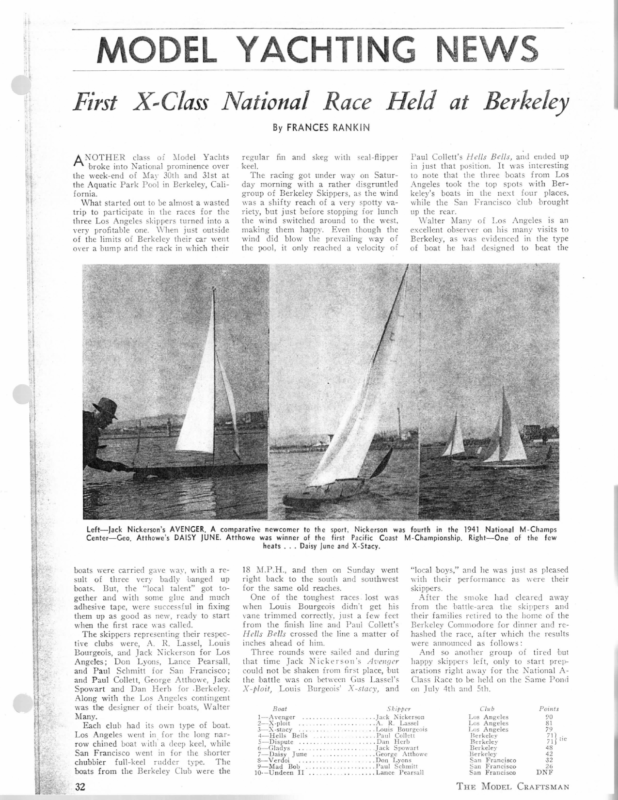
- The first National X-Class Race was held at the Aquatic Park Pool in Berkeley, California, on May 30–31, 1942. Despite their boats being damaged in transit, Los Angeles skippers dominated the event.
- More About Finless Fin Keel. By T. W. Houk.
- The finless fin keel is taking the limelight in Model Yachting circles this month. It started when the Executive Committee of the M.Y.R.A.A. turned down a proposal calculated to bar said keel. The proposal read, “A metal fin keel is defined as any member constructed of metal that supports the ballast of the yacht”

MODEL YACHTING NEWS First X-Class National Race Held at Berkeley By FRANCES RANKIN NOTHER class of Model Yachts broke into National prominence over the week-end of May 30th and 31st at the Aquatic Park Pool in Berkeley, Cali- regular fin and skeg with What started out to be almost a wasted trip to participate in the races for the The racing got under way on Saturday morning with a rather disgruntled group of Berkeley Skippers, as the wind was a shifty reach of a very spotty variety, but just before stopping for lunch three Los Angeles skippers turned into a the wind very profitable one. When just outside of the limits of Berkeley their car went over a bump and the rack in which their making them happy. Even though the wind did blow the prevailing way of the pool, it only reached a velocity of fornia. Paul Collett’s Hells Beils, and ended up seal-flipper in just that position. It was interesting to note that the three boats from Los Angeles took the top spots with Ber- keel, keley’s boats while the in San the next four places, Francisco ‘club brought up the rear. Walter Many of Los Angeles is an excellent observer on his many visits to switched around to the west, Berkeley, as was evidenced in the type of boat he had designed to beat the cf Ny ihn Te Meas Bean a Bega —_—o ee eS. Ee ti 4 T as 4 Left—Jack Nickerson’s AVENGER. A comparative newcomer to the sport, Nickerson was fourth in the 1941 National M-Champs Center—Geo, Atthowe’s DAISY JUNE. Atthowe was winner of the first Pacific Coast M-Championship. Right—One of the few heats .. . Daisy June and X-Stacy. boats were carried gave way, with a result of three very badly banged up boats. But, the “local talent” got to- da eae debi eo enka bar tebe apn teenie ST neaaraae aed iitaitied 4h ee a MEA RRA ON gether and with some glue and much adhesive tape, were successful in fixing them up as good as new, ready to start when the first race was called. The skippers representing their respective clubs were, A. R. Lassel, Louis Bourgeois, and Jack Nickerson for Los Angeles; Don Lyons, Lance Pearsall, and Paul Schmitt for San Francisco; and Paul Collett, George Atthowe, Jack Spowart and Dan Herb for .Berkeley. Along with the Los Angeles contingent was the designer of their boats, Walter Many. Each club had its own type of boat. Los Angeles went in for the long narrow chined boat with a deep keel, while San Francisco went in for the shorter The chubbier full-keel rudder type. boats from the Berkeley Club were the 32 18 M.P.H., and then on Sunday went “local boys,” and he was just as pleased with their performance as were their skippers. ’ right back to the south and southwest for the same old reaches. One when of the Louis toughest Bourgeois races. lost was didn’t get his After vane trimmed correctly, just a few feet from the finish line and Paul Collett’s Hells Bells crossed the line a matter of inches ahead of him. Three rounds were sailed and during that time Jack Nickerson’s Avenger could not be shaken from first place, but the battle was on between Gus Lassel’s X-ploit, Louis Burgeois’ X-stacy, and Boat TSA VENRER: 2—X-ploit smoke on July 4th and Skipper cesses « vcorese + o exonmie © § tae SF aieTED Do the had cleared .–Jack Nickerson vmoedie R. Lassel 5th. Club Los Angeles Los Angeles 3—X-stacy …….. …+…….-Louis Bourgeois 4—Hells Bells ……………… Paul Collett Los Angeles Berkeley 6—Gladys ….e ee eee eee …Jack Spowart 7—Daisy June …………. …-George Atthowe S–VErdOt. _s sass = sores © esas 3 eremons s Don Lyons G—Mad Bob: wx « sxass « nets s & eoieres « Paul Schmitt Berkeley Berkeley San Francisco San Francisco San Francisco 5—Dispute …….0…. 02-2 eee Dan Herb 10-—Undeen II ………………. Lance away from the battle-area the skippers and their families retired to the home of the Berkeley Commodore for dinner and rehashed the race, after which the results were announced as follows: And so another group of tired but happy skippers left, only to start preparations right away for the National AClass Race to be held on the Same Pond Pearsall Berkeley Points 20 81 79 71) |: 7is US 48 42 32 26 DNF THe Mopet CRAFTSMAN
MORE YACHTING NEWS . More About Finless Fin Keel | By THEODORE W. HOUK “(3) To establish the point of measur- ing the garboard hollow at the greatest bulge of the deadwood (point of tangency of a tangent parallel with the centerplate of the hull). “(4) .To permit the use of sliding rig on X-Class yachts.” While the F.F.K. tempest rages the Executive ‘Committee of the M.Y.R.A.A. has not been napping. In adjusting the activities of the M.Y.R.A.A. to war-time conditions the Committee has raised the limits in National Championships to four yachts per club, with one additional entry allowed per club for each five models registered in excess of the entry first ten. Although custom in the past has been that each club could have two entries, plus one additional entry for each five yachts registered by that club in excess of the first ten, the wording of this most recent proposal seems to indicate that the entry limit is based on the total of all yachts registered in the M.Y.R.A.A. For example, if there are 100 M-Class yachts registered in the Frances Rankin, candidate for National Secretary, looks very much at home among the male skippers at the close of the 1938 National M-Champ s at Berkeley, California. Also recog- nized in the throng are, front row left to right: George Atthowe, Miss Rankin, Bill Wakeman, Walter Many, Paul Collett, True Sweetser . Second row, in sweater and glasses Ted Thorsen, in black yachting cap Gus Lassel, and next to him Gus Duvall and Harry Cartwright HE Finless Fin Keel is taking the limelight in Model Yachting circles this month. It started when the Executive Committee of the M.Y.R.A.A. turned down a proposal calculated to bar said keel. The proposal read, “A metal fin keel is defined as any member constructed of metal which supports the ballast of the yacht.” Of course keel bolts are made of metal, their stand on the Finless President Farley tossed the issue, like oF pie restatement a red hot rivet, into the laps of the clubs in his Special Report of May 28. He asks the clubs to consider the question and do some heavy thinking about the following: “(1) The FFK shall be allowed/prohibited on the A, M, X and 6M Classes because ; “(2) Give definition of ‘metal fin keel.’ “(3) The point of measurement for garboard hollow (radius) on M and X class shall be taken at the midship section/any convenient section.” Any action taken by the clubs in the coming Annual Meeting must be later ratified by the Executive Committee, ac- cording to the present Constitutional Beets, ve: fe setup of the M.Y.R.A.A. It will be remembered that the Ex. Com. vetoed the 34 the clubs at the Jarized the clubs with an intellectual apfor the F.F.K. Highlights of his peal paper are: Gus reveals that he places some credence in the Metacentric Shelf ance reveal by last Annual Meeting to allow sliding rigs turning down this proposal they still do not passed and spinnakers on the X-Class. So the good or evil of the Finless Fin Keel will finally rest with that august body. Meanwhile Gus Lassel has just circu- stated Fin Keel. We think this is more the merrier. a capital PERSONAL proposition and they support the ballast, so-o-o, the Ex. Com. turned it down. The Executive Committee can generally be depended upon to keep its legislation sane, and in whole U.S.A. when the National MChamps roll around, each club in the U.S. should, according to the wording of the rule, be entitled to ten entries! Systern of Balance, reiterates what we in last month’s Mopet Crarts- MAN, namely that the keel has a tremen- dous influence on the mathematical balof F.F.K. the will yacht, a la Turner. “Turnerize’ un-metacentric yacht. an The otherwise In the National X-Class Championship the first four yachts were F.E.K. types. that This should be evidence enough Gus really has something in his I.F.K. Without taking sides in the con- troversy, we would like to the inventor of the F.F.K. markable ingenuity. congratulate for his re- Referring to the controversy as a “Cyclone in the Cider Carafe,” Lassel winds up his circular with this appeal to the clubs: “(1) To allow the F.F.K. on all classes, because prohibition of this particular phase of dynamic balance can not suppress the principle of it. idea. The NEWS Frances Rankin has tossed her chapeau into the political ring and is running for Secretary of the M.Y.R.A.A. Frances types like a wizard, writes a neat hand. To see what she looks like just glance at the photo above at left: also note her article on page 32. Charlie came Heisterkamp, out with a fine the incumbent, Report of The National Secretary on May 28. He gives the Two-Meter and V-Class both a good boost, and includes a racing schedule for 1942, Ernie Stone sends evidence that the Jersey City M.Y-C. is still very much alive in spite of the War. He says he is trying to get in as much sailing as possible before he has to go fight the foe, that the ciub has regular four yachts the usual card. races, with Four of the members are using self-tacking vanes with satisfaction, finding they work best with long deep rudders. Jack Donahue of Chicago, remember he was second in the Popular Mechanics Race last year; well, Jack is living in Tacoma, Washington, now, 7048 So. Eye Street. A. J. Downing sent us a fine blue-print his 36” Sharpie, the one that took second in the S-Class designing contest. of She can be used in the 36” Juvenile Class. A. J. is a first class Naval Architect “(2) To define a metal fin keel as a who is becoming quite enthusiastic about fin of metal of less thickness than threeeighths of an inch. sharpies, or V-bottom jobs. He is even (Continued on page 35) keel appendage having a web, strut or the little yachts. His forte just now is THE Mopet CraFTsMAN
Sa hey ae cop ee Sits Sle ee ey AAS TEE INEWOS) IN EVER INCREASING TEMPO (Continued from ‘page 34) we are turning out mater iel to help designing a V-Bottom A-Class yacht, and is toying with the idea of a Two-Meter Sharpie. Interested.in the pres ervation and LICK THE AXIS Our Factory is now 100% in operation on War Produ ction, 24 hours a day, advancement of the Sport, Mr, Downing told us that any of his prints of Model Yachts are availabl e at cost. HOWEVER, we still have a good supply of almos t everything in our line of HO gauge Model Railroad supplies, and of course, our HO Hand book and Catalogue is He says: “All model yachtsmen should cooperate very closely with of the national orga nization present emergenc y, the by keeping desi gns MANTUA in circulation, and keep ing dues up to date .” This is a noble idea, and Mr. Downing Woodbury deserves the thanks of the model yacht- ing fraternity for fost ering it. Schools and individuals inte rested in his fine plans may write to 4118 Woodberry St., University Park, Hyat tsville, Md. prints of the Two-Meter may soon publish these columns, Incidentally Downing studied names says he has Charlie Carrol Grand visitor Farley Sweet, Rapids tells us former that Lieut. Commodore M.Y.C., was a of surprise at the Boston M.Y.C. race on June 14. He has been in the U. S. Navy for over two years, was attached to an airplane carrier, but is to command a P. C. boat. now scheduled Charlie hopes Carrol has good luck and gets us a few of “those d— Axis subs. ” Old-timers increases r.p.m. and_ of SOc. Check San Francisco NEW—H.P. Racing FUEL—$1.25 per qt. shipped express charges collect on receipt of remittance. HO HOW to BUILD a MODEL RAILROAD us. we consulted a Sociologist to find the basic reaso ns for the popularity of certain sports. The conclusion was that the Ameri can public is more interested in team Sports than individual that sports. fencing and popular It was pointed out chess were extremely in Mexico, whereas football, baseball and basketball captiv ated sports fans in the United States. Most model yacht racing in the past has been on an individual basis. Each skipper compe ted against his own club members as well as against members of visiting clubs. Ex- railroad Milwaukee, Wis. THE KNIFE THAT MAKES THOSE (We reserve the right to withdra w this offer if present supply is exhausted before above date.) MODEL CRAFTSMAN (Book Dept.) RAMSEY, N.J. M.P.H. CONSISTENTLY dt SELLEY O-HO-O0 GAUGE MODEL and Make Case cast 86 a Inc. REMOVAL PARTS scale ever offered by money will be refunded. cheer- DELIVERY BROOKLYN, $24.00, $34.50, Kansas City, ocoupying Mo. *HOBU 4 112 N. Y. 67 COMET “HO” MODELS NOTICE its New A contact office will be maintained at 110 W. 42nd St., New York (Room 610) but all mail should be addressed to: MODEL CRAFTSMAN, CAST SELLEY MFG. CO., INC. 1377 Gates Ave., Dept. 606 KANSAS CITY SPECIALTIES CO. Model Craftsman is now Building in Ramsey, N. J. DIE Guaranteed manufacturer. fully Hardening MC-20 parts single PROMPT your own castings of Dept. of Buy with CONFIDENCE from SELLEY, complete satisfaction or your aluminum, copper, bronze, silver, “Fouatey sets are available in three sizes includ- Box 6022, line MODEL RAILROAD die- New York City ing 2400 Deg. F. blast Furnaces, $17.50, f.o.b. Kansas City. Free Circular. P.O. RAILROAD most _eomplete Castings—Forging—Heat — — SCALE MODELS FOR DEFENSE” Selley can supply from stock, the finest, largest BRONZE FOUNDRY Treating Direct. X-ACTO CRESCENT PROD. CO., INC. 42,9,4¢te’r / SCALE Now — or send 75c for a full quart. eeu or Refill-blade KNIFE Write for FREE Descriptive Literature PINK, Dealer’s Send 10¢ for booklet “HOW TO FASTER—MORE POWERFUL— EASIER STARTING REGGIE QUICKER, EASIER, Your Sets $1 to $3.50 Extra blades. 50c for Pkt. of 5. REGPINK RACING FUEL Impossible to set up Recently 279 Erie St., SPECIAL OFFER Until Sept. 1, 1942 only, we will send you this cloth-bound book (regular price $2.00) for only $1.50. Get yours now, the quantity of this edition is Jimited. 2077 Southern Boulevard to model Catalog—Price 15 Cents practical ability and his girt for imparting his knowledge in simple, understandable language. Every railroad modeller, whether a beginner or an old hand, should own this valuable book, by “symmetrical juggling,” the schedules peal the WM. K. WALTHERS, ING, By Harold V. Loose This guide and reference book, written by one of the foremost authorities on model railroading, is generally conceded to be one of the finest ever written on the subject. Mr. Loose was a practical railroad modeller and was for years editor of Model Craftsman and Model Editor of Popular Science. This book demonstrates his (formerly known as J.A.P, Green Label) WHY “TEAM RACING” IS POPU LAR Team racing schedules particularly ap- in 112 pages of interesting reading covering every angle of the hobby; 200 illustrations of locomotives, cars, scenery, track materials and parts; diagrams to help in your planning and building and technical data not found elsewhere. Oo Catalog Price 25 Cents Postpaid or M.O. TILDEN UTILITY ENGINEERING CO. 1179 Market Street set of starting schedules upon which he and error method. ever published field! speed. has spent many long tedio us hours. It is hoped they may soon be published in booklet form, together with instructions for handicap racing. The sched ules permit racing not only in pairs but also in were worked out by the painstaking trial The newest, biggest, most complete and informative piece of hobby literat ure See hobby dealer, or order direct shipped prepaid on receipt co. Gauge) Model Railroad Catalogs FUEL FORTIFIER NOW _ 80-90-100 groups and teams. HO 25c¢ New Jersey better remember Carrol Sweet as Editor of Model Vacht Raci ng Magasine, a fine little publicatio n that flourished in 1935. Charlie sends us a fine will PRODUCTS in Dynamometer tests prove that H. P. added to your regular fuel in the Two-Meter rules and feels that they are as “foo l-proof” as a set of rules can be. Leader Sensational “Skookum- their (Pioneer & 102.5 MPH with and 194] National M-Champ “Humptulips” at cost. The address is 8053 Bothell Way, Seatt le, Washington. It is hoped that other designers will enter into the spirit of pure generosity that has prompted Mr, Dow ning to offer his designs for the common good and that we METAL Heights With A, J. Starting the ball rolling, this writer also offe rs with modesty, chuck” dems 18 FRAMERS 23 a» ouameenerranre always available at officers during the RAMSEY, N, J. (See story and pictures in this issue) When writing to advertisers please mention Mover CRAFTSMAN for August, 1942 SEE THEM AT YOUR DEALER’S. Comet offers 15 different ‘‘HO’’ scale Railroad Cars. Each scaled down from accurate, authentic drawings. Kits remarkably complete—sensational values at only accessories. 35c. Also full line of ‘“HO” COMET MODEL COMPANY 129 W. 29th St., Chicago, Dept. C-1 559 Sixth Ave., Now York City 35
cept for the champion and the runnersup, the spectators had little interest in the trailing skippers. Obviously this lack of attention and feeling of neglect discouraged the low-score boys. In a team, however, every member shares in Immediate Delivery On PLUGS Champ, VR2, Types V, Vi, VRI, Blue Crown, Types Al, AZ xs the glory of winning. COILS Smith Smith Smith If two teams are competing, at least half of the competi- Competitor Firecracker Big Shot tors go home happy. The sport of bowl- ing has taken a distinct upward surge since every little meat market and commercial club in town has its team. Last year the Metropolitan League sailed a Blitz Coil Brown Coil CONDENSERS Reaular Smith Speciat Smith Race Metal Condenser HORNET MOTORS and plug Car less 35 .45 25 Condenser coil, condenser full schedule of team races, and interest kept booming, while it lagged in other parts of the country where individual racing was continued, CYCLONE, HORNET, TORNADO, OHLSSON and BROWN parts that are still available at the factory, we have in stock. – All Postpaid. No orders under $2.00, No BOX Edwin P. Bastian, 228 Sumpter St., Brooklyn, New York, wants to know how to find the Center of Effort of the TROST two sails of his yacht combined. He already knows the Area and C. E. of each M MRE conte Chicago, III. |POWERTIST SPEEFERRE Proven Superior Racing Fuels Compounded for variable atmosphere, sion ratios and timing.| compres- Unquestioned Leadership ….90c Power Mist #6 Hornet: Red Label. qt. Power Mist Standard -Silver Label, qt. Power Mist Supreme Gold Label, qt. Royal Spit-Fire …….ccccccccccccces qt. $1.10 H!-Rev. Spit-Fire qt. $I. Power Mist 2 Cyole Fortified Racing Oil oy $1.00 Mist Supercharged Power Oi] … .-.–.- pt. 60c Power Mist Pick-up (Octanizer) …… nt. 75¢ Prices 10c higher East of Rockies FUEL FACTS. new our In folder, FREE FORMULA how to simply and safely compound the correct fuel mix. Save motor life. Advantages and disadvantages of all types of fuels. At your Hobby Dealer or shipped F. O. B. Folder and Testing Methods information with M.V.H, Please speed calculating table sent without cost. enclose addressed stamped envelope. 3787 Griffith View Dr, of his two sails—Answer: Divide the of the jib by the total Sail Area of both sails and multiply by the distance between the C. E. of the Jib and the C. E. of the Main. The result will indicate the distance the ‘Combined C. E. is forward of the C. E. of the Main. For example, assume the area of the is 600 sq. in., the Jib 200 sq. in. Centers of Effort are 12” apart. Main Their 200 di- vided by 800 times 12 equals 3. The combined C. E. is 3” ahead of the C. E. of the Main. aft This gives the position of the C. E. fore and To find its vertical position draw a line between the C. E. of the Jib and the C. E. of the Main. Measure forward 3” on this line from the C. E. of the Main. The point marked will indicate both the vertical and fore and aft position of the combined C. E. For further study consult “Model Sailing Craft’ by Daniels and Tucker, “Build a Winning Model Yacht” FRANCISCO LABORATORIES Los Angeles, Calif. by Moore, “Elements of Yacht Design’ by Skene, or any of the fine books men- Sere OUR PROJECTS IN SCHOOLS IN TRAINING CHINISTS ARE MAFOR DEFENSE WORK BEING These “brownies” should be given for serious breaches of the rules and errors in operation that result in wrecks, derailments, etc. Everyone should be called Pampas a erst, program to be devoted to this feature. result in a demotion may be decided by the individual club, but once the figure is set, then all should abide by the rule goodnaturedly. There is no place where good sportsmanship can be used so well as in a model club. You can build one of these passenger carrving locomotives in your own workshop by using the step-bystep method originated by MARTIN S. LEWIS. Enjoy the thrill of operating a Real Steam Locomotive Our New Enlarged Catalog lists all needs for building miniature steam locomotives; drawing and jnstruction sets, castings, boiler fittings, bolts, nuts, metals, tools, TRACK, rail joints, etc. Besides for your data. Send 25c (coin) copy. LITTLE Box 15-A the forward sections are lean the measurement line will probably rest entirely below the forward L.W.L. end section. The forward end of “L” will therefore be identical with the forward L.W.L. ending. If the after L.W.L. end section is full, a portion of it will project below the measurement line. Make a mark at the point where the section projects the farthest below the measurement line. From this mark draw a straight line upward, as nearly as possible perpendicular to the measurement line and the portion of the section that projects below it. It should cross the next section aft, also nearly perpendicularly. The length of this line between the two sections is called “B,” the distance from the measurement line to the point on the L.W.L. end section just marked is called “A.” “TL” is now found by the following formula . equals L.W.L. plus (A/B times section spacing). Example: Assume the L.W.L is 50”, A is .2”, B is 1” and the section spacing is 5”. 50 plus (.2/1 times 5) equals 51”. “L” is then 51”. Should neither of the end sections un- derproject the measurement lines, “L” Should both end would equal, L.W.L. sections underproject the measurement lines, then A/B times spacing is calculated for both ends and added to L.W.L. Further inquiries addressed to THE Mopet CrarrsMANn will be cheerfully answered, if they are within this writer’s knowledge or books. (Continued from page 24) How many demerits should engineering measure 5” out from the C. L. and 2” up from the L.W.L. Connect this point with the C.L. of the L.W.L. and call the line just formed the “measurement line.” Do the same on the opposite side. If CATALOG “on the carpet” by the superintendent after each operation night, a part of the of Grant Tanaka wants to know how to find the “L’”’ measurement on his TwoOn the section plan Meter design. MODEL RAILROADERS SAY WHOA! 14” scale 1144” O-gauge 4-6-4 & 4-8-4 psges series of articles, “The the 1942 STEAM LOCOMOTIVES man) in USED 4” seale 34%” gauge 4-6-4 & 4-8-4 — THE QUESTION C.0.D.’s If we can’t complete your order, we will send what we can and refund the difference. Sorry: No catalogs at this time. tioned Model Yachtman’s Library” by this writer in Mopet CrAFTSMAN for May, June and August, 1940. ENGINES Wilmington, Cal. The Milwaukee Club is an example where this type of operation has worked out well. There are no doubt many others. And on a model railroad there are bound to be many mistakes made and demotion inevitable. This the exception rather than the rule. The superintendent each night will fill temporary vacancies from the extras on the board and in his hands is the responsibility to choose men fitted for the job. And anyone who cannot enter into the spirit, and work where assigned, has no place in a model club or any other type So fellows, let us orof organization. ganize our clubs so that we can really Let us actually astound the visitors. railroad! Suppose you don’t have signals or train control; lots of real rail- roads get along without them on many divisions. I am just bursting with ideas on the subject and in future articles of this series will offer constructive suggestions on how to adapt real railroad practices to model railroading. So, next month we will get down to “brass tacks” gives all a chance to operate trains and the fun comes from trying to hold your place “on the board,” the sliding back and working up again. It is a great game. Of course, there may be some clubs where there are not enough mem- and offer a simplified system of traffic control and a coordinated system of signals to be used by the various members who actually do the operating. In the meantime, let us banish that odious word Ga LAA hi cece WE nf thin Sahin Lewk L606 22 Lens Aece orn nn hela nian