- What the Model Yachtsmen Are Doing.
- An English Restricted 10-Rating Model Yacht.
- Power Plants for Model Yachts.
- For a Model Yacht Department.
- The Racing Season at the Central Park Model Yacht Club.
- Schooner Yacht Lady Mary Makes Fast Trip.

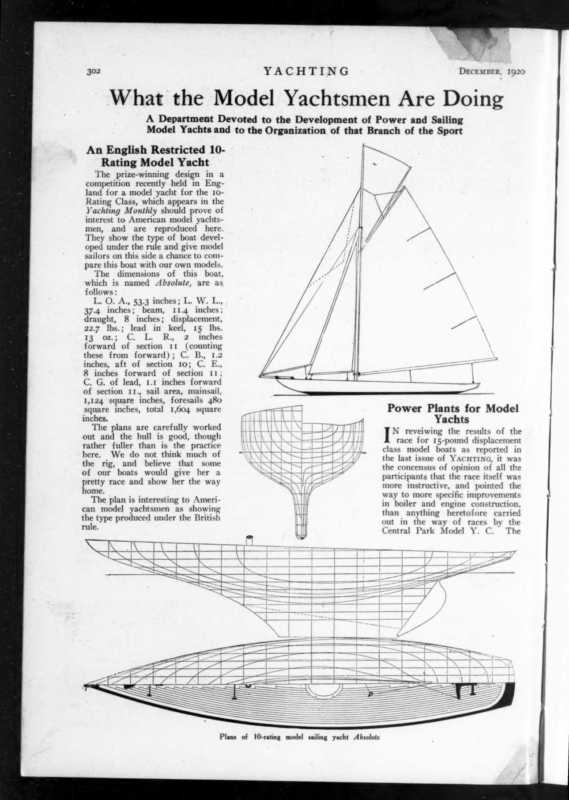
a YACHTING 302 e * DECEMBER, 1920 What the Model Yachtsmen Are Doing A Department Devoted to the Development of Power and Sailing Model Yachts and to the Organization of that Branch of the Sport An English Restricted 10Rating Model Yacht The prize-winning design in a competition recently held in England for a model yacht for the 10Rating Class, which appears in the Yachting Monthly should prove of interest to American model yachtsmen, and are reproduced here. They show the type of boat developed under the rule and give model sailors on this side a chance to compare this boat with our own models. The dimensions of this boat, which is named Absolute, are as follows: L. O. A., 53.3 inches; L. W. L., 37.4 inches; beam, 11.4 inches; draught, 8 inches; displacement, 22.7 Ibs.; lead in keel, 15 Ibs. m oo; C. R., 2 inches forward of section 11 (counting these from forward); C. B., 1.2 inches, aft of section 10; C. E., 8 inches forward of section 11; C. G. of lead, 1.1 inches forward of section I1., sail area, mainsail, 1,124 square inches, foresails 480 square inches, total 1,604 square inches. The plans are carefully worked out and the hull is good, though rather fuller than is the practice here. We do not think much of the rig, and believe that some of our boats would give her a pretty race and show her the way home. The plan is interesting to American model yachtsmen as showing the type produced under the British rule. N reveiwing the results of the race for 15-pound displacement class model boats as reported in the last issue of YACHTING, it was the concensus of opinion of all the participants that the race itself was more instructive, and pointed the way to more specific improvements in boiler and engine construction, than anything heretofore carried out in the way of races by the Central Park Model Y. C. The — | en ts Wa x Power Plants for Model Yachts * Plans of 10-rating model sailing yacht Absolute
DECEMBER, 1920 YACHTING Elmara VI, a 36” by 11” hydroplane, owned J. F. Rapp’s new hydroplane for 1921 shows a radical departure in her bow sections by J. F. Rapp. She has a 2-cylinder poppet and piston valve engine majority of boilers used in that race were of the flue tube and watertube construction, that is, an outer casing, two ends, and an inner or flue tube, in which were mounted a series of smaller tubes, running at right angles to and across the flue tube, and so arranged that the flame from the blow torch entering the flue tube had to pass these smaller tubes, which, of course, were filled with water held in the outside or large shell. It may be remembered that the winning boat, 7. N. T., carried a Scott type boiler, which, while having a greater or higher center of gravity, was a great deal lighter by comparison with the same size watertube boiler. This Scott type boiler is made up of a large tube, from the lower surface of which there are carried, in a semi-circular form, a series of small tubes which return to the larger tube. Outside of this construction is placed the outer casing, which is of any light metal, sufficient to return the flame from the blow torch in a path past these smaller tubes. In getting up steam from cold water, the watertube boiler takes on an average of about 5 minutes to produce a pressure of 80 pounds, while the Scott-type boiler produces the same pressure from the cold water start in about 3 minutes. There is, too, the added advantage erage 3-inch propeller carried by of easier construction in the Scottthe other engines. type boiler, and there is less liabilLightness of weight in propority to trouble from leakage in the tion to power seemed to be what When the small watertube type. the owners aimed at rather than tubes are brazed into the flue tube, hull form, as shown by the perit is not always convenient to make formance of 7. N. T. and Pep, a test of this portion of the work both of which appeared at the before placing in the boiler ends Central Park lake the Saturday for the final welding of the outside following the race. This time T. or large tube, the ends and the N. T. had a two-cylinder, singleflue tube. A test when all this acting engine in place of her single work is finished sometimes results cylinder, double-acting engine; and in leakage, where one of the small Pep had a Scott-type boiler in tubes is brazed in the flue tube and place of her watertube boiler and there is no possible way of remedya single cylinder, 34 inches x %4 ing it without a great deal of work, inches, double-acting engine in such as cutting ends, repairing the place of the extremely light twoleak and welding together again. cylinder, single-acting, 54 inches x This, of course, means a much shorter boiler when finished, due to — 5g inches. Although T. N. T. got into trouble on account of her blow the portion that had to be cut off torch, still she was badly beaten to get at the inside. Whereas, a by Pep as long as she did keep leak occurring in the Scott-type going. boiler, where all the brazing is on The introduction into the rules the outside and very “get-atable,” for this class of the stipulation merely means a new brazing job that the decks must be covered for at the particular point of leak two-fifths of their area, will, no doubt, produce some heating and ventilating engineering problems that will, at the first thought, seem obstacles difficult to overcome. This is as it should be for developing the gray matter and ingenu ity of the contestants. It might be mentioned, in passing, that all the boats participating Engines In the matter of engines, it was found that with the present type of two-cylinder, single-acting gines, such as were used in out en- four of five starters, the consump- tion of steam was excessive. A watertube boiler of 4 inches diameter and 10 inches in length, filled to its limit capacity, would supply steam to these engines for a maximum of 8 minutes, whereas the Scott-type boiler and the singlecylinder, double-acting engine of equal bore and stroke in this race, with the exception of one, were the design and work of the members who had taken instruction in the naval architecture course given by the club. would sup- ply steam for 12 minutes, the pressure in both cases being between 80 and 120 pounds per square inch. Another advantage is that of lightness, where the two-cylinder en- sy ve ae en. << S A 39” displacement type which is being finished for next year's use gines weighed 26 ounces as against 14 ounces for the single. No doubt the cushion effect of the double-acting type has a great deal to do with the steam consumption, and this seemed to produce, also,.a greater amount of torque. The winning boat, T. N. 7., swung a 4-inch propeller as against an av- é Wave formation of displacement type power boat, 1919 model
YACHTING 304 DECEMBER, 1920 The 42-inch load water-line class of the Central Park Model Yacht Club at the starting of a race For a Model Yacht Department For some time YAcHutiNnG has felt that not enough was being done to encourage model yachting, both sail and power, or to organize the sport on a basis where it would be helpful to those interested in it and beneficial to yachting and yacht building at large. We, therefore, take pleasure in announcing that we shall in future devote space in each issue to this branch of the sport and have a department for the interchange of news and ideas on model yachts and model yacht clubs. Here one can see what is being done in other parts of the country in model yacht development; -here the rules and regulations governing the various classes of racing models will be found and through this department steps may be taken to standardize them, as far as possible, and here all that is new and interesting in the sport will be given due consideration to the end of developing not only better models but of interesting the growing boy and the young man and creating a desire for a greater knowledge of this fascinating subject and of its relation to larger yachts and boats. It is also our aim to help any group desiring to form model yacht clubs, and to this end any questions on this, or other subjects. may be directed to the Model Yacht Editor of Yacutrnc, where they will be given careful attention, and be answered in detail. From the Atlantic to the Pacific Coast there is great interest in the building and sailing or running of model yachts. YACHTING wants to weld this interest for betterment ot the sport. y The Racing Season at the Central Park Model Yacht Club The racing season of the Central Park Model Yacht Club did not close until Nov. 28th, when the final race in the 42” L. W. L. class was sailed, the last race in the 306” class having been sailed a week before. In both of these classes the rac ing was extremely close. In the 36” class, the Imp, owned by L. 3. Battey, finished only two points ahead of F. L. Herreshoff’s Eaglet while in the 42” class, which is the Third Class, International Rule, the Impulse, owned by J. Weaver, collected a total of 135 points against 115 for the Frances, owned by W. Blumfield. The standing of all the yachts in these two classes follows: 36-FT. I. W. L. CLASS = 2 = 5 a Yacht and Owner Imp, 1. B Battey Eaglet, F. L. Herreshoff Alicia, S. A. Branig Triton, Wasp, H. Lyon J. THIRD ‘ McKenna.... CLASS, INT. RULE Impulse, J. Weaver.. Frances, V. Blumfield Sequoyah, J. McKenna Galatea, H. Griffiths Lassie, C. W. Bedell . Hornet, W. DeBuse Dauntless, F. A. Branig Duck, 'T. Malloy ....... _* MM. C. Heider... Oootukukunit, J. O. Berg Fly, T. H. Barrington. . a ‘ = & & -s A £H EE y 8 hy a 2 8 16 16 12 S$ I 149 147 108 if 7 (42-IN. 16 16 16 16 26 6 7 8 2 > 2 8 0 0 0.0 0.0 L. W. 0 141 189 108 i 7 L.) 146 211 119 2 4 112 2 @ 110 2 8 231. 210 G6 £¢ 9 160 0 7 68 «(0 37 0 0 19 0 0 10 BY 60 135 #115 106 102 361 ‘68 46 97 2 19 ite * No name. \ltogether the season just closed was one of the most successful in the history of. the club and, in addi- tion to the racing in these two classes, the model power boat men brought out a number of new boats in the 15-lb. displacement class, an account of which will be found elsewhere. For the past two years the sail boat division of the Central Park Model Yacht Club has been en- deavoring to arrange inter-club matches in the interest of the development of the sport of model yachting. Not a great deal of suc- cess has been met with along these lines, as there appears to be a lack of incentive of members of other clubs to race among themselves for the season and then pick theit good boats for racing in inter-club matches. The coming season, however, will see, we believe, at least one good cup put up for.an inter-club race, or series of races, and it is hoped that those clubs now in existence will get their members together, do some real hard racing during the season, and challenge for this cup, which will soon be officially offered. Schooner Yacht ‘‘Lady Mary”’ Makes Fast Trip The schooner yacht Lady Mary, owned by Mr. F. D. M. Strachan, of Savannah, sailed from Sandy Hook at 9:30 A. M. on Tuesday morning, November 23rd, and arrived at Brunswick, Ga. at 6:00 A. M. the following Saturday, Novem ber 7th, making practically the same time as the regular steamship lines This performance of the Lady Mary is particularly gratifying to the owner, who has been yachting for many seasons and has owned nearly every type of pleasure craft.