- What the Model Yachtsmen Are Doing.
- The International Model Yacht Race.
- Devices for Miniature Yachts.
- Central Park MYC Holds Elimination Races.
- Montreal MYC.

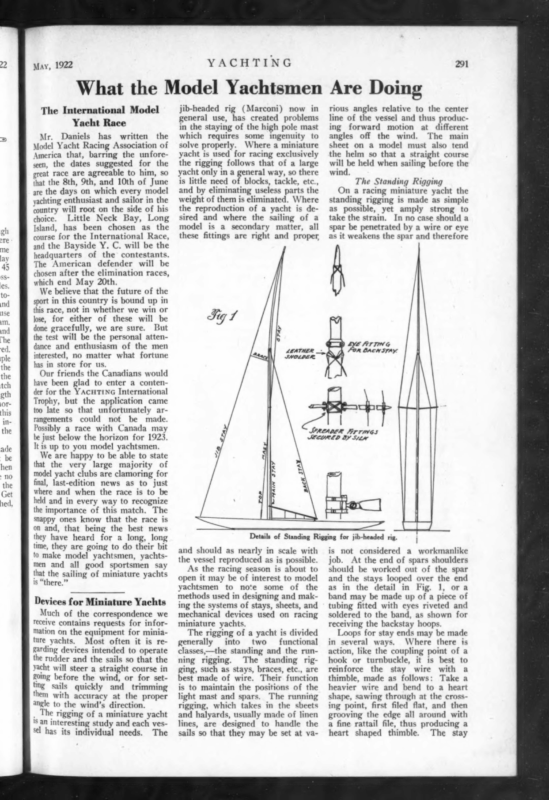
YACHTING May, 1922 What the Model Yachtsmen Are Doing The International Model Yacht Race Mr. Daniels has written the Model Yacht Racing Association of America that, barring the unfore- seen, the dates suggested for the eat race are agreeable to him, so that the 8th, 9th, and 10th of June are the days on which every model yachting enthusiast and sailor in the country will root on the side of his choice. es. to- ind “Ase 1m. ind The ed. ple the the tch gth or- this inthe ade hen no the Get hed, which end May 20th. We believe that the future of the sport in this country is bound up in this race, not in whether we win or lose, for either of these will be done gracefully, we are sure. But the test will be the personal attendance and enthusiasm of the men interested, no matter what fortune d N Ko ELIT TING LEATHER _-. ROACH STAY SNOLGER has in store for us. Our friends the Canadians would have been glad to enter a contender for the YACHTING International Trophy, but the application came too late so that unfortunately arrangements could not be made. att Possibly a race with Canada may be just below the horizon for 1923. It is up to you model yachtsmen. SPREADER Fir vivGs ALCOR ED BY Star We are happy to be able to state that the very large majority of model yacht clubs are clamoring for final, last-edition news as to just where and when the race is to be held and in every way to recognize the importance of this match. The snappy ones know that the race is on and, that being the best news they have heard for a long, long time, they are going to do their bit to make model yachtsmen, yachtsmen and all good sportsmen say that the sailing of miniature yachts is “there.” Devices for Miniature Yachts Much of the correspondence we receive contains requests for information on the equipment for miniature yachts. Most often it is re- garding devices intended to operate the rudder and the sails so that the yacht will steer a straight course in going before the wind, or for set- ting sails quickly and trimming them with accuracy at the proper angle to the wind’s direction. _ The rigging of a miniature yacht ‘S an interesting study and each ves- sel has its individual needs. The STAY lay as it weakens the spar and therefore wvyain me rious angles relative to the center line of the vessel and thus producing forward motion at different angles off the wind. The main sheet on a model must also tend the helm so that a straight course will be held when sailing before the wind. The Standing Rigging On a racing miniature yacht the standing rigging is made as simple as possible, yet amply strong to take the strain. In no case should a spar be penetrated by a wire or eye > gh ere : Little Neck Bay, Long Island, has been chosen as the course for the International Race, and the Bayside Y. C. will be the headquarters of the contestants. The American defender will be chosen after the elimination races, jib-headed rig (Marconi) now in general use, has created problems in the staying of the high pole mast which requires some ingenuity to solve properly. Where a miniature yacht is used for racing exclusively the rigging follows that of a large yacht only in a general way, so there is little need of blocks, tackle, etc., and by eliminating useless parts the weight of them is eliminated. Where the reproduction of a yacht is desired and where the sailing of a model is a secondary matter, all these fittings are right and proper ee A / Details of Standing Rigging for jib-headed rig. and should as nearly in scale with the vessel reproduced as is possible. As the racing season is about to open it may be of interest to model yachtsmen to note some of the methods used in designing and making the systems of stays, sheets, and mechanical devices used on racing miniature yachts. The rigging of a yacht is divided generally into two functional classes,—the standing and the running rigging. The standing rigging, such as stays, braces, etc., are best made of wire. Their function is to maintain the positions of the light mast and spars. The running rigging, which takes in the sheets and halyards, usually made of linen lines, are designed to handle the sails so that they may be set at va- is not considered a workmanlike job. At the end of spars shoulders should be worked out of the spar and the stays looped over the end as in the detail in Fig. 1, ora band may be made up of a piece of tubing fitted with eyes riveted and soldered to the band, as shown for receiving the backstay hoops. Loops for stay ends may be made in several ways. Where there is action, like the coupling point of a hook or turnbuckle, it is best to reinforce the stay wire with a thimble, made as follows: Take a heavier wire and bend to a heart shape, sawing through at the crossing point, first filed flat, and then grooving the edge all around with a fine rattail file, thus producing a heart shaped thimble. The stay
YACHTING 292 wire is soldered while being held tight in the groove, and for some distance along the wire. Where stay wires pass through spreaders it is well to have them pass through a short length of brass tubing made fast in the spreader, particularly if the spread- ers are of wood or of the hinged variety. The turnbuckle is one of the weak points on the average miniature yacht, owing, perhaps, to the difficulty of buying a well-made part of proper size and manufacture. A very good way of making a substantial turnbuckle, which can be made with a minimum of tools, is to use 4%” 21-gauge seamless brass tubing, tapped No. 3—48 threads R. H. in both ends as deep as the top will allow. Then thread short lengths of No. 10 Phosphor Bronze wire with the same die, being careful to expand the die so that the fit into the threaded tube will be snug. ‘One end of this turnbuckle must be screwed in and soldered fast into the tube, the other left free to screw in or out to bring the stay wire to proper tension. The dimensions of the turnbuckle are given in Fig. 2. The securing of the stays to the hull at the rails is accomplished by threading eyes and screwing them into the side after a smaller hole has been drilled and flowed with shellac, two eyes forming a device as in Fig. 3. Right and left turnbuckles require tools and have no advantage except that one need not uncouple the stay to pull it taut, and the range of action is greater. The connection of the turnbuckle to the stay should always be loose, preferably with .a heart-shaped thimble made as before described. If the proper size wire is used it will be found large enough, upon annealing the eye end and flattening it slightly, to leave sufficient metal after a hole has been drilled through, as shown. For the builder having access to a lathe the making of the turnbuckle is an easy matter, a hollow mill being used to reduce a larger sized rod to the proper thread diameter and a clevis filed out at the large end. The body may be made of a flat bar, 3/16” x 1%”, and the center opened to reduce weight. Still lighter fittings may be made with right and left thread having clevises at each end only, as shown in Fig. 2. The reason for the strut in the forestay is to minimize the sag of that stay when sailing before the wind. In a model not using backStays it is difficult to avoid the bend- ing forward of the mast when under strong pressure because the side stays cannot be brought aft far enough to operate against pressure in a forward direction. The after position of the stay at the deck is determined by the main boom, which must swing no less than 80° each side of the center line. The strut above mentioned will minimize somewhat the sag created by the springing of the mast. The stays may be rigged further aft if the pivot point of. the boom is brought aft of the mast in the minner shown in Fig. 3. This, however, tends to deform the sail somewhat when going before the wind. ‘The automatic back stay devised by the writer gives the best possible condition wi‘hout changing the form of the sail. May, 1922 flame of a gas stove. By drawing the wire over the heated shovel slowly as it is uncoiled from the spool, it will be straightened out ; fectly and remove the “spring” , to the hardness and the winding wu, the spool. In the event that a torch is used the wire may be run over a sheet of metal fitted to it so that the flame will heat the metal evenly to not quite a red heat. Hooks should be made of . somewhat heavier wire not annealed and the eyes of them should always be soldered closed. The better grade of brass nickel plated safety pin may be utilized to good advantage for making hooks. Central Park M. Y. Club Holds Elimination Races The Central Park Model Yacht Club is running off elimination races to pick the club representa- tives for the international race, at Cas L weer AB. WORE D FLAT D be WAMVERE ENDS ASEALE Fig. 2. po If the yacht is to be used for outside sailing from a skiff it is necessary to consider that the stays will often rub on the sides of the skiff and receive rough treatment generally, much more so than in sailing on run-around ponds. Therefore heavier wire is in order. In Fig. 1 we have a layout of the standing rigging for the jib-headed rig. The head stay is of No. 24 wire, mast head stay of No. 20 wire, topmast stay of No. 22 wire, bobstay, if any, of No. 16 wire, the head stay brace of No. 19 wire, all of phosphor bronze. Phosphor bronze or nickel silverwire may be purchased in coils or on spools, both are quite hard and are apt to break if “kinked.” The thinner the wire the more brittle. It is, therefore, best to anneal the wire to straighten it and to soften it somewhat before use. If a gasoline torch is not to be had this may be done by placing a coal shovel of the kitchen variety inverted over the the summer station of the club, foot of 55th Street, Corona, L. I., in Flushing Bay. The trials have been interesting up to the present writing in so far as the races have been sailed in light and heavy weather and the casualties have been running high, as might be expected with so many new boats racing so early in the season. There are several yet unfinished which have still to appear at the starting line, making twelve new boats out of fifteen promised at the beginning of the season. The sailing time shows the Class B boats to have a fine turn of speed, three miles being covered in less than one hour, in average winds. This is not so bad and keeps the oarsmen on the go. Harp A. LEE Montreal Model Yacht Club A meeting was held in Montreal on Wednesday evening, April 5th, at which it was decided to form a Model Yacht Club to be called “The Montreal Model Yacht Club” with a membership of sixteen to start with. The following gentlemen were elected to office: Hon. Commodore, His Worship, Mayor Martin; Commodore, A. S. Collins; Vice-Commodore, C. H. Croucher; Rear Commodore, M. Taylor; SecretaryTreasurer, L. Serre. It was decided to start with both Senior first and for Junior members sections—the of twenty-one years of age, or over, the latter for youths from fifteen to twenty- one years of age. The object of the club is to encourage the sport 0! model yachting, both sail and power