- What the Model Yachtsmen Are Doing. JO Berg, ME
- The Sailing of Miniature Yachts.
- Sailing Rules for Outside Sailing. (Adopted by MYRAA)
- Model Yachting in the Pacific North West. by Marco Polo
- A Meeting of Old Rivals.
- Power Model Yachts.

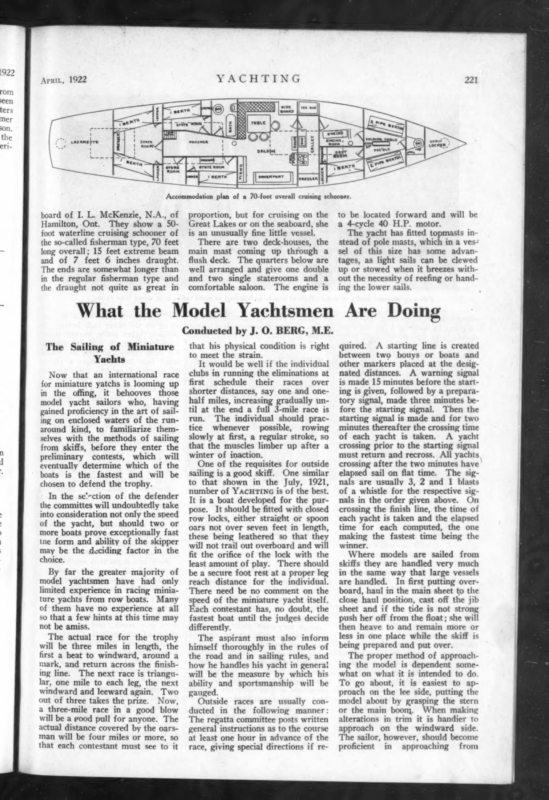
1922 YACHTING Aprit, 1922 221 rom een x pacectghs®, PEAT seseesee SOX IO sate” resatararstelecs ters », mer On. the eri- 1 SERTH Accommodation plan of a 70-foot overall cruising schooner. board of I. L. McKenzie, N.A., of Hamilton, Ont. They show a 50foot waterline cruising schooner of the so-called fisherman type, 70 feet long overall; 15 feet extreme beam and of 7 feet 6 inches draught. The ends are somewhat longer than in the regular fisherman type and the draught not quite as great in proportion, but for cruising on the Great Lakes or on the seaboard, she is an unusually fine little vessel. There are two deck-houses, the main mast coming up through a flush deck. The quarters below are well arranged and give one double and two single staterooms and a comfortable saloon. The engine is to be located forward and will be a 4-cycle 40 H.P. motor. The yacht has fitted topmasts instead of pole masts, which in a vessel of this size has some advantages, as light sails can be clewed up or stowed when it breezes without the necessity of reefing or handing the lower sails. What the Model Yachtsmen Are Doing Conducted by J. O. BERG, M.E. The Sailing of Miniature Yachts Now that an international race for miniature yatchs is looming up in the offing, it behooves those model yacht sailors who, having gained proficiency in the art of sailing on enclosed waters of the runaround kind, to familiarize themselves with the methods of sailing from skiffs, before they enter the preliminary contests, which will eventually determine which of the boats is the fastest and will be chosen to defend the trophy. In the se‘-ction of the defender the committes will undoubtedly take into consideration not only the speed of the yacht, but should two or more boats prove exceptionally fast tne form and ability of the skipper may be the deciding factor in the choice. By far the greater majority of model yachtsmen have had only limited experience in racing miniature yachts from row boats. Many of them have no experience at all so that a few hints at this time may not be amiss. The actual race for the trophy will be three miles in length, the first a beat to windward, around a mark, and return across the finish- ing line. The next race is triangu- lar, one mile to each leg, the next windward and leeward again. Two out of three takes the prize. Now, a three-mile race in a good blow will be a good pull for anyone. The actual distance covered by the oars- man will be four miles or more, so that each contestant must see to it that his physical condition is right to meet the strain. It would be well if the individual clubs in running the eliminations at first schedule their races over shorter distances, say one and onehalf miles, increasing gradually until at the end a full 3-mile race is run. The individual should practice whenever possible, rowing slowly at first, a regular stroke, so that the muscles limber up after a winter of inaction. One of the requisites for outside sailing is a good skiff. One similar to that shown in the July, 1921, number of YACHTING is of the best. It is a boat developed for the purpose. It should be fitted with closed row locks, either straight or spoon oars not over seven feet in length, these being leathered so that they will not trail out overboard and will fit the orifice of the lock with the least amount of play. There should be a secure foot rest at a proper leg reach distance for the individual. There need be no comment on the speed of the miniature yacht itself. ach contestant has, no doubt, the fastest boat until the judges decide differently. The aspirant must also inform himself thoroughly in the rules of the road and in sailing rules, and how he handles his yacht in genera! will be the measure by which his ability and sportsmanship will be gauged. Outside races are usually conducted in the following manner: The regatta committee posts written general instructions as to the course at least one hour in advance of the race, giving special directions if re- quired.