- What the Model Yachtsmen Are Doing.
- How to Measure Model Yachts Under the New Rule.
- Irvington MYC Annual Meeting.
- Royal Vancouver Yacht Club Wants to Challenge.
- The First of the B Class Model Yachts.
- Model Yacht Exhibit at Detroit.
- A Hail to Power Boatmen.
- Model Boat Department.
- A 26-Inch Waterline Model Yacht.

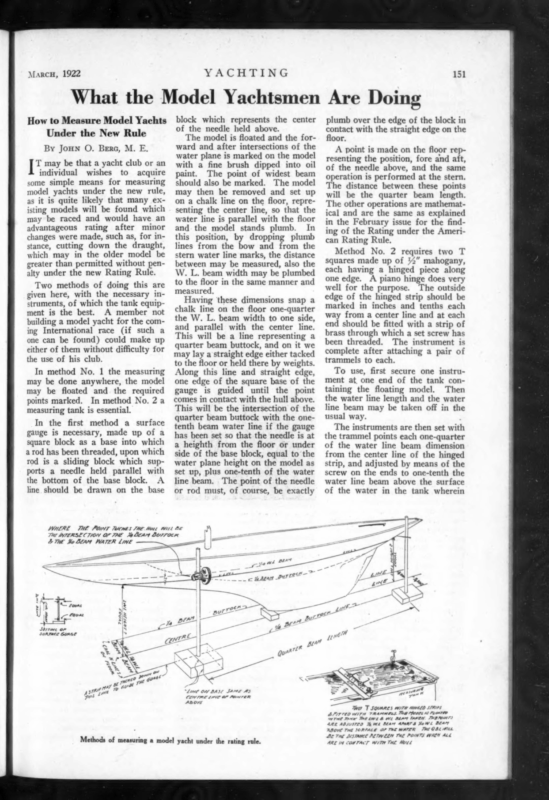
YACHTING Marcu, 1922 What the Model Yachtsmen Are Doing How to Measure Model Yachts Under the New Rule By Joun O. Bere, M. E. T may be that a yacht club or an individual wishes to acquire some simple means for measuring model yachts under the new rule, as it is quite likely that many existing models will be found which may be raced and would have an advantageous rating after minor changes were made, such as, for instance, cutting down the draught, which may in the older model be greater than permitted without penalty under the new Rating Rule. Two methods of doing this are given here, with the necessary instruments, of which the tank equipment is the best. A member not building a model yacht for the coming International race (if such a one can be found) could make up either of them without difficulty for the use of his club. In method No. 1 the measuring may be done anywhere, the model may be floated and the required points marked. In method No. 2a measuring tank is essential. In the first method a surface gauge is necessary, made up of a square block as a base into which a rod has been threaded, upon which rod is a sliding block which supports a needle held parallel with the bottom of the base block. A line should be drawn on the base block which represents the center of the needle held above. The model is floated and the forward and after intersections of the water plane is marked on the model with a fine brush dipped into oil paint. The point of widest beam should also be marked. The model may then be removed and set up on a chalk line on the floor, representing the center line, so that the water line is parallel with the floor and the model stands plumb. In this position, by dropping plumb lines from the bow and from the stern water line marks, the distance between may be measured, also the W. L. beam width may be plumbed to the floor in the same manner and measured, Having these dimensions snap a chalk line on the floor one-quarter the W. L. beam width to one side, and parallel with the center line. This will be a line representing a quarter beam buttock, and on it we may lay a straight edge either tacked to the floor or held there by weights. Along this line and straight edge, one edge of the square base of the gauge is guided until the point comes in contact with the hull above. This will be the intersection of the quarter beam buttock with the onetenth beam water line if the gauge has been set so that the needle is at a heighth from the floor or under side of the base block, equal to the water plane height on the model as set up, plus one-tenth of the water line beam. The point of the needle or rod must, of course, be exactly WHERE THE PONT Terns (hE Beet Wil 22 Tt IVTERSE C TION OF THE My Oth DUT rocrK YA plumb over the edge of the block in — with the straight edge on the oor. A point is made on the floor rep- resenting the position, fore and aft, of the needle above, and the same operation is performed at the stern. The distance between these points will be the quarter beam length. The other operations are mathematical and are the same as explained in the February issue for the finding of the Rating under the American Rating Rule. Method No. 2 requires two T squares made up of 1%” mahogany, each having a hinged piece along one edge. A piano hinge does very well for the purpose. The outside edge of the hinged strip should be marked in inches and tenths each way from a center line and at each end should be fitted with a strip of brass through which a set screw has been threaded. The instrument is complete after attaching a pair of trammels to each. To use, first secure one instrument at one end of the tank con- taining the floating model. Then the water line length and the water line beam may be taken off in the usual way. The instruments are then set with the trammel points each one-quarter of the water line beam dimension from the center line of the hinged strip, and adjusted by means of the screw on the ends to one-tenth the water line beam above the surface of the water in the tank wherein —_— 3 7E He OLAM WATER LINE af ‘4}af ‘ — sow i yo Sweat 2 In 1% IN NIRS alg JSérrveg oF SURIMCE GUAGE i | “LIVE O BASE SAME AS CLV IRE LINE OF PRINTER ABOVE Faw T SQUARES WITH WELD STRIPS Bfyr ree wirn 7 Race @15. Tel FEaCL 1S FLOATED we Te Tawar Fee Awe BG Bare TAMER, THE POINT) 4RE ADIVSTEO Se Wk BAM APARTES HaWi BEA ABOVE THE SURFACE OF THE WATER Methods of measuring a model yacht under the rating rule. Tht OBL AML Le Tab LISTAICE PET LEN THE POINTS WHEN Abd ARE iN COMTACT WITH THE Mvil
YACHTING tion is in progress. in his vicinity have adopted the new American Model Rating Rule as their standard for classification for model yachts and he is anxious to know whether a contender from Canada would be acceptable as an additional entry for the International race. The matter will be re- ferred to Mr. Daniels and the Model Yacht Racing Association of America and it looks as though the test might be broadened, thus extending the interest in this first international model yacht race. The First of the B Class Model Yachts The first boat built for the International Race and tried out under sail is the Owisquat, designed and built by John O. Berg. Here are Irvington Model Y. C. Annual Meeting The Annual Meeting and Dinner of the Irvington Model Yacht Club, of Irvington, N. J., was held on January 11th, at the Elk’s Clubhouse in Irvington. The following members were elected officers for 1922: Commodore, Edward K. Southwick; ViceCommodore, Ira A. Gibson; Treas- urer, Charles W. Pfeil; Secretary, Theodore Woolman. The outlook for the 1922 season is very bright, particularly regarding the numerous local and interclub races for Class D sloops to take place during the coming regatta season. The Cups were presented to the owners of the Model Yachts which secured the most number of points ‘ during the past season’s races, and Opisquat, first model yacht built for the Interthe “Irvington Class” Perpetual national races next Summer to take the water. Challenge Cup was officially presented to the Club to keep until it is won by some other Model Yacht Club, The Montclair and Central Park Model Yacht Clubs will endeavor to lift the Cup in a series of inter-club races during the coming sailing season. Mr. George W. Magalhaes, Treasurer of the Central Park Model Yacht Club, of New York City, as guest of honor, gave a very interesting talk on Model Yacht Design and Construction, which was greatly appreciated by all the members present. Royal Vancouver Yacht Club Wants to Challenge Mr. John Winslow, Chairman of the Model Yacht Committee of the Royal Vancouver Yacht Club informs us that all of the yacht clubs the particulars about her: L. O. A. 69”, L. W. L. 45”, Dis. 35 Ibs., S. A. 2,900 sq. in. Has been sailed each Sunday since Dec. 31, 1921. Course 3 miles in light S. W. wind. Windward and leeward from long dock to channel light off College Point. Time 1 hour 39 minutes. Course, 3 miles, heavy west wind. Triangular, long dock—end of breakwater—steamer docks at Astoria and return. Time 58 minutes. Over C. P. Model Yacht Club, course, Flushing Bay. it opened until late at night, showing the interest in these boats that is being aroused. The Detroit Model Yacht Club, which got up the exhibit, is the youngest member of the Yacht Racing Association of America and it is understood that they will have an entry for the coming International races to be sailed this June. A Hail to Power Boatmen Mr. Harry Johnson, Vice-Commodore of the Central Park Model Yacht Club, has an interesting proposal on classification for Model Power Yachts. He writes as follows: “The recently formed Model Yacht Racing Association has put model yachting on a sound footing. It is acting like a tonic and we can hope for a large fleet of models built to standardized rules for the coming season. Of still greater value than the International match will be the interclub races which are bound to come along. So far so good—for sailing yachts. But how about power boats? “Now, if anything ever needed help it is model power boating. It is in a worse fix than yacht sailing ever was, for most of the yacht had knowledge of the old rules, whereas no one ever heard of any power boat rules. Power boat racing would undoubtedly receive an impetus if a practical set of rules were evolved and adopted by the Model Yacht Racing Association. Interclub races would follow in its wake and even the picking of a national champion would be an easy matter. As somebody has to start something, here goes—— “T propose three classes, viz.: “Class, A—’% cubic inch piston displacement, saturated steam only. This class is to be raced over a 50yard straightaway course. “Class B—1 cubic inch piston displacement, saturated steam only. To be raced over a _ 100-yard straightaway course. “Class C—1 cubic inch piston displacement. Flash steam. To be raced over a 300-yard course, either a straightaway or circular (tethered toa pole). The 300 yards need not be traversed at once but may be split up into three one hundred yard runs. Model Yacht Exhibit at Detroit The recent exhibit of model yachts at the Board of Commerce, Detroit, caused much favorable comment in the papers and the exhibit was crowded from the time “Classes A and B would be ideal classes for club racing while Class C would take care of the high speed bugs. Class B would undoubtedly prove the most popular, in fact two clubs have been racing for a season to rules somewhat similar. “Harry JOHNSON.” ee The model a the model is floating. is then pushed backwards until the hull is in contact with the trammel points of the stationary instrument and the center line of the model corresponds with the center line on the instrument. Then the sliding instrument is brought to the model until the trammel points thereon make contact with the hull. The model may then be removed and the distance between the trammel points measured, which will give the quarter beam length. On the instruments which the writer is making for the Central Park Model Yacht Club a sight similar to a gun sight is placed on the center line of each instrument so that an assistant may guide the model more easily while the opera- Marca, 1922 ea 152
YACHTING Marcu, 1922 a \ Y m ‘ \ \ — SX Sy a NR XZ Lines of 26-inch water-line model yacht, designed to the rating rule by E. I. Schock. ment 1034 Ibs. Model Boat Department Feeling that the model yacht department of YACHTING has grown to such proportions as to require the services of a special editor, we are glad to announce that we have secured Mr. John O. Berg, a wellknown amateur model yacht designer, builder and sailer, to conduct this department. With his wide experience, we feel that this will be of advantage to all model yachtsmen.—EDITor. 7 © Now that the skipper has put me at it to look over the mizzen rigging of the good ship YAcHTING, I would like to call to the attention of all model yacht clubs and individual model yachtsmen the great advantage of cooperation. It is not so many years ago that model yachting was in the doldrums and had all the appearance of becoming a total loss. There was no reason apparent for this stagnation in the sport except, perhaps, that everyone who sailed at all built any old size of boat so that interclub rac- ing was carried on very rarely and then only for such trophies as the Eagle Cup. * @ Perhaps at the time of the lowest ebb in the sport an organization was created which proposed as a “keel timber” the assembly and distribution of such information as it could gather from a class of model yachts built under specific dimen- sions limiting the load, water line length, sail area and draught. We are not ready to state that this reso- lution had all to do with the successful assembly of the Frame as it stands today, but those who have followed the sport since that time Her over all length is 3414 inches and her displace- cannot fail to agree with the statement that at no time has the sport been so active throughout our U. S. A. as it is today. attracted o A class for instruction in naval architecture was organized for the members of the Central Park Model Yacht Club, to which two members of any other model yacht club wishing to send them, were invited. The charge for all was the same and nominal. The only condition made was that the visiting model yachtsmen organize classes in their own clubs to spread the good work. The Model Yacht Racing Association of America is the latest advancing step. * yachts was a pleasant surprise. The Onisquat, a description and illustration of her being given elsewhere in this issue, was the magnet which © #® many to the YACHTING booth, so also to the one showing the fleet of models made by students of the New York Manual Training Schools of New York. Altogether the future looks bright for the sport, and it will be our aim to give the best that can be had to further the sport and to answer all requests for information on the subject. Joun O. Bera, M. E. A 26-Inch Waterline Model Yacht The plans which we publish here What I want to point out is the are of a 26-inch waterline model value of distribution of facts, and yacht designed to the new model the policy of these columns will be to broadcast as much as the space rating rule of the Model Yacht Racwill permit what is of interest to ing Association of America by E. I. model yachtsmen. The Interna- Schock. They show a well-balanced tional race should assure the permacraft with good displacement, nent advance of the sport. Boats plenty of lateral plane, without too for this race are building all_over long a keel, and a Marconi rig. the country and plans are being The ends are somewhat shorter formulated which will give a boat ‘than is customary with models of from any locality the chance to the past, particularly the stern, prove itself the best—and nothing which is cut off short 234 inches short of the best will do. I am beyond the waterline. This practice prophesying that the Association is being followed by some naval Committee is going to have one architects in large boats, where the busy time of it. saving of weight is of great importance. That reason would hardly * 2 hold in the case of a model, howThere is much to be learned from ever, and we believe the after overthe racing which is going to take hang could be carried out a little place. The club which assembles farther and improve the appearance data of value will gain thereby and of the stern. help the sport by passing it on to Her dimensions are: Length others. overall, 34% inches; waterline, 26 * 8 © inches; beam, 944 inches; draught, imches; displacement, 10% The interest shown at the Motor 8% Boat Show at New York in model pounds.