
- Steering Gears for Models. Thomas Darling. One of the most important items in the building and outfitting of a miniature sailing boat is the steering gear.
- New Boston Model Yacht Club.
- Model Yacht Racing at Put-in-Bay.

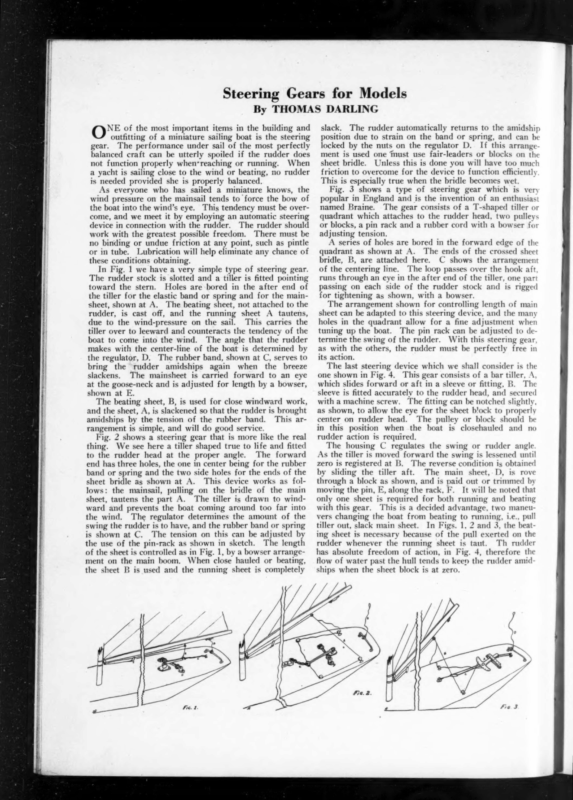
Steering Gears for Models By THOMAS DARLING i pte of the most important items in the building and outfitting of a miniature sailing boat is the steering gear. The performance under sail of the most perfectly balanced craft can be utterly spoiled if the rudder does not function properly when‘reaching or running. When a yacht is sailing close to the wind or beating, no rudder is needed provided she is properly balanced. As everyone who has sailed a miniature knows, the wind pressure on the mainsail tends to force the bow of the boat into the wind’s eye. This tendency must be overcome, and we meet it by employing an automatic steering device in connection with the rudder. The rudder should work with the greatest possible freedom. There must be no binding or undue friction at any point, such as pintle or in tube. Lubrication will help eliminate any chance of these conditions obtaining. In Fig. 1 we have a very simple type of steering gear. The rudder stock is slotted and a tiller is fitted pointing toward the stern. Holes are bored in the after end of the tiller for the elastic band or spring and for the mainsheet, shown at A. The beating sheet, not attached to the rudder, is cast off, and the running sheet A tautens, due to the wind-pressure on the sail. This carries the tiller over to leeward and counteracts the tendency of the boat to come into the wind. The angle that the rudder makes with the center-line of the boat is determined by the regulator, D. The rubber band, shown at C, serves to bring the rudder amidships again when the breeze slackens. The mainsheet is carried forward to an eye at the goose-neck and is adjusted for length by a bowser, shown at E. The beating sheet, B, is used for close windward work, and the sheet, A, is slackened so that the rudder is brought amidships by the tension of the rubber band. This arrangement is simple, and will do good service. Fig. 2 shows a steering gear that is more like the real thing. We see here a tiller shaped true to life and fitted to the rudder head at the proper angle. The forward end has three holes, the one in center being for the rubber band or spring and the two side holes for the ends of the sheet bridle as shown at A. This device works as follows: the mainsail, pulling on the bridle of the main sheet, tautens the part A. The tiller is drawn to windward and prevents the boat coming around too far into the wind. The regulator determines the amount of the swing the rudder is to have, and the rubber band or spring is shown at C. The tension on this can be adjusted by the use of the pin-rack as shown in sketch. The length of the sheet is controlled as in Fig. 1, by a bowser arrangement on the main boom. When close hauled or beating, the sheet B is used and the running sheet is completely slack. The rudder automatically returns to the amidship position due to strain on the band or spring, and can be locked by the nuts on the regulator D. If this arrangement is used one Tnust use fair-leaders or blocks on the sheet bridle. Unless this is done you will have too much friction to overcome for the device to function efficiently This is especially true when the bridle becomes wet. Fig. 3 shows a type of steering gear which is ver) popular in England and is the invention of an enthusiast named Braine. The gear consists of a T-shaped tiller or quadrant which attaches to the rudder head, two pulleys or blocks, a pin rack and a rubber cord with a bowser for adjusting tension. A series of holes are bored in the forward edge of the quadrant as shown at A. The ends of the crossed sheet bridle, B, are attached here. C shows the arrangement of the centering line. The loop passes over the hook aft, runs through an eye in the after end of the tiller, one part passing on each side of the rudder stock and is rigged for tightening as shown, with a bowser. The arrangement shown for controlling length of main sheet can be adapted to this steering device, and the many holes in the quadrant allow for a fine adjustment when tuning up the boat. The pin rack can be adjusted to determine the swing of the rudder. With this steering gear as with the others, the rudder must be perfectly free in its action. The last steering device which we shall consider is the one shown in Fig. 4. This gear consists of a bar tiller, A, which slides forward or aft in a sleeve or fitting, B. The sleeve is fitted accurately to the rudder head, and secured with a machine screw. The fitting can be notched slightly, as shown, to allow the eye for the sheet b!ock to properly center on rudder head. The pulley or block should be in this position when the boat is closehauled and no rudder action is required. The housing C regulates the swing or rudder angle As the tiller is moved forward the swing is lessened until zero is registered at B. The reverse condition is obtained by sliding the tiller aft. The main sheet,-D, is rove through a block as shown, and is paid out or trimmed by moving the pin, E, along the rack, F. It will be noted that only one sheet is required for both running and beating with this gear. This is a decided advantage, two maneuvers changing the boat from beating to running, i.e., pull tiller out, slack main sheet. In Figs. 1, 2 and 3, the beating sheet is necessary because of the pull exerted on the rudder whenever the running sheet is taut. Th rudder has absolute freedom of action, in Fig. 4, therefore the flow of water past the hull tends to keen the rudder amid ships when the sheet block is at zero.
FACHATING June, 1924 Jib Main sai | ee Method of rigging jib and main sheets on a model yacht. 0.4. This is the type of steering gear, or one somewhat similar to it, used on the Cup Defender Polka Dot, in the last International Model Yacht Race. growing fast and is gaining in popularity each season. The Interlake Yachting Association of the Great Lakes is put ting up six medals for model races. Every model boat owner belonging to an Interlake club or any recognized model boat clubis asked to be on hand and get into the fray. There will be races in Classes A, B, C, D, with handicaps. The racing rules of the Model Yacht Racing Association of America will be generally adopted. The judges will be selected by the Interlake Association. New Boston Model Yacht Club ODEL yachtsmen of the United States will be pleased to hear of the formation in Boston, during the winter, of a club for the building and sailing of model yachts, known as The Boston Model Yacht Club. A number of enthusiastic yachtsmen as well as model yacht sailors are interested in the new club and the first Commodore is John Black, and secretary, Fred Pigeon. P a —+ft Ns : Every entry must have certified certificate of rating For information write Commodore H. S. Miller, 3431 Park Avenue, Detroit, Mich. Make your entry to above address as soon as possible so that you will not be disappointed in row boat service. Mr. Miller is Commodore of the Detroit Model Yacht Club and owner of the undefeated Class C model Embree. But members of that club want any eligible model owner to step up and help trim this boat. The power boat races take in any boat propelled by steam, from 24 to 40 inches in length. The entries re- ceived are sufficient to assure a very interesting and hotly contested event. The Detroit Model Yacht Club is a live and fast-going organization of model enthusiasts in both sail and power models. They have, to this date, over twenty boats of each type. Boston, builtin 1869 and lostin the Pacificin