- Strictly Sail. By Rod Carr
- Talking about jibs.

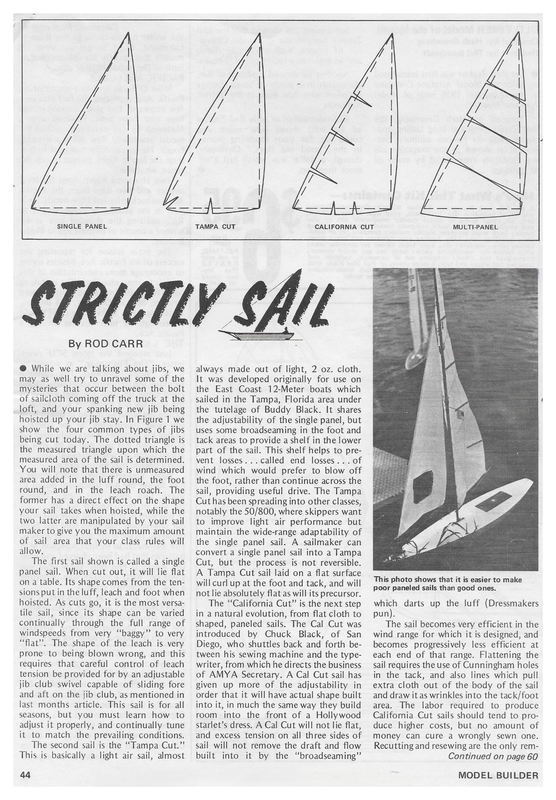
al SINGLE PANEL By TAMPA CUT = bese) CALIFORNIA CUT ROD CARR @ While we are talking about jibs, we always made out of light, 2 oz. cloth. may as well try to unravel some of the mysteries that occur between the bolt of sailcloth coming off the truck at the loft, and your spanking new jib being hoisted up your jib stay. In Figure 1 we show the four common types of jibs being cut today. The dotted triangle is the measured triangle upon which the measured area of the sail is determined. You will note that there is unmeasured area added in the luff round, the foot round, and in the leach roach. The former has a direct effect on the shape your sail takes when hoisted, while the two latter are manipulated by your sail maker to give you the maximum amount of sail area that your class rules will allow. The first sail shown is called a single panel sail. When cut out, it will lie flat on a table. Its shape comes from the tensions put in the luff, leach and foot when hoisted. As cuts go, it is the most versatile sail, since its shape can be varied It was developed originally for use on the East Coast 12-Meter boats which sailed in the Tampa, Florida area under the tutelage of Buddy Black. It shares the adjustability of the single panel, but uses some broadseaming in the foot and tack areas to provide a shelf in the lower part of the sail. This shelf helps to prevent losses…called end losses… of wind which would prefer to blow off the foot, rather than continue across the sail, providing useful drive. The Tampa Cut has been spreading into other classes, notably the 50/800, where skippers want to improve light air performance but continually through the full range of windspeeds from very ‘‘baggy’’ to very “flat”. The shape of the leach is very prone to being blown wrong, and this requires that careful control of leach tension be provided for by an adjustable jib club swivel capable of sliding fore and aft on the jib club, as mentioned in last months article. This sail is for all seasons, but you must learn how to adjust it properly, and continually tune it to match the prevailing conditions. The second sail is the “Tampa Cut.” This is basically a light air sail, almost 44 MULTI-PANEL maintain the wide-range adaptability of the single panel sail. A sailmaker can convert a single panel sail into a Tampa Cut, but the process is not reversible. A Tampa Cut sail laid on a flat surface will curl up at the foot and tack, and will not lie absolutely flat as will its precursor. The “California Cut” is the next step in a natural evolution, from flat cloth to shaped, paneled sails. The Cal Cut was introduced by Chuck Black, of San Diego, who shuttles back and forth between his sewing machine and the typewriter, from which he directs the business of AMYA Secretary. A Cal Cut sail has given up more of the adjustability in order that it will have actual shape built into it, in much the same way they build room into the front of a Hollywood starlet’s dress. A Cal Cut will not lie flat, and excess tension on all three sides of sail will not remove the draft and flow built into it by the “broadseaming”’ This photo shows that it is easier to make poor paneled sails than good ones. which darts up the luff (Dressmakers pun). The sail becomes very efficient in the wind range for which it is designed, and becomes progressively less efficient at each end of that range. Flattening the sail requires the use of Cunningham holes in the tack, and also lines which pull extra cloth out of the body of the sail and draw it as wrinkles into the tack/foot area. The labor required to produce California Cut sails should tend to produce higher costs, but no amount of money can cure a wrongly sewn one. Recutting and resewing are the only remContinued on page 60 MODEL BUILDER
_ Salling:s + —_— a. 4. Continued from page 44 edies. Some say that the stitching which occurs at the sail’s luff will promote turbulence across the sail, while others. talk in terms of boundary layers and leading edge spoilers and say that the stitching promotes an attached boundary layer, increasing efficiency. | don’t know. | suspect that the differences can be masked by the heavy rudder thumb of a trigger-happy skipper who over controls his boat. California Cuts have made serious inroads in the 50/800 class, especially in the tall, high- aspect ratio rigs which are appearing on WARRIOR II’s and other vessels. The broadseaming allows nice shape to exist across the sail all the way up, even though . the chord may be 12 inches or less for some ultra-tall rigs. I’m sure that we’ll Start to see race results carry descriptions of not only hulls used in the development Classes, but sail cuts and manufacturer names as well. The multi-panel sail uses individual Strips of sailcloth in a manner analogous _of full-size practice. Vortex used to make paneled sails to special order for the Santa Barbaras, but turned that over to ‘CARR SAILS, as their business in- creased. Properly made paneled sails re- quire so much time and effort that the prices asked are almost unrealistic. The photograph shows a_ paneled mainsail that we spotted at a regatta. It /was made during the ’73 season for an East Coast 12. As you can see, it is easier to make poor paneled sails than good “ones, and the differences in dimensioning are on the order of the error size that one can control while sewing. Some big boat sailmakers and manufacturers are experimenting with ultrasonic welding techniques to ‘‘tack”’ the: panels together for sewing. It will be interesting to see what model yacht sail-maker ventures into the field first. For esthetic reasons only, paneled sails can be made out of flat, non-beveled panels, -and a single panel pattern used for the. actual sail. All kinds of stripes and other attention getting designs are available,. and one is assured of the single panel sail reliability. | Next month we’ll take a look at -mainsails, their care and feeding. Ques- | tions will be fielded by Rod Carr, 7607 Gresham Street, Springfield, Va. 22151. Remember to join AMYA. Dues are only 5 bucks, and can be sent to Chuck Black, 4761 Niagra Avenue, San > Diego, Ca. 92107. @