- Strictly Sail. By Rod Carr
- Looking at new breeds of Marbleheads 50/800.

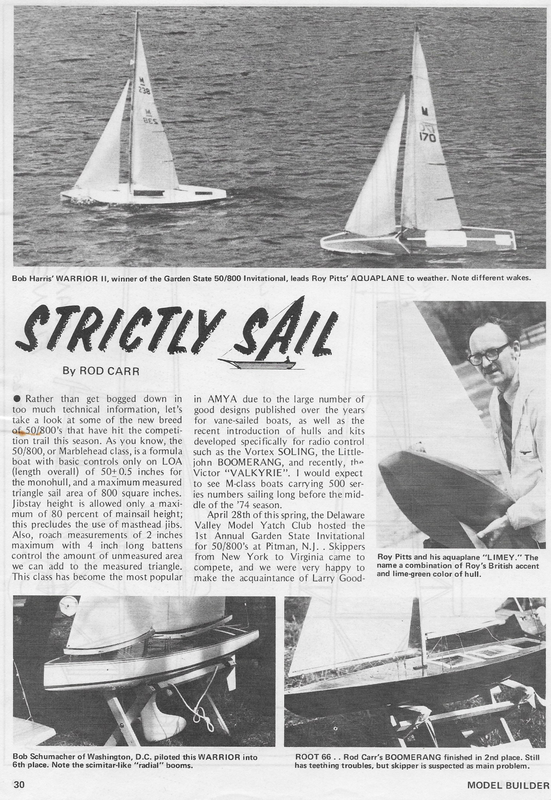
By ROD CARR @ Rather than get bogged down in too much technical information, let’s take a look at some of the new breed in AMYA due to the large number of good designs published over the years Of~50/800’s that have hit the competi- recent tion trail this season. As you know, the developed specifically for radio control such as the Vortex SOLING, the Littlejohn BOOMERANG, and recently, the Victor “VALKYRIE”. | would expect 50/800, or Marblehead class, is a formula boat with basic controls only on LOA (length overall) of 50+0.5 inches for the monohull, and a maximum measured triangle sail area of 800 square inches. Jibstay height is allowed only a maximum of 80 percent of mainsail height; this precludes the use of masthead jibs. Also, roach measurements of 2 inches maximum with 4 inch long battens control the amount of unmeasured area we can add to the measured triangle. This class has become the most popular for vane-sailed introduction as well of hulls as the and kits to see M-class boats carrying 500 series numbers sailing long before the middle of the ’74 season. April 28th of this spring, the Delaware Valley Model Yatch Club hosted the Ist Annual Garden State Invitational for 50/800’s at Pitman, N.]. . Skippers from New York to Virginia came to compete, and we were very happy to make the acquaintance of Larry Good- Bob Schumacher of Washington, D.C. piloted this WARRIOR into 6th place. Note the scimitar-like “‘radial’’ booms. 30 boats, ROOT 66. Roy Pitts and his aquaplane “LIMEY.”’ The name a combination of Roy’s British accent and lime-green color of hull. . Rod Carr’s BOOMERANG finished in 2nd place. Still has teething troubles, but skipper is suspected as main problem. MODEL BUILDER
Larry Goodrich tries to figure out what to wind up next on his 4th place own-design. rich, who is an AMYA member, as. well as serving as National Secretary of MYRAA, our vane-sailing counterpart. Wind and weather couldn’t have been better, and the course allowed a very long leg to weather which pleased all the skippers, since pointing and tacking ability soon separated the boats on the weather mark. Eighteen heats were sailed, with each skipper sailing in 9, and getting the chance to compete with everyone except shared frequency. a those with When whom he the smoke of battle cleared, Bob Harris, AMYA presidential nominee, showed us. all by taking home first place honors with finishes of 1-1-1-1-1-1-2-2-2. Next in line was this columnist with a 1-1-1 -1-1-1-2-2-4, for a total point sepera- tion of only 2 points over the course of..the entire day. Having monopolized the first place finishes, the rest of the pack came scores as up they with some divided very 2nds, 4ths during the afternoon. close 3rds and Of interest are the vessels sailed by the leading scorers, as well as some of the other occurences and vessels with which we shared the water. Our lead photo shows the winning boat, No. 238, leading No. 170 up the windward leg. Harris’ vessel is a stock WARRIOR II Goodrich’s hull had powerful sections and reveled in the stronger gusts. with 2 Oz. Dacron sails from my loft. The hull is available from Black’s Boat Accessories, 4761 Niagara Ave., San Diego, Ca. 92107. There are two basic reasons for the success of theWARRIOR in this competition. First, the boat is now entering it’s second year in active racing, having been worked over last year in our local fleet regattas as well as the =Paris,- JULY 1974 invitational Tuning takes time, andis well worth the effort. Secondly, the hull form is very longitudinally stable, and runs like it is on rails. The displacement of 19-20 pounds makes her relatively slow to accelerate, so one should contrive to stay out of tacking duels, and sail his own race. As youcan see from the photo, the WARRIOR does throw ahefty bow wave. The No. 170 boat, called an Aquaplane, was built by Roy Pitts of the DVMYC. She is very much like a fullsized scow, and needs to be sailed well heeled to reduce her wetted surface and cut down on drag. Though finishing well down in the fleet, 170 showed bursts of speed to weather that surpassed anyboat sailing. Rapid sail trim and well pulling sails are a requisite for this boat, as she has no momentum wind stops. or As New HUSON 36 prototype fits AMYA’s 36/600 Formula class, and almost fits in your hip pocket! Wis- Coastability Roy tunes when the her up, | Chet Purdy designed YANKEE. Third generation vessel from this new American design. think we can all worry. Plans for this boat are available from ‘that English model boating magazine.” The underbody of the WARRIOR: can be seen in the photo of Bob Schumacher’s version of the beast. His boat sports the ‘radial booms” so popular in California. These are an attempt Continued on page 63 Jim West’s sneaky method of sailing to windward really snowed the troops. Gets better mileage out of your sails, too! 31
to gain a little effective area as well as provide for some “end plate’ effect O_O EE by preventing air from spilling off the foot of the sail. The “duck foot’ keel and plumb bow configuration seem to have a purposeful beauty all their own. Though only the 2nd or third time on the water, Schumacher finished a creditable 6th. A quick peek at the underside of the Aquaplane shows the surfboard like bottom and the large resulting wetted surface. Roy’s mains’! wrapped all the way around the mast in a form Called double-luffed. We will talk about that in style the when next we cover couple of mainsails articles. The lime-green paint job on the Aquaplane and Roy’s English accent combined to see the boat christened 50/800 ACCR in Toronto this August 10th and 11th. She’ll be up near the top at the final gun too, mark my words. Fourth place was claimed by Larry Goodrich with a design of his own converted from a vane-sailed format to R/C. In his association with the “set-them-up”’ and turn-them-toose”’ variety of vane sailing, Larry has provided the maximum amount of adjustability to his rig as you can see from the deck outfitting. The boat weight was in the region of 22 pounds or so, and once she got ing, Or to steaming, looked like a juggernaut. But when forced into tackin the pre-race maneuvering, the low acceleration proved somewhat of a handicap. Of course, one must expect “LIMEY”’, a trade off between accelera- tion and momentum, and _ it will be But you should see that thing plane decided by what kind of air you On a broad reach. The bow wave be- routinely expect to sail in. | kidded comes a horizontal sheet of water Larry about whether he took inventhrown out to each side, and the con- tory of his floating hardware before vergence of the rudder wake is so violent or after the season, or both times, that an actual rooster tail is formed to see if he lost any parts in competi- about two boat lengths aft of the transom. tion. The second photo shows the cutaway fin keel with attached bulb, but – The second place finishing BOOMonly ERANG was seeing competition out of town for the first time, and was really on the water for only the sixth time. | built her very lightly keel weight at 8.5 Ibs. for a ballast/ displacement ratio of 62 percent. How- of those dratted, Whiz Kids who keep giving us older fellows such a hard time on the lake. The eventual fifth place boat was a weight is only about 13.7 pounds, with ever, the stability of the hull is for théTMmost part due to the wide beam Carried’ way aft of the center of the boat. We are carrying the standard 50/50 main jib to ratio as recommend- ed by the builder, L.J. Yachts, 430 Wapello, Altadena, Ca. 91001. And I’m pleased with the big jib that | may try a 60/40 rig when | get the chance. This boat’s forte is acceleration. If | could get a good start, | had little trouble in covering people behind me on the weather legs, and in tacking duels with Jim West’s SOLING, | could usually pick up a boat length per tack. Another plus is the use of one of the LITTLE HERCULES winches put out by Harris Engineering, 7628 Dunston St., Springfield, Va. 22151. I’m running it on 9 volts, which gives me full winch travel in about 4 seconds. Fast, but when you are counting on acceleration, your sails must be kept pulling as long as you Can. The third place boat belongs to Chet Purdy of Germantown, Maryland. This one is the third in a series that Chet has done the design for from keel to mast He says step. the Note the waterline plumb length bow. (LWL) is SO 3/16 inches. It is new this season, and I’m afraid that when YANKEE is finally on her stride, we’ll all be sitting in her wake. Chet is a good example of what patient development can accomplish when a full measure of time is taken for evaluation in all wind strengths and sea conditions. We don’t know who will be sailing it, but YANKEE will definitely be competing at the AMYA fine bow and fat stern that the [OR MK II rule has evolved. How she will do in competition we don’t know. Ours will feature a bulb keel for added stability, and a fully battened Hobie Cat style main which will take her sail area up to almost 750 square inches. The photo shows one of the factory prototypes, and hulls should be available by now from Leisure Products, Div. of Model Masters, 6920 Braddock Road, Annandale, Virginia Next month we will launch a two part discussion of mainsails. Questions will be fielded by writing to Rod Carr, 7607 Gresham St., Springfield, Va. 22151, or in care of MODEL BUILDER. Remember to send in your $5.00 annual dues to AMERICAN MODEL YACHTING ASSOCIATION, 4761 Niagara Ave., San Diego, Ca. 92107. The Quarterly Newsletter is worth twice the price. Over 200 individual events are planned by AMYA for this season. | know …1 was the fool who got the hat that said “REGATTA SCHEDULE COORDINATOR?” on it. e behind a skeg rather than a counterbalanced one so prevalent in the newer boats. Larry’s son Neil acted as tactician for his father and looks to be another all the gives-a hint of the rudder hung up and racer with stock SOLING skippered by DVMYC Club Contact Man Jim West. Prior to the start of the racing, he demonstrated an uncanny ability to move his boat directly to windward in complete defiance of the laws of physics. Well, it turned out to be in complete defiance of the laws of AMYA too, for as a joke he had suction cupped a small power pod onto his hull aft of the keel and wasin reality motoring into the wind to the amazed, and horrified gasps of the assembled skippers. | for one really got a kick out of the trick, and I’m sure the next stunt pulled will be even bigger and better. So, with a good cross section of boats making up the Garden State Fleet, we can see that each type of vessel… homebrew, kit, designed-for-R/C, or converted-from-vane . . . when equipped with a modern day skipper, can acquit itself well in racing. | might add that the variety of boats to look at between races is ahobby all in itself. To change the subject, remember that another AMYA class is run ona formula basis similar to the M’s. This is the 36/600 class. The difference is that the 36’s are wide-open . . . no roach limitations, multi-hulls such as catacers marans are allowed, the sky is the limit. We are presently outfittinga HUDSON 36, for our youngest to sail. This little gem is made to look like an ocean — me ~~ Huson! or 4 t val UON9D N