- Title. Author. Summary

NEW… TEMPERATURE COMPENSATED \\, A ROD FOR ALL SEASONS »»\ | NEW 8° METAL ROOD (S PERFECT FOR THESE NYROD inner tubing “ INSTALLATIONS – BENO AS NECESSARY NEW! 8″ METAL ROD NYROD outer tubing as most sailplane wings, with 1/8 inch mount is then installed on the pylon and the main shaft inserted through the fuselage. The biggest surprise of the entire kit was the free-wheeling clutch, which connects the starting pulley shaft FOP PL aIinrrersd SU-PR-KLEVIS NO W A VAILA BLE PECK PIETENPOL 0 G TURBULENT FLYS OVER ONE MINUTE $ HANNAN PLANS -9¢ TO PICK =P PECK. POLYMERS is a roller bearing when the rotor is autorotating, but grips the main shaft firmly when the pulley drives the rotor. To make a long story shorter, 4 channel radio was installed and the proper adjustments made in accordance Sailing…… Continued from page 22 $3.29 §3.29 PIPER CUB $3.29 a” oe $3.49 $3.49 ANDREASON COUGAR wn $1.39 Ls ¢ me Ripe Oe ano PLANS FOR BUDMER POWERED MODELS P.O. BOX 2498 MB with the main rotor shaft. This litthe jewel looks exactly like a typical ‘’stabilizer paddle-bar” roller bearing . . . it LA MESA, CALIF, 92041 PHONE (714) 648.3164 or [714] d69 8675 with | $3.29 PECK R.O.G. FROM ALL SIZES OF PLASTIC PROPELLERS iat ‘ SPORT MODEL KITS WONDER $2.49 STRINGLESS 1.39 JAPANESE TISSUE — RUBBER LUBE —- HUNGERFORD WHEELS 7 KITS MILES R. owe bd 60546 jF J SUPER EASY TO BUILD ba > LOTS tLerwmors greSeat KITS © PLANS » ACCESSORIES RUBBER POWERED FLYING MODELS music wire spars and brass tube guides. The Helix has no elevator, since attitude is controlled by a conventional swash-plate driving the stabilizer paddles and rotor blades. Direction control is maintained with a more-than- adequate rudder carved from a solid balsa sheet. The HP 61 engine was mounted on a Kraft motormount without downthrust or side thrust. The plastic engine cowl was then cut to fit and throttle push rod installed to complete the power pack. Kim, who is the engine expert in my family, insisted upon using a 12 oz. fuel tank because of the high fuel consumption. A Schluter swashplate is furnished, assembled, as well as the Cardon head, which needs only a 10 minute assembly to the rotor hub. The upper bearing Se -PPR-LINVE, * bd the instructions. Final 4 paint scheme was K & B Super-Poxy Orange. All that remains is to fly the beast. And that is where my 4 days ran out! I’m not too sure | would have flown it if | did have the time, ‘cause | wanted to study up on my gyrocopter theory) before launching it. | did, however, come up with different method of try- back, will probably have to fall off to clear their air, as tacking on a Jeg thatis a straight shot to the next mark is suicide iin all but the most extreme cases. +, % Before turning away from the lake, the photographer took a shot that was 45 seconds into the race. The 757 boat had drawn out to 5 boat lengths, 413 and 75 were still gunwale to gunwale, 392 had passed 374 to leeward and was drawing up on 498. The eventual finish | do not know, but | am certainly a believer in the words of one skipper, who claims that a good start is 40% of everything required to win a race. In retrospect, the fellow who won the start, did so by observing the rules for light-air sailing. He kept his boat moving, made broad sweeping turns, avoided the influences of other boats, and took no chances in interacting too closely with other boats. As | pointed out, handing your opponent 2 foul points in no way enhances your own score. A collision may leave you dead in the water .. . dead right at the protest meet- PLUS 25 SECONDS: As the parade to the weather mark begins, we see the benefits that clear air can bring. No. 757 has already stretched out a boat length and has come up to weather a little high of the course in order that any boat that tries to overtake her will have to sai! below her’and through her bad air. A good tactical manuever on 757’s part and one that will consolidate her lead. The rest of the heat is left just about where it was, with little chance for escape, the only boat with half a chance being No. 392, who ought to be able to sneak by to weather of all of them. The others, from 75 on FEBRUARY 1976 ing, but dead in the water as if you’d been wrong. In future columns pointed at the racing skipper, we’ll touch on mark rounding, tactics on the weather legs, and a tittle bit of the racing rules which apply in such situations. The AMYA racing rules are now being studied by a committee headed by Rich Matt and members Rich Whan and Sandy Littlejohn. Contact any of those fellows with your questions or suggestions for revisions. I’ll field questions directly at 7608 Gresham St., Springfield, VA. 22151, or in care of MODEL BUILDER. WHEN CONTACTING ADVERTISERS, TELL ‘EM MODEL BUILDER SENT YOU! e 81
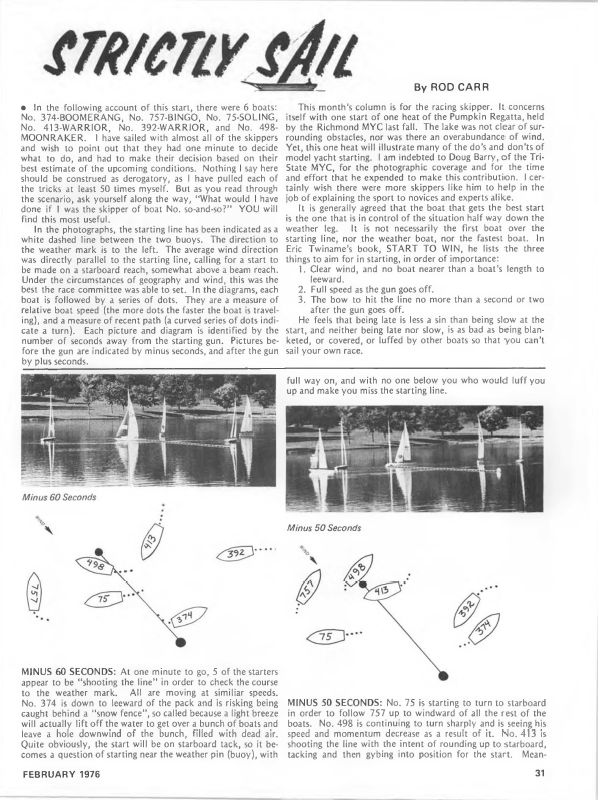
sharply and lost a good deal of her momentum. No. 392 is underway and looks like she wilt go high for the pin to avoid being backwinded by the fleet. There is no reason in such a position to blindly follow the pack. No, 392 should split off and see if she can get a shift, or by sailing in clean air, make up on the leaders who are fighting among themselves. No. 392 has the benefit of having only to concentrate on boat speed, and need spend no effort on tactics, as do the boats out in front. No. 757 is faced with trying to find a clear path to the line, and has elected to go above 498, who had no way on and a m= couldn’t luff up, but below 75 who would have to keep clear = of a leeward boat eventually. The projected path is marked on the diagram with a series of x’s. Minus 10 Seconds z = % Plus 15 Seconds A MINUS 10 SECONDS: With only 10 seconds to go, No. 75 is gybing for the line and looks like the one that will grab the start. % No. 413 is in a good position as she will wind up to weather of 75 after the start, and even if behind, will control 75’s moves. The 374/498 raft-up is almost dead tn the water, and I’m sure the skipper of the former is not the least bit consoled by the 2 foul points his opponent should have been awarded. No. 757 seems now has the problem of blanketed by the raft-up, of them and starting third to have a good turn of speed and getting to the line without being or alternatively going to windward behind 413. Down in the south 40, No. 392 has completed her tack and should begin moving, as she is in clear air behind the mess at the line. PLUS 15 SECONDS: Fifteen seconds after the gun, everyone has started properly except 392. But she is gathering way, and instead of bearing off, should be staying high, passing just to leeward of the pin and hardening up afterward. No. 757 has administered the coup de grace to the fleet and is now a boat length ahead of the opposition. This was primarily accomplished by the careful saving of her momentum in wide sweeping turns. The barrier formed by 413 and 75 is felt all the way back in the fleet. No. 75 is partially luffing 413 and preventing her from clearing her air. (Remember No. |, in our list at the beginning? No. 413 was on time and moving as fast as the conditions would allow, but the boat to leeward of her The Start! 2 . + y , proved her undoing.} The raft-up seems to be coming apart, but unable to get moving as a result of the blanketing of the 413/75 / duo. Bo START! When the gun goes off, No. 413 is coming along nicely, finally having found the air that had been helping 75. No. 75 completes her gybe, but in doing so, has turned rather FEBRUARY 1976 Continued from page 81 Plus 25 Seconds 33
while, No. 392 is circling to weather of 374 and the latter is still sailing away from the line, a risky choice in such light airs. At this point, No. 392 should have hardened up and driven directly at the weather pin, circled it and been in good position for a start with good way on. MINUS 30 SECONDS: Now the plot thickens. Both 757 and 498 suddenly pick up speed. This may have been due to a small puff loca] to them, or to the passage of a puff a ways up off the water, which only their tall rigs felt. In either case, it must have had an extremely limited extent, for the four other boats apparantly have not felt it. ears Lo . oer. | eos vow. aTM *, They are both on port tack and will have to gybe (turn their sterns through the wind) to Meer 4 i =e : ‘ _—_—_— — – – | head back toward the line. In such light airs as this, gybing is preferred to tacking. The former will help maintain momentum and keep the boat moving, while the latter will require the boat to coast, head to wind, and kill headway and maneuverability. No. 413 is tacking and will lose speed as a result, as is 392. At this time, 374 is in the catbird seat, she is sailing on Starboard tack, is aimed right at the pin, and controls everybody to weather of her. Minus 20 Seconds MINUS 40 SECONDS: No. 392 chooses to bear off and head away from the line, downwind from the pack. No. 374 begins 6 — % to tack to port, with which she hopes to be ready on starboard tack to drive for the tine and luff anyone above her … a good tactic if she can find a puff with which to get moving. No. 75 has tacked and chooses to re-cross the line by driving directly for the pin, since she is not able to do otherwise with the ar- rival of 413 on starboard tack (who has the right of way). No. 757 has placed herself directly to weather of 498, both of these boats being on port tack. MINUS 20 SECONDS: No. 413 has filled away on its new tack and has only to gybe around the pin on time to have a good start. No. 75 has felt the puff previously used by 757 and 498, and re-crosses the line, also ready to gybe onto starboard tack and a good start on the line. No. 498 has gotten herself into trouble. She has gybed around and at some point come down upon 374. If she made contact while gybing then 374 should protest since she was on a tack and privileged while 498 was not on a tack, ie. gybing. If 498 had completed her gybe, and then made contact, then 374 should protest since she is the leeward boat and 498 must keep clear. In these drifting conditions, | would say that 374 suffered a significant change in course and speed as a result of 498, who is entitled to 2 foul points for her error in either case. No. 757 has wise- ly stayed clear of 374, and is beginning a wide sweeping turn designed to conserve her momentum as much as possible. It looks as if 392 is still trying to tack and just does not seem to have the headway necessary to get the bow through the wind. And to make things worse, the “snow fence” is beginning to form to weather of 392, as many boats start to congregate at the weather end of the line. 32 MODEL BUILDER
STRICTIV SAL @ In the following account of this start, there were 6 boats: No. 374-BOOMERANG, No. 757-BINGO, No. 75-SOLING, No. 413-WARRIOR, MOONRAKER. No. 392-WARRIOR, and No. 498- | have sailed with almost all of the skippers and wish to point out that they had one minute to decide what to do, and had to make their decision based on their best estimate of the upcoming conditions. Nothing | say here should be construed as derogatory, as | have pulled each of the tricks at least 50 times myself. But as you read through the scenario, ask yourself along the way, “What would | have done if | was the skipper of boat No. so-and-so?” YOU will find this most useful. In the photographs, the starting line has been indicated as a white dashed line between the two buoys. The direction to the weather mark is to the left. The average wind direction was directly parallel to the starting line, calling for a start to be made on a Starboard reach, somewhat above a beam reach. Under the circumstances of geography and wind, this was the best the race committee was able to set. In the diagrams, each boat is followed by a series of dots. They are a measure of relative boat speed (the more dots the faster the boat is traveling), and a measure of recent path (a curved series of dots indicate a turn), Each picture and diagram is identified by the number of seconds away from the starting gun. Pictures before the gun are indicated by minus seconds, and after the gun By ROD CARR This month’s column is for the racing skipper. It concerns itself with one start of one heat of the Pumpkin Regatta, held by the Richmond MYC last fall. The lake was not clear of surrounding obstacles, nor was there an overabundance of wind. Yet, this one heat will illustrate many of the do’s and don’ts of model yacht starting. | am indebted to Doug Barry, of the TriState MYC, for the photographic coverage and for the time and effort that he expended to make this contribution. | certainly wish there were more skippers like him to help in the job of explaining the sport to novices and experts alike. It is generally agreed that the boat that gets the best start is the one that is in control of the situation half way down the weather leg. It is not necessarily the first boat over the starting line, nor the weather boat, nor the fastest boat. In Eric Twiname’s book, START TO WIN, he lists the three things to aim for in starting, in order of importance: 1. Clear wind, and no boat nearer than a boat’s length to leeward. 2. Full speed as the gun goes off. 3. The bow to hit the line no more than a second or two after the gun goes off. He feels that being late is less a sin than being slow at the Start, and neither being late nor slow, is as bad as being blanketed, or covered, or luffed by other boats so that you can’t sail your own race. by plus seconds. full way on, and with no one below you who would luff you up and make you miss the starting line. & % \ Minus 50 Seconds 4 % MINUS 60 SECONDS: At one minute to go, 5 of the starters appear to be “shooting the line” in order to check the course to the weather mark. All are moving at similiar speeds. No. 374 is down to leeward of the pack and is risking being caught behind a ‘snow fence”, so called because a light breeze will actually lift off the water to get over a bunch of boats and leave a hole downwind of the bunch, filled with dead air. Quite obviously, the start will be on starboard tack, so it be- comes a question of starting near the weather pin (buoy), with FEBRUARY 1976 MINUS 50 SECONDS: No. 75 is starting to turn to starboard in order to follow 757 up to windward of all the rest of the boats. No. 498 is continuing to turn sharply and is seeing his speed and momentum decrease as a result of it. No. 413 is shooting the line with the intent of rounding up to starboard, tacking and then gybing into position for the start. Mean31