- Title. Author. Summary

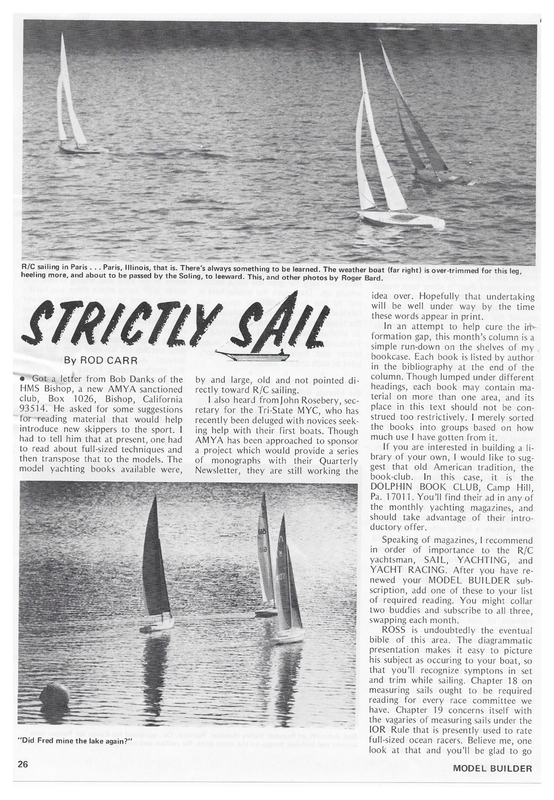
* we neste R/C sailing in Paris… Paris, Illinois, that is. heeling more, and about to be passed by the idea over. Hopefully that undertaking will be well under way by the time these words appear in print. By * ROD CARR e@ “Got a letter from Bob Danks of the HMS Bishop, a new AMYA sanctioned club, Box 1026, Bishop, California 93514. He asked for some suggestions for*reading material that would help introduce new skippers to the sport. | had to tell him that at present, one had to read about full-sized techniques and then transpose that to the models. The model yachting books available were, by and large, old and not pointed directly toward R/C sailing. | also heard fromjJohn Rosebery, secretary for the Tri-State MYC, who has recently been deluged with novices seeking help with their first boats. Though AMYA has been approached to sponsor a project which would provide a series of monographs with their Quarterly Newsletter, they are still working the In an attempt to help cure the in= formation gap, this month’s column is a simple run-down on the shelves of my bookcase. Each book is listed by author in the bibliography at the end of the column. Though lumped under different headings, each book may contain material on more than one area, and its place in this text should not be construed too restrictively. | merely sorted the books into groups based on how much use I have gotten from it. If you are interested in building a library of your own, | would like to suggest that old American tradition, the book-club. In this case, it is the DOLPHIN BOOK CLUB, Camp Hill, Pa. 17011. You’ll find their ad in any of the monthly yachting magazines, and should take advantage of their introductory offer. Speaking of magazines, | recommend in order of importance to the R/C yachtsman, SAIL, YACHTING, and YACHT RACING. After you have renewed your MODEL BUILDER subscription, add one of these to your list of required reading. You might collar two buddies and subscribe to all three, swapping each month. ROSS is undoubtedly the eventual bible of this area. The diagrammatic presentation makes it easy to picture his subject as occuring to your boat, so that you’ll recognize symptons in set and trim while sailing. Chapter 18 on measuring sails ought to be required reading for every race committee we have. Chapter 19 concerns itself with the vagaries of measuring sails under the IOR Rule that is presently used to rate “Did Fred mine the lake again?” 26 full-sized ocean racers. Believe me, one look at that and you’ll be glad to go MODEL BUILDER
back to your one-design or 50/800. HOWARD-WILLIAMS’ two. books are a bit more technical from the stand- point of sail construction. | think that if the average model yachtsman knew a bit more about what goes into a sail, there would be more satisfied skippers on the water. The photographs of sails full of air with various defects are quite valuable and should aid you in discussing your sails with your sailmaker. MARCHAJ, though over 10 years old, still remains the basic theoretical text concerned with sail aerodynamics. Each individual section is understand- able by itself, well documented with vector diagrams. The problem comes in trying to integrate all the different sections and come up with a path to follow in handling your sails. I’ve seen a number of skippers who read one small section, run out and take that recommendation to excess on their boat, and not realize that tuning and design is a continual series of trade-offs. Something that works well to weather, like a highaspect sailplane, will not work well ona reach or run. An all-round boat will not go to extreme in any part of its construction. However, MARCHAJ does al- low us to look at each part of the hull/ keel/rudder/sail system, and makes a good volume *nightstand. to squirrel away in the FLETCHER and ROSS, are two Americans who use photographs to great advantage to cover a plethora of different class boats. They stick strictly to tuning of an existing boat, discussing sheeting, sail shape and their effects on boat speed and balance. | believe this is the first book | would go back into a burning house to rescue, as it has provided me with much food for thought. WALKER, “Wind and Strategy”’, while not working down to the scale and altitude that we are concerned with, nevertheless gives a basic understanding of what is happening during the course of a day. | quiz the locals about the wind whenever | sail on “away water’’, and it is amazing that one is able to fit that kind of information into the more general picture that Dr. Walker presents. At the level of competition we have today, knowing which side of the course is most likely to feel new wind first early in the morning, or where it is likely to lose it in the afternoon, is very important. His comments on wind shadow by obstructions, and wind refrac- tion (bending) by banks and shores, is most pertinent to our needs. DESIGN Here we seem mostly concerned with hull design, and probably more with 50/800’s than any other class. | have found CHAPPELLE to be the most informative, as in Chapter 3, LINES, he takes the reader through all the necessary detail required to produce a complete description of a hull on a MARCH 1976 “Last one home pays for the grog.” flat piece of paper. Calculations of displacement, center of buoyancy, and so on, help the novice designer to quantify his design on the board. We will go into this further in the pages of MODEL BUILDER as | find new designers who are willing to share their efforts with us. In the near future we will be looking at the WING 50/800, design by Forrest Godby, of Mt. Kisco, New York. KINNEY has brought Norman Skene’s design philosophy up to date and produced a very handy reference with a lot of scantling and strength of materials data included. The short chapter on tank testing is a good introduction to that practice. HENRY & MILLER address themselves specifically to sailing yacht design and present a series of plots of acceptable ranges of parameters such as LWL vs. Beam, and so on. RACING AND TACTICS CURRY, though the edition | have was printed in 1948, still provides some very healthy observations on vessel performance as a function of sail shape and trim. The author was one of the first to record scientific tests made on sails ina wind tunnel under controlled conditions. His work makes a strong plea for maintaining the cambered shape of the sails all the way to the foot, with which | wholeheartedly agree. ELVSTROM should be one of the first 3 or 4 books you add to your collection. This volume is really a compendium, and touches on all areas of interest, from the boat itself, to sails, to trim and helming, and right on through tactics and racing rules. The author’s record as a racing skipper stands by itself, and his idea as a designer have recently culminated in a 6-meter which features a bulbous bow similar to that found on new supertankers. SCHULT, on the other hand, concentrates only on tactics, and is especially concerned with the one-on-one types of duels which seem to arise so often on the race course. My trouble is in finding skippers who have taken the trouble to learn enough to realize that they are getting ‘‘lee-bowed’’, for example. Most skippers are sadly lacking in elementary considerations of fleet or individual tactics. | will admit that Schult seems to be an entire barrage when a shot or two would be overkill, but here is another book which can be reread often with continual profit. PINAUD is a recent addition. It is a wide-scope book with a lot of photo work and an equally impressive text. It is not particularly cheap, though few books are these days. It has complete segments concerned with fleet racing as well as care and feeding of sail plans. The investment is well worth it. His treatment of the aerodynamic theory connected with sails is written in a prac- tical tone pointed toward results on the race course rather than elegant demonstration in the class room. As with all of my books, I like to be able to underline pertinent points that | have learned the hard way at the lake. For this reason | recommend that you buy the publications if at all possible. TWINAME (1974) covers basically the same territory as ELVSTROM, but ina slightly abbreviated form. On page 3 he presents a flow diagram titled ‘“‘First- Place Thinking”. The Caption starts out, ‘A race won is a series of decisions correctly made.’’ Much room here for di- rect application to your own particular style of racing. He puts the responsi- bility for winning performance directly, and wholly on the shoulder of the skipper, not on the boat. This is something many model yacht skippers still have to accept. The number of folks who go out and immediately bid on the winning boat at a regatta, are examples. The boat didn’t win the regatta, its skipper did!!! Twiname (1971) concerns itself directly Continued on next page. 27
Continued from previous page. with team racing, and | would recommend that club fleet captions take a good look at this as a style of competition which will liven up club activi- ties. : OAKLEY takes half of his book to go Over typical every racing solitary fitting on the boat. On our R/C versions, some of his advice is not applicable, but the value here comes from reading the words of a master skipper who continually stresses simplicity and strength in all fittings and gear. His approach to a big regatta, from preparation at home to the first gun of the first race, is quite valuable. We could certainly take heed of his suggestions, as I’ve Well, there you are. Not an exhaustive list of my holdings, but a culling of the ones that I’ve found most helpful. R/C yachtsmen must share with their full-sized counterparts a requirement for resourcefulness. Just because a printed page addressed to your problem of the moment does not fall into your hand is no reason to give up. Get out and dig, you might be surprised what is leaning up on the shelves at the local library. I’m indebted to Roger Bard for the photographs of the Paris, III. 50/800 regatta that accompany this article. No specific comments on the photos ex- cept to say that I think they convey the relaxing time that awaits anyone who goes “‘to Paris for the weekend.” Thanks again Roger. seen skippers show up at lake side and embarrassingly drive home to pick up a forgotten mast. A simple check list would have avoided that! Remember to send your $5.00 AMYA dues to the Secretary, 3917 Sunnyside Ave., Brookfield, III. 60513. BROWN, though previously mentioned in this column, deserves mentioning again. It is a programmed type of test that asks you for a decision in a tactical situation shown graphically. Then it provides you with an explanation of the proper response, and illuminates the appropriate controlling race rule. It is done utilizing the rules that you are And while you out, make sure have your checkbook you take out a bi- centennial year subscription to MODEL BUILDER. Send questions directly to MODEL BUILDER or to me at: Rod Carr, 7608 Gresham St., Springfield, Va 22151. BIBLIOGRAPHY the race BROWN, Alan, /NV/TATION TO SAILBOAT RACING, Simon and Schu- course, so that you rapidly get checked out on the do’s and don’ts that will CHAPELLE, Howard |., YACHT DE- most prone to encounter on help you avoid getting foul points. HALL is a loose-leaf vresentation with a skimming once-over-lightiv. treatment, sort of It is interesting, as many of the drawings are made as if seen from the water level, rather than from the Goodvear blimp. As many of our problem situations occur at the far mark, such a picture is a good help. He also provides a prototype log-book form which we should ail be keeping in order to improve our set-up and trim on our boats. OLD MASTERS These three oo0oks are each full of all sorts of hints and tips. On top of it all, they were each written by a skipper of long experience, whose anecdotal style of illustrating a point makes for enjoyable reading. They all touch on all of the major areas of our interest, and all make a strong plea that sailing is a sport that we engage in for fun…fun… FUN. McDERMOTT spends half of his vol- ume talking about specific sailing techniques on each leg of the course. His dis- cussion can be taken word for word and applied to your boat. SHIELDS is more conversational, but | learn from him without feeling that | am studying. KNAPP steers a middle course be- tween these two, and gets specific into some discussions of equipment presently available for modern racing boats. Any one of these three is worth its price. They are all trying to sing the same song, emphasis. _ but with slightly different Sabi . ster, (1972) Lib. Cong. No.-70-154095 SIGNING AND PLANNING, W.W. Norton and Co. (1936) copyright renewed 1964. CURRY, Dr. Manfred, YACHT RACING, THE AERODYNAMICS OF SAILS AND RACING TACTICS, Charles Scribner’s Sons (1948) ELVSTROM, Paul, EXPERT DINGHY AND KEELBOAT RACING, Quadrangle Books, (1967) Lib. Cong. No.67-25632 FLETCHER, Mike and Bob ROSS, TUNING A RACING YACHT, WWM. Norton and Co., (1974) American Edition. HALL, Major, COMPETITIVE SAILING, REFLEX AND DECISION, American Design Industries, Box M, Rochelle Park, N.Y. 07662 (1974) HENRY, Robert and Captain Richard MILLER, USN, SA/JLING YACHT DESIGN, Cornell Maritime Press, Inc. (1965) HOWARD—WILLIAMS, Jeremy, SAILS, John de Graff, Inc., (1971) HOWARD—WILLIAMS, Jeremy, RACING DINGHY SAILS, Quadrangle Books, Inc. (1971) Lib. Cong. No.-74- 143578 KNAPP, Arthur Jr.. RACE YOUR BOAT RIGHT, Grosset & Dunlap, (1973) Lib. Cong. No.-73-6898 KINNEY, MENTS OF Francis, SKENE’S ELEYACHT DESIGN, Dodd, Mead and Co., (1962) Lib. Cong. No.- | 62-16304 MARCHAJ, C.A., SA/LING THEO- RY AND PRACTICE, Dodd, Mead and Co., (1964) Lib. Cong. No.-64-13694 _ McDERMOTT, Thomas, MANUAL OF SAILBOAT RACING, The Macmillan Co., (1964) Lib. Cong. No.-6316113 OAKELEY,. John, WINNING, Quadrangle Books, (1971) Lib. Cong. No.-70143577 PINAUD, Yves-Louis, SA/L/ING FROM START TO FINISH, Adlard Coles Ltd., (1975) ROSS, Wallace, SA/L POWE R, Alfred A. Knopf (1975) Li b. Cong. No.77-154937 SCHULT, Joachim, TACTIC S AND STRATEGY IN YACHT RACING, Dodd, Mead and Co., (197 0) SHIELDS, Cornelius, CORN ELIUS SHIELDS ON SAILING, Prentice-Hall , Inc., (1968) Lib. Cong. No .-64-14011 TWINAME, Eric, DINGHY TEAM RACING, Adlard Coles Ltd. , (1971) TWINAME, Eric, START TO WIN, W.W. Norton and Co., Cong. No.-74-10814 (1974) WALKER, Dr. Stuart, WIND A ND STRATEGY, W.W. Norton and Co (1973)* Lib. Cong. No-72:6453=. © *** — Lib. Cong. No. refers to Library of Congress Card Number. 2