- Title. Author. Summary

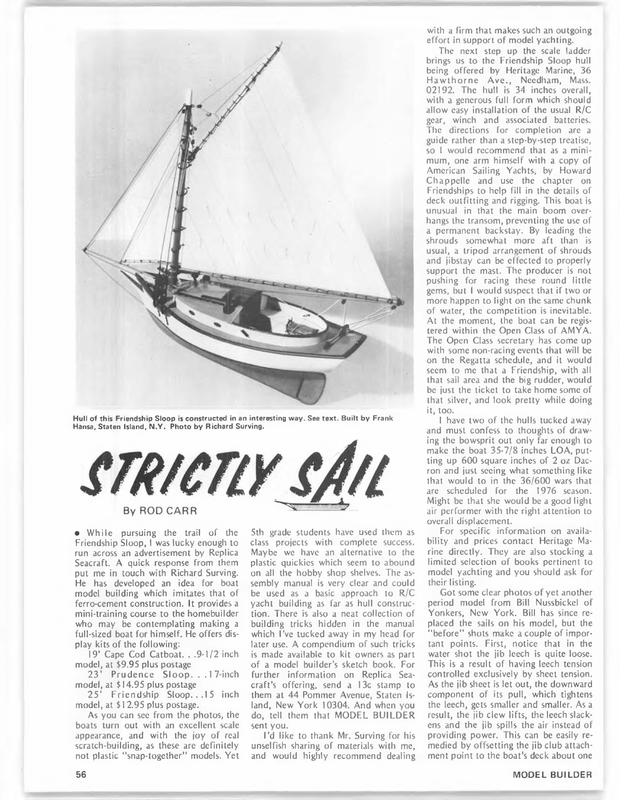
with a firm that makes such an outgoing effort in support of model yachting. The next step up the scale ladder brings us to the Friendship Sloop hull being offered by Heritage Marine, 36 Hawthorne Ave., Needham, Mass. 02192. The hull is 34 inches overall, with a gencrous full form which should allow easy installation of the usual R/C gear, winch and associated batteries. The directions for completion are a guide rather than a step-by-step treatise, so | would recommend that as a minimum, one arm himself with a copy of American Sailing Yachts, by Howard Chappelle and use the chapter on Friendships to help fill in the details of deck outfitting and rigging. This boat is unusual in that the main boom overhangs the transom, preventing the use of a@ permanent backstay. By leading the shrouds somewhat more aft than is usual, a tripod arrangement of shrouds and jibstay can be effected to properly support the mast. The producer is not pushing for racing these round little gems, but | would suspect that if two or more happen to light on the same chunk of water, the competition is inevitable. At the moment, the boat can be registered within the Open Class of AMYA. The Open Class secretary has come up with some non-racing events that will be on the Regatta schedule, and it would seem to me that a Friendship, with all that sail area and the big rudder, would be just the ticket to take home some of that silver, and look pretty while doing Hull of this Friendship Sloop is constructed in an interesting way. See text. Built by Frank Hansa, Staten Island, N.Y. Photo by Richard Surving. STRICTL , Al By ROD CARR @ While pursuing the trail of the Friendship Sloop, | was Jucky enough to run across an advertisement by Replica Seacraft. A quick response from them put me in touch with Richard Surving. He has developed an idea for boat model building which imitates that of ferro-cement construction. It provides a mini-training course to the homebuilder who may be contemplating making a full-sized boat for himself. He offers display kits of the following: 19’ Cape Cod Catboat. . .9-1/2 inch model, at $9.95 plus postage 23’ Prudence Sloop. . .1 7-inch model, at $14.95 plus postage 25′ Friendship Sloop…15 inch model, at $12.95 plus postage. As you can sec from the photos, the boats turn out with an excellent scale appearance, and with the joy of real scratch-building, as these are definitely not plastic “‘snap-together” models. Yet 56 5th grade students have used them as class projects with complete success. Maybe we have an alternative to the plastic quickies which seem to abound on all the hobby shop shelves. The as- it, Loo. | have two of the hulls tucked away and must confess to thoughts of drawing the bowsprit out only far enough to make the boat 35-7/8 inches LOA, putting up 600 square inches of 2 oz Dacron and just secing what something like that would to in the 36/600 wars that are scheduled for the 1976 season. Might be that she would be a good light air performer with the right attention to overall displacement. For specific information on availa- bility and prices contact Heritage Marine directly. They are also stocking a limited selection of books pertinent to model yachting and you should ask for sembly manual is very clear and could their listing. Got some clear photos of yet another yacht building as far as hull construction. There is also a neat collection of building tricks hidden in the manual which I’ve tucked away in my head for Jater use. A compendium of such tricks is made available to kit owners as part of a model builder’s sketch book. For further information on Replica Seacraft’s offering, send a 13c stamp to them at 44 Pommer Avenue, Staten |sland, New York 10304. And when you do, tell them that MODEL BUILDER period be used as a basic approach to R/C sent you. I’d like to thank Mr. Surving for his unselfish sharing of materials with me, and would highly recommend dealing model from Bill Nussbickel of Yonkers, New York, Bill has since replaced the sails on his model, but the “before” shots make a couple of important points. First, notice that in the water shot the jib leech is quite loose. This is a result of having leech tension controlled exclusively by sheet tension. As the jib sheet is let out, the downward component of its pull, which tightens the leech, gets smaller and smaller. As a result, the jib clew lifts, the leech slackens and the jib spills the air instead of providing power. This can be easily remedied by offsetting the jib club attach- ment point to the boat’s deck about one MODEL BUILDER
Prudence Sloop under construction, same method as Friendship. Bill Nussbickel’s gaff-rigged sloop with new sails and some recomm- Full size plans with each model. Photo courtesy Rudder Magazine. ended rigging changes. See “before’’ photo below. inch aft of the front of the club. Alternatively, a vang can be fitted, but the specific arrangement on Bill’s boat would require a little thought. Second we observe the main leech to be slack, and the main boom lifting severcly. If the wind were blowing from you down your line of sight, the pressure would be felt on the port side of the lower after mainsail, and on the star- board side of the upper part of the sail. This does not spell e-f-f-i-c-i-e-n-c-y. It does spell a need for a simple vang which might be fitted with a little fiddling. Such adjustments can be made, and made in such a manner that the appearance of the vessel is not damaged. Yet the performance of the boat will improve, and its appearance under sail when underway. We also have a shot of Bill’s boat with the new sails on it, and must thank him for the opportunity to use his fine little craft as an example of sail set and trim techniques. | might add as postscript, that just as in a racing boat, a forestay which is connecting the masthead and the bow should be left as loose as possible if its presence is re- will improve. No prototype ever let its Continued on page 84 Le Ew ae aS hen . ; Vie” main get into that configuration. It takes only a little more effort to insure that your scale sailing vessel looks scale —_ sloop. Both photos taken by Bill. APRIL 1976 Heritage Marine’s 34 inch LOA Friendship Sloop hull. See March ‘76 Classifieds. Lon Hocker built and took photo of this 6 ft. Massasoit coastal schooner. See text for more. 57
plished by a scaling up of the usual system we use in the sloop rigged boats. TRIDENT II RACING TRIMARAN FOR R/C The myriad of headsails were made non-overlapping so that they are selftacking. In order to generate enough FIRST PLACE IN 1974 AND 1975 36-600 ACCR REGATTAS *STYRENE HULLS AND DECKS ©36” LOA. ®SEWN DACRON SAILS °6.5 LBS. DISPLACEMENT ©36″” BEAM force to take the long hull through the eye of the wind while tacking, Lon *HARDWARE *600 SQ. IN. found it necessary to fit a rudder with 4 COMPLETE KIT (LESS WINCH)….. $100.00 COMPLETE PLANS SAIL CONTROL WINCH times the area of the scale one. But since it is underwater while sailing, he feels that it was worth the departure. A $50.00 CUSTOM R/C DESIGN FOR ALL BOAT SIZES — — — full-page article appeared in National Fisherman about Massasoit in the November 1975 issue. In it, the builder advised that one should measure the back of his stationwagon before laying the keel on a too ambitious project. With the opening of the 1976 regatta season, we are faced with continued pressure for fair competition at crowded regattas. I’m coming to the belief that 30 boats marks the maximum limit for reasonable size. This might consist of 3 boats per frequency, with 10 possible frequencies. How to decide on which 30 boats to let compete will be the subject of a report by AMYA Director Cas Woodbridge sometime this spring, for he has collected and collated the experi- POWER — 40 IN. LB. FAST ——5SSEC. VOLTAGE 4.8 – BV. LIGHT — —8 OZ. SMALL — 2°x2″x5” FIRST PLACE tN °73 S/B ACCR, ’74 36-600 ACCR & ‘75 50.800 ACCR SHEET EXIT GUIDES — $8.50 EACH Dewer inquiries invited PROBAR DESIGN P.O. BOX 639 model biplane, with the size being the only difference. You have to concern yourself with dihedral, proper wing incidence in both upper and lower wings, and the wing tips must be in equal distance from the tail post. | was fortunate in having two designees from my EAA chapter who were willing to give so ESCONDIDO, CA. 92025 much of their time and knowledge. You may not have any idea how much fun it is to build a full-size airplane, or the amount of valuable information one gathers from its education aspect. The wealth of knowledge garnered should with the winner being truly the fellow who beat every body? help So far, the best bet is a diabolical patchwork called the Mark 30. This was developed in the winter of 1975, and in making better flying scale models. . .at least | certainly hope so! Note: June 20th is the date for the Sailing Yachts For Radio Contral 9 ‘¥%q in $38.95 seam letter categories with only one or two people are minimized. The better you are able to do this, the more nearly equal the heat sizes will remain. 2. Make up a 3×5 Card, listing the heats is 74.5 inches LOA and that each skipper sails. For example, CARR SAILS VALKYRIE 50/800 CLASS LENGTH letter (a, b, c…) completely so that carries 14 pounds of fead in the fiberglass shell. Only two channel radio is presently fitted, and winching is accom- SAIL AREA GOO sq In AMYA Sailing…… Continued from page 57 foot the hull 36 in BEAM has yet to have been improved upon by 4 different computer types who tried. In Figure 1, is the Mark 30 Heat List. A square with a slash in it is a heat that is sailed by a competitor. 1. Split the skippers into groups of three according to frequency. Skippers on 53 mHz can be saved till tast to fill up open holes. Try to fill each sasoit. At a scale of 1/3 inch equals | AMYA 36/600 CLASS LENGTH Flightmasters R.O.W. Scale Contest at Lake Elsinore. e quired for scale appearance. Contrive to let the jibstay carry the whole job of supporting the mast in a forward direction. For in so doing, it will become taut and straight, allowing the jib to set with the shape the sailmaker intended. Last in our presentation of scale efforts in Lon Hocker’s magnificent Mas- \, TAHOE 600 ments from last season. But now that you have thirty boats, how to treat them fairly? How to arrive at the end §0 In 11% Ia $74.95 Salt AREA BOO sq in Complete kits include molded plastic hull and components, all rigging, finished sails and semi-firished wooden parts. TAHOE SAIL SYSTEM $27.95 VALKYRIE SAIL SYSTEM $35.95 VICTOR. PRODUCTS *: 7607 GRESHAM ST. SPRINGFIELD, VA. 22151 STAN AL ON All CARR Finest American-made Vinyl, press-on numerals ARR Santa Barbara – East Coast 36/600 West Coast – insiqnia. – $30.00 12-Meter – – Calif residents add 6% tax for a Scale – $30.00 jg-Meter 11715 Adenmoor Ave. Downey, Ca. 90241 84 sallicloth. and Heat sealed edges eliminate fraying. Coated staintess steel] (ibstay Instalted. Rolled-edge grommets In tack,clew & head. Bolt-rope mafins’! luff mast attachment. Vanguard “J”-boat DEALERS WELCOME SAILS DACRON vessels, quote, = – $30.00 – 410.00 special and for $25.00 purpose our 10-Rater ~« ~ £30.00 – £10.00 Internat. A-class- Star 4S £35.00 – – – TAA Petre] a – $30.00 boats, one-of-a-kinds: 1975 @rochure and Used WHEN CONTACTING ADVERTISERS, TELL ’EM MODEL BUILDER SENT YOU! – So/80a(M-class) $30.00 Write Sails List. MODEL BUILDER
A2:5-6-8-11 (Make up duplicates for as many times as you plan to cycle through the Mark 30.) 3. On regatta day, check in the skippers right on the sheet. If there are no- shows, fill up the holes with skippers from below as frequency will allow. [ usually make a list of each entrant 4. and the frequencies he could sail on. At the skipper’s meeting, the skipper’s names can be put on the appropriate card and he ts ready to sail. 5. The racing can be stopped after 6, 9, or 12 heats, with each skipper having sailed an equal number of races. These are good times to update a scoreboard that you have at lakeside. 6. For a one-day event, plan on running through the Mark 30 twice, a twoday event, either 3 or 4 times. Fill out the Mark 30 (Steps 1-4 above) differently for each round. That is, switch frequencies as possible, and never let a skipper be the same letter designation unless absolutely un- avoidable. (This would be the case of rd three skippers, each with only oneand-the-same frequency in a 4-round event. But since everybody else would be getting mixed up well, it would not seriously bias the set up.) oy) 7. On the score sheet, the upper left half of the hash marked square is where you put the score for that heat, the lower right half is where you add that heat score to the previous score to keep a running cumulative score. 8. We have found it handy to reproduce the left-hand column with the skip- PEA POD BY OESIGNWED Tom Protheroe per names and boat numbers on a manila cardboard which can be slid along from heat to heat. It makes book-keeping much easier and helps to avoid errors. 9. We also have found that a clip board, with one 8 x 11 sheet of paper for each heat, is a useful way to keep the actual finishes and protests which may then be transcribed onto the master score sheet. Often the scoring tent is some way from the finish line, and yelling back and forth ts not condusive to keeping the skippers calm. The Master Score Keeper should have nothing to do but enter the data from the heat finish sheets onto the master score sheet. And he or she should be declared off-limits to skipper inquires. The Mark 30 can be improved upon, and there is a simple way to analyze a new heat list to see if it is better, ie, to see if it does a better job of having each skipper meet every other skipper an equal number of times. If you have a heat list, contact me and let’s see if it is an improvement. The analysis system was published in the winter 1974 AMYA Quarterly Newsletter. Next month we will present Forest Godby’s 50/800 design, “Wind,” and discuss 50/800 hull shapes in general APRIL 1976 z FINISH IN FRONT You wil! lead the fleet, in any class you race in, when you sail a Leisure Products boat. In the East Coast 12 meter class, our hulls have won more trophies than all other manufacturers combined. Our EC/12 kit has all spars, rigging and fittings, fiberglass hull and deck, rudder, detailed instructions and Carr ready-to-race sails. It needs only R/C gear, sail control unit and ballast. Lead the parade to the finish line ina Leisure Products EC/12. Complete EC/12 meter kit — $174.50 We also have available: HUSON 36 – A ‘mini’ ocean racer for competing in AMYA 36/600 class. Full kit (like EC/12, above) – $125.00 YANKEE 50/800 – A lightweight planing racer (as described in Model Builder). Sells as a hull/keel/rudder semi-kit combination. $55.00 LEISURE PRODUCTS 6920 Braddock Rd., Annandale, Va. 22003 WRITE or CALL 213-661-7928 $29.95 FREE CATALOG KIT FEATURES @ COMPLETE @ SAIL CONTROL MACHINED WOOD e@ COMPLETE BASIC @ Ait @A RiC RIGGING BASIC & AND A COURSE SAILPLANES MECHANISM METAL HARDWARE FULL IN & PARTS PACKAGE SAIL PLAN SAILING ACCESSORIES “AVATAR 72 $32.95 CURIO $44.95 DEALERS & DISTRIGUTORS M.S STD. TERM LIMITED FO. BOX 39748 L.A. CA, WHEN CONTACTING ADVERTISERS, TELL ’EM MODEL BUILDER SENT YOU! 90039 85
THE LIBERATORS ARE HERE! Ge e >) UAE OBS (M006 28-° MUSEUM SCALE … WING SPAN 90 INCHES, FOR FOUR .15 TO .25 ENGINES SEND STAMP FOR RETRACTS … FOWLER FLAPS…BOMB BAYS… RETRACTABLE BALL TURRET DETAILED BROCHURE MOLDED CANOPIES… TURRETS…COWLS… TURBOCHARGERS… MACHINE GUNS AND NEW CATALOG. BALSA CONSTRUCTION … FOAM WING … FUSELAGE ASSEMBLY JIG JACK STAFFORD MODELS ¢ 12111 BEATRICE ST. e CULVER CITY, CA. 90230 e BOATS e TANKS pod clear, the parachute can open and drag the pod off the glider boom. The thrust ring is inserted by using an engine of the size you plan to use to push it up into the pod, after running a line of glue inside the back end of the tube. Leave about a 1/4 inch ofengine projecting. e@CARS e SUPER AIRCRAFT VERSION electric throttle To fly prep the recovery system as shown in the instructions included with the engine. Friction-fit the engine in the pod by wrapping it with masking tape Electronic Speed Control with full variable speed forward, until it makes a fairly tight fit. Launch- reverse, DYNAMIC center stop. Full 15 ampere capacity. ers are described in the Centuri and FSI catalogs (incidentally, you can get one Actually conserves current. Send for free info: from INTERNATIONAL MARINE EXCHANGE 2450 LOS SERRANOS DR., LAGUNA NIGUEL, CA. 92677 terms. Remember to send in your $5.00 dues to the AMYA Secretary, Bud Salika, 3917 Sunnyside Avenue, Brookfield, tl. 60513. VI field questions either directly at 7608 Gresham St., Springfield, Va. 22151 (Send a self-addressed, stamped envelope}, or in care of MODEL BUILDER. e Rocketry …. Continued from page 32 pod, the side opposite the boom attachment; this helps prevent the clips which connect to the engine ignitor from dropping off and catching on the stabilizer, an embarrassing occurrence. The pylon is balsa, the same thickness as the glider boom, and the alignment plates on either side of i1 are thin plywood. The thrust tongue is cut from the glider boom, in the shape shown, and glued to the pylon. The alignment plates are then carefully glued in place, and serve to keep the boom and pylon paralle! dur- ing powered flight. Once the whole assembly is dry, test-fit it to the boom. It should slip out backwards with a very slight tap on the nose. If it’s too tight, sand the sides of the boom a bit, or sand the back of the thrust tongue slot. 86 Assemble the glider as per the instructions, except for fitting the rudder to the underside of the fuselage to avoid getting it fried off! Trim for a slight stall, which will improve the boost characteristics; experience will soon give you other ideas to try. Oh, yea, build it extra strong; sooner or later everyone zorks one of them into the ground. The pylon should support the pod at least a 1/2 inch above the wing surface, as shown. A little higher is allowable, but too much will cause the whole business to nose down under power. The length of the pod Is rather uncritical, as long as it is at least 1 to 2 times the wing chord. Longer pods give improved boost stability. They also make it easier to eject a parachute properly. Note the string, knotted and glued to the joint between the pod and the pylon. This string (heavy carpet thread is fine, or fishing leader) slips past the nose cone and is tied to a short piece of shock cord, which is attached to the nose cone. The reason for this outside attachment is simple; in case the shock of parachute ejection doesn’t kick the Centuri at Box 1988, Phoenix, Arizona 85001). You hook her up to a car battery or other power source, (NO fuses!) clear the area, hit the button, and you’re underway. Setting up for the next flight is simple; collect the pieces, pul! the old engine, and start over again. So give it a try, if it interests you. It could turn out that, once you get a !ittle exhaust smoke up your nose, you’ll find that you have another exciting flying hobby on your hands! e Choppers …. Continued from page 25 When it came time to design the main rotor head and associated components for control, Charlie had some unusual ideas. Rather than experiment with a variable speed motor unit which would absorb power without giving performance in return, he chose to run the main rotor at full speed and control the vertical movements with a collective pitch set-up. This was accomplished In the time-honored fashion of sliding the swash-plate up and down on the main rotor shaft and connecting it to blade pitch arms. The rotor head itself was machined from Delrin, a space-age plastic, and holds a pair of built-up rotor blades with a diameter of 38 inches. The main rotor blades are constructed in the same manner as a sailplane wing, WHEN CONTACTING ADVERTISERS, TELL ‘EM MODEL BUILDER SENT YOU! MODEL BUILDER