- Title. Author. Summary

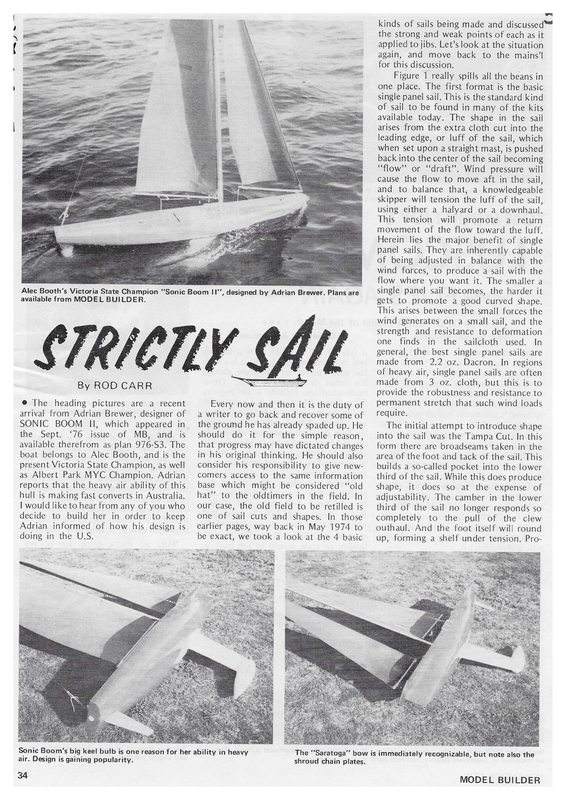
aaa kinds of sails being made and discussedTM the strong and weak points of each as it aay epi applied to jibs. Let’s look at the situation again, and move back to the mains’! for this discussion. Figure 1 really spills all the beans in one place. The first format is the basic single panel sail. This is the standard kind of sail to be found in many of the kits available today. The shape in the sail arises from the extra cloth cut into the leading edge, or luff of the sail, which when set upon a straight mast, is pushed back into the center of the sail becoming “flow” or ‘draft’. Wind pressure will cause the flow to move aft in the sail, and to balance that, a knowledgeable skipper will tension the luff of the sail, using either a halyard or a downhaul. This tension will promote a return movement of the flow toward the luff. Herein lies the major benefit of single panel sails. They are inherently capable of being adjusted in balance with the wind farces, to produce a sail with the Alec Booth’s Victoria State Champion ‘“‘Sonic Boom II’, designed by Adrian Brewer. Plans are available from MODEL BUILDER. By @ The heading are a gets to promote a good curved shape. This arises between the small forces the wind generates on a small sail, and the strength and resistance to deformation one finds in the sailcloth used. In general, the best single panel sails are made from 2.2 oz. Dacron. In regions of heavy air, single panel sails are often made from 3 oz. cloth, but this is to ROD CARR pictures flow where you want it. The smaller a single panel sail becomes, the harder it recent arrival from Adrian Brewer, designer of SONIC BOOM II, which appeared in. the: Sept. 76 . issue. ;of MB -and. is available therefrom as plan 976-S3. The boat belongs to Alec Booth, and is the present Victoria State Champion, as well as Albert Park MYC Champion. Adrian reports that the heavy air ability of this hull is making fast converts in Australia. | would like to hear from any of you who decide to build her in order to keep Adrian informed of how his design is doing in the U.S. Every now and then it is the duty of a writer to go back and recover some of the ground he has already spaded up. He should do it for the simple reason, that progress may have dictated changes in his original thinking. He should also consider his responsibility to give newcomers access to the same information base which might be considered “old hat” to the oldtimers in the field. In our case, the old field to be retilled js one of sail cuts and shapes. In those earlier pages, way back in May 1974 to be exact, we took a look at the 4 basic provide the robustness and resistance to permanent stretch that such wind loads require. The initial attempt to introduce shape into the sail was the Tampa Cut. In this form there are broadseams taken in the area of the foot and tack of the sail. This builds a so-called pocket into the lower third of the sail. While this does produce shape, it does so at the expense of adjustability. The camber in the lower third of the sail no longer responds so completely to the pull of the clew outhaul. And the foot itself will round up, forming a shelf under tension. Pro- sa Sonic Boom’s big keel bulb is one reason for her ability in heavy air. Design is gaining popularity. 34 The “’Saratoga”’ bow is immediately recognizable, but note also the shroud chain plates. MODEL BUILDER
Hooked leach on a Newport 12-Meter main, caused by too tight Resewn leach tabling, and proper battens in place. See text. leach tabling. Battens removed. ponents of this sail form tell you that this shelf is acting as an ‘end plate”’, keeping air from escaping around the foot of the sail. Should you desire it, a single panel sail can be recut into a Tampa Cut, but the reverse is usually not attempted. The benefits of the Tampa Cut are generally believed to be increased drive in light airs, since the wind does not have to deform the sail to the airfoil shape before producing the differential pressures that result in thrust. It does have the small disadvantage that the foot can never be completely flattened, but if used as a light air sail, this should never be noticed. The nextlevel of sophistication was to spread the broadseaming to the luff of the sail. Now we have really started to build the shape in. A good sailmaker will do the cutting for the broadseaming, sew it up and then attend to the question luff round. California Cutting, as this is called, since Chuck Black was its first major promoter, seems to be just wonderful for use in jibs. It seems that a very tight leech develops when a sail is built this way, and when hit by a gust, the middle of the sail bulges, the leech tightens even more, and hooks to weather, backwinding the main slightly. This is precisely what one would do to keep the boat on her feet, yet the California Cut jib does it automatically. When used in mainsails, however, the same process seems to produce a vicious temporary weather helm which can overpower a rudder quite easily. The California Cut isnotnearly so adjustable as the previous two, and can be obtained in forms with too much camber, or too little, or not in the right place, if careful specifications are not made. point that it will have a definite peak performance at one windspeed, and be less efficient on either side of that speed. It can mean superior performance, as long as the wind is steady and typically over a range that is 4-5 knots either side of the “magic speed.’ This can mean less versatility, and may require a continual switching of rigs as wind builds and dies during a day-long regatta. California cuts are made in both popular Dacron weights, since they can be tailor-made for a specific range of wind. Finally, we get to the fully-paneled sails that some skippers are using. In sails of this type, shape can be designed into the sail in a very precise manner, through the tapering of the seams, and the tapering of the panels themselves. The result can be a sail which will exactly match a limited range of wind, more limited than the California Cut. It is a sail which cannot be adjusted much at all, save for tensioning the luff to avoid the draft moving too far aft, though the sail should have been built for that wind speed already. The surface roughness has increased measurably, and the more panels that are used, the worse it gets. Typical sails of this kind use panels in the 10 to 12 inch width, which makes an EC/12 main consist of 5 or 6 panels. There are cosmetic advantages, since you can have sails made in arainbow of colors and schemes. If you want your cake and would like to eat most of it too, you can specify that the sailmaker make you a paneled sail, but not taper any of the seams. He is in effect making a flat sail out of anumber of flat pieces (maybe multi-colored), then proceeding to cut out a single panel sail with all its adjustability, and the bright appearance. ‘Tis a neat trick, but not cheap, as the time required for such a sail is the time for paneling. The main point of trouble with all sails seems to wind up being the leach shape. The leach of the main, like that of the jib, is the longest side which is unsupported except at the head and clew. The shape it takes is the result of a number of forces: its effect on mast shape. The actual construction of the sail at the leach will have an effect too. In many of the larger classes, or on tall 50/800 rigs, it is standard practice to provide additional strength to the leach by tabling. it, through a separate strip of cloth folded over the edge and sewn down, or just folding the leach over and sewing it. Whichever is done, it is common to see a “hooking leach” start to develop (Photo 1). The cure is really two fold. First, don’t sew the tabling tightly, give Continued on page 96 aN = ; see | increase in surface roughness caused by all the seaming and sewing along the NOVEMBER 1976 wind pressure, b) sheet tension, c) traveler location, d) vang tension, e) backstay tension and The benefits derived from having the shape just sitting there waiting for the wind are partially offset by a drastic leading edge of the sail. Smooth airflow is important on sails of the size we use, and each increase in surface roughness is going to result in a disturbance of easy airflow and an increase in drag. A California cut sail is also getting to the a) SINGLE PANEL TAMPA CUT CALIFORNIA CUT PANELED FIG. 1 35
Sailing…… Continued from page 3B it a chance to adjust itself, use light tensions on the sewing machine. Having done that, assure that properly matched battens are put in the pockets. Photo 2 shows the sail with a resewn leach tabling as well as proper battens. To be picky, I’d take the one out that is in the second white panel from the bottom and replace it with one that is slightly more flexible. Bad battens are almost worse than no battens. Ones that are too tight will make the whole leach area hard, flat and not smooth in transition from popular bolt-rope method of mains’! luff attachment. But, the inside of the track is servo could so adjustments smooth, be that an ordinary used while. for luff tension ,underway. ‘SPARS sell for $3.@@ The a linear foot, and are available in lengths up to 85 inches. Should you decide to try one, just remember how much time you spent making your last wooden mast, and figure out how cheap the GOLDENSPAR really is. If you order, tell John that | fuller sent you (By way of MB, of course. wen), going to want a recommendation. Based on 4 years of testing and analysis, | Now is the time to renew your membership in AMYA. The American Model Yachting Association’s 1976 elections have given us a new set of officers who are raring to go with the business of organized R/C yachting. They can’t properly represent you if you are the mid-body of the sail. A discussion of battens can be found in Model Builder December 1974, p. 30. With all these options, somebody is think that the best all-around perfor- mance can be had from a combination of cuts. For all normal sailing, and by that | mean up to the point where the wind blows steadily at above 18 knots, and for any boat smaller than a J-boat, | would choose a fairly flat, California Cut jib of 2.2 oz. Dacron. If | absolutely had to have some sort of color coding for identifiability, | would have the sailmaker do some striping on the jib. Behind the mast | would put a 2.2 oz. fempercerenanrs® with a tabling on the leach (SINGLE PAWEL) As long as we are giving out prescrip- | tions, let me add that | would use one of John Reynolds’ (3010 Chris Lane, Orlando, FL, 32806) GOLDENSPAR | aluminum masts. These are absolutely | the best thing I’ve seen yet. Light, but | plenty strong, and they take a very repro- ducible bend under backstay tension, if you contrive to mount your hardware without drilling holes in the mast. We’ll go into the fitting end of it next time around. The GOLDENSPAR has z generous sail track, allowing use of the not a member and let them know of your interest. Send your $5.00 annual dues to AMYA Secretary, Bob Crysler, 2709 So. Federal Highway, Delray Beach, FL 33444. Tell him that | sent you from Model Builder. 1 will continue to field questions and comments at: Rod Carr, 7608 Gresham St., Springfield, VA. 22151, or in care of Model Builder. If you want a direct answer, please enclose a Stamped envelope. -X, self-addressed, =~ r —–. a _ 3. ——-e 2 _-osS “ee ——a a tah a eS SS — ~ as a —r rts ~sa o aw PO rr aoe ry “war exe es,a – 3 -v4 n a) ~ , *) af – 7 Y ” we iz 54°. ot nT ee o> ee aSpiSalt rewrae ed smi Mewadnay sePeehoeau 2a