- Title. Author. Summary

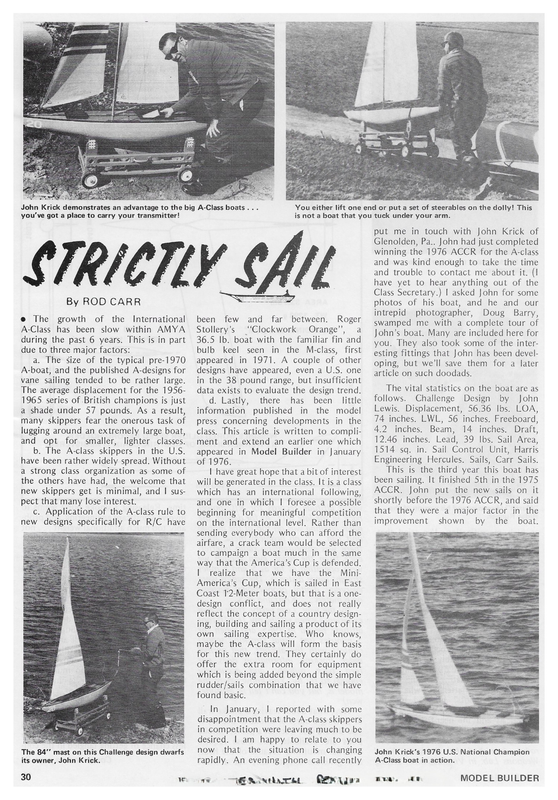
Sas John Krick demonstrates an advantage to the big A -Class boats… you’ve got a place to carry your transmitter! You either lift one end or put a set of steerables on the dolly! This is not a boat that you tuck under your arm. put me in touch with John Krick of Glenolden, Pa.. John had just completed winning the 1976 ACCR for the A-class and was kind enough to take the time and trouble to contact me about it. (| have yet to hear anything out of the By e The growth Class Secretary.) | asked John for some ROD CARR of the International A-Class has been slow within AMYA during the past 6 years. This is in part due to three major factors: a. The size of the typical pre-1970 A-boat, and the published A-designs for vane sailing tended to be rather large. The average displacement for the 1956- 1965 series of British champions is just a shade under 57 pounds. As a result, many skippers fear the onerous task of lugging around an extremely large boat, and opt for smaller, lighter classes. b. The A-class skippers in the U.S. have been rather widely spread. Without a strong class organization as some of the others have had, the welcome that new skippers get is minimal, and | suspect that many lose interest. c. Application of the A-class rule to new designs specifically for R/C have been few and far between. Roger Stollery’s “Clockwork Orange’, a 36.5 lb. boat with the familiar fin and bulb keel seen in the M-class, first appeared in 1971. A couple of other designs have appeared, even a U.S. one in the 38 pound range, but insufficient data exists to evaluate the design trend. d> tastiv. = there “has been: ‘little information published in the model press concerning developments in the class. This article is written to compliment and extend an earlier one which appeared in Model Builder in January of 1976. | have great hope that a bit of interest will be generated in the class. It is a class which has an international following, and one in which | foresee a possible beginning for meaningful competition on the international level. Rather than photos of his boat, and he and our intrepid photographer, Doug Barry, swamped me with a complete tour of John’s boat. Many are included here for you. They also took some of the interesting fittings that John has been developing, but we’ll save them for a later article on such doodads. The vital statistics on the boat are as follows. Challenge Design by John Lewis. Displacement, 56.36 Ibs. LOA, 74 inches. LWL, 56 inches. Freeboard, 4.2 inches. Beam, 14 inches. Draft, 12.46 inches. Lead, 39 Ibs. Sail Area, 1514 sq. in. Sail Control Unit, Harris Engineering Hercules. Sails, Carr Sails. This is the third year this boat has been sailing. It finished Sth in the 1975 ACCR. John put the new sails on it shortly before the 1976 ACCR, and said that they were a major factor in the improvement shown by the boat. sending everybody who can afford the airfare, a crack team would be selected to campaign a boat much jn the same way that the America’s Cup is defended. | realize that we have the Mini- America’s Cup, which is sailed in East Coast 12-Meter boats, but that is a onedesign conflict, and does not really reflect the concept of a country designing, building and sailing a product of its own sailing expertise. Who knows, maybe the A-class will form the basis for this new trend. They certainly do offer the extra room for equipment which Is being added beyond the simple rudder/sails combination that we have found basic. In January, | reported with some disappointment that the A-class skippers in competition were leaving much to be desired. So The 84” mast on this Challenge design dwarfs its owner, John Krick. 30 ts now | am happy to relate to you that the situation is changing rapidly. An evening phone call recently 7 “VER SNek et «= BE 2 John Krick’s 1976 U.S. National Champion A-Class boat in action. Aw. 48 MODEL BUILDER
At any rate, congratulations to John and many photos thanks and for providing information on the he 1976 ons oh BE: g* As a further incentive to new skippers who may be looking for a “Sound Adrian Effect.” the Sis \ of Mieke x 3k is ‘ Si6 : Wg : Brewer design, As with 4 ui from other classes who would like to build a boat from the ground up, we new of SEO Qs: : growing class to enter, or for skippers a 26 the National Champion. present a O’s ike “Sonic | Boom II” 50/800 we recently featured, ye the Sound Effect is a well-tested competition design, yet of recent vintage, with the lines scarcely three years old from drawing board to bringing home the silver. She is well drawn for good sailing in all conditions, and all-round performance is certainly something to be considered if one is going to invest in a boat for this class . . . although | will say that supposed light-air boats are ee 3 ; i i ENG f | | , I fica t na 1 i i z – ei : eet: | if aT 1 | i ! \ | q Ay I : as a ey . an Teo i Pad f i t S x a 4 eB Z | N PAS ~ x ‘ NI doing better and better as they learn to cope with stormy conditions, and provide the proper sail handling techniques as we have previously discussed (Model 1 g t | + } | po | | i | | ‘Cougar’ was not ready until the 1972 Australian Championships (vane). ‘To cut a long story short, | could not have been more pleased with / | 2 g M ns record so far is; Sy) a) 3 b|p vey it | | | 4 U > L ‘Cougar’, | have i | b < par Wy | W | i her lines accompany this article. radio control was beginning the changes made to 9 ‘Cougar’s’ lines were as follows: } i \ i ho 1 , nl hy pa Rig Sew e Wy S ks a Ak . / RR Led Nee Fe ie uals& eau saa wl ee | IN dq loubs ed] Mesa aH ea | aed I DN i fol i | ie i \ he Vi bo fl WA 5 3 Vane \ Ar \ 8 8 35 1 ies de 313 pila ie SiR : SeV re’ eed VU neemi Lt\ I Addy S N Pen ete \ i’ r é pest een |! Wiles ERE. dipe go Sekeas Rak ¥ tual Wi MA eQees aa3 k 38 3 53 e BY Nod SPs | Rants 2 ay3 YER ERY N na a Eso ¥ Sess N | M 4 Se i1% / al Ks to move rather rapidly in Australia, it was felt that this point should be a major factor when evaluating any changes. Briefly, | eel | | | Lt l othckapat | Hee Htet Aya ‘Tf dimensions, and performance in general and felt that a revision could be rewarding. The result was ‘Sound Effect’, and have produced a very efficient boat. As (} { + ; \ 1 | / NQe coy inet l by Re | \ out as the best all-rounder. About two years ago, | re-analyzed her lines, “The changes were minor, but they | 1} | {yet designed but the ‘Cougar’ type of boat has stood thy ae QXey Fe (aARE Berton niagara tle \ & oye f S 0 a : {| } \! i Ihe \! i WI if ek +4 teak a S 1972 many ‘A’s as my experience increased, | ia Yee hanes y Hie Feel i ie lage first. “Since Ly pa [hoy s her (Adelaide) second, 1973 (Sydney) third, 1974 (Melbourne) first, 1975 (Adelaide) q ‘| 4 f Pej if X ee / en i cs f aU Cys ae / i 5 | ve L | le f * / ~ xs / ff Ss / iY eye f > aks 4 Zé | | speed and handling, and her Australian Championship | { | N Q i | many existing designs were studied and dimensions analyzed before | finally put pencil to paper. good ballast ratio, and well balanced to windward. The lines were drawn, but because of tertiary studies and a general lack of spare time, the prototype F ) ~ + Wl ‘Into ‘A’ Class design. Prior to this, | had “Right from the start | had decided that my first design would be very conventional, both in shape and dimensions, but nevertheless, be easily driven with a | ge Here are the designer’s comments on Sound Effect: ‘About ten years ago, | ventured | i aN Builder Oct. 1976). confined myself to the ‘M’ Class, as its rule is fairly simple and can accommodate a wide range of shapes and ideas. The ‘A’s however, were different, and re bie 7 : R 8 ke x <~ 3 ees TSS3 3 Ze c= § ac w~ Continued on page 70 DECEMBER 1976 FULL SIZE PLANS AVAILABLE — SEE PAGE 112 31
Sailing ...... Continued from pa ge 31 ment, measured L.W.L. (inches) contributed to increased sailing length, but did increase windage. 3. A ‘fence’ was added under the hull, aft of the keel, which was hoped would help control the directional Stability of the boat downwind. It was also felt that if the enormous power generated in the quarter wave on a broad reach cou ld be The waterline penalty and remained the same. beam flip open to any page, you'll be hope lessly »sidetracked from your goal. Suffice it to say in these pages that the maim: key for the formula is load waterline length coupled with displa ceoa MAX. MIN. (sq. in.) 49.0 41.0 51 1830 1700 52.0 44.0 52 1790 1670 55.0 47.0 53 1750 1640 58.0 49.0 54 1710 1610 61.0 52.0 55 1670 1580 64.0 55.0 56 1640 1550 67.0 58.0 1610 1520 + 3.5 inches. For a this works out to be excess over this js and added directly works such a stiff bulb keels in this class is one of putting as much of the mass of the boat into the bulb which hangs from a very stubby keel fin compared to mo dern 50/800’s. In part, we have seen the fin and bulb beginning to be used now that lightweight but strong fiberglass hul ls For those interested in a full discussion of the A-class formula and_ its and if you are not firm in your resolv e to read about the A’s, or you just idl y MAX. MIN. (Ibs.) 50 and are four ‘Sound Effects’ currently sailing in my own Club, one of them being the 1976 State and Club Champion.”’ Beware . .. they also cover the 10-Rater classes and 50/800’s in the same book, SAIL AREA area at a rapid rate. So the swit ch to fin ‘‘The alterations were a great success and the problems in ‘Cougar’ are no longer apparent in ‘Sound Effect’. There application to actual designs, there is no better reference than ‘Model Raci ng Yachts’ by — Priest and Lewis. DISPLACEMENT control on draft that rarely is a penalty ever taken, since it acts to redu ce sail was incurred, waterline area-of the mainsail to be 0.16 x LWL 52 inch LWL boat, 11.82 inches. Any multiplied by three to the rating. This ‘The displacement was reduced from 55 Ibs. to 50 Ibs. as a result of these changes, which also reduced the sail small triangle The maximum draft js only allowed by moving it further aft, then the stern would lift rather than squat. a sail plus 0.85 times the area of the foretriangle (formed by the forestay, deck and mast) with a maximum forest ay height of 64 inches. The following table gives an idea of the interrelatio n. slightly finer bow waterlines. It also got rid of long overhangs which never fully as determine then fixed and Sail area is define d as point and towards the stern were very slightly flattened, to improve weight distribution and to try and correct a tendency to squat by the stern while sailing downwind and hard pressed. 2. The overall length was reduced from 84 to 74 inches, which resulted in area, together area. Actually, if you have chosen an y two of the three factors, the thi rd is hk. The mid-section retained its original shape, but the buttocks about this used as a ‘surfing’ wave which are being employed. I’m sure that there is more A-boat activity in this country than a lot of folks would believe. If you will let me know what you are doing, we can share it will all the skippers who read Model Builder. Many thanks this month to Adrian Brewer for his new Sound Effect design which is now available from Model Builder. Also, many thanks to John Krick and Doug Barry for the photo coverage of the 1976 A-Class Ch ampion. AMYA’s — new Secretary, Bud Chrysler, 2709 So. Federal Highwa y, Delray Beach, Fla. 33444, is just Wa iting for you to send in your American Mo del Yachting Association dues for 1977 . Only $5.00 and you will be amazed to see how much racing and sailing is going on in this country, ; I'll continue to field questions at 7608 Gresham, Springfield, Va. 22151. @ e e