- Title. Author. Summary

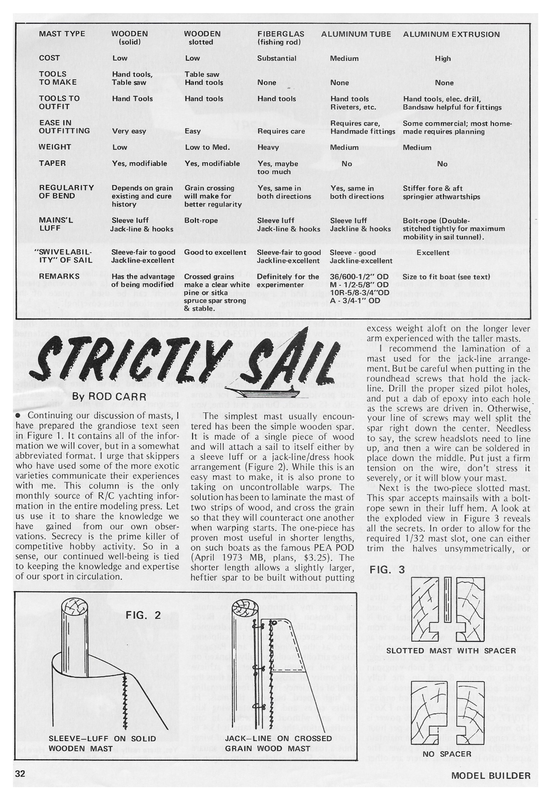
MAST TYPE WOODEN WOODEN (solid) FIBERGLAS slotted ALUMINUM TUBE ALUMINUM EXTRUSION (fishing rod) COST Low Low Substantial Medium High TOOLS TO MAKE Hand tools, Table saw Table saw Hand tools None None None TOOLS TO OUTFIT Hand Tools Hand tools Hand tools Hand tools Hand tools, elec. drill, Riveters, etc. Bandsaw helpful for fittings Requires care, Some commercial; most home- EASE IN OUTFITTING Very easy Easy Requires care Handmade fittings made requires planning WEIGHT Low Low to Med. Heavy Medium Medium TAPER Yes, modifiable Yes, modifiable Yes, maybe No No too much REGULARITY Depends on grain OF BEND existing and cure MAINS’L LUFF Yes, same in both directions both directions Stiffer fore & aft springier athwartships history Grain crossing will make for better regularity Sleeve luff Bolt-rope Sleeve luff Jack-line & hooks Sleeve luff Jackline & hooks Bolt-rope (Doublestitched tightly for maximum Jack-line & hooks Yes, same in mobility in sail tunnel). “SWIVELABILITY’ OF SAIL REMARKS Sleeve-fair to good Jack line-excellent Good to excellent Sleeve-fair to good Jackline-excellent Sleeve – good Jackline-excellent Has the advantage of being modified Crossed grains make a clear white pine or sitka Definitely for the experimenter 36/600-1/2″” OD M – 1/2-5/8″ OD 10R-5/8-3/4””0D A – 3/4-1″ OD spruce spar strong Excellent Size to fit boat (see text) & stable. excess weight aloft on the longer lever arm experienced with the taller masts. | recommend the lamination of a mast used for the jack-line arrangement. But be careful when putting in the roundhead screws that hold the jackline. Drill the proper sized pilot holes, By ROD CARR Continuing our discussion of masts, | have prepared the grandiose text seen in Figure 1. It contains all of the information we will cover, but in a somewhat abbreviated format. | urge that skippers who have used some of the more exotic varieties communicate their experiences with me. This column is the only monthly source of R/C yachting information in the entire modeling press. Let us use it to share the knowledge we have gained from our own _ observations. Secrecy is the prime killer of competitive sense, hobby activity. So in a our continued well-being is tied to keeping the knowledge and expertise of our sport in circulation. The simplest mast usually encoun- tered has been the simple wooden spar. It is made of a single piece of wood and will attach a sail to itself either by a sleeve luff or a jack-line/dress hook arrangement (Figure 2). While this is an easy mast to make, it is also prone to taking on uncontrollable warps. The solution has been to laminate the mast of two strips of wood, and cross the grain so that they will counteract one another when warping starts. The one-piece has proven most useful in shorter lengths, on such boats as the famous PEA POD (April 1973 MB, plans, rope sewn in their luff hem. A look at the exploded view in Figure 3 reveals all the secrets. In order to allow for the required 1/32 mast slot, one can either trim $3.25). The shorter length allows a slightly larger, FIG. heftier spar to be built without putting FIG. 2 halves unsymmetrically, or 3 é or | BD the ED) i: aN @ and put a dab of epoxy into each hole_ as the screws are driven in. Otherwise, your line of screws may well split the spar right down the center. Needless to say, the screw headslots need to line up, and then a wire can be soldered in place down the middle. Put just a firm tension on the wire, don’t stress it severely, or it will blow your mast. Next is the two-piece slotted mast. This spar accepts mainsails with a bolt- 4 UI gis SLEEVE—LUFF WOODEN 32 MAST ON SOLID JACK—LINE GRAIN ON WOOD CROSSED MAST | NO SPACER MODEL BUILDER
to keep the tunnel clear. Use a piece of cardboard to keep the slot clear (Remember to pull the twine out before the whole thing sets!!). FIG. 4 } Some folks try to use a ball router to make a track in a solid wooden mast. Believe me it is not worth the effort. The slot turns out too big, and the problems with potential warping are still there. It is desirable to get plenty of the adhesive (I prefer polyester resin) into the sail tunnel. This coats the sides and allows the sail’s bolt-rope to slide easily in the tunnel. It prevents snagging on slivers which can let uneven tension exist up and down the luff. | have heard of skippers who have built hollow masts. | have yet to see one, or hear how they work in company with solid or other masts of more common occurence. expand | would be happy to this discussion at a later date to include such masts, and await help from those skippers who have made them by this method. All of the wooden masts should be made from fairly close-grained, and Sstraight-grained wood. | have used both Sitka Spruce and clear White Pine. The price of the former has driven me to the latter, but for the skipper who wants strength and lightness, the spruce is ideal. | keep two or three 1×4’s up in my loft rack at all times. They seem to need to have the time to dry a bit and cure some. On occasion, I’ve ripped a 3/8 inch side off of them, identified it, and watched what kind of a curve developed Aree tat ee eee MTR atk be Uk eee We pcitet ee ee VS Pare OME Seet telFUEL By 1as | foe — EY cer 83 ¥, el 0 ssty “eel i akc nt une eee leWie ae : : , i as the wood seasoned. Some stay straight . . . those are the ones | make masts out of. Others start to curl up like a dog’s hind leg . . . those | use for other projects. A hint … leave the 1×4 (-3/8) whole until you are ready for a mast, then rip off only what you need. The stock stays happier and seems less prone to curl. The finished cross-section in Figure 3 shows you some dimensions that you we / ee nf / should provide to your sailmaker when he is outfitting your mast. With it, he can size the proper bolt-rope into the luff hem so that it slides easily, yet won’t pull out through the slot. The ideal NOMINAL SPECIFICATIONS LOA 50” LW.L. Draft 9.5” 40.5” Sail Area measurements are something to shoot for Beam 14” 1000 Sq. In. utilize a spacer of aircraft plywood, with holes punched in it with a paper Aon as | pez — MAY 1977 punch for the adhesive to pass through for a good bond.- | have kept an absolutely die-straight 2 x 4 to use as a when making the mast. Note that the sail tunnel is really square. Making it round is not worth the effort, and will increase the drag on the luff when making tension changes. BE CAREFUL OF YOUR FINGERS WHEN USING THE TABLE SAW. ALWAYS USE A PUSH STICK, AND KEEP BYSTANDERS AWAY FROM THE PLANE OF workbench when gluing these up. A half- dozen 5-pound lead weights and a 12 THE BLADE!! Next we come to the tapered fiberglas spar. These usually have been origi- A foot length of twine are needed too. Glue the spacer to one side, and after it nally intended for use as fishing poles. ae drys, add the other. Remember to cross = > Y aaa the grains of the mast halves. Before the final joining, slip the twine into the sail tunnel and pull it back and forth I’ve seen 3 aspect rigs, number of or 4 in use, all in high’ and all on 50/800’s. A things seem to mitigate Continued on page 917 33
er against their widespread use. First they are quite heavy. They have a severe taper over their length. The butts are usually in excess of 1 inch, and within 7 to 8 feet, they are down to the “whippy” 1/4 inch or so that makes for good lure action when fly-fishing. One spectacular application of the fishing pole mast was by Neil Goodrich, of the Central Park MYC. He loaded all 800 square inches onto the mast and proceeded to step it on the keel, wedged at the deck . .. no stays at all. Mast shape became a power loading balance and between sail the main sheet tension. He made his own sail, which worked rather well over the wide range of mast shapes encountered. Maybe we can get him to share his experiences with us. For a rig like his, the sleeve luff worked just fine. Another experiment was done by Joe Schoonover, of my club, who put a 84 inch monster on a_ Victor VALKYRIE. He drilled holes, and then epoxied sheet metal screws into the spar for ajack-line. Standard spreaders and so on were installed. Try though we did, the thing was just too limber in its upper sections to be controllable. | will not rule fiberglas spars out entirely, but unless somebody has found a good compromise between taper and flexi- point of jibstay attachment. This has the effect of opening the slot between the main and jib, and allowing the air to pass more freely. All the while this is going on in the athwartships plane, we would prefer that the fore-and-aft shape of the mast stay as constant as possible. This will keep the draft from moving around in the sail and also keep any style with the input of a certain amount of labor. | refer you to Griffin’s excellent book, “Model Racing Yacht Construction’, from Model Allied Press in England. The vagaries of sleeve luff sails are something we can leave for later, but suffice it to say that not many are used in this country, and there are good reasons for avoiding them. The aluminum tube mast certainly fits the criteria we set up last month for the mast standing straight, and taking on a controlled bend. However, the bend that the mast takes on is completely symmetrical around it. What | mean is, that it is just as stiff fore-andaft as it is athwartships (perpendicular to the centerline of the hull!!). Up toa certain point this is good, but as one becomes more experienced, we find the need for the mast to be stiffer fore-andaft than it is athwartships. The reason is that the luff curve in the sail must fit the mast in the under heavy fore-and-aft plane. But wind pressure, we would like the upper part of the mast to bend off to leeward, this releases the leach and reduces heel and weather helm. At the Same time, the lower part of the mast _will be levered to weather, pivoting at the VORTEX MODEL ENGINEERING 210 East Ortega Santa Barbara, California 93101 REYNOLDS MFG. CO. 3010 Chris cane: — ==. Orlando, Florida 32806 At the present time, VORTEX has fittings ways bending and not do a similar amount in the fore-and-aft direction. to make up your own. l’ve got some ideas together and will toss them In and drilled in the mast was my criteria, and from the shapes I’ve measured (as we the boat on the beach. The aluminum tube mast will not be able to do the side- As a result, we can expect a boat with an aluminum’ tube mast to tend to react’ more violently to puffs varying wind speeds. It does not have the cushioning ability that a mast has with a little bit of sideways give. Last on the list are the aluminum extruded masts on the market. | know of three: 1) Vortex Model Engineering’s, 2) Reynolds Mfg. Large, and 3) Reynolds available for its extrusions. REYNOLDS is in the design and development stage, so you may have next month. Elimination of holes to be discussed last month) it has worked out well. Well, there you have it; many spars and spar materials to choose from. Good reasons exist for each ,one, be It cost, shape, weight, sail luff or what have you. | guess that is one of the Mfg. Small. The first is used on Santa Barbaras and Solings (I’m ashamed to say that if they are different, I’ve not checked). For 50/800’s, the section is reasons this hobby is so much fun. There are as many ways to get a job it is excellent. It has the smallest fronta we have gotten an announcement of the introduction of the new SCHEEL 50. Not a new 50/800, but a scale-like ocean racer of 50 inch overall length, a 40.5 inch waterline, 14 inch beam and 1000 square inch sail area. | don’t have a displacement figure, but with that beam just about right, and for a 36/600 area of all, and will present a very clean entry to the bolt-rope mains’ which sets on it. How the spar does on an S/B | don’t know from persona experience, as all the boats in my area that have been raced are older anc have seen just are often used in conjunction with sleeve luff sails, .but are adaptable to manufacturers directly: the camber we required when we set up sported wooden spars (We even had boat No. 95 here for a while.). I have and Very popular with the Europeans— helped put an EC/12 rig up on one would have to say that in that appliand vane sailors who have switched to cation, the spar proved much too R/C, are aluminum tube masts. They bility, the spars that | _ don’t cut the mustard. For price information contact the limber in both planes. The Reynolds Large has been used almost exclusively on the big J-boats. In this role, it performed admirably. It even withstood the total dismasting that a waterspout visited upon Bob Harris at the 1976 ACCR. Don’t ask him about it, as it is horrible to see a grown done as there are ingenious skippers to puzzle it out. Under the heading of new products, she must be in the 22 to 24 pound range at least. Get further details from: ~ HERITAGE MARINE Post Office Box 554 Needham, Mass. 02192 | understand that the design was done specifically for R/C by naval architect Henry Scheel, and that he has incor- porated his SCHEEL boat. You may have SCHEEL KEEL in a YACHTING Magazine. KEEL into the read about the recent issue of I’ve put my bid in for a hull, as it sounds like we might man cry so. The spar is not light, but has the capacity to carry as much sail as one needs, also on a bolt-rope have the starting of a true one-design class of the same calibre and reliability as the Santa Barbara and SOLING. If The Reynolds Small “GOLDSPAR” read about it in Model Builder. An main luff. seems to be having the widest impact, with its use extending from 50/800’s all the way up to my new A-Class packs 1600 square which monster, inches. This spar shows the differential between fore-and-aft and flexibility athwartships bending that we spoke of as lacking in the aluminum tube mast. The section is somewhat larger than the Vortex spar, and the increased wall thickness increases the weight somewhat. For my applications, it has fit my needs to a 1, even though the retail price of $3.79 per foot in lengths up to 9 feet is kind of steep. However, if you you write to HERITAGE, tell them you outboard profile appears in Figure 4. Tantalizing ain’t it??? | think that the size of the hull is going to provide a roomy platform for some of the additional gear with which skippers have started to experiment. I’ve heard some rumors of the testing of a new trimming winch by one of the winch .manufacturers. The unit is supposed to be a little more than twice as bigas an R/C servo, and would provide a 10 pound tug on whatever you wanted to snug down. More information when | get it. Remember to send in your $5.00 figure the time and effort you put into a annual dues to the AMYA Secretary, come outeven. mail. | will continue to field questions: wooden one, | think you just about 2709 South Federal Highway, Delray Beach, Fla. 33444. He likes to get the St., Springfield, Va. 22151. Sailing…… Continued from page 33 addressed envelope to Model Builder or direct to me: Rod Carr, 7608 Gresham Oe when accompanied by a stamped, self- PT