- STRICTLY SAIL By Rod Carr Recap of August 28th, A Class ACCR at Marsh Creek

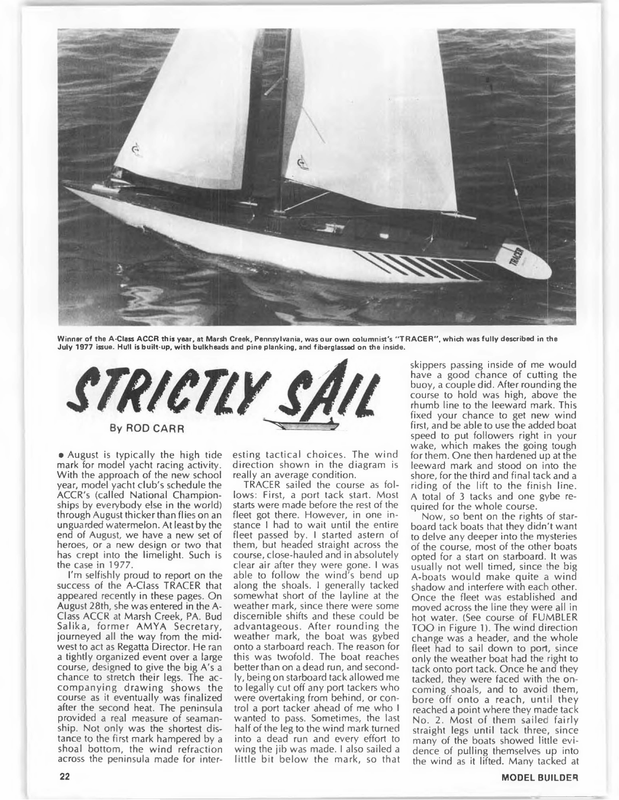
te Winner of the A-Class ACCR this year, at Marsh Creek, Pennsylvania, was our own columnist’s “FRACER” , which was fully described in the July 1977 issue. Hull is built-up, with bulkheads and pine planking, and fibergiassed on the inside. STRICTLYSAUL By ROD CARR @ August is typically the high tide mark for model yacht racing activity. With the approach of the new school year, model yacht club’s schedule the ACCR’s (called National Championships by everybody else in the world) through August thicker than flies on an unguarded watermelon. At least by the end of August, we have a new set of heroes, or a new design or two that has crept into the limelight. Such is the case in 1977. I’m selfishly proud to report on the success of the A-Class TRACER that appeared recentlyin these pages. On August 28th, she was enteredin the AClass ACCR at Marsh Creek, PA. Bud Salika, former AMYA Secretary, journeyed all the way from the midwest to act as Regatta Director. He ran a tightly organized event over a large course, designed to give the big A’s a chance to stretch their legs. The ac- companying drawing shows the course as it eventually was finalized after the second heat. The peninsula provided a real measure of seamanship. Not only was the shortest distance to the first mark hampered by a shoal bottom, the wind refraction across the peninsula made for inter22 esting tactical choices. The wind direction shown in the diagram is really an average condition. TRACER sailed the course as follows: First, a port tack start. Most starts were made before the rest of the fleet got there. However, in one instance | had to wait until the entire fleet passed by. | started astern of them, but headed straight across the course, close-hauled andin absolutely clear air after they were gone. | was able to follow the wind’s bend up along the shoals. | generally tacked somewhat short of the layline at the weather mark, since there were some discernible shifts and these could be advantageous. After rounding the weather mark, the boat was gybed onto a starboard reach. The reason for this was twofold. The boat reaches better than on a dead run, and secondly, being on starboard tack allowed me to legally cut off any port tackers who were overtaking from behind, or control a port tacker ahead of me who | wanted to pass. Sometimes, the last half of the leg to the wind mark turned into a dead run and every effort to wing the jib was made. | also sailed a little bit below the mark, so that skippers passing inside of me would have a good chance of cutting the buoy, a couple did. After rounding the course to hold was high, above the rhumb line to the leeward mark. This fixed your chance to get new wind first, and be able to use the added boat speed to put followers right in your wake, which makes the going tough for them. One then hardened up at the leeward mark and stood on into the shore, for the third and final tack and a riding of the lift to the finish line. A total of 3 tacks and one gybe required for the whole course. Now, so bent on the rights of starboard tack boats that they didn’t want to delve any deeper into the mysteries of the course, most of the other boats opted for a start on starboard. It was usually not well timed, since the big A-boats would make quite a wind shadow and interfere with each other. Once the fleet was established and moved across the line they were all in hot water. (See course of FUMBLER TOO in Figure 1). The wind direction change was a header, and the whole fleet had to sail down to port, since only the weather boat had the right to tack onto port tack. Once he and they tacked, they were faced with the oncoming shoals, and to avoid them, bore off onto a reach, until they reached a point where they made tack No. 2. Most of them sailed fairly straight legs until tack three, since many of the boats showed little evidence of pulling themselves up into the wind as it lifted. Many tacked at MODEL BUILDER
No. 3, it seemed out of sheer boredom and then had to tack again at No. 4, and bear off onto a reach to round the weather mark. Some, but not all, went onto starboard by gybing after weather mark, and generally an almost dead downwind parade resulted. Those lucky enough to be ahead of the pack were amazed at how much slowing occurred by the interaction of wind shadows on the run. Many fell below the rhumb line on the way to the leeward mark. Those boats that FIG. 1 TRACER eee err eee ee Fee PORT TACK START, 2 TACKS, 1 GYBE AND A FINAL TACK TO THE FINISH. FUMBLER TOO ? TACKS, 1 GYBE went high generally improved their position, since they got clearer air and moved faster to compensate for the slight extra distance to the mark. Rounding the leeward mark there was a general tendency to tack immediately (No. 5), and then not have enough of the lift to allow you to make the mark, requiring two more tacks (Nos. 6 and 7). In comparing the two tracks, we see that twice the number of tacks, and at least a 15% increase in distance can become a burden to a skipper who has not studied the course. This would require a 15% increase in average speed to make up the deficit, and is just not to be found in any product on the market today. Let me say at the outset, as | have in the past, this kind of Monday morning skippering is easy, at least easier than doing it on the lake. But if the analysis helps us understand the system, then it is worthwhile doing. Look at your lake and see if you don’t see some similar situations. When the smoke cleared, the fleet had run through 12 races. The finishing order of the top seven boats was as follows: 1. Rod Carr 17 pts. 2. Charles Obersheimer 29.5 3. John Krick 41 4, Fred Frey 53.75 5. George Debonis 61 6. Henry Morris 67 7. Jim West 72.75 The two top boats were sailed by sailmakers, giving some weight to the theory that knowing how to set and trim your ‘motor’ will stand you in good stead. Mr. Obersheimer makes full-sized sails from his loft, and this marks the first venture into model yachting’s top levels of competition. | expect to see him become a common threat on the race course in future regattas, and must thank him for fielding a heavy (60 Ib.) boat that was handled superbly. It took me all day to finally tune TRACER to the point where she would point with his white-hulled craft. It shows how important it ts to sail with other skippers, if your goal is to improve your performance. The most important result of this regatta was the demonstration of the potency of a lightweight, heavily canNOVEMBER 1977 T3 %, vassed A-boat. In the light airs of the regatta, 1-8 knots, her acceleration allowed TRACER to start on port tack, and keep clear air all the way to the weather mark, regardless of the fact that the majority of the fleet started on starboard, farther up the line. This ability has filled a hole in the typical A-Class fleet of recent years. This lightair hole was supposedly fillable by a well-handled East Coast 12, which some say would rate under the A-Class rule. Well, the best 12 finished dead last, and though a broken jib club contributed to her woes, she only won a single heat on the basis of finding new air before anyone else did. For those skippers who are contemplating entering a 12 in this class, my advice would be twofold: first, think twice, a 42 inch LWL and 1100 square inches seem to be hopelessly outgunned by a small A’s 50 inch LWL and 1600+ square inches. Second, go through the required measurement procedure and stencil a big A on your sail to prove that you are really trying to comply with the spirit and letter of the rule. TRACER’S heat record is worthy of note, if only to indicate that the yellow punkin’ seed really did dominate the event. Remember, all boats sailed all heats. TRACER FINISHES: 1-1-4-1-31-2-2-1-1-1-1 The top four boats were named to the AMYA Team, which will sail with the MYRAA Team at Whiting, N.J., in October. With the expectation of stronger winds, it will be interesting to see if TRACER can acquit herself with such finality in heavier conditions. The hope is that her surfing and plan- ing bottom sections may begin to make a contribution to her speed, with the sail plan being kept under control by judicious use of the travelers that control her sheets. Before leaving TRACER, let me say that as of this writing, the designer has not yet released the lines for distribution. I’ve queried him, and hope that arrangements may have been completed by the time this is printed. In a recent letter, he (Adrian Brewer) Continued on page 103 23
§ CN =P R O DU GTS; IN S » 535 DAVISVILLE ROAD + WILLOW GROVE, PA. 19090 «+ (215) 659-3900 We’ve Got a Lot to SHOUT ABOUT! SMOOOTH LANDINGS SINGLE GEAR FITS NOSE OR MAIN GEAR $3.50 to SUPERSTAR OF STARTERS $4.00 Sales zooming past 100,000. The starter that’s turned on the whole world. higher SET OF 3 torque & RPM’s, heavy Has duty, Patented, patented, patented… just about every one of our products is patented. That’s because there’s something unique about each one. Something better. Take these products, for instance. Better yet, go to your dealer and buy them. long life motor, “instant-on” strip switch, safety hand guard, and 2-year guarantee. FOR NOSE AND WINGS $9.95 to $10.95 CHARGER FOR SUPER/GEL & OTHERS Strong, lightweight, “REALISTIC” landing gears eliminate erratic vibration and feature short fulcrum for ground hugging ability. Caster action. Adjustable pres- GLOW PLUG KLIP Sure. reliel feature ends broken wire problem Easy to customize Sizes to Fully assembled and unbreakable. Strain fit wheels from 1 3/4″ to 3″. Free replacement if this Glow Plug Klip ever breaks. the extra tissue tautness gives greater resistance to motor torsion. Run the grain up-and-down to prevent stringers from sagging between formers under the tight tissue. After shrinking, give everything one or two thin coats of dope. The control surfaces and metal panel joints were outlined with black tissue strips. Compared to black chart tape, these weigh practically nothing, won’t leave a sticky edge to grab dust and lint, and look just as good. The tissue strips can be sliced easily with two halves of a double-edged razor blade (must be sharp!), separated by a balsa spacer. Cut the strips on a soft board and bury the corners of the blades in the board when cutting. Strips of different widths are obtained by varying the thickness of the spacer. Attached to the model with clear dope, the black strips go a long way toward improving the looks of your model, and unlike felt-tip lines, do not have fuzzy edges. If you look hard enough, you will see riveting detail in one of the photos. These rivets were made with a felt-tip pen, and waterproofed with dope when dry. If you decide to attempt this, practice first on an old peanut to get the hang of it. Get a good 3-view for all extra scale work. The secret of this model’s performance is a good cruise, and a NOVEMBER 1977 battery in 12 hours. 500 ma. output. superb glide. With a loose freewheeler and proper adjustment, the ship has the glide of a sick HLG, which is better than most other peanuts, which as a rule, fall out of the sky when their power runs out. Mushing must be avoided, so bring the C.G. a little in front of F4. Just how much will vary with different airplanes. The stab incidence can be changed by sliding narrow balsa wedges under the leading or trailing edge. Whatever you do, remember to maintain a fast glide, and make sure the prop will freewheel with ease. My ship uses a 15 inch loop of 1/8 Sig rubber, which will be too thin if you tend to build heavy. With this particular airplane, a high climb is essential for good flight times. Switch to thicker rubber if your ship just cruises around at grass-cutting level. Properly adjusted, the peanut should easily climb past 50 feet every time. So there you are, all ready to reap in that gleaming hardware. Good luck and watch the thermals! Ideal teammate to Super-Gel battery. Can also be used for most wet cell batteries UL Listed, plugs into ordinary house current. Fully charges e Westburg …. Continued from page 39 forward of the insignia. The canopied S1-A has a dark green fuselage above the lower longeron, fin and rudder and upper surfaces of the wing and horizontal tail. The remainder of the airplane was alumi- num. The number “51” appeared in white on the engine cowling and rudder, the number “8” in black ahead of the fuselage insignia, which had a yellow border around the blue disc. The Sparmann P-1 was a different airplane and it should be a welcome addition to the collection of modelers who like to fly inverted engines. But don’t let anyone try to tell you that it’s a done-over Ryan ST! ° Sailing…… Continued from page 23 told me that he had produced a fiberglass hull for the boat, using carbon fibers for reinforcement. The whole hull weighed slightly over two-and-ahalf pounds. Compare that with the 6 pound weight of the TRACER. Oh yes, a number of you are probably mumbling and grumbling about the 7-channel gear that | reported as being aboard TRACER. | was not able to sail the boat as much as | liked before the ACCR, and had not gained sufficient familiarity with the jib trim and backstay functions to tell if they were a benefit. Two days before the event, | took both out, and sailed with only rudder and main winch. So you see, with two channel R/C you can become a champion (confidentially, there is probably something smart about not having too WHEN CONTACTING ADVERTISERS, TELL ‘EM MODEL BUILDER SENT YOU! 103
SP jean – – – – – +} SP ))) The MODEL ROCKET ENGINES of the FUTURE ((( straighter, higher altitude flights. SS . S Ce SS gw MORE POWER and efficient use of that power for we OS goo F100-8 ry) we °18.4 ow Send, $1.00 for catalog of our entire line of model rocketry products. a Flight Systems, Inc. Dept. B 4 a 9300 East 68th Street Raytown, Missourl * NAR Designation -CALIPERS. CTS National Camera 2000 West Union Av Englewood, Calo, v. S.A. 80110 many controls on your boat). It’s been a banner year for sailmakers as a group. We are generally somewhat misunderstood, and are often looked askance when we admit to actually sewing on a machine … “‘Isn’t that women’s work????” . . . But in the heat of the midwest, Charles Black, former AMYA Secretary, and the fellow responsible for introducing me to this sport, has pulled off the most amazing tour de force I’ve ever seen. He won, back-to-back, not one, not two, but THREE ACCR’S. And these were in the 1st, 2nd, and 4th largest population AMYA Classes; the 50/800, 36/600, and Santa Bar104 64133 es ee ee ee ee ee we bara. | wasn’t there, but he was, and I’m most pleased to let him tell it in his own words. His account was sent to me directly, and was unsolicited. So in effect you are all looking over my shoulder and reading my mail: “Dear Rod, “Thanks a million for your congrats and your long letter of some time ago that | neglected to reply to. . . bad boy, but you should know me… | DON’T LIKE TO WRITE, but regret that I can’t pass alonga little of what | do best by the seat of my pants, and that is basically “‘Now My basic midwest Peterson sailing. for a little background … purpose in going back to the was to give the new Doug 50/800 ‘ORION’ some ex- posure in the big one, such as | did with the BINGO in ’74 at Dulles. Since the MYC’‘s planned to have other ACCR’s within a reasonable time frame, Rich and Dick suggested that | also include the 36/600 and S/B ACCRs, so | entered each. “I sailed a modified Equation 36/ 600 with a 56 inch luff mainsail and an equally large jib at the 36/600 ACCR. The hull, basic, was split in the bow and expanded to one inch at the deck line, and then one inch was added to the beam at amidships and at the stern. This really changed the basic Equation to where we really don’t consider it to be the same model. The keel was a fin similar to the Scampi, with a total fin and bulb weight of 6 lbs. The model displacement was 10 Ibs., and sailed extremely well in all conditions. |, of course, maintained the same designers W.L., and changed rigs to meet wind conditions. Within a two-hour period on Saturday: afternoon, | used three rigs with equal success … 56 inch, then 50, then lastly, when the wind began to really blow, | even shifted down to 40 inch luff, the original Equation rig. Anyway, the model moved quite nicely, and | lucked out and barely beat Ray Ozmun with his modified Scampi. I, of course, was on high. “Then | rigged Rich’s S/B 445 and went to the pond on Tuesday for the S/B ACCR. | asked Rich if the model looked as though it was rigged correctly, and he made a few adjustments he thought would help because he had sailed the model a lot more than I. Well, after the first race which | must have won by a country mile, | swore not to touch any aqyjustment on the S/B until after the completion of the regatta. After 6 consecutive 1sts, | made doubly sure no changes would be made. Well, | was on high again, and until my fatal dismasting, ! could do no wrong, but what fun it was to sail against Steve Sansom, Rich Matt, Don Prough, Henry Morris and Max Barton, and do well. Well, again | lucked out after taking a DNF by dismasting, and finished in pretty good shape to retain the lead. As you can imagine, | was really on high again, and had really forgotten the basic purpose of my trip back to the midwest . . give the ORION exposure and hopefully do well. “After the short trip to Indianapolis to enter the 50/800 ACCR, setting up the 78 inch luff suit, which | had never sailed, and Andy Littlejohn saying to me as he sailed by, ‘Chuck, those are the worst looking sails I’ve ever seen.’ | couldn’t have agreed with him more because they looked! terrible and everyone was passing me with ease. Oh well, | brought the model in and made a thousand and one adjustments, but by that time | had discovered that my ‘Little Brother’ was at the motel, so | decided to put the model away and go see him. The re- gatta morn came with me in a dither, ‘cause the ORION was slow, | could care less about nothing, and | was having a good time … what’s this thing they call sailing model boats… . something like watching grass grow. Well, after 3 or 4 premature starts and missing marks, | was fit to throw it into the nearest trash can. The only consulation | had all day was that the ORION seemed to do rather well catching up, for that is all | did all day. There was one race | recall in which | had gotten my typical lastover-the-starting-line start, and had decided to take a calculated risk and cut inside two wide models at the wind mark only to discover that | had missed the mark. Well, as is obvious, 5 or 6 models passed me as | frantically tried to round properly, but the stunning thing that followed was that the ORION got to the leeward mark first, having passed the fleet en route. That made my day. Anyway, at the end of the day .. . Saturday, someone told me | was in fourth place behind Rich, Ray, and Stan. | never look at the running tally, because looking at the standings doesn’t do a thing in winning a regatta. | strive to do my best WHEN CONTACTING ADVERTISERS, TELL ‘EM MODEL BUILDER SENT YOU! MODEL BUILDER
4S oH Kame Kwa a KKK K NK K KK Kke Kk Ke Kea KKK KKK HOT STUFF 35° PER UNIT HS-4 a © 14 GRAMS (TWO 7 GMBTLS) w @ 6 INCHES OF Control Drop 24° PER UNIT © 113.4 GRAMS 4 OUNCES > = Satellite City CONTINUOUS TEFLON ‘7 EXCLUSIVE ew FORMULA!! , Control Drop FOR ALL HOT STUFF in each race and hopefully do better in the next. It all comes out in the wash, and looking at the board doesn’t help matters. So after being told that | was in 4th place, | thought to myself that | was letting Doug and his ORION down, so after a talk with myself and a Friend | hope | know upstairs, things improved immensely on Sunday. Just prior to my last race, Neil Bennell, my friend from Sydney, Australia, came over and said, ‘If you win this race no one can catch you.’ Rod, | thought | would have a heart attack, because | had not looked at the board all day and | didn’t think | was in contention for the top spot. |, of course, did the best | could and took first, which gave me first by 1/4 point over Ray Ozmun. “That in a nutshell, is what happened in the midwest. | enjoyed every minute, and give each Regatta Chairman and host MYC a hearty WELL DONE. You would have enjoyed each and every heat/race. Each had its own personality because of the different individuals who made up the heat. Your name was mentioned on a number of occasions in that you should have been there to get regatta info first hand. You missed, | confess, one of the best round of regattas in which | have had the pleasure to participate. Again thanks for the letter and note. | promise to do better next time … writing in return, that is.’’ Chuck | hope you will all cut Chuck’s letter out and paste it inside your too! box. | think he shows very positively that we can lose a lot for ourselves and others when winning becomes more important than having a good time, enjoying our friends and wallowing in the joy of sailing. His comments about not keeping track of the score as the day progresses, are food for thought. I’d welcome any thoughts you readers have on that. We might publish a series of letters giving your views on how the score affects performance, tempers and enjoyment. We are still planning to get down ADHESIVE Vv 14.2 GRAMS (SINGLE BTL ADHESIVES 10 PKS/COD PO BOX 1935, ARLETA, CA 91331 BLUE INSTANT Ww FOR COMPLETE DETAILS. SEE R/C Modeler SEPT 77 “FROM THE SHOP” APPLICATOR TUBING @ 2 SETS OF INSTRUCTIONS KKK KK AH KKH NOVEMBER 1977 S=BLUE LINE= e 18 INCHES OF (TWO 56.7 GRAM BTLS) CYANOACRYLATE SUPER ADHESIVES NEW HOT STUFF T-500 .50 PER Pk % TEFLON APPLICATOR TUBING |@ 12 INCHES OF Contre! Drop APPLICATOR TUBING ® @ COMPLETE INSTRUCTIONS * STARS_ a ORIGINAL CLEAR Formula HS-1 ALL HS-5 PHONE (213) 899-2301 Kh hk Kara Kk ke Kaka 4952 into the construction of the EC/12 kit. By the way, the class has voted to call the boat the HERITAGE 12, but I’m afraid !’Il slip now and then and use the old name. (But then, | still use cycles-per-second instead of Hertz, too!!!) Remember to send in your 1978 AMYA dues to Bob Crysler, 2709 S. Federal Highway, Delray Beach, Florida 33444. And I’ll answer inquiries if they are accompanied by a stamped, self-addressed envelope in care of MODEL BUILDER, or directly to: ROD CARR, 7608 Gresham St., Springfield, VA 22151. e MIDWEST MODEL SUPPLY “Your Supplier, Not Your Competitor” @ Stocking over 150 lines of merchandise ®@ Fast service to all parts of the USA Counter….. Continued from page 11 second, interest you? How about a tubing bender or cutter for that fuel tank installation? Nutdrivers, metric or inch? Or how about some hardened steel hex wrenches? These are only a few of the handy dandies found in the Fall Catalog, from Jensen Tools & Alloys, 1230 S. @ Weekly mailer @ Phone orders encouraged @ Many only source items @ Special sales DEALERS ONLY Priest Dr., Tempe, AZ 85181. This company specializes in small hard-to-find tools for electronic assembly and precision mechanics, which is just the industrial way of saying: MODEL BUILDER. This 6 x 9 inches, 144 page catalog, is fully illustrated, contains many photographs, many in color, is definitely an asset in every modeler’s library. Whatever kind of engineer, technician, mechanic or hobbyist you are, you will find tools designed specially for you. And if you hurry, you can head off another Christmas tie. Send for your free copy and leave it laying around, properly marked, as a hint to the wise. It’s free, just for telling them at Jensen that you read about it in MB. + * & Not for landlubbers … but the R/C power boater will find this one quite interesting. It is a Rolls Royce Dummy Engine Shell for .40 and .60 size hydros. It is approximately 1.5 inch-to-the-foot, and can be used as CALL US AT 312-586-7101 VAY; SUPPLYCO. * a cowling for your favorite boat mill. Priced at only $19.95, from your dealer, or direct from the manufacturer, Pinckert Custom Boats, P.O. Box 138, Coconut Grove, FL 33133. World Engines is back in the hands of modelers! John Maloney, who has been acting as President and Chief Executive Officer of World Engines Division during its ownership by Consolidated Foods, has announced that he has purchased all World Engines assets. lt will now be known as World Engines, Inc., and will continue as a WHEN CONTACTING ADVERTISERS, TELL ‘EM MODEL BUILDER SENT YOU! 105