- Title. Author. Summary

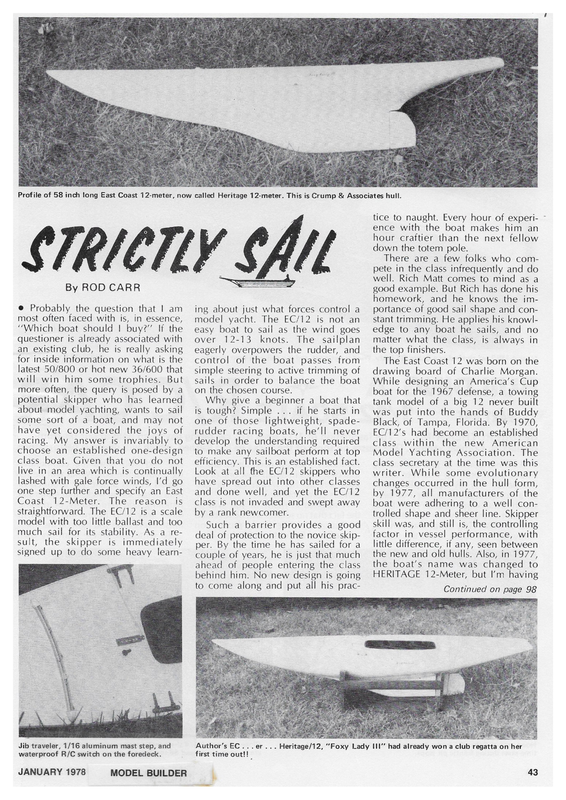
Profile of 58 inch long East Coast 12-meter, now called Heritage 12-meter. This is Crump & Associates hull. By ROD CARR @ Probably the question that | am most often faced with is, in essence, “Which boat should | buy2” If the questioner is already associated with an existing club, he is really asking for inside information on what is the latest 50/800 or hot new 36/600 that will win him some trophies. But more often, the query is posed by a potential skipper who has learned about model yachting, wants to sail some sort of a boat, and may not have yet considered the joys of racing. My answer is invariably to choose an established one-design class boat. Given that you do not live in an area which is continually lashed with gale force winds, I’d go one step further and specify an East Coast 12-Meter. The reason is straightforward. The EC/12 is a scale model with too little ballast and too much sail for its stability. As a result, the skipper is immediately signed up to do some heavy learn- ing about just what forces control a model yacht. The EC/12 is not an easy boat to sail as the wind goes over 12-13 knots. The sailplan eagerly overpowers the rudder, and control of the boat passes from simple steering to active trimming of sails in order to balance the boat on the chosen course. Why give a beginner a boat that is tough? Simple … if he starts in one of those lightweight, spaderudder racing boats, he’ll never develop the understanding required to make any sailboat perform at top efficiency. This is an established fact. Look at all fhe EC/12 skippers who have spread out into other classes and done well, and yet the EC/12 class is not invaded and swept away by a rank newcomer. Such a barrier provides a good deal of protection to the novice skipper. By the time he has sailed for a couple of years, he is just that much ahead of people entering the class behind him. No new design is going to come along and put all his prac- tice to naught. Every hour of experi- ~ ence with the boat makes him an hour craftier than the next fellow down the totem pole. There are a few folks who compete in the class infrequently and do well. Rich Matt comes to mind as a good example. But Rich has done his homework, and he knows the importance of good sail shape and constant trimming. He applies his knowledge to any boat he sails, and no matter what the class, is always in the top finishers. The East Coast 12 was born on the drawing board of Charlie Morgan. While designing an America’s Cup boat for the 1967 defense, a towing tank model of a big 12 never built was put into the hands of Buddy Black, of Tampa, Florida. By 1970, EC/12’s had become an established class within the new American Model Yachting Association. The class secretary at the time was this writer. While some evolutionary changes occurred in the hull form, by 1977, all manufacturers of the boat were adhering to a well controlled shape and sheer line. Skipper skill was, and still is, the controlling factor in vessel performance, with little difference, if any, seen between the new and old hulls. Also, in 1977, the boat’s name was changed to HERITAGE 12-Meter, but I’m having Continued on page 98 ay Jib traveler, 1/16 aluminum mast step, and waterproof R/C switch on the foredeck. JANUARY 1978 Author’s EC …er… Heritage/12, “Foxy Lady III’ had already won a club regatta on her first time out!! : MODEL BUILDER —— ; 43
Sailing …… ‘Continued from page 43 trouble remembering to incorporate that in my discussion. The class has maintained strong control over auxiliary functions. Only sheets, and jib twitchers are allowed as running rigging. The idea is to make skipper skill, not pocketbook, the difference between winning and losing. This tight control has been the result of a class techni- cal committee. The Tech committee Keeps abreast of new developments and advises the Class Secretary of their effect on the one-design philosophy within the class. They also do a good job of sounding out skippers throughout the country to find out what kinds of planned evolution might make the boat a better one to sail. An example of this was the decision to ask the class to vote on a reduction in mainsail roach from 3 to 2.25 inches. The appearance of the boat was improved, as the new main looks more scale-like (and let’s face it, there is a large component of esthetic enjoyment in model yachting). Also, heavy weather performance was improved by reducing sail area way aft on the mains’l where it did the most to promote a wild weather helm. Overall performance was just about unchanged. | took an absolutely new boat out into our local fleet wearing the only ‘‘small’” main. With weather from O knots to some wild 18 knot gusts, the new main came through and the boat wound up winning the event. The reduction in area certainly did nothing to devaluate downwind performance. Building a 12 can vary from the ready-to-run variety, to nothing more than a bare hull and a copy of the class specifications. Most of the presently manufactured boats can be obtained with the deck already at- tached to the hull. This does eliminate a rather tedious evening of measuring to be sure that the sheer beam tolerances are met, but makes gear installation a little bit tougher. The pictures accompanying this column are of my new boat. FOXY LADY Ill is a Crump and Associates hull, (see ad in December ’77 MB). It came with the deck on, all blocks in, and the rudder installed. | adapted the mast off of the TRACER to the 72 inch length required by the EC/12 specs. It took me exactly one day to mount all the gear, pour the lead and test float the boat. That is hardly to be called ‘‘building’’ in my book. While most of the winning boats are using wooden masts, | have opted for the aluminum one from Reynolds Mfg., in Orlando. saying that this kind of a job can This boat was built the right way. | assembled all the gear that was to go in result in your untimely demise if you take a jaunty attitude. Don’t risk it; winch, batteries, R/C gear your eyes or skin. Wear some old mounting boards, the rig, and so on. The whole package was weighed inside the hull/deck. That weight was subtracted from 24.5 pounds and yielded the amount of lead ballast that could be poured into the keel. clothes, and make sure yOU Wear a good set of goggles or safety glasses. While you are engaged, send the family and the dog out to a movie (or a Builder channel, but the class rules do allow both a jib trim function and a jib- twitcher, container, on a slight bow down it with water. Do not let any of the keel which is to be filled with lead touch the bottom of the container. people sailing with jib trim, and since they don’t really understand what it is doing, they spend as much time hurting themselves as helping. There must be free circulation of the water to remove the heat from the lead and preserve the integrity of the fiberglas and resin hull. | Beginners are best left to learn how to sail the boat. Extra functions de- tract from developing the concentra- usually put a masonite lid over the hull, with a 3 inch hole centered over the keel cavity. Spend plenty of time leveling the hull and blocking It securely. MOST IMPORTANT … THE KEEL CAVITY MUST BE ABSOLUTELY DRY. NOT ONE DROP OF WATER IS ALLOWED IN THE tion necessary to sail well. In this one-design class, there is no gadget that will make you significantly faster than everybody else. This is really true if you are sailing against the likes of Ron Stephanz, Buddy Black, Bob Harris, or any of the dozen or so top skippers to be found in the class. is that the hot lead will convert any water in the hull into superheated steam. As the TIPS ON SAILING AN EAST COAST 12 the molten lead back out of the boat all over your body!!!! Be sure that you you pour the lead. With cold water, and good cir- culation around the hull, I’ve seen this job done to hulls with lacquered bottom paint and not even one blister forms. Be very careful!!! Get rid of all children, dogs, and wives before you start. If you use old tirebalancing weights as a source of lead, they are going to (1), smoke like crazy while the oil burns off and (2), be about 25% short on weight after you skim the metal clips off the top of the lead melt. Let me finish my comments by addition to the two of the absolute minimum twochannel arrangement. | see a lot of slope. Weight the hull and surround have an assistant check the bottom of the keel cavity immediately before in sheets and the rudder. Any other kind of running rigging is absolutely illegal. I’ll stay on record on behalf dam in place, inside some sort of a blow a really necessary, unless you have your heart set on the national championship or the Mini-America’s Cup. I’m going to assume that if you have set that as your goal, you’ll do the job carefully enough to insure your survival to sail the event with two eyes and all your fingers. . . I’ve seen 12’s sailed with every conceivable kind of internal equipment. The R/C gear is usually two- ing, mount the hull, with the keel will use fine with lead shot poured in for ballast. The molten-lead trick is not less bucket to be a good choice. If the melting is done indoors, provide adequate ventilation, since zinc fumes may be emitted from the lead, and that can stop you from further modeling … to say nothing of further living. While the lead is melt- it can rental outlets. A well handled 12 will sail just GEROUS, and requires careful attention to detail. We are absolutely not responsible for any difficulties, injuries or damage which may be caused by pouring molten lead into a model yacht. The proper weight of lead is melted in a crucible of some sort. | have found a stainless steel, seam- expands you a very reasonable cost, from tool reading these instructions. It is DAN- steam If outside, so much the better. They are available, with propane cylinders, at magazine disclaim any responsibiity for any problems which may occur if this process is tried as a result of KEEL. The reason fight). plumber’s rig for melting the lead POURED LEAD KEELS The writer and Model cat _ Sailing to weather … This is where fortunes are made or lost. A good start in this class is worth 40% of the total for winning. Making it to the weather mark first will put you in control of about 60%. Anybody who gets by you after that will have to get through your dirty air and that: is extremely difficult. Most changes of position after that first beat occur at the marks. Beating with a 12 is a game of conservation of momentum. Keep the boat moving at all times, and resist the pinching that the hull is capable of. The boat will point a good 10 degrees higher than the direction at which she is making her best speed to windward (Vmg).
Being a displacement hull, the 12 pushes a lot of water out of the way when she goes forward. It takes energy to do this. As long as the sails are pulling well, the boat will move. ae: When you tack, the power from the | Ask Sails is lost. As a result, the boat slows down as it swings through the wind. The power does not come on CARR SAILS — ——_— Sane again until the sails have filled on = the new tack. The twisting of the hull ahead. The result is a tremendous loss of speed every time you tack. os moral of the story is to keep tacking to a minimum. Don’t put the | helm over even ume vou dink headed. etter in the dong It comes nun to ken out — 7608 GRESHAM STREET – SPRINGFIELD – VIRGINIA – 22151 STANDARD ON ALL CARR SAILS FINEST AMERICAN-MADE DACRON FABRICS. VINYL, PRESS-ON NUMERALS/ INSIGNIA, HEAT-SEALED EDGES ELIMINATE FRAYING, was just allowed to coast straight been ge a eee a 4 NYORA COURT – DEVONPORT in the water as it turns causes a greater loss of energy than if the boat you’ve a | SHAPED CALIFORNIA CUT SAIL…+..$7.50 BoLT-RoPE MAINS’L LUFF, LISTS FOR : FULLY STANDARD + TASMANIA + AUSTRALIA + 7310 UPTIONAL ITEriS AVAILABLE AT EXTRA COST HOOKS FOR JACKLINE ATTACHMENT. ..$5,00 CUSTOM STRIPED SATancsscs i0 s010 $5000 LIGHT-AIR TAMPA CUT SAILissses1+ $2.50 ieee SEM SBE IN JIB LUFF. PRICE SUITS PANELED SPINNAKERS SAILS FROM…$20.C0 FRO!…$30,00,.WILL decent size. This ki QUOTE SANTA BarBARA, EAST Coast 12-meTeER, West Coast (NewPorT) 12-meTeR, 10-RATER, Me aint are rai long lasting, and | 50/800, Star 45, T&A PetreL, REGATTA o/b, MAGNUM O/D……. a @ ah ll ———_—_—_—_—_—S——__— boat speed up, Bt only tack hes of 3 $30.00 tacti . 3 ; will in general see EC/12 fleets going | INTERNATIONAL “A”. … $35.00 VANGUARD “J”…., $40.00 36/600.. $25.00 to weather on one side of the course | QyyeR CLASSES, CRUISERS OR SCALE VESSELS…+..+.SEND DIMENSIONS FOR QUOTE, or the other. Skippers who try to short tack up the middle usually drop back with each tack. On the beats as well as other legs, avoid luffing matches. The speed you lose when you luff a nearby compe- titor is just the speed that the rest of the boats behind you are keeping as they catch up with you. Good skippers usually only resort to luffing Strategies when approaching the finish line, or in the period just before the gun goes off- at the start. When sailing the reaching legs, do everything you can to get and keep clear air. Reduce your heel angle, and the size of your wake, by slack- 2 Os DACRON – White only; 3 Oz – White, gold, Lt & Dk blue, rd, o-sen. During 1975, CARR SAILS were usep py AMYA sKIPPERS TO WIN: STAR 45 ACCR anp PLACE 3rD, 4TH, STH AND 6TH IN THAT NATIONAL CHAMPIONSHIP. 36/600 CLASS EASTERN DIVISIONAL CHAMPIONSHIP, RICHMOND, VIRGINIA. ist, 2ND, 3RD IN THE MID-ATLANTIC RACING CIRCUIT FOR EC/12 METERS. 2ND ANNUAL MINI-AMERICA’S CUP ELIMINATION REGATTA. FOUR FLEET CHAMPIONSHIPS AS WELL AS 7 INVITATIONAL REGATTAS SUCH AS THE COLONIAL 50/809, LIBERTY BELL, 2ND CHESAPEAKE, ROSE FESTIVAL 50/800, AND MODEL MASTERS OPEN BOTH EC/42 AnD 36/600 EveENTs. WHILE ALL THAT WINNING WAS GOING ON, AUSTRALIA, PRODUCED CARR SAILS oPENED A NEW SAII. LOFT GIGANTIC, SPHFRICAL SPINNAKERS FOUND TIME TO BUILD FULLY-BATTENED SAILS PTT FOR FOR THE J-CLASS AND IN STILL SCALE HOBIE CATS, TCTHFCGCPCPP*CACOCDP*CCPPASPSCSFCGCCg¢og¢gggH FGREGCOOOSO ing your sheets. The boat will be going faster, but the smaller wake and the lack of heel will seem to you to be indicative of a slowing down. T’aint true, though. Convert all the energy into forward thrust and you’ll scoot out ahead of all rest. Remember that old dictum, “WHEN IN DOUBT, LET’EM OUT!” Remember to send in your 1978 AMYA dues to Bob Crysler, 2709 S. Federal Highway, Delray Beach, Florida 33444. And I’ll answer in- WHETHER YOU RACE OR CRUISE, CARR SAILS wILL GET You THERE FASTER, AND WITH GREATER RELIABILITY. A SAILMAKER AND OUR EXCESS OF TWO-WEEKS MAY BE MAKE CHECKS PAYABLE TO RODERICK A. CARR. INCURRED WITH PERSONAL CHECKS. VA. ALL SAILS SHIPPED FOB SPRINGFIELD, Va. VIA UPS. ae quiries if they are accompanied by a stamped, self-addressed envelope in care of MODEL BUILDER, or directly to: ROD CARR, 7608 Gresham St., Springfield, VA 22151. me YOU’RE HIRING SUCCESS WILL BE YOURS. PLEASE REMIT WITH ORDER. 4&. SALES TAX. YOU ARE NOT JUST BUYING SAILS, PRETTIER EAST COAST 12 METER L.O.A. R/C RACING YACHT 2 e Beam oe | Disvlacement -= Basic Includes ee u2″ Sail Area Kit A RESIDENTS ADD 59″ bebe A DELAY IN 11-172” ee CY 1200 sq. in. 25 lbs, kit $199.50 hull, deck, rudder, fittings and lines, spar materials, hatch cover and Kit C — a suit Short Includes of sails kit only 105,25 hull, deck and rudder 616/ 347-7934 Crump & Associates, Inc. 130] Uo>; 13D Seuth, Petoskey, Michigan 49770 é