- Title. Author. Summary

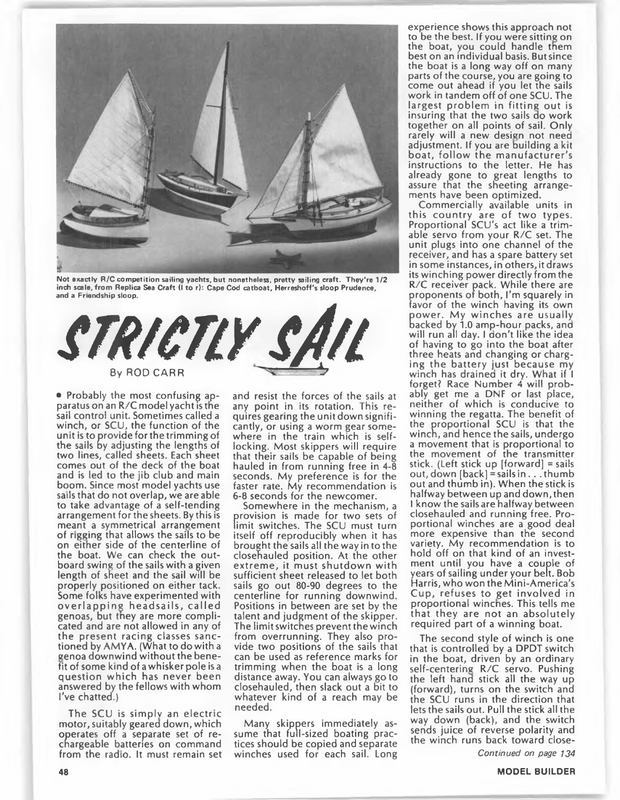
experience shows this approach not to be the best. If you were sitting on the boat, you could handle them best on an individual basis. But since the boat is a long way off on many parts of the course, you are going to come out ahead if you let the sails work in tandem off of one SCU. The largest problem in fitting out is insuring that the two sails do work Not exactly R/C competition sailing yachts, but nonetheless, pretty sailing craft. They’re 1/2 inch scale, from Replica Sea Craft (I to r}: Cape Cod catboat, Herreshoff’s sloop Prudence, and a Friendship sloop. STRICTLY By ROD CARR @ Probably the most confusing apparatus on an R/C model yacht is the sail control unit. Sometimes called a winch, or SCU, the function of the unit is to provide for the trimming of the sails by adjusting the lengths of two lines, called sheets. Each sheet comes out of the deck of the boat and is led to the jib club and main boom. Since most model yachts use sails that do not overlap, we are able to take advantage of a self-tending arrangement for the sheets. By this is meant a symmetrical arrangement of rigging that allows the sails to be on eitner side of the centerline of the boat. We can check the outboard swing of the sails with a given length of sheet and the sail will be properly positioned on either tack. Some folks have experimented with overlapping headsails, called genoas, but they are more complicated and are not allowed in any of the present racing classes sanctioned by AMYA. (What to do witha genoa downwind without the benefit of some kind of a whisker pole isa question which has never been answered by the fellows with whom I’ve chatted.) The SCU is simply an electric motor, suitably geared down, which operates off a separate set of rechargeable batteries on command from the radio. It must remain set 48 and resist the forces of the sails at any point in its rotation. This requires gearing the unit down significantly, or using a worm gear somewhere in the train which is selflocking. Most skippers will require that their sails be capable of being hauled in from running free in 4-8 seconds. My preference is for the faster rate. My recommendation is 6-8 seconds for the newcomer. Somewhere in the mechanism, a rovision is made for two sets of imit switches. The SCU must turn itself off reproducibly when it has brought the sails all the way into the closehauled position. At the other extreme, it must shutdown with sufficient sheet released to jet both sails go out 80-90 degrees to the centerline for running downwind. Positions in between are set by the talent and judgment of the skipper. The limit switches prevent the winch from overrunning. They also provide two positions of the sails that can be used as reference marks for trimming when the boat is a long distance away. You can always go to closehauled, then slack out a bit to whatever kind of a reach may be needed. Many skippers immediately assume that full-sized boating practices should be copied and separate winches used for each sail. Long together on all points of sail. Only rarely will a mew design not need adjustment. If you are building a kit boat, follow the manufacturer’s instructions to the letter. He has already gone to great lengths to assure that the sheeting arrangements have been optimized. Commercially available units in this country are of two types. Proportional SCU’s act like a trimable servo from your R/C set. The unit plugs into one channel of the receiver, and has a spare battery set in some instances, in others, it draws its winching power directly from the R/C receiver pack. While there are roponents of both, I’m squarely in avor of the winch having its own power. My winches are usually backed by 1.0 amp-hour packs, and will run all day. | don’t like the idea of having to go into the boat after three heats and changing or charging the battery just because my winch has drainea it dry. What if | forget? Race Number 4 will probably get me a DNF or last place, neither of which is conducive to winning the regatta. The benefit of the proportional SCU is that the winch, and hence the sails, undergo a movement that is proportional to the movement of the transmitter stick. (Left stick up [forward] = sails out, down [back] =sailsin. . . thumb out and thumb in). When the stick is halfway between up and down, then | know the sails are halfway between closehauled and running free. Proportional winches are a good deal more expensive than the second variety. My recommendation is to hold off on that kind of an investment until you have a couple of years of sailing under your belt. Bob Harris, who won the Mini-America’s Cup, refuses to get involved in proportional winches. This tells me that they are not an absolutely required part of a winning boat. The second style of winch is one that is controlled by a DPDT switch in the boat, driven by an ordinary self-centering R/C servo. Pushing the left hand stick all the way up (forward), turns on the switch and the SCU runs in the direction that lets the sails out. Pull the stick all the way down (back), and the switch sends juice of reverse polarity and the winch runs back toward closeContinued on page 134 MODEL BUILDER
FIG. M 1 o— — — fo) J ee. —— — ie oe oH ie TO JIB CLUB M eet oi ———