- Title. Author. Summary

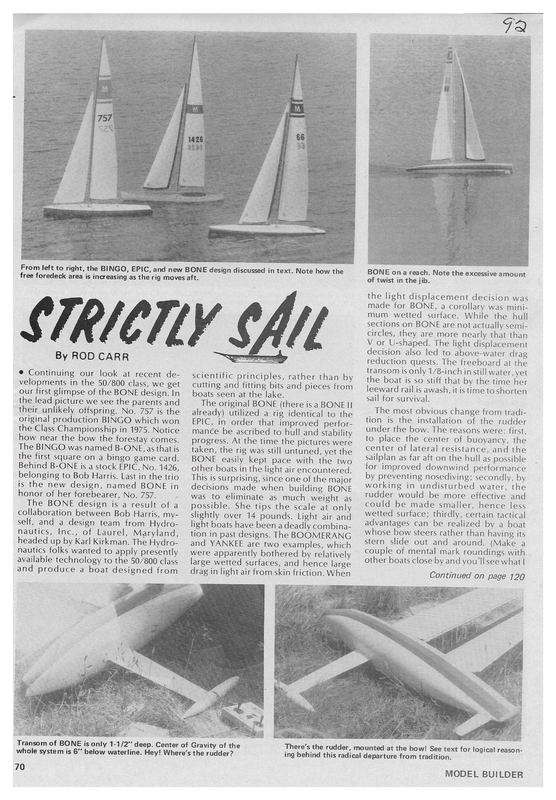
From left to right, the BINGO, EPIC, and new BONE design discussed in text. Note how the free foredeck area is increasing as the rig moves aft. STRICTIY SAUL By ROD CARR e Continuing our look at recent de- velopments in the 50/800 class, we get our first glimpse of the BONE design. In the lead picture we see the parents and their unlikely offspring. No. 757 is the original production BINGO which won the Class Championship in 1975. Notice how near the bow the forestay comes. The BINGO was named B-ONE, as that is the first square on a bingo game card. Behind B-ONE is a stock EPIC, No. 1426, belonging to Bob Harris. Last in the trio is the new design, named BONE in honor of her forebearer, No. 757. : The BONE design is a result of a collaboration between Bob Harris, myself, and a design team from Hydronautics, Inc., of Laurel, Maryland, headed up by Karl Kirkman. The Hydro- nautics folks wanted to apply presently available technology to the 50/800 class and produce a boat designed from scientific principles, rather than by cutting and fitting bits and pieces from boats seen at the lake. The original BONE (there is a BONE II already) utilized a rig identical to the EPIC, in order that improved performance be ascribed to hull and stability progress. At the time the pictures were taken, the rig was still untuned, yet the BONE easily kept pace with the two other boats in the light air encountered. This is surprising, since one of the major decisions made when building BONE was to eliminate as much weight as possible. She tips the scale at only slightly over 14 pounds. Light air and light boats have been a deadly combina- tion in past designs. The BOOMERANG and YANKEE are two examples, which were apparently bothered by relatively large wetted surfaces, and hence large drag in light air from skin friction. When Transom of BONE is only 1-1/2” deep. Center of Gravity of the whole system is 6’’ below waterline. Hey! Where’s the rudd er? 70 the light displacement decision was made for BONE, a corollary was mini- mum wetted surface. While the hull sections on BONE are not actually semi- circles, they are more nearly that than V or U-shaped. The light displacement decision also led to above-water drag reduction quests. The freeboard at the transom is only 1/8-inch in still water, yet the boat is so stiff that by the time her leeward rail.is awash, it is time to shorten sail for survival. The most obvious change from tradi- tion is the installation of the rudder under the bow. The reasons were: first, to place the center of buoyancy, the center of lateral resistance, and the sailplan as far aft on the hull as possible for improved downwind performance by preventing nosediving; secondly, by working in undisturbed water, the rudder would be more effective and could be made smaller, hence less wetted surface; thirdly, certain tactical advantages can be realized by a boat whose bow steers rather than having its stern slide out and around. (Make a couple of mental mark roundings with other boats close by and you’ll see what | Continued on page 120 There’s the rudder, mounted at the bow! See text for logical reasoning behind this radical departure from tradition. MODEL BUILDER
Sn == ——— mean.) Last, such a configuration opens up the foredeck, and the possibility of a working spinnaker in this class becomes more attractive. As of this writing, BONE is getting a new suit of sails with some modifications in the jib-main ratio, and the rudder may be moved a bit farther aft to quicken the tacking action of the hull. Meanwhile, her younger sister, BONE II, has been test-sailed twice and is now ready to be tested against the stable you see in the pictures. BONE II is the first cat-rigged 50/800 that I’ve ever thought had a chance. Her early performance on the runs makes one think there are rails under the water, and that is with the rudder dead amidships. | may have more details on her next month if the lake doesn’t freeze. The canoe bodies of BONE and BONE Il are essentially the same. Any reader who might be interested in obtaining a hull and embarking on his own basic research should make contract directly with Karl Kirkman, 17500 Skyline Drive, Ashton, Maryland 20702. If a reasonable number of skippers show interest, a means of production will be found. This A. J. FISHER INC. MANUFACTURERS SCALE BRASS OF SHIP x eZ ——S—=>= FIBERGLASS //, QUALITY AND SAILING YACHT FITTINGS SINCE 1925 MODELS PLANS – FITTINGS – KITS – BooKs ILLUSTRATED CATALOG, $1.50 PEMAQUID FRIENDSHIP SLOOP “FLORIDA” Hull Length 37” — LOA 56” “SIRIUS 45” NEW GLASS STAR 45 BOAT Ge for AMYA Star 45 Class HULLS @ KITS ® READY-TO-SAIL Send 50¢ postage and handling for details 1002 ETOWAH ST. ZIP – David Mainwaring MICH. OAK, ROYAL 48067 PO BOX 554 NEEDHAM, MA 02192 TRIDENT lI RACING TRIMARAN FOR R/C F| FIRST PLACE IN 1974 AND 1975 36-600 ACCR REGATTAS eSTYRENE HULLS AND DECKS e36″ LOA. ¢36’ BEAM eCOMPLETE PLANS e¢SEWN DACRON SAILS e¢6.5 LBS. DISPLACEMENT eHARDWARE e600 SO. IN. COMPLETE KIT (LESS WINCH) is not a project for a beginner, or forone $100.00 SAIL CONTROL WINCH unfamiliar with building light but strong structures. Along with the hull would $50.00 CUSTOM R/C DESIGN FOR ALL BOAT SIZES probably come a set of measurements and suggestions, but you’re definitely POWER — 40 IN. LB… FAST == 5ISEG on your own. 3 VOLTAGE 4.8 – 6V. I’m sure that there are other designs LIGHT — —8 OZ. coming off building boards across the country. Why not tell me about yours? You can never tell who might want to SMALL — 2’x2″x5” FIRST PLACE IN build one of your brainchildren. I’ve been in the model yachting business almost as long as Tom Protheroe and John Reynolds. Ain’t none of us getting rich, but we’re having a lot of good times. So if you are hiding your ideas under a bushel basket because you plan . 1973 S/B ACCR, ; ‘74 36-600 ACCR AND ’75 50-800 ACCR STAINLESS STEEL HARDWARE: Turnbuckles, Chainpiates, Goosenecks, Boom vang pivots, Pad eyes, Tangs, Deck cleats, Boom cleats, Rigging wire. MISCELLANEOUS ITEMS Sheet exit guides, Bowsie, Rudder posts, Mast head fitting, Dacron sheet line. Dealer inquiries invited. to retire on the income from them, look PROBAR DESIGN out. You’d be better off to share them and reap the reward of anumber of new friends and acquaintences. As I’ve said many times before, I’m happiest when | P.O. BOX 639 ESCONDIDO, CA. 92025 can present your projects and pictures, and | always give credit where it is due. Remember that I’ll answer questions for a self-addressed, stamped envelope. If you are asking something general, put two stamps on the envelope and I’ll be liable to send you MODEL BUILDER reprints from years gone past that cover the answer in detail. Rod Carr, 7608 Gresham St., Springfield, VA 22151. American Model Yachting Association Dues are now $10.00 and should be sent to Bob Espenshade, 7221 Casa Adobe, Citrus Heights, CA 95610. ) W-1.. . $50.00 ®Custom R/C design for all boat sizes @ Power 40 in. Ibs. @ Travel time – 5 seconds @ Voltage – 4.8-6 (W-1) @Size – 2 x 2 x 5 inches. The Probar W-7 is mechanically operated by a sepa rate, neutralizing servo. The Probar Propo W-2 is designed to plug directly into the receiver, and requires no extra batteries. Specify Kraft, Fut aba, or no connector. Both winches are fully assembled and tested, ready to install. All mounting hardware, switch pushrod (W-1 only), and winch arm blank are supplied. STAINLESS STEEL HARDWARE: Turnbuckles, Chainplates, Goosenecks, Boom vang pivots, Pad eyes, Tangs, Deck cleats, Boom cleats, Rigging wire. PROBAR DESIGN MISCELLANEOUS ITEMS: Sheet exit guides, Bowsie, Rudder posts, Mast head fitting, Dacron sheet line. Dealer inquiries invited. P.O. BOX 639 ESCONDIDO, CA. 92025