- Title. Author. Summary

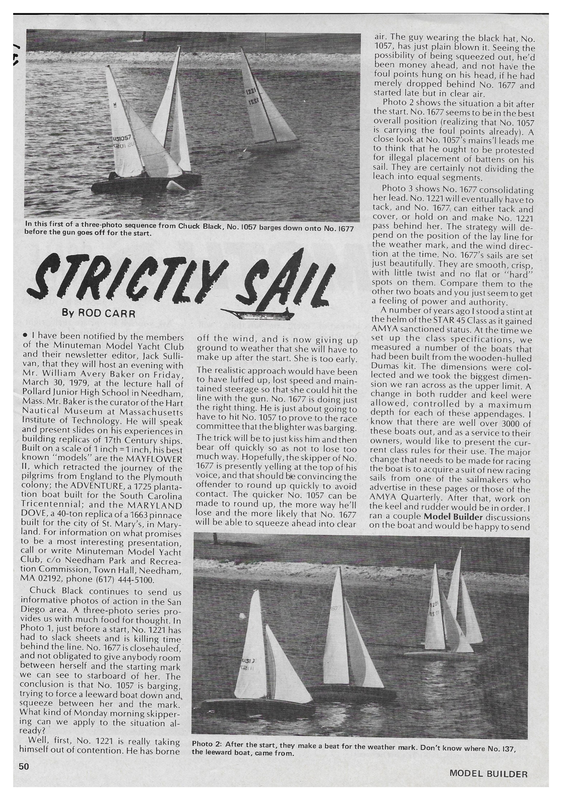
air. The guy wearing the black hat, No. 1057, has just plain blown it. Seeing the possibility of being squeezed out, he’d been money ahead, and not have the foul points hung on his head, if he had merely dropped behind No. 1677 and started late but in clear air. Photo 2 shows the situation a bit after the start. No. 1677 seems to be in the best overall position (realizing that No. 1057 is carrying the foul points already). A close look at No. 1057’s mains’! leads me to think that he ought to be protested for illegal placement of battens on his sail. They are certainly not dividing the leach into equal segments. Photo 3 shows No. 1677 consolid ating her lead. No. 1221 will eventually have to tack, and No. 1677, can either tack and In this first of a three-photo sequence from Chuck Black, No. 1057 barges down onto No. 1677 before the gun goes off for the start . cover, or hold on and make No. 1221 pass behind her. The strategy will depend on the position of the lay line for the weather mark, and the wind direction at the time. No. 1677’s sails are set just beautifully. They are smooth, crisp, with little twist and no flat or “hard” spots on them. Compare them to the other two boats and you just seem to get a feeling of power and authority. A number of years ago I stood astint at By ROD CARR the helm of the STAR 45 Class as it gained @ | have been notified by the members of the Minuteman Model Yacht Club and their newsletter editor, Jack Sullivan, that they will host an evening with Mr. William Avery Baker on Friday, March 30, 1979, at the lecture hall of Pollard Junior High School in Needham, Mass. Mr. Baker is the curator of the Hart Nautical Museum at Massachusetts Institute of Technology. He will speak and present slides on his experiences in building replicas of 17th Century Ships. Built on a scale of 1 inch =1 inch, his best known “‘models” are the MAYFLOQWER Il, which retracted the journey of the pilgrims from England to the Plymouth colony; the ADVENTURE, a 1725 plantation boat built for the South Carolina Tricentennial; and the MARYLAND DOVE, a 40-ton replica ofa 1663 pinnace built for the city of St. Mary’s, in Maryland. For information on what promises to be a most interesting presentation, off the wind, and is now giving up ground to weather that she will have to make up after the start. She is too early. The realistic approach would have been to have luffed up, lost speed and maintained steerage so that she could hit the line with the gun. No. 1677 is doing just the right thing. He is just about going to have to hit No. 1057 to prove to the race committee that the blighter was barging. The trick will be to just kiss him and then bear off quickly so as not to lose too much way. Hopefully, the skipper of No. 1677 is presently yelling at the top of his voice, and that should bee convincin the g offender to round up quickly to avoid contact. The quicker No. 1057 can be made to round up, the more way he’ll lose and the more likely that No. 1677 will be able to squeeze ahead into clear AMYA sanctioned status. At the time we set up the class specifications, we measured a number of the boats that had been built from the wooden-hulled Dumas kit. The dimensions were col- lected and we took the biggest dimen- sion we ran across as the upper limit. A change in both rudder and keel were allowed, controlled by a maximum depth for each of these appendages. | ‘know that there are well over 3000 of these boats out, and as a service to their owners, would like to present the current class rules for their use. The major change that needs to be made for racing the boat is to acquire a suit of new racing sails from one of the sailmakers who advertise in these pages or those of the AMYA Quarterly. After that, work on the keel and rudder would be in order. | ran a couple Model Builder discussions on the boat and would be happy to send call or write Minuteman Model Yacht Club, c/o Needham Park and Recreation Commission, Town Hall, Needham, MA 02192, phone (617) 444-5100. Chuck Black continues to send us informative photos of action in the San Diego area. A three-photo series pro- vides us with much food for thought. In Photo 1, just before a start, No. 1221 has had to slack sheets and is killing time. behind the line. No. 1677 is closehauled, and not obligated to give anybody room between herself and the starting mark we can see to starboard of her. The conclusion is that No. 1057 is barging, trying to force a leeward boat down and, squeeze between her and the mark. What kind of Monday morning skippering can we apply to the situation al- ready? Well, first, No. 1221 is really taking himself out of contention. He has borne 90 Photo 2: After the start, they make a beat for the weather mark. Don’t know where No. 137, the leeward boat, came from. MODEL BUILDER
them out if you’ll provide me with 2 stamps (16 cents each, of course). STAR 45 CLASS RATING RULES HULL Standard Hard Chine hull as manu_ factued by Dumas, Reynolds Manufacturing (Mainwaring mold), and other manufacturers as designated by the Class Secretary, Hulls may also be built from plans so long as they conform to the STAR design and specifications: Hull construction: Wood or Fiberglass Maximum LOA: 45-1/2 inches plus or minus 1/2 inch. Deck constructed in accordance with sound practices Beam maximum 11-1/2 inches plus or minus 1/2 inch. Rub rails up to 1/4 inch may be added at sheer, but will not be included in measurement at maximum beam. KEEL Keel shall be no more than 11-1/2 inches from bottom of hull to bottom of keel. RUDDER Skeg rudder or spade rudder. Rudder shall not project more than 7 inches below hull. MAST Maximum height above deck to be 70 inches. Rotating, permanently bent, permanently curved, or wing masts are prohibited. RUNNING RIGGING All running rigging controlled by R/C is prohibited except for main and jib sheets, jib tensioners and jib “twitchers’’. STANDING RIGGING Height of jib stay attachment to mast not to exceed 54 inches above the deck. SAILS All boats in the class shall be as alike as possible in sail plan, and none shall have undue advantage by reason of size of sails or construction. Cotton, nylon, and dacron sail material are permitted. All sail dimensions are to be cloth to cloth with sails attached to spars, and wrinkles ulled out. The sails shall conform tothe following dimensions which will represent the maximum allowable: (all di- Photo 3: No. 1677’s nicely-set sails pull her out in front. No wrinkles, cups, or creases make for maximum power. thick and clearly readable. NO LIMITS LWL, weight. PROHIBITED Movable keels, or movable ballast. * * aK During the recent AMYA balloting, the membership overwhelmingly voted to maintain organizational autonomy. The AMYA is not recognized by the International Model Yacht Racing Union (IMYRU), while another organi- zation , the Model Yacht Racing Association of America (MYRAA), is. In an effort to bridge the gap, MYRAA President Angus Scott-Fleming has invited groups of 5 skippers to form clubs for the purpose of obtaining MYRAA membership. The bottom line is the opportunity to sail in the 1980 IMYRU World Championships in Canada. I’ve offered to serve as a point of reference for individual skippers who may need help in interfacing with MYRAA, and sent the following letter to the AMYA Quarterly and MYRAA officials: Gentlemen: | am in receipt of the Angus ScottFleming letter of December 1, 1978, addressed to all AMYA Clubs. He offers a policy of cross-pollination, mensions in inches) and tactfully refrains assigning roles as Main: Leach 64-1/2; Luff 61-3/4; Foot 24-1/4; Roach 2-1/2; Foot Round 1. ~ bees or flowers!!! More power to him. | have been peripherally involved with MYRAA over the years, first as handling the admittance of our original Capitol BATTENSR/C’ers into MYRAA back in 1970 and Main: Maximum 4, equally spaced 1971, and more recently within the across leach and not to exceed 8-1/2 competition framework of the Internainches in length. tional A-Class in which John Krick and Jib: No battens permitted. Angus have forged some excellent JIB CLUB competitions for skippers within both Permitted on jib, or jib may be loose _ organizations. | have always been happy footed. to see that warm wind and a weather DISTINGUISHING MARKS mark were all that was necessary to leave mainsail her on carry Each yacht shall organizational squabbling far behind the class 5 point “STAR emblem’, and an the starting line. assigned AMYA registration number. My reason for writing this open letter The “star” should be at least 2 inches in is a concern for the individual AMYA size and positioned above the registramembers who make up an approximate tion number, and both should be posi65% of that organization. The MYRAA tioned on the upper half of the mainsail has taken the position of discouraging on both the port and starboard sides of individual memberships for the purpose the sail. Identification numbers shall be of eligibility in the 1980 World Champ3 inches in height and at least 3/8 inch Jib: Leach 36; Luff 41-1/4; Foot 14-3/4; Roach 1; Foot Round 1. APRIL 1979 ionship to be sailed under IMYRU sanction in Canada. This is areasonable result of their structure, which is a loose con- federation of clubs, while AMYA has chosen to organize as a collection of individuals. | propose to serve both organizations at the same time as a central contact point for AMYA members who either do not belong to AMYA clubs and wish to join MYRAA, or for AMYA members whose clubs choose not to affiliate. In either case, | will be able to shuffle such individuals into regional organizations that will be simultaneously compatible with the aims and structure of both organizations. Since | had the misfortune to draw the short straw and serve as AMYA’s first Secretary/Treasurer, | am well acquainted with her structure, distribution of membership, and roster of current skippers. | would seem to be an obvious choice for providing the administrative bridge which AMYA members will need for easing the passion of this phase of cross-pollination. | have maintained some semblance of credibility within both organizations, maybe through creative laziness if nothing else, as I’ve always preferred to sail rather than slug. When I felt the need to massage a typewriter, it was usually in production of copy for na- tional publication intended to introduce and promote model yachting across the country. ! selfishly hope that such a position will be repaid in an increased flow of photographs and technical information from MYRAA that | can use in descriptions of international formula class activities. (I’m quite proud of my record in promoting 50/800, A, and 10-R classes within the pages of Model Builder, Radio Control Modeler, Model Boats, Radio Control Model Boating, Model Boating World News, and a number of other publications.) Simply put, the bottom. line is as follows to AMYA skippers: Send me your name, address, AMYA number, a $2.00 bill, and a stamped, self-addressed envelope if you agree with me that cross-pollination between AMYA and Continued on page 98 51
Sailing…… Continued from page 51 MYRAA will result in better sailing for all skippers. Now, I’m sure that there area number of raised eyebrows inthe crowd. You are probably thinking what has driven me into such a public display of altruism? The answer is. quite simple. Model yachting enjoyed an almost explosive growth during the early 70’s. No matter which organization you look at, and no matter whether you count noses, clubs, registrations, number of turnbuckles or inches of battens, the sport has leveled off. Part of this leveling is due to natural turnover (model yachting is, after all, a voluntary sport). It seems to me that it will require the concerted dedication of the members of both organizations to re-establish the growth trends that are necessary to encourage garage-manu- facturers to supply specialty hardware for the sport. There is only a certain amount of administrative and promotional talent around that can be drawn upon. We must assure that we utilize each other’s talents in the most efficient way possible. An interesting problem is going to arise in the wide distribution of AMYA individual members who will want to Join MYRAA. | intend to see them organized in accordance with the estab- lished precedent within present MYRAA Clubs. Geographical closeness is desirable for the practical. requirements of sailing boats. Such closeness is not a requirement for the organizational coherence, nor for the passing of information within a MYRAA Club. The wisdom of this approach has allowed me, living in Virginia, to maintain a proper MYRAA membership by becoming a member of the Delaware ENT YOU! ‘ MODEL BUILDER
Valley MYC, headquartered in the suburban Philadelphia area. Similarly, one of my neighbors living in Virginia Is a member of the MYRAA club in Mont- clair, New Jersey, as well as a fellow who resides in San Diego who also is allowed to maintain membership with the Montclair Club. There had to be developed a means of circumventing the vagaries of one’s hometown by allowing membership with a MYRAA club some distance away. The option to let a single individual hold membership was chosen by AMYA, and is simply the other way to skin this kind of administrative cat. In summary, | am willing to share a part of the cross-pollination program by acting as an administrative interface. The procedure is to allow AMYA members, who are PERSONS, to easily become members of MYRAA CLUBS without undue inconvenience. I’d like to acknowledge the discussions and helpful concern of both Angus Scott-Fleming and John Krick, as well as continued dialog within AMYA with its members and directorate. The output of all these communications has formed itself into the offer I’m presenting. | would certainly be amiss if | was to present my role as strictly a one-way flow of information and people. | would be most happy to assist any MYRAA Club members who wish to take out AMYA individual membership, associate with or start AMYA sanctioned clubs, or learn about the AMYA activities and classes in their areas. AMYA has a batallion of class secretaries, each shepherding his awn flock of formula or onedesign vessels. Makes for an interesting approach to sailing, each fellow sailing the same boat!!! Sincerely yours, Roderick A. Carr So, sendin your dues, and if you have questions, send me a self- addressed, stamped envelope for a quick reply. ’’m finally able to give out the right address for sending your $10.00 AMYA dues, and that will be to the Treasurer, Dick Hein, 1884 Campus Court, Rochester, Michigan 48063. I’m still paying the mortgage at 7608 Gresham St., Springfield, VA 22151. e