- Title. Author. Summary

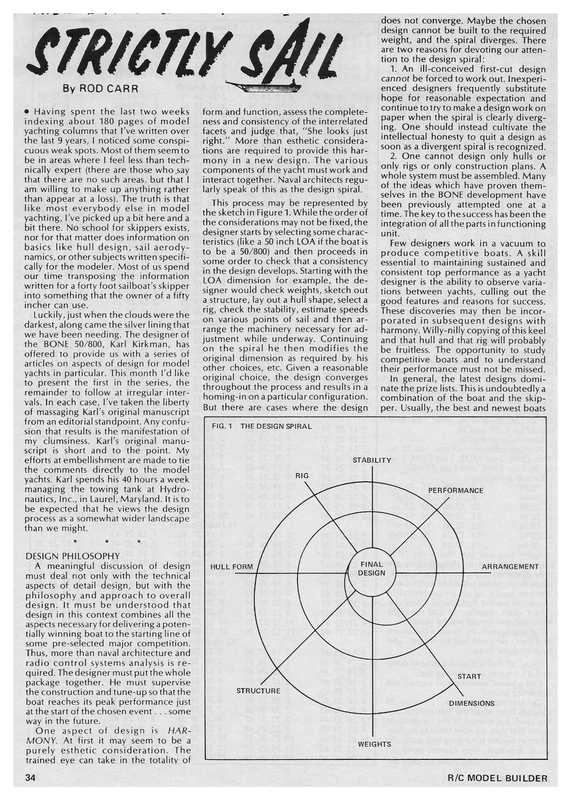
a —_— ed * os ~ —_—- STRICTIYSAUL By ROD CARR @ Having spent the last two weeks indexing about 180 pages of model yachting columns that I’ve written over the last 9 years, | noticed some conspicuous weak spots. Most of them seem to be in areas where | feel less than technically expert (there are those who say that there are no such areas. but that | am willing to make up anything rather than appear at a loss). The truth is that like most everybody else in model yachting, I’ve picked up a bit here anda bit there. No school for skippers exists, nor for that matter does information on basics like hull design, sail aerodynamics, or other subjects written specifically for the modeler. Most of us spend our time transposing the information written for a forty foot sailboat’s skipper into something that the owner of a fifty incher can use. Luckily, just when the clouds were the darkest, along came the silver lining that we have been needing. The designer of the BONE 50/800, Karl Kirkman, has offered to provide us with a series of articles on aspects of design for model yachts in particular. This month I’d like to present the first in the series, the remainder to follow at irregular intervals. In each case, I’ve taken the liberty of massaging Karl’s original manuscript from an editorial standpoint. Any confusion that results is the manifestation of my clumsiness. Karl’s original manuscript is short and to the point. My efforts at embellishment are made to tie the comments directly to the model yachts. Karl spends his 40 hours a week managing the towing tank at Hydronautics, Inc., in Laurel, Maryland. It is to be expected that he views the design process as a somewhat wider landscape than we might. * * form and function, assess the completeness and consistency of the interrelated facets and judge that, “She looks just right.”” More than esthetic considerations are required to provide this harmony in a new design. The various components of the yacht must work and interact together. Naval architects regularly speak of this as the design spiral. This process may be represented by the sketchin Figure 1. While the order of the considerations may not be fixed, the designer starts by selecting some charac- teristics (like a 50 inch LOA if the boat is to be a 50/800) and then proceeds in some order to check that a consistency in the design develops. Starting with the LOA dimension for example, the designer would check weights, sketch out a structure, lay out a hull shape, select a rig, check the stability, estimate speeds on various points of sail and then arrange the machinery necessary for adjustment while underway. Continuing on the spiral he then modifies the original dimension as required by his other choices, etc. Given a reasonable original choice, the design converges throughout the process and results ina homing-in onaparticular configuration. does not converge. Maybe the chosen design cannot be built to the required weight, and the spiral diverges. There are two reasons for devoting our attention to the design spiral: 1. An_ ill-conceived first-cut design cannot be forced to work out. Inexperienced designers frequently substitute hope for reasonable expectation and continue to try to make a design work on paper when the spiral is clearly diverging. One should instead cultivate the intellectual honesty to quit a design as soon as a divergent spiral is recognized. 2. One cannot design only hulls or only rigs or only construction plans. A whole system must be assembled. Many of the ideas which have proven themselves in the BONE development have been previously attempted one at a time. The key to the success has been the integration of all the parts in functioning unit. Few designers work in a vacuum to produce competitive boats. A skill essential to maintaining sustained and consistent top performance as a yacht designer is the ability to observe variations between yachts, culling out the good features and reasons for success. These discoveries may then be incorporated in subsequent designs with harmony. Willy-nilly copying of this keel and that hull and that rig will probably be fruitless. The opportunity to study competitive boats and to understand their performance must not be missed. In general, the latest designs dominate the prize lists. This is undoubtedly a combination of the boat and the i – But there are cases where the design — per. Usually, the best and newest eae FIG. 1 THE DESIGN SPIRAL STABILITY RIG PERFORMANCE * DESIGN PHILOSOPHY A meaningful discussion of design must deal not only with the technical aspects of detail design, but with the philosophy and approach to overall design. It must be understood that design in this context combines all the aspects necessary for delivering a potentially winning boat to the starting line of some pre-selected major competition. Thus, more than naval architecture and radio control systems analysis is required. The designer must put the whole package together. He must supervise the construction and tune-up so that the boat reaches its peak performance just at the start of the chosen event. ..some way in the future. One aspect of design is HARMONY. At first it may seem to be a purely esthetic consideration. The trained eye can take in the totality of 34 HULL FORM FINAL ARRANGEMENT DESIGN START STRUCTURE DIMENSIONS WEIGHTS R/C MODEL BUILDER
are driven by the best skippers, as there seems to be a direct connection between desire to win and the efforts that are expended in support of that desire. For the remainder of this discussion, let us accept the idea that regardless of skipper skill, potential boat performance follows a curve of improvement as time proceeds. This statement of progress can be shown in graphical form as Figure 2. Note that we have not put measureable quantities on the axis for time of performance. Performance is representative of speed around a race course, and time is some kind of a reference calendar time. Another way of saying this is that with the passage of time, designers are able to provide faster boats with a competitive advantage. FIG. 2 i PERFORMANCE is more on the order of 4-6 years. Clever skippering can have a saving effect on boat performance. The best example of skipper skill extending a design’s competition life is the efforts of 50/800 Class Secretary Stan Goodwin on behalf of his WARRIOR. Originally designed asavane boat, Stan was still sailing the WARRIOR in 1978 and doing very well with it. | do have to report that the new WARRIOR Ill is now on the water, proving the inexorable progress of the state-of-theart ramp. In the figure, the total time from A to Bto C is termed the useful life of the boat. It is interesting to note that in the 50/800 class, by the time a boat has been proven and is available commercially as a fiberglass hull it is very nearly at point B, just about at the state-of-theart. Now, in a mixed fleet of older boats, the new boat will do very well indeed, since it is less obsolete than its fleet mates. But at the upper levels of competition, like the top 5 at the National Championships, a commercially avail- FIG. 6 PERFOR M NCE ORMA USEFUL LIFE W/O MODIFICA TIONS =a. | TIME boat’s utility. You really need to have a yardstick for comparison if you decide to modify. The best bet is your sailing partner who makes no changes on his boat while you are changing yours. The practical requirements of design, construction, and shakedown complicate our picture of a new design’s lifetime. In Figure 7 these phases are added to the boat’s lifeline. It is clear that one must minimize the preliminary phases in order to maximize competitive advantage. FIG.7 4 able boat is going to be at adisadvantage. TIME There is little reason to assume that the state-of-the-art line will bend over and become horizontal. At least in the 50/800 class, progress has been continuous since 1930!!! Even so, the class went through a radical change of philosophy in the 1970-1975 era as the emphasis changed from vane-sailed boats to their radio controlled progeny. Figure 3 indicates the goal of developing a new design. One hopes that the design will be above the general state-of-the-art at the time it is put into competition, and will enjoy a competitive advantage. (Read between the lines. . . if you don’t want to build all the time . . . considera one-design.) In Figure 4 we show a horizontal path of the new design. Other paths are possible. Figure 5 shows what happens to a new design which is allowed to deteriorate. The usual problem is failure to take care of the sails. Stretched leeches, broken battens and so forth act just like barnacles growing on the bottom. Cleaning the hull well between regattas is often ignored. Fresh water algae will dry on the hull underbody and make it rough, increasing drag. We see in the figure a shortening of the useful life of the boat as a result of this neglect. FIG. 5 FIG. 3 | PERFORMANCE | | Pa eps ee UE USEFUL LIFE ————-_+} 3 INCREASING COMPETITIVE ADVANTAGE SPECIFIC DESIGN \ 3 DETERIORATION PERFORMANCE be ACTUAL USEFUL LIFE ~ DECREASING COMPETITIVE l Ape ae TIME We can now trace the impact of time on this particular design and unearth some interesting properties. First, the design will remain above the state-ofthe-art as time proceeds for a measurable time (A to B) in Figure 4. There is a LUEEL i h*————__ USEFUL LIFE———_w>] PERFORMANCE is indeterminate, but | would imagine it JUNE 1979 DESIGN CONSTRUCTION 2—\_-@- SHAKEDOWN —= PERFORMANCE 1 fl | | | i a CREE | ONAL USEFUL—o4 LIFE | TIME Up to this point we have assumed that a new design sails up to its potential speed from the time it is launched. More realistically, there is a period of adjustme andnt tuning as the quirks of the new boat are sorted out and handled. Figure 8 shows this in a schematic way. This work-up time is important if one is shooting for a specific competition. In my experience | think that the period between launching and reaching design performance is probably 4-8 months. It requires as much competition sailing as can be fitted in. The yardsticks are better, the fleets are bigger, and the skipper skill gets honed at thesame time the boat is being shaken down. | TIME I’ve given a number of clinics for various classes of boats over the years. | never fail to be amazed at the inadequacies that the skipper swore he was going to fix … LAST YEAR. Yet here he is again, and that widget still needs to be fixed. No wonder he is still down inthe middle 2 of the fleet. Many times, a skipper goes off in search of a replacement for his boat, when what he really needs is to go over it with a fine tooth comb and set right all those little details that are continuously robbing him of boatspeed. A strategy exists for extending the life of an existing design. This is the time honored method of modifications. further time period (B to C) during which the design is less competitive, but approaches obsolescence. At the present time, I’d say that the typical ABtime span is about 1 to 1.5 years. The BC time PaNCERT i FIG. & ADVANTAGE USEFUL LIFE WITH MODIFICATIONS: 4 Figure 6 shows a step increase in performance by incorporating a modification on an existing design. One sees a significant extension of its useful life by so doing. One should be warned that there are modifications which result ina step decrease and a shortening of the CONCEPT PERFORMANCE E C N A M R O F R E P L A U T C A Vs LAUNCHING — TIME The work-up time becomes especially crucial when the goal is top performance in a specific event, such as a National Championship. Figure 9 shows FIG.9 : Co — | — Sen a PERFORMANCE EVENT TIME = design A is started too soon and is outbuilt by B. Design C waits too long Continued on page 102 35
Sailing…… Continued from page 35 and has insufficient time to reach its peak. One really needs to pick the event and with a reasonable margin for emergencies, design for that ‘““window’”’. Another consideration a designer must deal with is that of risk. One may trade performance for risk. Inthe case of physical risk, one accepts the probability that the boat may be damaged, in order to give it a competitive advantage. A paper deck would allow the boat to be lighter, more weight could go into the keel bulb increasing stability for a given displacement (everything is OK as long as the deck is not pierced!!). Figure 10 shows that early in the game a little physical risk can be accepted (A) and a fairly large potential in performance can result. Farther out on the curve, one must accept large physical risk (B) for a much diminished increase in performance. No designer likes to be famous FIG. 10 me ee ee ee i ee | | | | | | | a~_——_—_——_—_ — — = PERFORMANCE + | | | | | | , : | | | | | 1 | $$ } — ——f A B PHYSICAL RISK for breakdowns. It is correspondingly unnerving to sail a fragile boat that is a real winner, unless it is touched by another boat. It is often said that anything that breaks was under-designed and needs to be strengthened. What
never breaks, has been over-designed and is carrying extra weight needlessly. Another kind of risk is technical risk (Figure 11). If we build a copy of boat A, the present winner, there is no risk, but there is also no gain. Somewhere down the line is a new design which will have an acceptable risk that is balanced against the potential gain in performance. Such a trade-off is not easy to quantitate. Decisions are usually made on the basis of the experience of the designer involved. FIG. 11 PERFORMANCE | TECHNICAL RISK Figure 12 gives a picture of the process “s of innovation. From a functioning design A, logical development leads to subsequent designs of increased perfor- tg mance. Examples are the previously mentioned Goodwin WARRIOR series, Godby’s WIND series, and Purdy’s YANKEE line. These are evolutionary developments leading in a natural order. The farther one departs from the existing design, the wider the band of performance uncertainty. The more time that is spent on design the narrower the band. FIG. 12 stopped playing musical secretaries, and the following address is good for at least the next year or so. My apologies for any delays that were caused by the addresses previously published. I’m sure nothing was lost, just slowed a bit. AMYA Secretary, 11913 Ferina St., Norwalk, CA 90650. | will field questions for the SASE send to 7608 Gresham St., Springfield, VA PERFORMANCE 2285 Ts e F/F Scale… . Continued from page 57 EXTENT OF DEVELOPMENT Please remember to send in your AMYA dues of $10.00. AMYA has finally sults. This technique works well even for rubber models. You may wonder why the clear is applied to the inside instead of the