- Title. Author. Summary

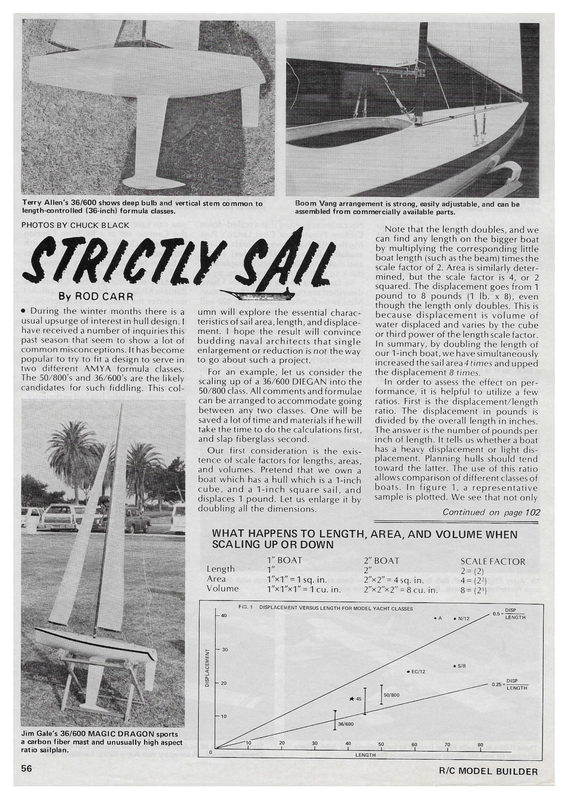
Terry Allen’s 36/600 shows deep bulb and vertical stem common to length-controlled (36-inch) formula classes. Boom Vang arrangement is strong, easily adjustable, and can be assembled from commercially available parts. PHOTOS BY CHUCK BLACK Note that the length doubles, and we STRICTLY By ROD CARR @ During the winter months there is a usual upsurge of interest in hull design. | have received a number of inquiries this past season that seem to show a lot of common misconceptions. It has become popular to try to fit a design to serve in two different AMYA formula classes. The 50/800’s and 36/600’s are the likely candidates for such fiddling. This col- can find any engi on the bigger boat Gf umn coe will eee the essential charac- teristics of sail area, length, and displacement. | hope the result will convince budding naval architects that single enlargement or reductionis not the way to go about such a project. For an example, let us consider the scaling up of a 36/600 DIEGAN into the 50/800 class. Allcomments and formulae can be arranged to accommodate going between any two classes. One will be saved a lot of time and materials if he will take the time to do the calculations first, and slap fiberglass second. Our first consideration is the existence of scale factors for lengths, areas, and volumes. Pretend that we own a boat which has a hull which is a 1-inch cube, and a 1-inch square sail, and displaces 1 pound. Let us enlarge it by by multiplying the corresponding little boat length (such as the beam) times the scale factor of 2. Area is similarly determined, but the scale factor is 4, or 2 squared. The displacement goes from 1 pound to 8 pounds (1 Ib. x 8), even though the length only doubles. This is because displacement is volume of water displaced and varies by the cube or third power of the length scale factor. In summary, by doublivie the length of our 1-inch boat, we have simultaneously increased the sail area4 times and upped the displacement 8 times. In order to assess the effect on performance, it is helpful to utilize a few ratios. First is the displacement/length ratio. The displacement in pounds is divided by the overall lengthin inches. The answer is the number of pounds per inch of length. It tells us whether a boat has a heavy displacement or light dis- placement. Planning hulls cherie tend toward the latter. The use of this ratio allows comparison of different classes of boats. In figure 1, a representative sample is plotted. We see that not only doubling all the dimensions. Continued on page 102 WHAT HAPPENS TO LENGTH, AREA, AND VOLUME WHEN SCALING UP OR DOWN Length Area Volume FiG.1 40 eat 1” BOAT 1” 2” BOAT ge 1”*1=”1 sq. in. 1°x1°*1″ = 1 cu. in. 2″* 2″ = 4 sq. in. 2°*2″* = 82” cu. in. SCALE FACTOR 2= (2) 4 = (22) 8 = (23) DISPLACEMENT VERSUS LENGTH FOR MODEL YACHT CLASSES DISP 09 TENGTH 30 = S < o Qa o25< oS \ | som 36/600 Jim Gale’s 36/600 MAGIC DRAGON sports a carbon fiber mast and unusually high aspect ratio sailplan. 56 50 0 60 70 80 LENGTH R/C MODEL BUILDER
Sailing ...... Continued from page 56 does displacement increase with length, it increases faster than length. The table below gives the disp./length ratio for these boats. GEASS DISP./LENGTH $6 /G0G og i ee a SAID. kechie aa wep ere ae hea DOZB OUTS eters cas caite oA Sb} Re Seen OA a ee etAl (72 OE hg Ay cS Peete eee 0.16-0.33 ee 0.24-0.42 eee 0.28-0.4 wy ae ee NRE: 0.36 0.41 NeW poRtel2 wares soc. ee cae 0.55 A-Class: ((ijaGer awn sen ee 0.606 We see that the ratio overlaps for the 36/600's and 50/800’s. The Diegan has a disp./length of 9.6/36, or 0.267. We can use this value to calculate a target weight for the 50-inch version by substituting into the ratio: displacement/50” = 0.267. Therefore, the displacement should be about 15.35 Ibs. Another ratio which is helpful is the sail area/displacement (SA/DISP) ratio. The area (square inches) of sail area is divided by the displacement in pounds. The resulting answer is the number of square inches that are assigned to push each pound of boat. In the DIEGAN, the SA/DISP. = 600 sq. in./9.6 Ibs. = 62.5 sq. in. per pound. Remember that we hoped for a 15.35 lb. 50-inch boat in the paragraph above, based on displacement/length. Now we can calculate the amount of sail area the 50-inch boat must have to maintain 62.5 sq. in. per pound: 15.35 lbs. x 62.5 sq. in./pound = 959.4 sq. in., sq. But the 50/800 rule only allows us 800 sq. in., SO we must operate at a reduced sail area. Our actual SA/DISP. will be 800/15.35 = 52.1 sq. in./pound. We’ve lost 16% of our potential power because of the class rule controlling total sail area. Geometrical areas scale in the ratio of the squares of the lengths. So 502/362 = 1.92. If we just make the sail rig proportionally larger, it will have 600 sq. in. x 1.92 = 1152 sq. in. But again, we will only be allowed 800 sq. in., so we lose 352 sq. R/C MODEL BUILDER
SAILS: 800 sq. in. x 0.518 = 414.4 sq. in sails. But since we’re allowed 600 sq. in., let’s use it, even though we are overcanvassed. DISPLACEMENT: 15.5 Ibs. x 0.373 = 5.78 pounds total weight. Good luck on building it So, when one scales down a 50/800, the 36-inch boat that results is too light and unable to carry 600 sq. in. of sail. We’ve not been able to transfer the good match of sail area, length, and displacement which made the 50/800 a winner. What to do? Take the bull by the horns and design to the class rules. Carry all the sail allowed and design hull beam, keel depth and so on to fit the class. It has been said that the ideal yacht would bea sailplan connected to a keel bulb with no hull to interfere! As far as | can see, the hull should be considered as a structural member which maintains the required geometry between sailplan and keel. (It also keeps the R/C gear dry.) The hull should service the sail/ keel combination, not vice versa. Too often, the keel and sail plan are put ona hull. WRONG. The keel and sail plan should be designed ... usually under rule constraints, then a hull fit between which has minimum bulk, minimum weight, and minimum drag. In a future discussion I'll go into what one should be expecting to happen to the prototype hull as a new design is worked over in early tuning trials. Prototypes never earn beauty contests; to expect them to interferes with the evolution of the rigging and gear placement. If you decide to design, be ready to build 3 models, with the third one ready to look good in competition. JULY 1979 "Radio Control Ying =—séF ving “BYforPAULThe Non” jodeier a time bt KUGLER “Ra Modele book” yourse: buildin plane proof unique flight that tt even w For a book ting started building and flying questic years in preparation. ee To be sure that it cov3 ers all of the basics, author, < Paul Kugler, has had a number of non-modelers read the manuscript and build the “Performer” from scratch. The book was then revised to answer any questio that these beginner’s had. The ‘’Performer” can be easily built from scratch or from the kit available from Midwest Products Comp have a way to get that new RC Flyer in difficulty. “Radio Control Flying for Non-Moc templates and a detailed list of materia om oe 6 oe oe ee oe oe oe oe oe oe op If we use a 16-pound 50/800, we find: Help Fo beginning R AT BETTER HOBBY SHOPS OR ORDER DIRECT! AAA aap =e in. or 30.5% of what a scale model of the 36-inch boat would have. Volumes scale in the ratio of the cubes, or third power of the lengths. In our case we have 503/363= 2.69. This tells us that the 50-inch boat must weigh over 2-1/2 times what its little brother did, in order that the boat sits on its design waterline. This works out to 25.82 pounds! This is 10 pounds more than we had hoped for, based on the DISP./ LENGTH argument previously made. But the actual displacement must be 25.82 pounds! We may calculate the true SA/DISP. ratio now: 800sq. in./25.82 Ibs.= 30.98 sq. in. per pound. This is half the power per pound we had in the 36/600 version. The boat is going to be heavy, ponderous, slow to accelerate, and dead last!! The SA/DISP. ratio of contemporary 50/800’s is 50 to 60 square inches per pound. Insummary, when you scale up a successful 36/600 to 50/800 size, you get a boat that is too heavy, short on sail area, and completely uncompetitive. The obvious question is: can the reverse work? What if we scale down a 50/800 to a 36/600? Well, the scale factors will be as follows: Length scale factor: 36/50 = 0.72 Area scale factor: 362/502 = 0.518 Volume scale factor: 363/503 = 0.373 Non-Modeler’’. Er Please send me for each book plu __ Total Enclosed an Street Address: __ City, State, ZIP:_ Return to: Boynt In the meantime, send your $10 AMYA dues to Secretary, 7013 Ansbrough Dr., Citrus Heights, CA 95610. The evolution of formula classes and the control of one-design classes rests in the hands of skippers with boats registered with AMYA. Have a voice in the affairs that affect your boat by being an AMYA member. I'll take questions at 7608 Gresham St., Springfield, VA 22151, if you'll provide a stamped, self-addressed envelope for my reply. © Hannen TS CFVR gprs airs 6 Cietre tF « a ene a Oe ES “wt ed os —_ aa) ae EM 2 Z.ix~ és Jt