- Title. Author. Summary

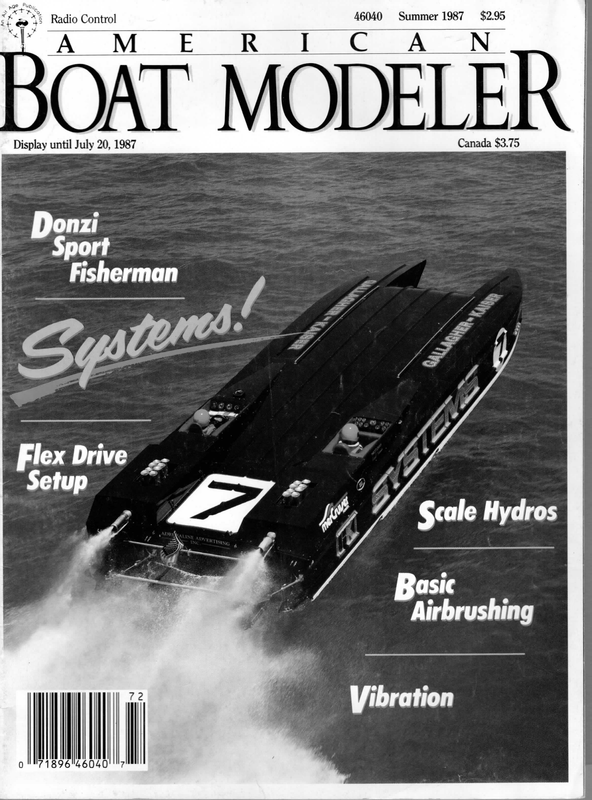
ox * Radio Control 46040 Pl AM. Summer 1987 $2.95 _EeN 3O0AT MODELER Display until July 20, 1987 Canada $3.75 Donzi nzi Fisherman Flex Drive .. Setup = Basic Airbrushing 0 7 1896″46040! “7 a
Tips from the champ! ini-America’s Cup Winner Dan Abma by RICH HEMSTREET AN ABMA, the 1986 MiniAmerica’s Cup (MAC) winner, has some tips for other skippers. For sailing, he says “the key is to get the sails trimmed so your boat sails without touching the rudder.” It takes time and practice to learn the right balance to get the most out of your boat. While most of Abma’s competitive experience has involved regatta style racing, he admits that he prefers match racing, because of “the strategy involved.” In the round robin series to decide who would be defender of the cup, he had 13 match races. Abma finished with 12 wins and one loss. The only loss came against the 1983 winner, Buddy Black, of St. Petersburg, Florida. Black was the designer of the East Coast 12 Meter (EC-12M) and won the inaugural MAC in 1974. “Buddy had me psyched. That was my worst competition. He got me at the start. I went for the wrong mark on the first leg. It wasn’t until a spectator yelled that I realized my mistake. I also hit one mark and had to reround it. | completely blew it.” Black also finished with a 12-1 record. That set up a best 4 out of 7 series between the two skippers to determine the defender. In the first race of that series, Black again beat Abma at the start. Unlike the previous match, Abma overtook him by the first mark and held the lead to the end. Abma had the lead in the second race, only to lose when he hit the last mark and had to reround it. The last three races belonged to Abma from the start to finish as the series ended 4 to 1. Inthe MAC series, challenger Dr. Gerhard | | | | Kelter, Jr. of Sweden was shut out 4-0 by Abma. Abma’s MAC winning EC-12M is built on a 7-yearold Dumas* hull. The fiberglass deck was replaced bya lightweight wooden one. In an effort to keep the weight as low as possible, Abma poured hot lead into the keel, rather than using lead shot. He also SUMMER 1987 37
The key is to control the other boat from the start. uses some loose lead bars to fine-tune the boat to wind and sails. In heavy winds, he moves some of the weight forward. In light winds, the weight is a. moved toward the stern. i The standard wooden mast is replaced bya lighter aluminum one. —— q Abma says you can tell a top-heavy boat, which will heel over much | The aluminum — in one mounts Thisofhelethe ales, ee to fine-tune the boat’s performance. further, effectively cutting down the sail area that is exposed to the wind.” Abma has his boat set up so he can move the mast fore and aft. The total possible movement is approximately two inches, in 14-inch increments. By moving the mast forward for heavy winds and back for light winds, it gives Abma one more way to fine-tune his boat. He prefers to have his boat set to weather-helm; that is where the boat tries to turn upwind. One way to make an EC-12M more maneuverable is to make a new barn-door type rudder. Abma says “the key to match racing is to control the other boat from the start. I don’t care if I start two minutes after the bell, as long as the other guy starts behind me.” The extra rudder area is especially helpful in the crucial pre-start jockeying for position. As for the future of the EC-12-meter class, Abma would like to see a move back to Dacron sail material. The Mylar and Kevlar sails used at the MAC are more expensive, but “they don’t look as good or last Dan Abma with his seven-year-old Dumas EC12 Meter. 2 as long as the Dacron sails,” says Abma. If everybody uses Dacron there won’t be tH ADD HERE any unfair megabuck advantages for some skippers. It’s important to maintain the purpose for this one design class, Pde a RUDDER gee 38 AMERICAN BOAT MODELER especially when you look at the public relations potential for the Mini-America’s Cup series. *The following is the address of the manufacturer mentioned in this aticle: Dumas Products, Inc., 909-AM East 17th O St., Tuscon, AZ 85719.
1-SCALE MODELS (Continued from page 75) modeler that will work well for the general colors. When using the decals, a clear protective coat of paint is required because of the fuels used in competition. In this case the automotive paint gener- ally works better because it won’t yellow like the epoxy paints. If everything goes well in the building, setup and testing of your new boat, you’ll be rewarded with a beautiful replica of one of the full-size thunderboats, and fulfill your dream of racing the Miss Budweiser. *The following are the addresses of the manufacturers mentioned in this article: Dumas Products, Inc., 909-AM E. 17th St., Tucson, AZ 85719. Aeromarine Laminates, Cedar ST., Babylon, NY 11702. Steve Muck’s, 6003 Daven Oaks Dr., oO Dallas, TX 75248. PORTOFINO (Continued from page 73) questionable is the water-activated decals. The Arrow and the Hydro-speed both have plastic stick-ons andId prefer to see them in this kit too. ’’m not sure if the water-activated type will stand up to the moisture or not, so coat them with clear just to be safe. CONSTRUCTION. The most timeconsuming step, it takes about 2 hours, is trimming the ABS parts. Using a razor knife, make several passes to deepen the score line; then bend. The scrap will break away cleanly leaving a straight line. Final touch-ups are obtained with alacrity using a variable-speed moto-tool and sanding the drum. After gluing-in the plywood transom brace, the most critical step is to align the two drive units and cement them in place. The holes to be drilled for the stern tubes are pre-marked for facility. Whenever alignment is im- portant, I find the following method to be most advantageous. Place the units in the boat with the stern tubes through the transom. Simply tack-glue them in the correct position with Pacer’s* Zap-agap and Zip kicker. Check over your work from all angles, and take a coffee break before returning to recheck everything with a fresh per- spective. If all is okay, finish the job with the included Stabilit Express or Flex Zap. If all does not check out, just break the tiny tack-glue joints and start over. With this technique there is never any reason for strained nerves while aligning these or any other future components. After the drive units are in place, the radio and battery box are glued-in; and if you wish, the servos may be installed at this time as well, but it’s not necessary due to the large openings in the cockpit. Before you glue-on the deck, I feel it’s advisable to glue scrap blocks of foam to the underside of the deck for flotation. I’ve never flipped any of the Graupner boats but the foam does give me a feeling of security. After you’ve reached this point, the remainder of the construction is a piece of cake—cutting out and gluing in place the detail; finishing the wiring, which is well illustrated in the plans; and painting, if you so desire. My Portofino was sprayed with metallic strawberry, striped with Goldberg* striping tape, and given acoat of crystal clear Krylon. Whenever masking, always use a plastic tape to give a sharp line. Remember to press down the edges of the tape several times to insure against bleed, and pull the tape off while the paint is still tacky to avoid peeling. I used double-sided tape to attach the radar bar so the boat would be able to be run without it, if desired, to cut down on drag. The finished Portofino with its sleek lines gives the impression of movement, even when at rest. Out of the Graupner fastboats I’ve built so far this is the most beautiful. PERFORMANCE. The model under way with its twin rooster tails is even more beautiful than it is at rest. When the throttle is punched, the props will cavitate at first until the boat is on a plane. The high-pitch props really come into their maximum efficiency at high speeds. The mechanical speed control was quite linear in response, giving that feeling of control. Incidentally, the speed control has jump switches that bypass the coil completely at full throw, which makes for excellent current flow. The model can be backed up with a minimum of throttle blips without getting STRIDER. A light, fast 48- inch trimaran for 2-channel r/c. The Strider kit includes sail winch, finished fiberglass hulls, fully-battened sail, aluminum spars & struts, and stainless steel hardware. $583 direct from: Vortex Model Engineering 434 East Ortega Street Santa Barbara, CA 93101 (805) 962-4566 76 AMERICAN BOAT MODELER
Tradewinds Length: 3612” a. “i a1 _. bt eam: 10% Riviera h: 20” Lengt Height: 40” Weight: 2% Ibs. Beam: 6 l!ij Radio Contro pond with ay You can set sail on any lake or e | era — and never leav Kyosho Tradewindseor Rivi graceful sailboats are the shore! Thes 2-channel controlled bylea sepa designed torolbesyst rately) ilab (ava em radio cont require a; , minimal assembly. The and only o laminated foam hull, metal masts, and radi uilt pre-b all are ents artm equipment comp and finished so you can be smooth sailing in no time. most The Tradewinds is by far the and a popular R/C sailboat ever made standard in sanctioned “36/600 Class” International Model Yachting Association races. These boats perform amazingly like the real thing — they’re agile and © fast. The Tradewinds can cruise u to ten knots with excellent handling. The small Riviera is perfect for ponds or even your back-yard pool. The look and attention to detail~ on these attractive sailing crafts will even make you proud to exhibit them in their wooden display stands (in-_ cluded). If you’d like to . catch the spirit of real sailboats, you’ll love radio control_ sailing.