- Title. Author. Summary

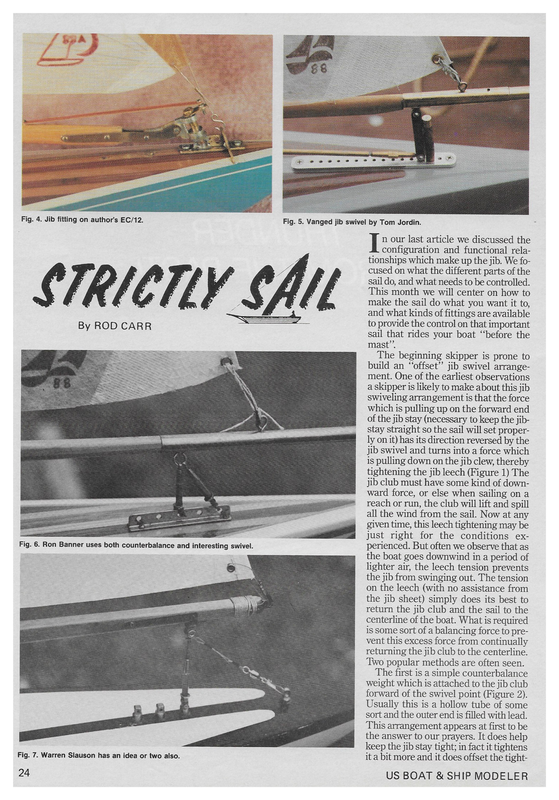
nig te aie € ue ee Ms teva, eat Nicely finished “Magic Dragon Mk II” by Tom Walker, Severna Park, MD. Sails set well and working together. Photo by Tom Walker. tseems that as longas we havejibs on our boats, people will wrestle with the problems of controlling their behavior in all sorts of weather conditions. Our preceding discussions in these pages have made the point that the jib has influences on the mainsail. The rigging which supports the jib likewise has a definite impact on the mastand theloadsit must carry. Since varying loads on the mast can affect its shape, it follows that jib rigging must be considered not only with respect to the jib, but to the mast/mainsail combination so important to the power developed by the sail plan. We have explored a number of different ways ofsettingajibup, andthe postman has started to bring me suggestions for other methods. Photo 1 was sent by Bill Whitten, of Birming- ham, Alabama. Bill has chosen the simplicity and reliability of the offset jib swivel arrangement, but he has separated thejibstay, upon whichthe head. Photo by Turner. 64 Offset jib rigging arrangement by William Whitten, Birmingham, Alabama. By ROD CARR sail sets, from a forestay which attaches to the forward end of the jib club. By this method he can individually adjust the tensions in both stays. Forestay tension can be set to match the prevailing wind direction and provide proper downward tension on the jib leech. Note that the class rules would allow the forestay to run to the masthead if desired. Jibstay tension can be set to allow the appropriate camber or flow in the sail, again as a function of windspeed. However, adjustment to either of the stays will require additional fiddling to maintain the required mast shape. If both are attached at the 80% location on the mast, it is conceivable that a large variation in the forces on the mast at that point will have to be dealt with. As a minimum, the jenny stays will need attention to maintain a straight topmast. Lower shrouds will have to beslacked or stressed to keep the lower reaches of the mast from bowing forward and removing flow from the mainsail. Bill wrote to say that he was considering addition of a jib club topping ift. This would be a line from the jibstay mast attachment point to the after end of the jib club. Intended to balance the force of the forestay, the topping lift provides more control at the cost of more windage and more adjustment which has to be made as the conditions change. Topping lifts have a bad reputation for snagging spreaders, and many skippers have gone to elastic connections designed to keep the topping lift taut during the gybing of the jib. Again, more com- plexity is the cost of more control. Anyway, thanks to Bill for his contribution. As a last parting shot, I noticein his photothat there has been The “Turner Spline Tweaker,” Marblehead Class, 1989 version. Turner photo. US BOAT & SHIP MODELER
MAXIMUM LWL 43in IMUM LWL 43in MUM LWL 43in =9-~ 35 te BASELINE Hoe a good deal of effort expended in coming up with a light but strong jib swivel, attachment tothejibclub, and even theclubisaniceexample of light but strong construction. But I believe that the jib rack on the deck may be one of those traditional brass items from A.J. Fisher. Has anybody ever weighed one of those things? Since taking weight out of the ends of a boat will allow her to turn faster and to pitch less, maybe there is another consideration which needs to be put ing line and the first mark. If you can figure a way to cut that down to only fourtacks, you willautomatically gain aminimum of 6-8 boat lengths on that leg alone. I know this by careful observation of our one-design fleet of East Coast 12’s. There is a direct relationship between tacking and being in the back of the fleet. What I am suggesting is that one can often im- into our complicated equation. When considering the addition of new controls ontoyour boat, stopfora moment andtry toimagine how much ofa benefit they will bein arace which lasts 15 minutes. Will thenew control give you an additional three boat lengths per leg? That is hard tofigure, you say. I agree. On the other side of the ledger is something that is easier to quantify. Let’s say that you typically tack six times between thestartFALL 1989 “Wawa 17” exhibits longitudinal variation in hull shape developed by Gerhard Mentges. prove his performance by modifying how he sails the boat, rather than the continual search for some sort of a gadget to put onthe boat. Tackingless can help you in all wind strengths, while most gadgets are good only on certain points of sail and of measurable benefit only occasionally. Do I like gadgets? Of course. . . it is part of the hobby. But it needs to be balanced with the operational part of getting a boat around a race course. The relative importance of the sailing part of thesport was demonstrated most vividly in the recent interclub sailing that has becomestandard with the five Pacific Northwest model yacht clubs. During the past winter, four new East Coast 12’s were built. Using standard Ozmun hulls, all the parts for each boat were completely prefabricated prior to placement of the main lead ballast. In this way, 95% of the lead could be poured into the hull, leaving only a small leeway for trim65
1 ming the boat. Final stages of the lead pouring were carried out in the float tank so that longitudinal trim would match the proposed requirements of the new EC/12 rule. As is common in any fleet, there was a lot of talk about these new boats. “Superboats” they were referred to. Lightweight drum winches were fitted, with the most precise resolution available by dual 66 ais spools, plus modular R/C boards and everything planned to a clean and lightweight installation. The unspoken assumption was that this new breed was going to sail right off the cradles intothe front of the fleet. What theskippers hoped was that there was sufficient slack in the EC/12 onedesign, that some boats could be “more equal than others.” Well, we’ve been sailing with these new vessels for about four months now. The skippers are doing well, but no better than one would predict from their willingness to work on tactics and an understanding of the rules. In fact, the author continues to chase Kelly Martin, and be pursued by the other three. So, my 16-year-old, nonoptimized EC/12, when teamed up US BOAT & SHIP MODELER
SeP amy a of an historical nature. Remember, up until the mid-1960s, little had been tried in the way of radio controlling boats. Before that, boats were free sailed with various ingenious methods applied for controlling the rudder and keeping the boat on a more or less steady course. The boats themselves were designed to cope on their own with the wind and the waves, for once released, the skipper was reduced toa spectator (Like flyingfree-flight model aircraft. wen). In aircraft the analogy would be a high wing trainer which can be counted on to be stable all by itselfin theair. Asaresult, theformula classes, and indeed, all model yacht thinking seems to havea general bias which focuses on the boat and the 1 oO 134 ce ee Ng. ih, re Sie SEACE é5/87 UL j7as. 19 SAIN 1 WAWA 13 DISPL. 10.22 Ibs. CB 29.45” ¢ with my bifocals and shaking thumbs, seems not outclassed by the Superboats. . .theone-design concept seems vindicated. There has been one specific advantage discovered in my old swing arm proportional winch. When faced with a buoy rounding from closehauled to running free, the additional speed of the old style winch has allowed me to get the one boatFALL 1989 length jump I needed to hold the nearby competitor in my wake on the run to the finish. The additional precision of the drum winches was obtained at the cost of speed of reaction. Just about anywhereon the boat one looks, if you gain in one area, you are probably losing in another. A substantial amount of the literatureavailable about model yachting is biG ‘BA sails as if the skipper wasn’t there at all. But in reality, the world has changed dramatically. The great majority of U.S. national championships are being won by two or threechannel radio, handled by a skipper who knows how to work his boat. In general, thetopskippers seem tohave the cleanest, simplest … and hence most dependable boats in the fleet. Complexity appears to draw the attention of our good friend Murphy, who bides his time and strikes just when you need a good finish tosew up a trophy for the day’s work. A lot of boats go sailing by my nose and it is obvious that the skipper has Continued on page 75 67
NEW SHIP DECKING & SCALE MODEL WOODS …in Basswood, for the true craftsman OVER Northeastern’s handsome ship decking is authentic in appearance, 4991 easy to work with and really saves time! Available in .050 thick laminated sheets with 4 choices of spacing representing caulking between boards. Our extensive line of sca e model hardwoods are used by hobbyists and professional prototype modelmakers around the world. Ne ¢ Ship decking in 3” x 22” lengths with spacing in Ug”, 0″, ig” and %e” © Carving blocks up to 24″ lengths » Belaying pins ¢ Scale sheeting ¢ Dowels */e/ to “a” » Double beads * Wood strips from .012 and up « Wood for mastheads, hatch covers, etc. * Mahogany, cherry and walnut also available in many items « Satisfaction guaranteed or money back! —— = NORTHEASTERN oye=m (0/0) aan] (ems P.O. Box 727US Methuen, Mass, 01844 Tel. (508) 688-6019 gift certificates and books from Bluejacket, Model Shipways, and Model Shipbuilder magazine. Each of the clubs put up a prize as well: books, a kit, and one of themost basic modeling materials, cash. Preac Tools, which had attracted a crowd all morning demonstrating a precision table saw, donated the saw itself at the last minute, a very generous prize. A prize was also given to each winner of the balloting for the models exhibited: choicefrom agroupof three ceramic plates decorated with scenes of famous ships. The most votes were given to aconstruction style (exposed ribs and frame, oiled finish) USS Con- stitution built by Len Brainsky of Connecticut. Second most popular was Bluenosell, finished byJim Wiser and mounted in diorama style, and third was Bob Okerholm’s modern frigate Hancock. The results of the balloting generated some lively discussion, too; particularly, expressions of surprise that so knowledgeable a group would still favor the old standard subjects. Clearly, the obligation to vote heightened everyone’s concentration during the morning viewing, so there was plenty to talk about on the way home. More than 100 model builders and enthusiasts attended the meeting, and quite a few brought models: a great success. Why? A central location, so everyone could be home for dinner; modest cost ($22); an informationpacked program showing techniques of interest to kit builders, and to advanced modelers; presentations with enough meat and heat to be food for more thought; and enthusiastic promotion by each club among its memFALL 1989 bership. A lot of work is demanded of the volunteers who organize such a meeting; but it is demanded only once every four years at most, anditis very satisfying work. ® (ie eee eee St eee el aaa] rare . .Continued from page 67 HH {e substituted an ever-increasing selection of doodads and widgets, when what he really needed was to spend some time learning how to set and trim his sails. The ultimate in precise adjustment is only a benefit if you fully understand what theadjustment is doing for your boat’s performance, or in some cases, not doing. I have been asked to assess how much of a boat’s success can be assigned to the skipper, and how much should bethe physical arrangement of the boat. I have to go back to the common ground of the EC/12 class to develop a basis for an answer. Since we are continually reminding ourselves what a complex and interrelated system our boats are, let’s explore this idea witha focus on one part of the boat, the main ballast. In the EC/12, we havea standard hull form, and we will have a standard fore and aft trim represented by themaximum LWL marks. How the ballast is arranged in the boat is very much up to the skipper. Figure 1 shows three distinct arrangements. The first is the standard way that boats were built from 1970 up until about 1981] or 1982. The second is a configuration employed by our Australian counterparts as they tried to fit the boat to the heavier air that they often encounter. The third is an obvious compromise between the first two. or write today for See your local dealer our catalog and price list. Please send $1.00 to cover postage and handling. Refundable with first order. If you talk to any skipper, he will inevitably tell you that thekey concept in deciding how to ballast your hull is the location of the center of gravity. The lower in the boat, the stiffer the boat and the more it will stand up to stronger winds. Now, here in our local clubs, there are boats representative of all three arrangements. There is an obvious difference in stiffness, with the boats getting stiffer the lower the lead is placed. But the author is sailing a 16-year old boat that is probably the most tender of any in the fleet, and not catching Kelly Martin, our current National Champion, but in general staying ahead of the group of boats who are all stiffer. What goes? WellI believe it lies ina totally different aspect of the lead arrangements within the boats. You notice that while the lead is lower from ‘A’ to ‘B’ to ‘C’, it also becomes elongated. The length of ‘A’’s lead is 10 inches, while in the extreme ‘C’ it can measure a distance of 24 to 25 inches along its length. The difference in performance comes in the rotation of that lead about both a horizontal and a vertical axis. Once set swinging by the rudder, the long bar of lead in ‘C’ develops a rotational intertia which is far greater than the more compact mass in ‘A’. ‘A’ develops two benefits from this: 1) Less rudder is needed to start or stop a turn or tack, thus preserving more boat speed and momentum; 2) The same degree of rudder throw will turn the boat in a smaller circle with nodecrease in boat speed. All things being equal, boat ‘A’ will be more maneuverable, will lose less speed in the tacks, andin addition, 75
PRATHER RECORD BREAKING BOATS WHY CHOOSE A PRATHER BOAT? eee aa Z new! BOAT PROPS HIGH PERFORMANCE Prather Props have been performance tested in competition to insure contest winning performance. Quality workmanship will insure precision shaped blades. All props are available in the record ee setting alloy beryllium * copperaswellasour new strong corrosion , resistant stainless steel. Available Ya – %.. for most R/C boats. AWESOME COMPETITION CLASS PERFORMANCE! Our contest proven hulls hold more N.A.M.B.A. National Championships and World Speed Records than any other manufacturer. These competition class hulls will deliver awesome performance even if you just want to have a fun day at the lake. Epoxy-glass construction provides many times the strength of polyester resin as well as reduced shrinkage for an accurate true hull. PRATHER PRODUCTS, INC. ies0 ravenna ave. witmineTON, Ca 90744-1398 (213) 835-4764 SEND $2.00 FOR COMPLETE CATALOG will pitch less in rough water, also conserving boat speed. So the tenderest boat turns out to be more maneuverableand less likely to bestopped by pitching inalumpy lake. Here we have another of those tradeoffs which our sport is sofullof. Dol want thestiffest boat, or the most maneuverable? Do! sail in waves or smooth water? Finally it needs to besaid that when people borrow my boat they often are disappointed by her windward performance. Shedoes not strongly follow the wind direction with significant weather helm, but beinga tender boat, must be worked to weather. Often the lighter boat does not point with the fleet, but makes a better net progress to weather by a combination of boat speed and scalloping between wind and waves. What comes out of this is some kind of assessment of the relativeimportance of skipper and boat. In my case, the combination of a somewhat tender but maneuverable boat and my willingness to work the boat to weather provides better overall performance than a simple decision to go for the stiffest boat one could get. I’ll maintain that the skipper is the dominant force in virtually every class. But when one gets into the top 10% of theskippers, suchas Divisional Championships and of course ACCR’s, the boats come more into their own as the relative differences between the skippers narrows. One thing is sure, it doesn’t matter what kind of a boat you have if you haven’t taken thetimetolearn about sailtrim, about keeping the power on the sails, and minimizing the steering and tacking that you are doing on the course. In defense of the Superboat skipFALL 1989 pers, I have to admit they are doing better as a group, but more because of their willingness to study and learn about all aspects of sailing in general than the simple addition of gadgets. Building a new boat causes you to think things through again. . . if you are willing toexercise your brain a bit. Theresult is improved understanding of the relationships between the different parts of the boat, and their impact on performance. Sailing withthe Superboat skippers is excellent, for no quarter is asked or given .. . but the rules are scrupulously followed, with 720’s turned when the skipper knows he fouled. Fourth and fifth places are furiously fought for,andat theendofa 14-race regatta, one feels as if he was sittingon the boat actually haulingon the sheets. I have received some very interestingresponse to my call for thesharing of designs from John Turner, 107-B Seminole Lane, Stratford, CT 06497. John has been busily involved in working through an entire series of M-Class boats which he calls the WAWA. Currently working on WAWA17,hesent mesomeexamples of the earlier boatsin theseries. Photos 2 and 3 show a sneak preview of WAWA 17 which was inspired by a series of design articles in Model Yachting News, by Gerhard Mentges. Photo4showssomeof the progressive evolution of hull shape that is the result of Mentges’ studies of hullwater interaction. John was looking for someone to make a mold from the plug when he sent the photos to me. John is kind enough to share some details with us of the earlier boats in the series and the figure shows his working drawing of WAWA 13. He experimented with aseries of different keel and rudder configurations. Having sailed acanard BONE back in the late ’70s, I was interested in his conclusion that bow mountedrudders are not for the birds either. Some of that must surely come from the incredible lightweights that are typical with current M-class boats. WAWA 13 was designed at 10.22 pounds. I would suggest that you correspond directly with John if you would like to make arrangements to buy one of his designs for construction. He may even be willing to discuss manufacturing rights, provided a royalty arrangement can be worked out. But back to WAWA 13. Configuration No. 1 was a forward sloping fin with a rather close set and deep rudder. This arrangement had great straightline speed, but maneuverability was “lousy” according to the designer. Configuration No. 2 kept the same fin, but reduced the size of the rudder and moved it forward. Not much improvement was found, possibly in that the rudder action is forcing the bow of the boat to turn, pushing it, rather than what may be a smoother, “‘trailing’’ kind of action whenastern mounted rudder is used. (Any comments from you budding naval architects out there? Anybody else done experiments with canard forms?) Configuration No. 3 added a stern mounted rudder, keeping the same fin and the bow rudder. This was much like the approach taken by Tom Blackaller’s America’s Cup 12 Meter. Maybe the trick here is to decrease the keel fin to as small as possible and use the rudders as the side plane and the leeway reducing mechanism. I can see the rudders might 77
| IMPORTANT INSTRUCTIONS: Non-commercial Cc LASSI Fl E D AD S (personal items) rate is 40 cents per word, with a INDEX TO ADVERTISERS minimum of $6.00. Commercial rate is 50 cents per word, with a minimum of $10.00. No advertising agency discounts allowed. Name and address to be counted, phone number A JRE Isher. COs counts as two words, abbreviations count as whole words and will be spelled out. All ads are Ace R/C Inc. payable with order, and may be for any consecutive insertion period specified. Send ad payments to: Coles’ Power Models RCMB INC., Classified Ads, 898 W. 16th St, Newport Beach, CA 92663. WANTED: Used class 36-600, class 50-800,or Complete instructions/Full size plans $5.99. W. Jones, Jr., Dept. BSM49, P.O. Box 818, Suf- 40356, 606/885-7163. folk, VA 23434. Dimeipoduteinee Bluenose. Includes lines plan. Shipped rolled in era Fully operational small boat boom almost three months while other projects have come and gone, not the smallest of which was a new 18 x 28-foot outside deck attached to my home that replaced a smaller version which finally succumbed tothe Pacific Northwest humidity. Although PO- COHANTAS needs only fitting of the keel and rig, I think I have about decided to allow a modification below the waterlineand gofora7.5 pound fin and bulb. This will allow me to increase the aspect ratio of the sails somewhat in hopes of better light air performance. Almost adozen copies of the lines for POCOHANTAS have been mailed out, and a local chap has gone off with the original shadows, mumbling something about planking up a hull. I am hopeful that we will have a picture of at least one of the boats on the water soon. Please let me know what is happening in your pond. Photos are always welcome. I’m especially interested in collecting main boom, gooseneck, and vang fitting ideas for an upcoming column. I’ve received a few already, and would like to do an entire article on that subject. Remember to send in your $20.00 annual dues tothe American Model Yachting Association, c/o Membership Secretary, Pat Hein, 1884 Campus Court, Rochester Hills, M1 48309. © eRe RES Ba Bir As I, TE RON TE oe TEL Cap’N’S Log .. Continued from page 9 Blue beacon strobe light Operating search light Operating navigation lights Operating interior lights Walkway lighting (with handmade fixtures) Floodlights over small boat deck Operating smoke stack (with real diesel smell) Working anchors and winch asFALL 1989 OREO OI OC (can lift, swing, and lower small boat _ |) Intemational Hobby corgi K&S Engineering…………….. 56 used on the mod cameel from the paint locker at the Coast Guard station. Spat sk ane. 63 International Modeler Show (IMS) ……. 4 Sal also points out that the paint lain in the cradle catching dust for 55 Hobby Stuffinc. …………….. 36 into water) s …….. Hobby Lobby International. . . . . Cover 3, 80 funds only. Blueprints, 43 Thistle St. Dartmouth, | – reproduction, is embarrassing. It has Gilmer Hobby & Machine, Inc. bao taken from the Originals of Nova Scotia’sfamed | sembly » ee. Pp ig et eel ee = TORIANS. Three sheets of drawings (44″x26″) Nova Scotia, Canada B3A 2V6. en 50 | | Full-Size Plans Service …………. 78 } ATTENTION BLUENOSE BUILDERS/HIS- 0ipestage and handiing3US5) oe\le: e) « Je% eels 6 0, e206 ¢ SHIP-IN-THE-BOTTLE.SECRETSREVEALED! | | Dynamic Models ……..-.+-….. 3 class M model in good condition. Hal Downing, 517 Apple Grove Drive, Nicholasville, Kentucky Ibe 920.00» 2 62. 1. ctever 2a cer ees e 60 WAC iN aneiy 1 th ae i eter, ene eae Oe Midwest Products Co. Built-incolordocumentation! Thanks | 4odel Builder Subs… 60 | for the response to our request, Sal, you ve done a job that should make you proud, and we can see that you certainly deserved that Master Mod- eler award! ANOTHER COAST GUARDER Robert Klubertanz, 70 years young and a retired tool engineer from Holmen, Wisconsin, sent us photos of his 40-foot Coast Guard Utility Boat model, scratch-built to 3/4” = 1’ scale (Again, Taubman has 1/4” and 1/2” scale drawings), making it 30 inches long. The original 40559 was assigned to Milwaukee, WI during the late 1940s and 1950s. Robert says, ‘““The model has twin electric drive with home-built motor controls. The motors are each independently controlled, so that one motor may be stopped, half or full speed ahead, while the other may be ‘“Therear, hinged, cabin doorcan be opened and is latched shut by means of the doorknob. The ring buoy and life raft can be removed from their brackets. Theleft front cabin window is hinged and operable. The bow hatch is also hinged and provides access to the radio switch. The Danforth anchoriscorrectly lashed initschocks and the anchor flutes pivot as on the prototype. ‘The life lines are elastic cord with shackles, so they can be unhooked in order to remove the cabin top. Both fireaxes areinchocksand removable. Instruments are mounted below the panel and are plastic covered.” Robert is currently working on a model of the 41-foot Coast Guard utility boat that is now stationed in Mil- 1 | modet Racing Products………….. 3 Model Rectifier Corp. (MRC) …… Cover Norio noceaenn Nohara Soa as Octura Models et) Parma International Inc. Pop Up Migh Cot. OOO Ct rr) ………….