- Title. Author. Summary

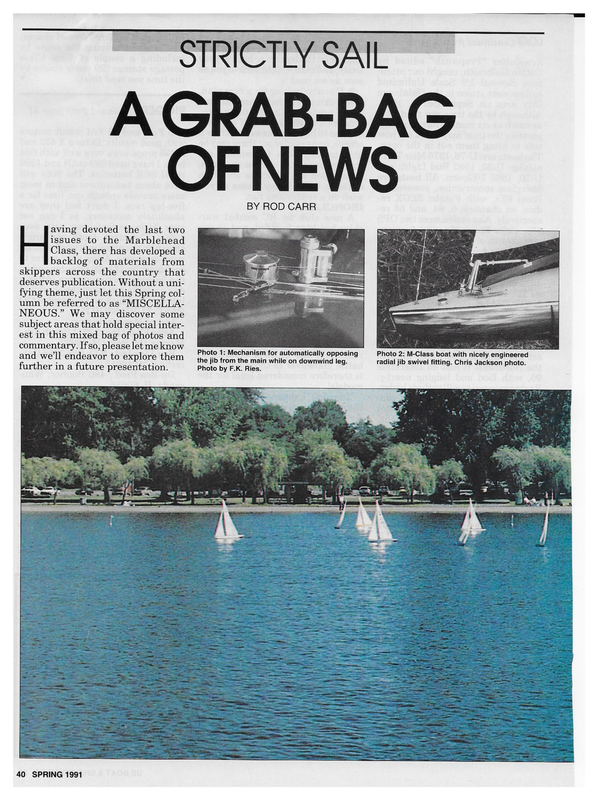
aving devoted the last two issues to the Marblehead Class, there has developed a backlog of materials from skippers across the country that deserves publication. Without a unifying theme, just let this Spring column be referred to as “MISCELLANEOUS.” We may discover some subject areas that hold special interest in this mixed bag of photos and commentary. Ifso, please let me know and we’ll endeavor to explore them further in a future presentation. Vicenes 40 SPRING 1991 Seee Photo 1: Mechanism for automatically opposing the jib from the main while on downwind leg. Photo by F.K. Ries. a ahs Se, a, a Photo 2: M-Class boat with nicely engineered radial jib swivel fitting. Chris Jackson photo. Nee,
PHOTO No. 1 Here we see a mind-boggling ac- cessory which is apparently capable of sensing which side of the boat the main boom is on and then swings the jib out to the opposite side when ona downwind run. A version of this, called the Butterfly, has been used by J. Walicki, who took third place at the TYRU-MYRD World Championship held at Fleetwood, England in August 1990. I learned of this from Chris Jackson, editor ofModel Yachting News, a quarterly for which you can obtain a year subscription by sending $20.00 directly to Chris at 5 Malvern Court, Abbey Road, Photo 3: Another “M” showing use of dropped club and compression vang. Chris Jackson Malvern, WRl4 3HG, ENGLAND. PHOTOS No. 2 & 3 Chris also sent some negatives of other M-Class boats and a pair are reproduced here. Both of these are of European M’s and show the high standard of construction that is typical of their fleets. Of interest is that both of these boats are using forestays in addition to the jibstay upon which the jib luff is sitting. With all the fiddling in the US with topping lifts and offset swivels, one might pause for a moment and think about letting a forestay from the jibstay attachment point on the mast carry the load, leaving the jibstay tension adjustable and independent of the mast bend loadings. Note that both of the jib swivels can have their angle changed to match thejibstay angle of varying suits of sails. Something to consider when putting together a radial swivel for your boat. PHOTOS No. 4 & 5 American skippers are experimenting with an entirely new boat built to resemble the full-sized America’s Cup Class. I hesitate to use the term “International” as that term denotes recognition by the International Yacht Racing Union—Model Yacht Racing Division. But should the class grow and spread, there is always the Photos 4 and 5: Interesting keel and bulb shape on new America’s Cup class boat. With a 75″ LOA and a 96″ mast, your little old VW will have to be traded in! Cradle/stand produced by Byron Originals. —a SK photo. _ Photo 14: Juanita Beach Park, home sailing -_ water for Greater Seattle M.Y.C. More in text on all photos. This photo by Rod Carr. US BOAT & SHIP MODELER 41
opportunity for it to be adopted as a new International Class. Nevertheless, a rather complicated mathematical rule and measurement procedure is producing boats of approximately 70 to 75 inches with eightfoot masts and approximately 1800 square inches of sail area. This is something a bit bigger than a Santa Barbara, as the beam measurements are in the range of 16 inches, with displacements in the 23 to 27-pound area. Genoajibs are allowed. Acouple of hulls are available, and designers are said to be turning out other responses to the rule. I’ve seen a video PHOTO No. 6 This is one of those rogues gallery shots that needs to appear from time to time to keep the subjects from getting too stuffed up with their own self-importance. Captured ina “quiet” moment at the AMYA East Coast 12 Meter Annual Class Championship Regatta (why don’t they call it the National Championship?) held in early Junein Kewanee, Illinois, from left to right we see Rich Matt, first AMYA President and sometime banana republic dictator; Dick Hein, AMYA Founding Father and AMYA President; and finally this colum- PHOTO No. 7 Noticeably absent from published description of American boats are methods for RC adjustment of various aspects of the rig while underway. This European M-Class boat has the capability of changing the amount of camber in the lower 1/3 of its mainsail by moving the outhaul of the mainsail. The outhaul runs forward to the mast then down inside the boat to an ordinary RC servo. The trick here is to pre-calibrate the system so that you know what the camber is for any given setting of the non-centering transmitter stick. On eat ean ae pe Nae CA OLIN NE Photo 6: Rich Matt, Dick Hein, and Rod Carr (I to r), founding fathers of the Photo 7: Mainsail foot outhaul adjustment sets amount of mainsail camber American Model Yachting Association. Glen Comer photo. by RC. Photo by Chris Jackson. AN WES Photo 8: Clever hatch idea seals hull and carries receiver high and dry, just under deck. Jackson photo. tape of the “BOOGEYMAN?” design in light air. Photos No. 4 and 5 givea couple of views of an America’s Cup Class boat under construction by Glen Comer, 4802 Broken Elm, Spring, Texas 77388. Certainly plenty ofroom in the hull, and free rein can be given to design of the fin and bulb. 42 SPRING 1991 Photo 9: Deck-mounted drum winch on M-class “Amigo.” C. Jackson photo. nist, who was AMYA’s first Secretary/Treasurer. Of the original “Chosen Nine” who founded AMYA in 1970, we believe that this represents the majority of the plank holders of the 20-year-old organization. It was a good reunion, and one that was long overdue. the high aspect M-Class rigs, it only takes a little bit of adjustment to drastically change the shape of the sails. One needs to make changes that are predictable and can be related to improved performance in a reproducible way. Simply being able to pull on every corner of every sail
while underway is not a guarantee of success. The following photo shows that initial adjustment of the camber is by rotation of a screw fitting at the forward end of the main boom. PHOTO No. 8 Same boat with a somewhat wider view, showing a very clever idea for the radio installation. The deck coaming has been constructed to fit one of those plastic snap lids that we find Photo 13: Maury Thoreson-designed outhaul control system. Allows one-hand adjustment. Rod Carr photo. on margarine tubs in this country. The receiver is mounted on the underside of the lid, keeping it dry and holding the critical wiring connections up out of any stray water which enters ‘che hull. Note the deck- mounted drum from the winch just forward of the hatch with the sheet does not stay parallel with the boom, but rotates faster. This capability proved to be the secret tothe Una-rig wettest hy. Photo 11: Skippers of the Sassafrass Star Sailing Society show off their Star 45 One-Designs. E.R. Bradley photo. rigging and blocks above deck under the main boom. The sheet horse puts the sheet guide directly beneath the main boom when closehauled. This makes optimum use of the center sheeting arrangement without hay- ing complicated travelers. PHOTO No. 9 Another M-Class, named “AMIGO,” with winch drums on deck and sheet guide elevated to almost the height of the underside of the main boom. Hard to see, but RC gear and servos are mounted directly underneath the deck in this boat. PHOTO No. 10 A somewhat longer shot of AMIGO provides some interesting food for thought about handling main booms. Notice that the boom is fixed into a swivel mechanism and that the mast rotates with the boom. This provides for a much cleaner leading edge to the mainsail. Careful scrutiny leads me to believe that the mast is overrotating, i.e., its fore and aft axis Photo 12: E.R. Bradley’s Star 45 and custom tool box. Nice, professional looking color coordina- tion. Bradley photo. “BONE” that I sailed in 1979. With the mast over-rotated, the rig developed significantly more power than with passive mast rotation. On the BONE the system was dynamic with a servo doing the job, the system in AMIGO may be such that no servo is required. Definitely the way to go. Twist in AMIGO’s mainsail, is apparently controlled by the swiveling mainsail clew fitting which looks to be controlled by a line to the end of the boom which turns in toward the swivel point of the boom. PHOTOS No. 11 & 12 Believe it or not, there are other one-design classes being sailed in competition. E.R. Bradley of 2551 Old Springfield Road, Tipp City, OH 45371, was kind enough to send pictures of the local fleet. From left to right we see J. Collier, N. Rhodes, T. Wilkins, J. Maxson, E. Bradley, a guest, and B. Dunnam. A close inspection shows most of the mainsails to be rigged by attachment of the sail foot all along the main boom. This follows prototype practice, but flat- tens the sail near the boom. The class continued on page 46 US BOAT & SHIP MODELER 43 \&
SAIL Continued from page 43 PHOTO No. 13 Always searching for reliable, requires dacron sails and I certainly like the look of the fleet. The second photo gives a good impression of the large main/small jib sailplan of the “STAR.” My experience is that the boat is nimble, points extremely well and is a good performer in light air, with exciting performance in the heavier stuff if you can keep her under control. Bradley’s boat and custom toolbox show a polished, professional image. simple, and easy-to-adjust fittings, I have used this kind of outhaul fitting on my EC/12 for almost a year. Invented by Maury Thoresen, of Marysville, Washington, a bent music wire track sticks into the boom like a wide croquet wicket. I push it all the way through the boom and put a blob of solder on each leg just for insurance. A triangle of square brass tubing is soldered up with the vertical leg drilled out and threaded to receive a piece of 2-56 Kwick Link. The brass slides on the music wire, with a tight, friction fit teflon button as a stop. Theclevis is screwed onto the 256 threaded stub and can be run up or down to adjust the amount of twist in the jib leech. The only thing not shown in the picture is to add aclevis keeper (a short piece of fuel tubing) to prevent the clevis from opening up and letting go of the jib. When tacking, the sail shakes and can sometimes be violent enough to open the clevis. Out of sight on the other side of the boom is a millimeter scale which allows me to reset things exactly as before. The jib exit has been since simplified with the substitution of a brass exit guide from A.J. I like the white bottom paint, as it makes reading the boat’s heel angle easy on any point of sail. The club burgee is unique and prominent on the tool box. Mr. Bradley asked if I would doa column on trouble-shooting radio problems. I have to defer, for I know just enough about radio to remember to charge the batteries, find the onoff switch, and once upon a time passed the test for an Amateur Technician’s Class “Ham” license. (We’d suggest that questions on trouble-shooting radio problems be addressed to our “Radio Waves” columnist, Eloy Marez, 2626 West Northwood, Santa Ana, CA 92704. Include an S.A.S.E. for a quicker reply. wen) HAYES WHIP ANTENNA Vertical whip antenna replaces any 18 or 36-inch receiver antenna for R/C cars and boats. Connec tors, vertical and horizontal mounts and safety ball all included. Stainless spring steel whip only 1/32 diameter for minimum wind resistance. Available at your local dealer. POWER HUNGRY? “Black Diamond Boats are engineered for speed. ¢ Complete kits with all electrics or as hull kits only. ¢ Hulls pre-joined and perform well with all electric drive systems. E.0.M. Systems ¢ 9730 Ash Creek Dallas, Texas 75228 ¢ 214-321-3673 PROPORTIONAL REVERSE & PROPORTIONAL FORWARD High rate Electronic Throttles. These 1.8 X 1.87 X 82″ optically isolated units plug in like a servo. Connectors for Futaba, Airtronics, JR, Cirrus, Cannon/Deans & Ace. Order this month and get a free servo. Buy the HW55 for R/C CARS and , performance boats. 416Amps of MOSFETs handle most ’05, 540’s, & Astro ferrite motors operated up to 14 cells or 18A genuine continuous duty & 45A starting surge. $109.95 ea Order the RET44 with “Say control of scale boats with Dumas, stock 540’s, Astro 02-10, geared Astro 15-25 on 12VDC & other motors rated 48-16 V HAYES PRODUCTS DC & 12A continuous duty & 25A starting surge. $79.95 ea. NO RISK 21 DAY EXAMINATION. If you’re not satisfied we’ll buy it back! One year limited warranty. 14325 Commerce Wy. @mm) 1- (800) 8- VANTEC == Garden Grove, CA 92643 46 ofMOSFETs for smooth SPRING 1991 Visa/Mastercard& COD welcome. ToPS oiler call toll freeto “G@P) 460 Casa Real Place, Nipomo, CA93444 aE] Fisher, 1002 Etowah Ave., Royal Oak, M1 48067. PHOTO No. 14 Looking toward the beach at Juanita Beach Park, Kirkland, Washington, home sailing water for the Greater Seattle MYC. Behind the photographer is six miles of open Lake Washington, providing unobstructed access for the typically southerly winds that dominate the site. Boats sail inside the concrete elevated walkway in water that is approximately four feet deep. Walkway allows some waves from the lake to enter the sailing area, providing a range of wind and wave conditions to be dealt with over the season. Nearby, a fish & chips restaurant, barbecué area, snack bar and restrooms provide a pleasant setting for the family. Thanks to all who provided photos, especially Chris Jackson from the United Kingdom. Inthe fallissue of USB&SM, Glenn Chalder, my successor as AMYA EC/ 12 Class Secretary, took issue with statements of my opinion which have appeared in this column from time to time. Any column has some percentage of personal viewpoint to it, even if only in deciding what to write about in the first place. I urge anyone with opinions that differ from mine to take the time to write to the editor. Itisa way of returning something to the sport and is really everyone’s responsibility. If you don’t provide input, then new rules may be put in place without your comments. While I do not agree at all with Glenn’s comments, I will valiantly defend his First Amendment Right to make them, and I applaud the effort that he put forth. (We support Carr’s latter statement, otherwise his comments, and Chalder’s rebuttal, would not have appeared in print. As for the readers who telephoned to complain about our printing the material, we asked you to write in with your opinions, but you didn’t. That puts you in the “let George do it” category. wen) While you have your pencil and paper out, send your 1991 dues tothe United States International East Coast 12 Meter Class Owners’ Association. This group is the national sanctioning body for the International configuration of the East Coast 12 Meter Class. Make the check out for $10.00 payable to: Ron Banner, 115 – 17th St. SW, Puyallup, WA 98371. Your comments on anything and everything nautical are always welcome either to the editor or to: Rod Carr, 3011 – 177th Ave., NE, Bed: mond, WA 98052.