- Title. Author. Summary

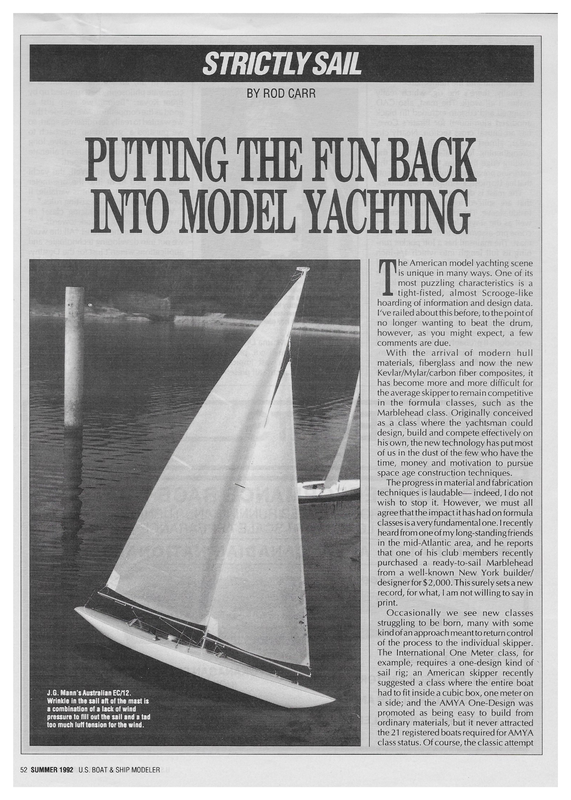
STRICTLY SAIL BY ROD CARR PUTTING THE FUN BACK INTO MODEL YAC he American model yachting scene is unique in many ways. One of its most puzzling characteristics is a tight-fisted, almost Scrooge-like hoarding of information and design data. I‘ve railed about this before, to the point of no longer wanting to beat the drum, however, as you might expect, a few comments are due. With the arrival of modern hull materials, fiberglass and now the new Kevlar/Mylar/carbon fiber composites, it has become more and more difficult for the average skipper to remain competitive in the formula classes, such as the Marblehead class. Originally conceived as a class where the yachtsman could design, build and compete effectively on his own, the new technology has put most of us in the dust of the few who have the time, money and motivation to pursue space age construction techniques. The progress in material and fabrication techniques is laudable— indeed, | do not wish to stop it. However, we must all agree that the impact it has had on formula classes isa very fundamental one. | recently heard from one of my long-standing friends in the mid-Atlantic area, and he reports that one of his club members recently purchased a ready-to-sail Marblehead from a well-known New York builder/ designer for $2,000. This surely sets anew record, for what, | am not willing to say in print. J.G. Mann’s Australian EC/12. wrote in ihe wl ne ie nee is ;picts Pit ini ota i: sao wiucle lull tenelnn forthe wind: | a rags: mn i | Occasionally we see new classes struggling to be born, many with some kind of an approach meantto return control of the process to the individual skipper. The International One Meter class, for example, requires a one-design kind of ~ sail rig; an American skipper recently suggested a class where the entire boat is had to fit inside a cubic box, one meter on a side; and the AMYA One-Design was =| | promoted as being easy to build from | ordinary materials, but it never attracted the 21 registered boats required for AMYA class status. Of course, the classic attempt 52 SUMMER 1992 U.S. BOAT & SHIP MODELER
at control is manifested in the one-design classes like the International East Coast 12 Meter and the Star 45. Hard to complain when every skipper’s boat is just about identical. Whether these solutions are working is a question that AMYA should be trying to answer. A static total membership of about 1200 for the last 10 years, with an average 30% turnover in membership each year, would seem to indicate that something needs to be changed. Unfortunately, organizational health has not been identified as a priority and the officer corps is a Virtual monarchy with no real choices in leadership appearing on the annual ballots. However, do not confuse the organization with the sport. They are separate and distinct, unfortunately having little in common. But to get back to the individual skipper and his dilemma, maybe there is a way to recapture some of the fun of the “old days”. Two prescriptions may assist us. First, why not require that the boats be made from the kind of socializing. Give prizes for the largest, smallest, most unique, etc., but not for the fastest. 5) Insure that a trip to the lake provides relaxation, enjoyment and achance to take part in the growth and development of our peers. I‘ve really not invented anything at all, merely described my perception of the operation of the English Vintage Group spearheaded by my fellow correspondent Russell Potts. Russell has been deluged by all sorts of craft which seem to come tumbling out of attics and garages. Dust is blown off, new varnish applied and newsails fitted. Launchings of revitalized boats from the ‘30s and even the ‘20s are not unusual. Such an approach is long overdue for American skippers. We are woefully unaware of our own beginnings from the vane Sailors of the Model Yacht Racing Association of America. We have little knowledge of the early boats in the Marblehead Class which was easily available materials that are an American invention. We within the reach of modelers The mainsail from J.G. Mann’s EC/12 fitted to another, similar boat shows not quite seem to have let racing and everywhere? The list need not be enough luff tension for the wind speed available. competition become more overly long, but should be a important than enjoyment, and comprehensive breakdown of the want to add GRP to the list and stipulate in this stress-ridden world, | do not believe materials which one may utilize. General that it may be used only internally. It has we serve ourselves well by so doing. categories might be: woods, adhesives, been shown to do a good job of holding We need for model yachting the fabrics, ballast, and more. Each general older planked hulls together rather than equivalent of model aircraft’s John Pond. category would then be expanded as much risking disassembly and potential loss of John has collected some 8000 individual as necessary. Fabrics might be: Woven of an antique hull. : antique model aircraft plans and is busy any or any combination of cotton, nylon, Two years ago | spent an enjoyable supporting the growing number of people or dacron. (Do you want to allow Mylar? winter reproducing a 1936 vintage who enjoy making a re-creation of one of After all, itis available as drafting material.) Marblehead class design called the the old birds from yesteryear. John has the The next question is, how we are going to Pocohontas. With her conservative sail history of the sport between the pages of catch the rule beaters? The answer is, we plan, and small jib/big main arrangement, his four single-spaced catalogs. We need probably won‘t, since | hope that the | can put her in the back of my minivan, to do that for model sailing yachts. building and sailing will take precedence fully rigged. | did made a concession and continued over the winning. put a balanced spade rudder on her so as That brings us to the second to give her a fighting chance at Our columnist’s 1936 vintage M-class Pocohontas design, christened the Chester M. Purdy, nestles fully prescription. Boats could be required to maneuverability when mixing it up with rigged in the back of his Voyager minivan. Rod has be of designs completed prior to 1960. the local M-class fanatics. But she is so some interesting thoughts on using these low-tech Date oforigin of the original drawing or its pretty that I’ve yet to risk her on the vintage designs to put the enjoyment back into mode! publication would serve to fix this. Or we starting line. Maybe next year! yachting— similar to what the so-called “Old Timer” movement has done for the model aircraft hobby. could stipulate that a vintage boat was We may be taking a giant step backward one which was no longer considered as a and saving the sport by doing it. viable contender in its class for fleet or Now that we all have pre-1960 boats, match racing. made by our own hands, what can we do We might well return to the days of 18with them? | propose in order of pound Marbleheads and 50-pound Aimportance we should: boats. Skippers would have to either build 1) Bring them to the lake and admire a reproduction from plans, or if he was a them and the person who built them. true purist, locate an existing boat and 2) Share the tools and techniques of restore it to sailing condition. Now before construction among our friends. we go any farther, we will have to stipulate 3) Put them on the water, with or without that restorations will be required to use RC, and enjoy the timeless beauty of the materials in the original boat but can vessels under sail. carry out the refurbishing using materials ‘ 4) Set out some sort of a race format, but from our list of accepted items. We might provide plenty of time for lunch and pps U.S. BOAT & SHIP MODELER SUMMER 1992 53
If you would be interested in an American Vintage Group, drop me a line: Rod Carr, 3011 177th Ave. NE, Redmond, WA 98052. Maybe we could start a central databank for plans, hull lines and so forth as a basis from which to start. | believe there are many more than the 1200 AMYA skippers who want to sail, but don’t want to sacrifice their love of sailing on the altar of hard core competition. — The impetus for these suggestions has come from a couple of different sources. A key one is the excellent coverage that one encounters of the English Vintage Group in the pages of Mr. Potts’ column, “Curved Air”, which appears in the modeling press. The photos of schooners, yawls and ketches sailing across the pond are such a welcome relief from the endless parade of sloop rigged “high tech” yachts that are occasionally published here. MISS SEATTLE REDISCOVERED A second force mobilizing these thoughts was the recent loss to the modeling community of one of its pioneers. Coe Wescott, a retired Boeing engineer, was the holder of an immense A-class yacht which had originally been designed and built by Gus Lassel of California for Dr. Ted Houck, Commodore of the original Seattle Model Yacht Club. The boat, christened Miss Seattle, was ultimately fitted by Coe with hand-built RC gear and entered in MYRAA‘s DX Class Championships in 1956, placing first. It was through the good auspices of Francis Reynolds of Bellevue, Washington, and Mrs. Wescott, that Miss Seattle has been saved and will be the subject of a concentrated restoration effort. She is big, very much the classic form for the class in the late ‘40s and early ‘50s. Length overall is 77 inches, with a 56-inch LWL and a 15.5-inch beam. Displacement will be between 48 and 50 pounds, actually on the light end for the class at the time. The hull is of cedar strip planking with the outer layer fore and aft and the inner layer at 90 degrees to that. Though over AO years old, the hull appears at its initial survey to still be remarkably watertight. The deck was also planked with cedar, and scale caulking lines were scribed on the deck parallel to the gunwale and fitting into a central kingplank. Topsides were stained with what looks like a redwood stain. The deck was probably spar varnished. The hull bottom was painted dark green with a white boot top. | can think of other color schemes but will probably opt to renew the original for authenticity. The keel profile shows a vertical leading edge, similar to some of the experiments carried out by the famous English designer, John Lewis. The keel weight is definitely San Francisco Bay Scow Schooner LOA: 17” Height: 17-3″ Skill Level 3 Beam: 4-3/8″ Scale: 1/4″ = I’ $84.95 bulbous, and allows the lead to be carried deep so that maximum stability is attained without having to accept a draft penalty. Originally designed for vane control, the hull is very balanced with very little movement of the center of buoyancy as it heels. Both the forward and after sections have a pronounced V inthem, blending to an easy curve at the bilge. The wooden mast is a single piece of spruce or cedar, nicely tapered with a jackline attached on the after side. As originally rigged, a large antenna cable ran up the mast, but that will no longer be necessary. The mast heel fits into a movable socket which can slide fore and aft for rig balance. The framework carried the jib attachment point, the side stays and the mast heel back and forth a distance of about six inches. This was done as a means of reducing the nosediving tendency that developed when sailing downwind. When Coe Wescott converted the boat to radio control in the 1950’s the vane mechanism that controlled the rudder was removed and a home-built radio system installed. The transmitter consisted of a hand-held box which was cabled to a very large battery which sat on the ground. The rudder was positionable in a strict sequence: left-center-right-centerleft, etc. From the transmitter it was not possible to determine the position of the rudder, so a semaphore signal was attached to the tiller arm, and from the transom of the boat displayed a signal to the skipper so he would know what position the rudder was in. Sail trim was provided by an abovedeck drum driving an endless loop to which were attached the main and jib sheets. The drum was actually cone shaped, which automatically provided for fine control of the sheets when near closehauled, and coarser, more rapid movement when running downwind. The deck drum was controlled by a relaydriven double-pole double-throw switch. It anticipated the early ‘bang-bang’ winches such as the C&H Drone servo that was so popular in the late ‘60s and early ‘70s in the RC version of the sport. On the after deck was mounted a small, light wind vane. This sensed the direction of the wind .relative to the boat, and through making or breaking two pairs of Sharpie Schooner LOA: 17″ Beam: 3-3/4″ Height: 12” Scale: 3/8″ = I’ Skill Level 2 $57.95 contacts, the sail winch was directed to retrim the sails. Such a system has recently been fitted to some modern RC yachts and their efficiency rediscovered. | wonder if the skipper of Miss Seattle might have been so busy trying to keep track of the rudder situation that he was more than willing to let ‘Iron Mike’ handle the sail trimming chores. Though RC aboard a model yacht was new, some things were slow to change. In typical vane style, most of the equipment continued on page 58 54 SUMMER 1992 U.S. BOAT & SHIP MODELER
STRICTLY SAIL continued from page 54 was mounted above deck with only the receiver, electronics, batteries and sail control unit below deck. All access was through a single hatch about six inches square right in the center of the boat. RESTORATION OF MISS SEATTLE The first order of business will be to make a new cradle which will allow Miss Seattle to sit with the full weight of her keel properly supported from below. A new cradle will both protect her and be designed to show off her underbody to advantage. Before proceeding further, we must develop a plan for the restoration. Rather than a museum piece to be put on display in its 1950 configuration, | believe a more fitting tribute to her designers and owners would be to renew her external finishes, insure her structural integrity and fit new RC gear, sails and rigging necessary for her to compete again with her newer sisters. | petitioned the AMYA Class Secretary to allow her to wear the original #503 as assigned by MYRAA 40 years ago and have received a registration from him. The next step will be to reassemble her in her current state aftera quick dusting off and then do an exhaustive documentation of her condition with photographs, measurements and drawings to completeness. Preservation of the control system in some sort of a separate display is probably warranted, given the uniqueness of her history. A key component will be an interview with Francis Reynolds, who assisted in the design and installation of the gear in the first place. The hull restoration will be based on a careful survey of the present condition. As previously mentioned, there seems to be little damage from her storage method. Having been housed inside we would expect no dry rot or other decomposition of the wooden structure. A detailed analysis of the condition of the adhesive holding the planking together will be necessary, especially in the areas of the keel, shroud chainplates and rudder tube. Renewal of the bottom paint will depend on using the rudder as a color chip to get a good match. Revarnishing the deck will be considered at some length, as a means must be found to remove the old finish and clean the deck but not remove the scribing lines done by the builder. Some areas where the deck has lifted from the deck beams have been found, but reattachment can probably be successfully accomplished using CA glues or epoxy, though working through the hatch will be a challenge. A toe rail of some kind will probably be fitted to the gunwale to provide some badly needed protection to the vulnerable corner. The cedar crushes easily, and a half-round of mahogany may well be the answer. Installation of an Ace Nautical Commander with a Sail Engineering SE3P proportional servo is contemplated. The sail control unit was aboard the boat that won the 1977 AMYA A Class ACCR, so it adds a small tidbit to the historical picture that is evolving. By using astandard underdeck installation, we will be able to remove the non-functional deck fittings, filling the mounting holes before refinishing is completed. New sails of 2.2 ounce snow white Dacron will be fitted. A broadseamed variety, in which shape is built into the sails without the necessity of panels, will retain the smooth look of the original cotton sails. Do any of you out there have history or information on Miss Seattle designer, Gus Lassel? He was a key part of the West Coast model yachting scene in the ’50s and ‘60s. His efforts are remembered by a Memorial Trophy competed for within the AMYA Santa Barbara class. Are any of his other designs preserved either as actual boats or as plans? Please let me know. e TAKE THE HOBBY SHOP HOME WITH YOU. pay Te ree ees THE 15th ANNUAL RADIO CONTROL BUYERS GUIDE is the only reference guide for all R/C hobbies. Browse through the guide, find the items you need, and youll know just what to ask for at your favorite hobby shop. The RADIO CONTROL BUYERS GUIDE lets you turn your wish list into a shopping list. By knowing what’s available, you can plan new projects or improve existing projects. Price information also helps you add up just what your plans will cost. Look for the RADIO CONTROL BUYERS GUIDE at your local hobby shop. Or call (800) 533-6644 to order ® Jo order send to: Dept. X0480, RADIO CONTROL BUYERS GUIDE, : P.O. Box 1612, Waukesha, WI 53187-1612 © YES! I’d like to order ® (#13002) for$ Q (_ : RADIO CONTROL BUYERS GUIDE(S) OQ} Payment enclosed O Charge my account Please print: Name Street City, State, Zip Country Charge to: 0 Mastercard Card# O Visa OQ American Express (min. $15) Exp. Date signature_, $9,95/#13002 Include for postage and handling: U.S $3.00; Canadian and foreign add 18% (minimum $4.00). Wisconsin residents add 5% sales tax. Canadian orders add Price and availability subject to change. Payable in U.S. funds. 98 SUMMER 1992 U.S. BOAT & SHIP MODELER 7% GST to total. Dept. X0480