- Title. Author. Summary

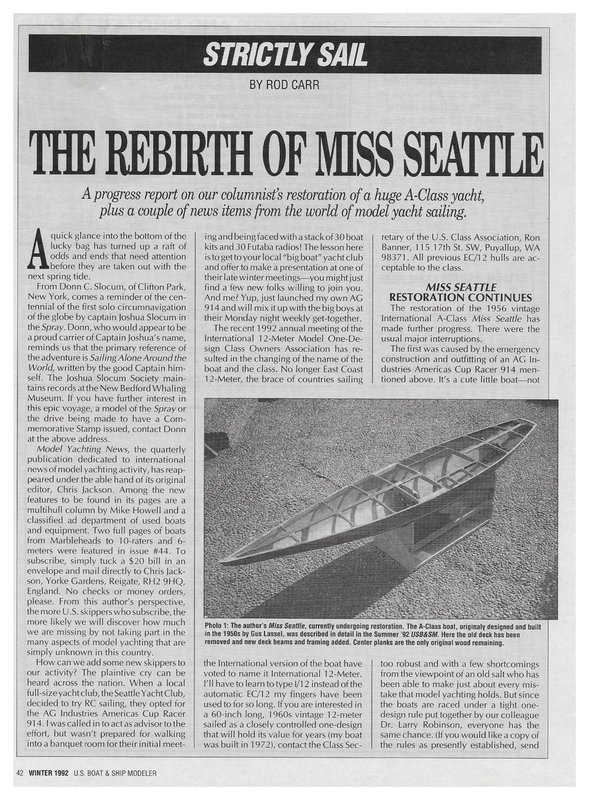
STRICTLY SAIL BY ROD CARR Tok REBIRTH OF MISS SEATTLE A progress report on our columnist’s restoration of a huge A-Class yacht, plus a couple of news items from the world of model yacht sailing. quick glance into the bottom of the lucky bag has turned up a raft of odds and ends that need attention before they are taken out with the next spring tide. From Donn C. Slocum, of Clifton Park, New York, comes a reminder of the centennial of the first solo circumnavigation of the globe by captain Joshua Slocum in the Spray. Donn, who would appear to be a proud carrier of Captain Joshua’s name, reminds us that the primary reference of the adventure is Sailing Alone Around the World, written by the good Captain himself. The Joshua Slocum Society maintains records at the New Bedford Whaling Museum. If you have further interest in this epic voyage, a model of the Spray or the drive being made to have a Com- ing and being faced with a stack of 30 boat kits and 30 Futaba radios! The lesson here is to get to your local “big boat” yacht club and offer to make a presentation at one of their late winter meetings—you might just find a few new folks willing to join you. And me? Yup, just launched my own AG 914 and will mix it up with the big boys at their Monday night weekly get-together. The recent 1992 annual meeting of the International 12-Meter Model One-Design Class Owners Association has resulted in the changing of the name of the boat and the class. No longer East Coast 12-Meter, the brace of countries sailing retary of the U.S. Class Association, Ron Banner, 115 17th St. SW, Puyallup, WA 98371. All previous EC/12 hulls are acceptable to the class. MISS SEATTLE RESTORATION CONTINUES The restoration of the 1956 vintage International A-Class Miss Seattle has made further progress. There were the usual major interruptions. The first was caused by the emergency construction and outfitting of an AG Industries Americas Cup Racer 914 mentioned above. It’s a cute little boat—not memorative Stamp issued, contact Donn at the above address. Model Yachting News, the quarterly publication dedicated to international news of model yachting activity, has reappeared under the able hand of its original editor, Chris Jackson. Among the new features to be found in its pages are a multihull column by Mike Howell and a classified ad department of used boats and equipment. Two full pages of boats from Marbleheads to 10-raters and 6- meters were featured in issue #44. To subscribe, simply tuck a $20 bill in an envelope and mail directly to Chris Jackson, Yorke Gardens, Reigate, RH2 9HQ, England. No checks or money orders, please. From this author’s perspective, the more U.S. skippers who subscribe, the more likely we will discover how much we are missing by not taking part in the many aspects of model yachting that are simply unknown in this country. removed and new deck beams and framing added. Center planks are the only original wood remaining. How can we add some new skippers to our activity? The plaintive cry can be the International version of the boat have voted to name it International 12-Meter. Ill have to learn to type I/12 instead of the automatic EC/12 my fingers have been used to for so long. If you are interested in a 60-inch long, 1960s vintage 12-meter sailed as a closely controlled one-design that will hold its value for years (my boat was built in 1972), contact the Class Sec- heard across the nation. When a local full-size yacht club, the Seattle Yacht Club, decided to try RC sailing, they opted for the AG Industries Americas Cup Racer 914.1 was called in to act as advisor to the effort, but wasn’t prepared for walking into a banquet room for their initial meet- 42 WINTER 1992 U.S. BOAT & SHIP MODELER too robust and with a few shortcomings from the viewpoint of an old salt who has been able to make just about every mistake that model yachting holds. But since the boats are raced under a tight onedesign rule put together by our colleague Dr. Larry Robinson, everyone has the same chance. (If you would like a copy of the rules as presently established, send
arm variety of sail control unit (SCU). For a boat this big, the SCU needs to be mounted on one side of the hull and the arm must be able to swing 165 degrees. This requires a substantially clear hull interior, so the metal braces had to go. As a result, the deck and its substructure needed to be upgraded to allow the chainplates to carry the shroud loads. The age of the hull suggested that internal bracing to protect the keel/hull joint should also be added. As | intend to sail the boat in competition, strength and reliability Photo 2: Close-up view looking aft shows the battery pack Velcroed to the hull, the sail control unit below the mast step and the RC board through the hatch. took precedence in the design of the new deck structure. The additional weight would be offset by the reduced weight of the new RC gear and by the removal of the metal braces. Photo No. 1 shows the completed structure with new 3/8-inch plywood deck beams and hemlock corner gussets to give each joint strength. All were coated with internal equipment in any boat you are building before the deck goes down. Check its operation, and check that you can get everything out through the hatch cover without reaching through a place that will eventually be covered with the deck. The RC board mounts under the hatch, with the forward end sliding into a slot in the aft SCU doorskin frame. The after end sits flush on and is screwed to a 3/8-inch plywood partial frame cut to match the contour of the hull. All adjustments are made at the RC board, as it is right under the hatch opening and convenient. Not wanting to put more than one hole in the planked deck, | decided to make the rudder shaft/tiller arm arrangementfixed. Photo No.3 shows. it complete with the exception of a short piece of aircraft fuel tubing to be slipped over the clevis to keep it from opening up. continued on page 47 West System epoxy, and the gussets were me aself-addressed, stamped—52 cents— business size envelope.) Handed a boat by the manufacturer, | assembled it and am putting together a critique. The biggest problem is the need to secure, with very small sheet metal screws, the fittings that slide around the aluminum tube mast to allow the rigging to be set up consistently. | also opted to substitute 20-pound stay wire and small A.J. Fisher turnbuckles to allow careful mast shape control. With a mast this short (48 inches), it is critical to have good control over the side stays and the backstay to guarantee proper mast bend and the powerful sail shape which follows. As I’m not going to sail in the SYC competition, | made a set of Mylar sails as an experiment. The difference in performance between them and the stock nylon suit is quite amazing. Ifthe SYC decides to switch sails, they will do it as a fleet and maintain strict adherence to the one-design approach. The next interruption was embarking on some sail construction and testing experiments with Dr. Robinson. After three continuous hours of sailing two International 12-Meters against each other, we came to the conclusion that the boat | was working with needed a stiffer main boom, a larger jib trim servo and a new finish on the hull. Easy to say, but the job involved about eight hours of construction, sanding, priming, sanding, painting, sanding, painting and polishing. But that is behind us now and it’s time to continue with Miss Seattle. As originally constructed, Miss Seattle had only two deck beams. She used some internal metal bracing from the side stay chainplates to the keel bolts to transfer loads from the rig through the chainplates to the keel. This system allowed the deck to merely keep the water out of the rest of the boat. In putting modern RC into the hull, | wished to use the reliable swing- bedded in thickened epoxy, which used chopped cotton fibers to give the liquid a non-drippy consistency. To transfer the upward pull of the jib stay from the deck to the keel, a 3/4-inch Square post was fixed between the center deck plank and the keel. You can see it’s upper end in Photo No. 1, just aft of the first deck beam. The post angles forward to match the general direction of the fullsize sail suit established for the boat. Just aft of the bow block in Photo No. 1 you can see a short plywood filler piece, which runs aft to allow the center deck plank a place to land. This piece takes the place of a three pound chunk of lead that was discovered when the old deck was removed. It was put there for trimming the boat level, but will not be needed now because the new RC gear is much lighter, and the stern will not be as heavy. Heavy weights must not be allowed to find a home in the extremities of our yachts for they make the hull prone to “hobby horsing” or “bobbling” in a choppy seaway. They also make the boat hard to start and stop turning while tacking, requiring more rudder and slowing the boat. Better that as much weight as possible be centered in the boat, and located as low as possible. That’s why the battery pack is Velcroed to the bottom of the hull, as seen in Photo No. 2. Photo No. 2 also shows the general location of the sail control unit, mounted almost directly under the mast step. The unit slides into place on top of two plywood doorskin frames and is secured by a single sheet metal screw. You can see the battery cable disappearing through a hole in the forward frame. You can also see the line of gussets that bond the doorskin frames to the hull. These frames provide transverse support to the vertical oak members that hold the keel bolts and step on the centerline of the keel. Always remember to install all of the bedded in epoxy. Photo 4: View from the bow after the 3/32-inch plywood doorskin subdecking was applied. Photo 5: Miss Seattie’s lovely sheerline contrasts with modern-day racing machines, with no lack of overhangs on either end. U.S. BOAT & SHIP MODELER WINTER 1992 43
SCHOONER continued from page 40 | HALF MOON continued from page 35 { winters when | wasn’t commercial fishing inthe Bering Sea aboard my halibut schoo- boring one. Destruction reigned, but finally the little bastards wefe on. double as a decor piece.” / He chose the America as his proje¢t out of a love for schooners developed over his Removing the excess stock (they were far too thick), taperig and finishing were next. Using a staifless steel Beaver G3P interdontal blade, Scottie began scraping ner. | wanted a working model that would years of sea duty as a pick-up deckhand, merchant seaman and commercial fisher- man. / “I’ve been watching the Ameri¢a’s Cup for many years, been all moved in itand never heard anything about the original America. There is so little information avail- and shaping/The long leg of each knee was leftthat way; it would be cut to size after the’top rail was installed. Thanks to the Béaver (obtained through a dentist), thefe was minimum breakage, and most it could be mended with glue. able about her that it became/one of my incentives to use her as my subject.” With the model finally finished, Ron traveled to Taiwan to set up the manufac- oon hasarela- turing of the kit, expecting to/find what he refers to as “the inexpensive/Far East solu- boxwood. As a bonus, it has a rich, warm / color which imparts an aura of eleganc to the model. Half Moon has a relatively simp! leave them off. More importaftly, sails tend to deteriorate and will make a welldone model look like garbage when they start coming down. Once the rigging was completed using linen thread, | turned pedestals from Osage orange and nrvounted the model on a base covered with off-white Naugahyde. After the model was professionally photographed, Changed my mind and substituted roon-colored velvet for the Naugahyde. That was the ticket! The vel-. vet Added a luxurious touch which coynplemented and enhanced the model, uch to my client’s satisfaction. ® – tion.” Instead, he found disappointment. Not only was he disturbéd about their seeming lack of knowledgé, but the “solution” was far from cheap! He reassessed his priorities and decided that there was something philosophically inconsistent with fabricating such a center- SAIL continued from page 43 piece of American tradition in the Orient. “| really wanted America to be 100% made in the USA,” h¢ explains. Accordingly, Ronfa, Bil the services of an enthusiastic friend, Bill Driscoll, who helps in planning, /working up the press releases and handjing customer services. Together they approached Reese Anderson, a mold- and pattern-maker of the old school—an artist and craftsman who makes molds by hand. It took him years to pattern the molds for the four separate pieces that make up the fimished hull. Once that was established, Ron and Bill concentrated on the mast, sails and rigging, paying close ren to authenticity. There are over 230J individual parts to each kit. Using acombination of word descriptions, photos and pp: drawings, the modeler is lead through the assembly process, which can be completed in one day. The manufacturing process is injection molding, and the material is polystyrene Rails were 1/16-inch thick applewgod bent around a hot soldering iron. A draftsman’s plastic circle template assured the proper size. After cheat was placed inside the proper circle to ¢heck its roundness, then reshaped on the iron if necessary. Each rail had a substantially long tail which was cut to length with a slight overlap for a scarf joint. Rails were test-fitted to the knees before being permanently attached with glue and treenails. Clamping produced numerous broken knees and Scottie was worrying about the tops’ structural integrity. Once the two rails were affixed, however, the structures were rigid and song. Caps were made/ Dutch fashion with sheaves on either/side for hauling the structural foam. topmasts into plage. This made the caps more complex, but it took only two attempts before Scottie had the system down cific gravity of .70, which makes the boat pat. The pdlystyrene weighs in with a spe- unsinkable, as water has a specific gravity Of [stay Some of the other features include: watertight deck plates secured by six screws Caps, masts, and yards were applewood. Scottie has adopted my pas- sion for working in apple, and we urge you to try it/as well. Besides being readily available {I’ve collected my own wood custom tooled of brass with winch shaped heads; belowdeck sail and rudder control with’ motor; masts and sails, standing and for years/and one can’t beat FREE for a price), apple has a dense, intertwining running gear; sailing rudder and keel (re- the cross grain. This characteristic allows play mounting on surface or wall. appl¢ to bend well either steamed or cold. It cdn be worked to fine tolerances and, be¢ause of its toughness, won’t break at movable for display); and brackets for dis/ What Schooner America, Inc., offers is a inship with history, an acknowledgement f the present and an interest in the future for generations to come. ® grain which makes it extremely strong on points where other woods will. Apple has aved us many hours of remaking fittings /because it can take abuse and not crack. “That resilience makes apple superior to The mounting for the rudder is beefed up with 3/8-inch plywood and large 3/4inch gusset blocks. Like many of the old designs, Miss Seattle was built with a skeg that made the hull very longitudinally stable. The skeg was a fixed fin mounted forward of the rudder. It acted like feathers on an arrow and helped resist changes of course in a boat sailed without RC. But maneuverability is essential to RC yachts, so | simply slipped a good old Vortex Model Engineering balanced aluminum SOLING/SANTA BARBARA rudder in place of the original. Note also in Photo No. 3 that above the tiller arm there is a safety collar, so that the rudder will at least stay with the boat if the tiller fails. With everything done on the inside, | mixed a slow curing batch of thickened epoxy and troweled it liberally onto the deck framing. Having previously waterproofed the underside of the doorskin material, | plunked it down on the hull, weighted it securely along the centerline with lead chunks and then worked out from amidships on either side, pulling the deck down to the gunwale and securing it with duct tape (see photo No. 4). At that point, | went to the East Coast for two weeks and left the project to cure on its own. In the interim, | have made a new set of snow white dacron sails and mounted them on the beautiful wooden spars from the original boat. There are only two major operations left: First, the application of a strip planked deck, and finally the finishing of the hull. I’m leaning toward black topsides with some gold leaf scrollwork and a white bottom which will show when she kicks up her heels. Drop a line and some photos of your latest project to: Rod Carr, 3011 177th Ave. NE, Redmond, WA 98052 ®. U.S. BOAT & SHIP MODELER WINTER 1992 47