- Title. Author. Summary

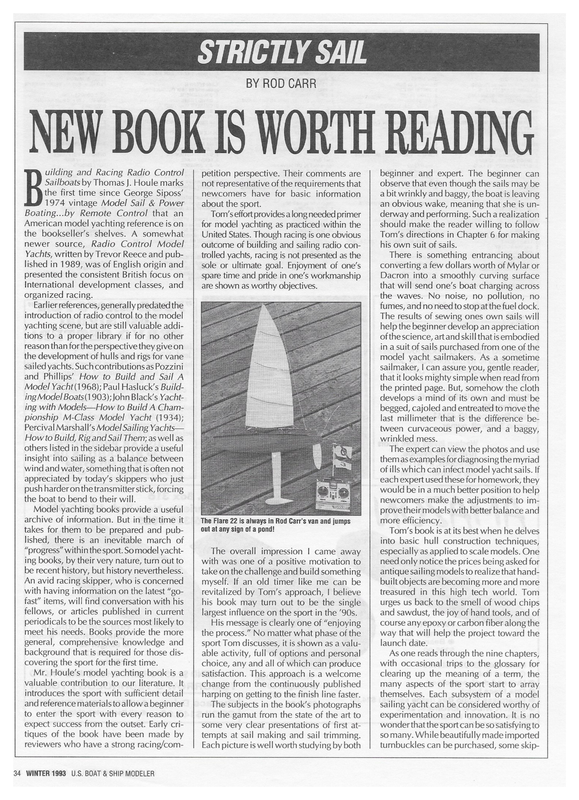
STRICTLY SAIL BY ROD CARR NEW BOOK IS WORTH READING uilding and Racing Radio Control Sailboats by Thomas J. Houle marks the first time since George Siposs’ 1974 vintage Model Sail & Power Boating…by Remote Control that an American model yachting reference is on the bookseller’s shelves. A somewhat newer source, Radio Control Model Yachts, written by Trevor Reece and published in 1989, was of English origin and presented the consistent British focus on International development classes, and organized racing. Earlier references, generally predated the introduction of radio control to the model yachting scene, but are still valuable additions to a proper library if for no other reason than for the perspective they give on the development of hulls and rigs for vane sailed yachts. Such contributions as Pozzini and Phillips’ How to Build and Sail A Model Yacht (1968); Paul Hasluck’s Building Model Boats (1903); John Black’s Yachting with Models—How to Build A Championship M-Class Model Yacht (1934); Percival Marshall’s Model Sailing Yachts— How to Build, Rig and Sail Them; as well as others listed in the sidebar provide a useful insight into sailing as a balance between wind and water, something that is often not petition perspective. Their comments are not representative of the requirements that newcomers have for basic information about the sport. Tom’s effort provides a long needed primer for model yachting as practiced within the United States. Though racing is one obvious outcome of building and sailing radio controlled yachts, racing is not presented as the sole or ultimate goal. Enjoyment of one’s spare time and pride in one’s workmanship are shown as worthy objectives. tween curvaceous power, and a baggy, wrinkled mess. appreciated by today’s skippers who just push harder on thetransmitter stick, forcing the boat to bend to their will. Model yachting books provide a useful archive of information. But in the time it takes for them to be prepared and published, there is an inevitable march of “progress” within the sport. So model yachting books, by their very nature, turn out to be recent history, but history nevertheless. An avid racing skipper, who is concerned with having information on the latest “gofast” items, will find conversation with his fellows, or articles published in current periodicals to be the sources most likely to meet his needs. Books provide the more general, comprehensive knowledge and background that is required for those discovering the sport for the first time. Mr. Houle’s model yachting book is a valuable contribution to our literature. It introduces the sport with sufficient detail and reference materials to allow a beginner to enter the sport with every reason to expect success from the outset. Early critiques of the book have been made by reviewers who have a strong racing/com- 34 WINTER 1993 U.S. BOAT & SHIP MODELER beginner and expert. The beginner can observe that even though the sails may be a bit wrinkly and baggy, the boat is leaving an obvious wake, meaning that she is underway and performing. Such arealization _ should make the reader willing to follow Tom’s directions in Chapter 6 for making his own suit of sails. There is something entrancing about converting a few dollars worth of Mylar or Dacron into a smoothly curving surface that will send one’s boat charging across the waves. No noise, no pollution, no fumes, and no need to stop at the fuel dock. The results of sewing ones own sails will help the beginner develop an appreciation of the science, artand skill that is embodied in a suit of sails purchased from one of the model yacht sailmakers. As a sometime sailmaker, | can assure you, gentle reader, that it looks mighty simple when read from the printed page. But, somehow the cloth develops a mind of its own and must be begged, cajoled and entreated to move the last millimeter that is the difference be- The Flare 22 is always in Rod Carr $ van and jumps out at any sign of a pond! The overall impression | came away with was one of a positive motivation to take on the challenge and build something myself. If an old timer like me can be revitalized by Tom’s approach, | believe his book may turn out to be the single largest influence on the sport in the ’90s. His message is clearly one of “enjoying the process.” No matter what phase of the sport Tom discusses, it is shown as a valuable activity, full of options and personal choice, any and all of which can produce satisfaction. This approach is a welcome change from the continuously published harping on getting to the finish line faster. The subjects in the book’s photographs run the gamut from the state of the art to some very clear presentations of first attempts at sail making and sail trimming. Each picture is well worth studying by both The expert can view the photos and use them as examples for diagnosing the myriad of ills which can infect model yacht sails. If each expert used these for homework, they would be in a much better position to help newcomers make the adjustments to improve their models with better balance and more efficiency. Tom’s book is at its best when he delves into basic hull construction techniques, especially as applied to scale models. One need only notice the prices being asked for antique sailing models to realize that handbuilt objects are becoming more and more treasured in this high tech world. Tom urges us back to the smell of wood chips and sawdust, the joy of hand tools, and of course any epoxy or carbon fiber along the way that will help the project toward the launch date. As one reads through the nine chapters, with occasional trips to the glossary for clearing up the meaning of a term, the many aspects of the sport start to array themselves. Each subsystem of a model sailing yacht can be considered worthy of experimentation and innovation. It is no wonder that the sport can be so satisfying to so many. While beautifully made imported turnbuckles can be purchased, some skip-
pers are more proud of figuring out how to accomplish the same function using some brass strip, a bitof Dacron line and the ever present super glue. Tom subtly reminds us that model yachting is what each of us decides to make it for ourselves. The appreciation of another’s handiwork isa common thread that should bind us together. — A copy of the book, autographed by the author, stands proudly on my bookshelf. The inscription is worth quoting, for itsums up the sense of responsibility thatshould be common to all model yachtsmen, and it speaks to the continuity that is so essential in the long term enjoyment of the sport: “4/12/93 – To Rod Carr, who, way back when, inspired me to get off my butt and build that first God-awful boat. Thanks much, Tom Houle.” If each of us just took the time to inspire a couple of newcomers to get their first boat on the water, we’d have more friends, more fun and a head start on building the kind of memories that will be so sadly missed if we highlights of the Pacific Northwest and its regional cuisine with many lineal feet of bookshelves inventoried, and even more feet of yarns spun about all things that float. Linda and | thoroughly enjoyed getting to know the people behind the postbox, as | had been corresponding with Russell for well over 10 years. His insight into the administrative side of model yachting as practiced in the United Kingdom was most informative. But best of all was his outrageous straightforwardness. After suffering through the lengthy and suffocatingly hot high school graduation of our youngest daughter, Russell proclaimed, “I would not have missed this forthe world, but! wouldn’t want to do it again!” We were pleased to also welcome Ear!| Boebert of Minneapolis, who managed his business travel to put him in Seattle to meet and talk with Russell. Earl is working on a database of hull form information, and it was most interesting to hear Ear! and Russell plan for the future. Can you imagine being able to download hull de- the back of my van, and can stop and sail in the Seattle mud puddles while I’m waiting for the red light to change! Doug advertises the F22 at $275 which includes two servos installed. You add a receiver, battery pack, transmitter and 12″ of water with a bit of wind on top of it. Doug also sentsome pictures of the Flare 22’s bigger brother, the Flare 36. Early reports from central Florida indicate that the F-36 prototype has proven embarrassingly fast compared to what used to be hot 36/600’s. Never one to slow down, Doug says work is underway on a 50″ version, but it is not as far along as he had hoped since he paused along the way to design and build what looks like a most interesting trimaran.. For further information, contact Doug directly and tell him who sent you. Let me know what areas of our hobby you are exploring. Inquiring minds want to know. Sent photos of your latest launching to: Rod Carr, 3011 177th Ave. NE, Redmond, WA 98052. ® Thomas J. Houle, Building and Racing Radio Control Sailboats, RC Performance Series. No. 10, ISBN# 0-89024-115-5, Kalmbach Publishing Co., Waukesha, WI. John Black, Yachting with Models— How. to Build a Championship M Class Model Yacht, McGraw-Hill, 1934. WJ. Daniels and H.B. Tucker,. Model Sailing Craft, Chapman and Hall, Ltd., London, 3rd Edition, 1952. G.H. Deason (Compiler) and D.A. Russell The Flate 36 carries a balanced swing rig similar to the English Mickey Finn. The Tri-Flare trimaran maximizes sail, minimizes hulls for amazing acceleration. don’t put some of ourselves back into our signs right off of Internet? Always on the lookout for new sources of model yachting equipment, | am happy to have the opportunity to give some early information on anew supplier—microSAIL sport. | cannot think of any model yachtsman, no matter what part of the sport he is most interested in, not finding many, many reasons to be glad that he has added Building and Racing Radio Control Sailboats by Thomas J. Houle to his nautical library. Should you agree, let me know. We ought to thank the author, together. @ @ @ In the midst of this review, | had the distinct pleasure of hosting a 5-day visit of Russell and Ghillian Potts from London. Russell is the Secretary of the English Vintage Model Yacht Society, a group dedicated to the preservation, restoration and sailing of historic model yachts. Ghillian is a noted author of children’s books and we managed to combine a quick tour of the Corp., 734 N. Irma Street, Orlando, FL 32803; (407)423-2427. The CEO is Doug Lord and he was kind enough to provide me a hands-on experience with his first prototype monohull, the Flare 22. Only 22″ long, | was skeptical, but its counterbalanced una rig, and its very modern hull form have proved their value on the water. I’ve never sailed something so small that performed so well. It goes to weather like a hunting dog sniffing the wind, and runs downwind with the rudder amidships just like it was on rails and Casey Jones was at the throttle. You can see from the pictures that it is only a handful. But | keep mine in (Ed.), The Model Boat Book, The Drysdale Press, Stanbridge, Bedsford, England, 1950. Paul N. Hasluck, Building Model! Boats Including Sailing and Steam Vessels, Cassell and Co., Ltd., London, 1903. Edward W. Hobbs, Model Sailing Boats—Their Design, Building and Sailing, Funk and Wagnalls, New York, ISBN# 0-912318-10, Newton K. Gregg, Kentfield, ‘CA., 1929, Republished 1971. Percival Marshall, Model Sailing Yachts—How to Build, Rig and Sail Them, Marshall’s Practical Manuals, No. 4, London, circa 1929. Charles L. Pozzini and Earl O. Phillips, How to Build and Sail a Model Yacht, McKnight and McKnight, Bloomington, IL. Lib. Congress Card No. 68-18243, 1968. Trevor Reece, Radio Control Model Yachts, Argus Books, Hemel Hempstead, Hertfordshire, England, ISBN# 0-8524297 2-X, 1989. George Siposs, Model Sail & Power Boating…by Remote Control, Tab Books, Summit, PA, ISBN# 0-830693, 1974. ® U.S. BOAT & SHIP MODELER WINTER 1993 35