- Yachts Totals by Class
- Treasurer’s Report
- Club News

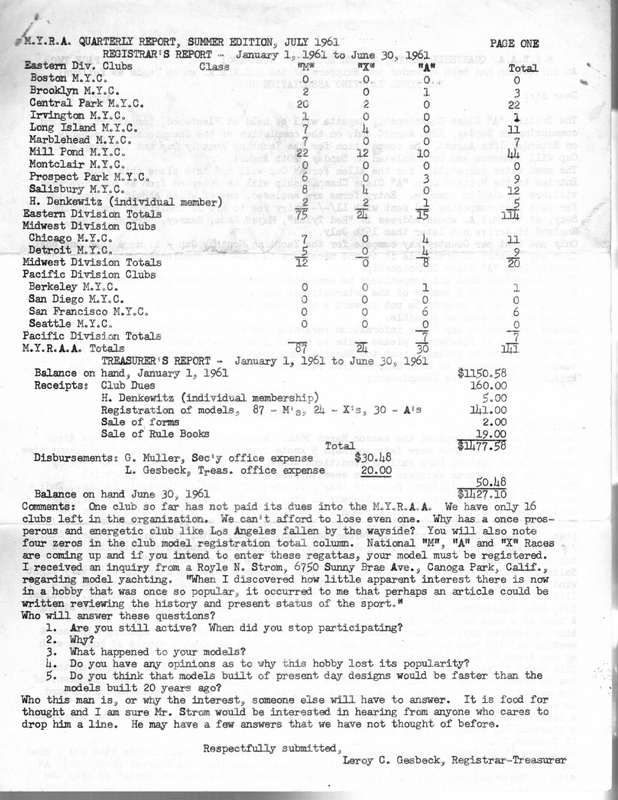
MO cloo Biurocokoronoo CG AO MAIATE ot SOOO tte M.Y.ReA-Ae Totals TREASURER’S REPORT – Balance on hand, January 1, 1961 Receipts: ooCco San Diego M.Y.C. San Francisco M.Y.C. Seattle M.Y.C. Pacific Divisicn Totals ~87 January 1, 1961 to Jun – OS 5 ; Oo a’o-o Detroit M.Y.C. Midwest Division Totals Pacific Division Clubs Berkeley M.Y.C. haw Eastern Division Totals Midwest Division Clubs Chicago M.Y.C. Ow Montclair M.Y.C. Prospect Park M.Y.C. Salisbury M.Y.C. H. Denkewitz (individual member) wy Irvington M.Y.C. Long Island M.Y.C. Marblehead M.Y.C. Mill Pond M.Y.C. Club Dues 87 = M’s, 24 – X’s, 30 – A’s Sale of forms Sale of Rule Books Disbursements: G. Muller, Sec’y office expense L. Gesbeck, Treas. Total $30.8 office expense 5.00 141.00 2.00 19.00 $177.50 20.00 Balance on hand June 30, 1961 Comments: One club so far has not paid its dues into the M.Y.R.A.A. clubs left perous and ‘ four zeros are coming $1150.58 160.00 H. Denkewitz (individual membership) Registration of models, PAGE ONE 3 REGISTRAR’S REPORT = January 1,.196i to June 30, 1961 Eastern Div. Clubs Class td wxe “A” Boston M.Y.C. Brooklyn M.Y.C. Central Park M.Y.C. BakSanto ata ee Bie oot ee ss Pe Eb Fein fiX.2. A. QUARTERLY REPORT, SUMMER EDITION, JULY 1961 E 2 # ‘ in the organization. We can’t afford to lose energetic club like Los Angeles failien by the in the club model registration total colum. up and if you intend to enter these regattas, $127.10 We have only 16 even one. Why has a once pros wayside? You will also note National “M”, “A” and “X* Races your model must be registered. I received an inquiry from a Royle N. Strom, 6750 Sunny Brae Ave., Canoga Park, Calif., regarding model yachting. “When I discovered how little apparent interest there is now in a hobby that was once so popular, it occurred to me that perhaps an article could be written reviewing the history and present status of the sport.® Who will answer these questions? 1. Are you still active? When did you stop participating? Why? « Do you have any opinions as to why this hobby lost its popularity? Do you think that models built of present day designs would be faster than the VLE Ww – – What happened to your, models? models built 20 years ago? Who this man is, or why the interest, someone else will have to answer. It is food for thought and I am sure Mr. Strom would be interested in hearing from anyone who cares to drop him a line. He may have a few answers that we have not thought of before. Respectfully submitted, Leroy C. Gesbeck, Registrar-Treasurer |
#? ; M.Y.R.A.A. QUARTERLY REPORT, SUMMER EDITION, JULY 1961 . s,s PAGE TWO An invitation has been extended the Skippers of the M.Y.R.A.A. which reads as follows: – Dear Sir: THE MODEL YACHTING ASSOCIATION April 1961 The British “A” Class Championship Regatta will be held at Fleetwood, Lancashire, England, commencing on Sunday, 13th August and, on the completion of the Championship, probably on Saturday 18th August, the competition for the Yachting Monthly Cup and the Wing & Wing Cup will commence and be completed on Sunday, 20th August. The open water competition for the Alien Forbes Cup will not take place this year. Entries to the British Open “A” Class Championship will be accepted from as many overseas visitors as wish to compete. Entry forms are enclosed, one of which should be completed for each boat competing and sent with L1/-/- entry fee to Mr. D. Tomlinson, Hon. Racing Secy. of the M.Y.A. whose address is “Red Tyles*®, Mayes Lane, Ramsey, Harwich, Essex, England to arrive not later than 15th July. Only one boat per Country may compete for the Yachting Monthly Cup – if more than one boat from any Country is available it is not necessary to name the challenger until after the British Open “A” Class Championship. It is essential that ail competitors be bona-fide members of Clubs affiliated to a National Authority which is a member of the International Model Yacht Racing Union. If your Authority intends to put forward a challenger for the Yachting Monthly Cup please let me know as soon as possible. . Should you require any other information regarding the racing, travelling in England or accommodation at Fleetwood, please write to me and I will do my best to help. I am authorized to intimate that the Regatta Committee will make a grant of L10/-/- towards the expenses of each Skipper from outwith the British Isles competing in the British Open “A” Class Championship. : Yours faithfully, /sf/ W. K. Rodrick Hon.Sec. CLUB NEWS & MISC: Central Park M.Y.C. opened the season March 26th. to the Committee Wayne Dail, Sec’y writes of the Arges Trophy Race, “The winds were fair, perhaps 5 knots from the NW. We had a very pleasant time under typical Central Park sailing conditions where the luck of the wind counts heavily but where the veteran skippers always seem to have all the luck (strange isn’t it) The results were as follow: Peluso’s ‘Kay’, 21 pts, Ist; Arges’ ‘Wonder’, 19 pts., ends; | Herrman’s ‘Erna II) 18 pts., 3rd; Seebaur 1h pts, ths Schierman’s ‘Marie’ 13 pts., 5th; Deil’s ‘Lady Lou’ 9 pts., 6th; Friedman’s Rita; 9 pts., 7th.* | Wayne also writes, * The results of the Central Park Cup were: 1st, Fred Greco, 22 pts; 2nd, Tony Peluso, 16 pts; 3rd Wayne Dail, 13 pts: th Wernes Herrmann, 11 pts; Sth, Tony Arges, 9 pts: 6th, Joe Freedman, 4 pts. Greco retired the cup. Central Park imtends to establish a new cup at some time in the future +o take the place of the retired trophy.” Salisbury M.Y.C. opened their season April 8th. It was a fine day starting with very light wind so racing did not start until 10:30 AM. ih boats started and two more showed up a little later. Sailing was halted about ):30 PM when the 5 to 8 MPH wind died out. Results: lst, Ains Ballantyne, 2nd, Geo. Bursuch, 3rd (tied) Bob Kennedy, Art Lawrence, Lew Strong A toss of a coin decided 3rd and the winner was Bob Kennedy. Ains Ballantyne writes, “Last Sunday April 16th Mill Pond attempted an opening day race & meeting but the race was rained out and only I sailed up and down a couple of boards with my new Arrow VI boat made of fibreglass by the Salisbury Club. This model I finished up with an experimental arrangement using a 3/4 lb. weight on the bow in order to keep the main lead back as far as possible. This permits the placement of the mast further aft. This model usually requires that the rig be placed as far forward as possible in order to keep her head out of the wind in a breeze.” A letter written very likely at the end of a perfect day, thus catching the true spirit of a glorious day spent yachting follows: Hi Skipper, Well here it is Sunday evening right after our Long Island Perpetual Trophy Race and a good day it was. Here are the results; a beautiful sunny day; the race started about 10:20 AM with 18 boats sailing; the wind was very light, about 2 – 3 miles but enough to keep the SE —__-ZZ_ = = eee |
M.Y.RoA.A.o QUARTERLY REPORT, SUMMER EDITION, JULY 1961 ad PACE THREE ane ee on @ good beat and run. Three heats were finished by 12:20 and then ‘iunch By then it had freshened to 8-10 miles and we got in six more heats making nine in all as we had set a PM finish. No spinnakers were allowed. | ; ih ist, Max Baum, 4O pts; 2nd Jim MacCawley, 35 pts (won the sail off); 3rd, Any Kovak, 35 pts. Finish line judges were Jim Warrell and Fred Titus; O@ was your truly. The prizes were the handy work (ceramic pieces of art) by none other than Jim Warrelll » Plus the trophy. All went home tired but happy and that’s what I am right now so I’ll say so dong and Happy Sailing, | George J. Meyer, S.c’y, L.I. MYC This office has received a communication from George Atthowe advising that the City of ‘ Berkeley has on their docket a request for $1000.00 to be spent on some immediate repair to their sailing facilities. He does not know of date whether this budget item has received the nod of approval of the City Fathers. W. have our fingers crossed wishing you the best of luck George. — Have received word that John Black is sailing the high seas on the Queen Mary from New York July 12th for a trip abroad and will be at Fleetwood for the Yachting Monthly Cup racing. Bon Voyage Mr. Black. Mr. C. O. Davis, former Secretary of the M.Y.R.AA. writes, “You may be interested to know that I received commmication from E.W.E. Blackmore, the life blood of the Maple Leaf M.Y.C., Vancouver, B.C. in which he teiis me that the local club has permission to use a Canadian Government pool at Chilliwack, B.C. and has extended aa invitation to the Seattle and the Portland M.Y.C. enter into sailing activities with them on an International basis as we used to do some ten years ago. The pool is 2000 ft. long and 300 ft. wide and it is possible to drive cars completely around it and to within 5 ft. of the edge. He states the water level is twenty inches below ground level, which would lead me to anticipation of many belly flops during the day in the effort to adjust rigging. Of course there is the possibility they may allow the use of turning poles. — The biggest deterrent to full activity in manual control racing is the time and distance factor. From Seattle to Chilliwack B.C. is 115 miles and three hours time including the stop at the International border. The only other place we can race is in Westmoreland Pool at the southern limits of Portland, a distance of 290 miles and a time of four & one~half hours.*® It was nice to encounter again the inimitable style of C.0. May we have the pleasure of hearing from you again’ soon. Mr. Chas. R. Seabrooke, co-editor of M.Y.A. News has been elected Vice-President of the International Model Yacht Racing Union. Detroit has. been honored to be host city for the National Class M championship. for the D.M.Y.C. and Larry Garibaldi, Sec. As Sec’y of the Chicago M.Y.C., Co-sponsor of this event, may We take this opportunity to invite all you Skippers of the M.Y.R.A.A. to join us in Detroit Sept Sth & 6th to sail upon one of the finest pools in the Country. For the benefit of those who have not visited here, the pool’s general characteristics are: 200 ft x 1080 ft, generally lying east and west, no weeds, excellent boardwalk, pumphouse to maintain its depth, Q to 30 MPH winds, many times reaching winds, with a straightaway wind from three sides and only a wind from the north cons‘dered at all tricky. Hotel and motel accommodations ($3.00 single with bath and up) within 2 – 3 miles of pool. Easy to locate from two Expressways entering City. In all 1961 National. Races unlimited number of entries prevail. May we remind you that para. (g) under G-10 states, “Entries shall be accepted in National events up to five (5) days prior to scheduled start of racing.” Send a card or letter notifying the Secretary of the sponsoring club your intention. The names and addressess of the secretaries are ~ Class A, Class M, : Class X, Ains Ballantyne Gerhard Muller Ray Wiilmes S Jefferson Sy 9162 Montrose Port Washington, L.I., N.Y. Detroit 28, Mich. 127 Valmar Terrace San Francisco, California |
M.YeR.AoAe QUARTERLY REPORT, SUMMER EDITION, JULY 1961 ‘PAGE FOUR card and have your sails marked. You P.S; Don’t forget to bring your boat’s registration te oblige. had best make hotel or motel reservations if possible. We will begiad In the last issue of the Quarterly Report your Secretary included an article on casting before ending had assumed but ce a keel, ete. This article began as a small filler! pie doctorate proporations. While this article may not have been guite proper to include in a Quarterly Report still it was hoped to encourage some comments. So far there has been silence from this side of the Ocean, but Mr. Vic Smeed, editor of ‘Model Maker’ magazine in England has proposed including parts of it in a current issue of this magazine. I have thanked him for his interest in model yachting and given him permission and will revert any A. financial gain from its publication into the Treasury of the M.Y.R.A t We are now honored to be able to present some correspondence from Mr. John Lewis, prominen yacht in ces experien their g regardin ne, Ballanty Mins English model yacht designer, and Mr. design. Comments from othersare welcome. May i6, 1961 Dear Mr. Lewis, I am sorry you could not make the trip to the States. Your suggestion that we exchange ideas about boat design is a good one, so I will express some personal opinions. affair, Designing sailing craft for maximum results in competitions, is not a universal occurs. tion competi the which in ns conditio but is dependent on the prevailing sailing rably being Steady The sailing conditions in a large country like the States varies conside the East Coast. on light mostiy and True and Strong on the Pacific Coast and changeable ely strong moderat and true fairiy and The Mid-West conditions are also variable at Chicago in Detroit. At Mili. Pond in Long Isjand the winds are so tricky and light at times that the boat that sails the best course wins regardless of the potential speed of the Hull. The control of the boat not the speed is the winning factor. at San Diego last year You mention the oversize “A” boat that won the National #A% Race strong and steady wind. lly genera a of and I venture to say that this type is the product Mill Pond a couple of years ago and was to A long “K” type boat from San Diego was brought for that race. winds tricky and light had we a great disappointment to its skipper because the designer’s taxes that one is winds varying The problem of sailing and winning in greatly now dead, Weaver Joe s, skipper best our of One skill and perhaps more the skipper’s skill. given day. always contended that the boat with the best trim would win in anyfog. By 11 AM fitful a and wind no with Take last Sunday for instance, the day started in fairly true and breezes came down the pond but lecalized in patches and graduallythesetsouth a run and. from was it probably reached 8 miles per hour by 3 PM. luckily pond. The changeablegiving ons reconditi the of a beat but with spots of calm along the sides to sailused r skippe a For . results best quired varying the trim continuously te get the fit to sail in, but if an important race not ing in a true steady breeze half the day was would skipper l skillfu most the and sailed had been scheduled a race would have to be probably win regardless of the hull design of his boat. that constant changes be made Discussing “A” boats (as you prefer) the conditions requirebest speed and in addition conto the trim and bellying of the sails in order to get the trol of gying to avoid the dead spots is a must. with large yachting, skiff sailIn the East in order to get sailing conditions comparable that only a strong rower can get the best ing is resorted to but this has the disadvantage out of his model as the courses are long and often in relatively open water so old fogies like me no longer can compete. on of cross section. One factor in regard to Model Hull design is the questibottom Vee (c) ar (b) Circul (a) Flat Floor m well in light winds because the boat The flat floor boat in my experience does not perfor does not lean easily so the sails hang in flat planes with no drive while there. Vee bottom boat leans easily and the sails take a good form by gravity. Further the fiat
H.Y.R.A.A. QUARTERLY REPORT, SUMMER EDITION, JULY 1961 — dl ) PAGE FIVE floor boat if large abeve the water line tends to lift out of the water when heeied and so shortens its water line, whereas the round or “V” bottom boat if kept lean above water sinks down and lengthens its water line when heeled. . 4round New York no “A” boats have been built of late years and if it were not for me, I doubt that anybody would bother with tham. We will be lucky to get 6 or 8 boats te sail in the National “A” race this year, and af these, five will be owned by me, 3 wili be chartered and one other boat will be one which I modified and re-built and gave to its new owner. ol eons like to see one of your designs and I can later on send you a couple of blueprints of mine. ; Yours truly, Mins Baliantyne As a rather recent entry into the field of model yacht design, and just a little longer in sailing model yachts, I find it difficult to make anything by general statements. I have designed a Class A boat to which I have buiit two models, an “M” to which I have built one model and a 36 to which I have built one model. The “M” is a rather chopped off version of the “A”, generally retaining its form, easy entrance with rather full waterlines aft. Neither are tuned up properly as yet, a rather singular development in this process occurring just two weeks ago. I had been having difficulty getting my “M” to sail to windward. Without the vane gear, with normal sail trim, it would generally head up into the wind irregardless of position of the mast. This was most aggravating and time consuming for she would sit there, pretty as a duck, and take 10 minutes or longer before coming back to shore. Finally I tried the same trick which had proven successful on my A, after @ whole summer of fruitless experimentation last year. I hanled my jib in tight. Both my “A® and TM” have 3″ jib travelers. With rubber bands on their traverse bars, I snubbed their range to 2″ or less and lo and behold both of my boats now sail to windward. How close and how fast I cannot tell. By the end of this season I should have a more complete comprehension of their merits. Presently I am inclined to believe that both boats carry a slight weather helm, for which I may have compensated by advancing the tiller pin outward on my vane gear approximately 3/4″ over what I had normally used before and uiscrewing the vane feather limiting screws to almost their outer Limit. Fortunately we have several good M’s in our club to sail against. Whether the Class A competition is keen I do not know, none of our A’s having had much interclub competition. My reason for building the two “A” boats to the same design was that I built the first one laminated (three 1/32″ strips glued up criss-cross) which I sprung somewhat when instal~ ling the inwales. (See Model Maker magazine, March 1961, page 160). It behaves slightly different on the two tacks. The second I built bread and butter and I am satisfied as to its accuracy. The “M“ I also built bread and butter style. In this Country we do not normally employ professional model makers to build our models. The cost of a Class A boat built in a professional shop in this Country would be almost fantastic ~ reaching, I would judge, the cost of a small automobile. Obviously then most cf our models are built by amateurs, with a sprinkling being constructed by professionals who may be interested in our hobby. Accuracy of construction then assumes the proportions of a riddle, and consequently also the attempt of the designer to determine whether or not a certain design has more merit then another. It is easily imaginable that @ model yacht designer may go backward in his design rather than advancing depending on what good fortune he may have had in obtaining skillful builders and skippers to sail his models. You may yourself have reached a stage from which it is difficult to foresee a design that is superior to your previous. It does seem rather a forlon predicament for a model sailing yacht designer to attempt to advance his knowledge based upon what has been certified before. In general, a compromise in beauty and composition, easily sailed and tuned, still should carry the greatest attraction. And rightly so – for while not winning all the races, its balance and ease of sailing will nearly always bring it in near the top and prove a continuous joy to its skipper. Fortunately, or unfortunately depending wpon how you react to the vicissitudes of life, some model yacht designers, as in other lines of endeavour, continue to seek the ultimate. My ‘line of reasoning presently attempts to follow American large sail boat practice ~ fine, straight entrance, with rather full waterlines aft. Logically it may follow that if the biunt bow of “Sceptre” was successful as ea). Se hla ee eeeeneeeawa
PAGE SIX M.YoRoAcA. QUARTERLY REPORT, SUMMER EDITION, JULY 1961 this tests, tank in forms normal more other vanquished having a model, it evidentally whether noticed not have I models. sailing our in feature should also prove successful this fact has influenced British model design, though generally speaking, it appears your designs have shown a greater concern for obtaining an easier exit rather than 2 fine entrance. As some old nautical salts have maintained right along however it may not make a difference which way you haul a model through a testing tank, forward or backward, the readings will be the same. To date I have not varied my method of design from that recommended by Daniels & Tucker in “Model Sailing Craft.” All of my designs have been fitted about a perfectly balanced diagonal, making no claim however of producing a ‘balanced hull’, my 20° heeled C.G. fal~‘ling 1/2″ aft of the upright C.G. in my Class A boat. The significance of this I shall let someone else determine. In answer to your inquiry with regards to American magazines publishing model yachting news and plans I regret to advise that there are none. We have ‘lost the two or three professional designers who used to take an interest in our sport and now I do not believe there are any. Messrs. Victor Ward and Louis Tramonti have developed an “A” Class boat, which may or may not be, peculiar to our West coast. Unfortunately, due to the great distances which isolate our model yachting activities throughout our Country, it is difficult to make equitable comparisons. Several models have been developed there that weigh over 70 lbs., which appear to have performed as well in light winds as 50 MPH gales. Under separate cover I am mailing you copy of our Quarterly Report which contains two pictures of one of these boats. If you like, I will include you on my list to mail you further issues of this report. Please feel free to correspond further. I have received a copy of Mr. Ains Balilantyne’s letter to yourself and believe it may make interesting reading to include three or four ‘letters of this discussion in a future edition of our Quarterly Report. Sincerely yours, Mr. A. M. Ballantyne Esq. Gerhard Muller, Sec’y MYRAA 6th June, 1961 I was delighted to receive your recent letter. Coincidentally I received a letter from Gerhard Muller on the same day. I was interested that you had sent him a copy of your a future ‘letter to me and that he is proposing to include some of our correspondence in shortly be will I idea t excellen an is think I This Report. y Quarterl edition of your replying to him and will enclose a copy of this letter. Club at From your remarks it would seem that I am living in something of a Utopia. Our new much as Birkenhead is one of the most active in this country, and there is probably building going on here than anywhere else. We are extremely fortunate in having a good pond on which to race although it is not very large. Added to this, we are only a short distance away from Fleetwood which is the finest lake in this country. Mithough of course we do have times when the wind is tricky, more often than not the weather conditions are such that it is not sufficient to be a first class skipper but, in order to win races, you have to have the fastest boat for the particular condition prevailing. Discussions on yacht design by letter can get very confused. The choice of Hull form is one of so much compromise that we can only really talk in general trends. I have now been actively designing for some 15 years and have reached the stage where I am somewhat at a loss as to what to do next. I have however come to the following general conclusions. a) Model yachts should be of heavy displacement rather than light displacement. Iionhave of yet to see a successful lightweight boat in any class except in a specific combinat wind strength and water condition to which it is peculiarly suited. b) I have little doubt that heavy displacement is necessary for good windward performance c) It is important that a boat be easily handled. This usually means that the change in C.B. should not exceed 0.1″ when heeled to 25°. ad) I am not an advocate of using the balanced diagonal method, the Admiral Turner metacentric analysis or any other geometric method of determining hull shape. e) For maximum speed it seems necessary to spread the displacement of the hull as far as possible into the ends of the boat. This can be carried too far and I would not ad-to vocate angles of water line entry exceeding 35°. This is exclusive of local snubbing reduce L.W.L. under certain rules. EO ©
5 , M.Y.R.A.A. QUARTERLY REPORT, SUMMER EDITION, JULY 1961 cs PAGE SEVEN 2) In the choice of midship section I agree with your remarks, but my own tendency is to go for a flattish flloor combined with heavy tumblehome to avoid the lifting out tendency. This type of section enables the requirements in “C” and “E”TM to be carried owt. On the other hand there are very many excellent “V” sectioned beats. It must be disappointing for you to have so few International “A” Class boats in the New York area but, presumably, there are considerably more Marbleheads. At the British International “A” Class Championship this year, which is being held at Fleetwood, we are hoping to have between 30 and 40 entries. This will be a particularly interesting race to me as it will be the first time that several new designs of mine will be competing in this class. Up to now TI have concentrated mainly on 10 Raters. I am also looking forward very much to meeting John Black who will be over here during that period. Iwas very pleased to have a letter from him also last week. In order to illustrate the trends ir our yacht design I am sending to you under separate cover two International “A” Class drawings and one Marblehead design. You will see that the “A” Class boats are of widely different types aithough their dimensions are somewhat similar. It has turned out that the design with the flatter type of sections is superior to the other boat except in very light airs. Both these boats will be racing at Fleetwood this year, As a matter of interest I have prepared a design for an “A” Class 60*® IWL and 80 lbs. displacement. This will probably be built during the next Winter. I would be interested to have your comments on the Marblehead design as I know that you are an expert in this Class and up to now T have oniy designed about six of these. You will find enclosed with this letter a photograph of one of my latest experimentai LO Rater designs. This boat was built by Mr. Ken Jones and won the overall Championship Cup at this year’s International Boat Show in London. The idea behind the design was to in- vestigate the possibilities of twin high aspect ratio fin keels. At normal angles of heel one of the fins is out of the water! Tests se far show that windward performance is average and down wind speed is above average! and 1,000 square inches of sail. The boat is 60″ IWL, 27 lbs. displacement Yours sincerely, John Lewis Dear Mr. Muller, 8th June, 1961 Thank you very much for your letter dated May 26th. It so happened that I also received one from A. Ballantyne on the same day, I am enclosing a copy of my reply to him. I was particularly interested in your remarks concerning the difficulties of continuous development in design and that the designer is so very dependent on the skill of builders and skippers. Fortunately at Birkenhead I am very lucky in that the general standard of building is extremely high and so is the sailing ability of the owmers. However, despite this advantage I have in fact reached the stage where it is very difficult to foresee 2 design superior to my previous ones. We reach a stage where we know what type of boat we shall produce for any specific condition and one is left with the chalienge of producing a beautiful and easily sailed yacht. Im the past I have carried out very many experiments and I am becoming more certain that there is an optimum design for all round performance in each racing class. However, if gn owner is prepared to gamble all on specific weather conditions it may still be possible to produce some designs of an extreme nature. The main difference in characteristics between American Design and British design is that in Britain we tend to provide a rather more blunt entrance than in America. Both basic types of hull have their merits and with the experiments I have carried out I believe that the blunter entrance does in fact have a higher potential speed. This does not, however, mean that it is the correct form as so much of 4 yacht’s time is spent travelling at @ speed considerably lower than its theoretical maximum. I do not think that Sceptre has had any influence on design in this country either full size or model. Your remarks about movement of centre of buoyancy are interesting and I would suggest that a 1/2″ movement in an “A” Class is excessive and it may well be that the difficulties you have had getting your boats to sail to windward satisfactorily are due to this characteristic. We generally trim cur sails so that the jib is slightly freer than the main sail for best windward performance and it is owr experience that if the jib is in any way closer hauled than the main, the speed of the boat is reduced. SOL — ‘ |
x PAGE EIGHT M.Y.R.A.A. QUARTERLY REPORT, SUMMER EDITION, JULY 1961 I would very much like to be on your mailing list for copies of your quarterly report and I shall look forward to receiving it. As a policy, I would yearly like to John Doe giving names and addresses and giving some general information wonder just what work your National Yours sincerely, John Lewis print a typical reply to a letter of inquiry from a of those who make sails, fittings, vane gears, etc. regarding our sport. There are some of you whe might Secretary does. Besides throwing away “junk mail” and publishing a Quarterly Report, he has of date answered not more than a dozen, or dozen and a half letters of inquiry since assuming office almost two years ago. Of these he has not received one follow up or further information letter. If there has been any discourage- ment connected with this work it has been this fact, though common sense could hardly decree the situation to be otherwise. To bring birth to a new club, build the first boat, learn how to sail it, find a pool’ Sail it on and entice a new membership isa most resolute task. Though I hate to use the word impossible, I would judge it to be highly improbable that ; one inexperienced person would be willing and capable to carry such a load y but would need the assistance of others, preferably influential, to help build the bulwark of a club. The future of our sport then rests almost exclusively on our present club organizations. A depth of gratitude is due those skippers who have at least: maintained a symbolic repre- sentation of our sport in their respective cities. It is hoped that they shall provide the inspiration and experience which will enable others to carry on the work of building up a club. to an intelligent jetter of inquiry.. Here then is a typical reply Dear Mr. John Doe, Thank you for your letter of inquiry of June lst. There are three phases to the sport of model yachting, designing, building and racing. You may participate in any one of these activities or in all three. They are each & challenge to the ingenuity of man. Taken as a group they provide one of a few remaining opportunities for modern man to exercise his creative talents which also provides an outlet for his competitive instinct and physical exertion. A book that is the most authoritive on the subject is “Model Sailing Craft” by Daniels & Tucker. Your local library may stock this book or you may purchase it from “The Rudder”, 575 Lexington Ave., New York 22, New York, for $12.50. It covers all phases of model — yachting, design, building and sailing technique, besides containing plates of excellent designs of each representative class. By far the most popular class beat in the U.S.A. and throughout the world is the 50/800 Marblehead Class, the general restrictions of which are that the boat be 50″ in length and contain not more than 800 sq. inches of sail area. Mr. Leroy Gesbeck, Registrar-Treasurer of the Model Yacht Racing Assoc. of America, 11010 S. Lowe, Chicago 28, Illinois, will mail you copy of a loose leaf booklet upon re- quest. for $1.00 which contains rating rules for all classes and other pertinent informa- tion. May I recommend you do not build to the V Class or the 36″ Class as described in these regulations as there are no boats registered in these classes. There is no kit boat available in this Country, though there are two fiberglass hulls available from Great Britain in the 50/800 Marblehead Class. England devoting some coverage to model yachting, A magazine published in including selling of model yacht plans, is “Model Maker”, 38 Clarendon Road, Watford, Herts., England. is approximately $.00/year. The cost of this magamine There are two sources in the USA from which you may purchase saiis and fittings for all classes of racing boats = A. J. Fisher, Inc., 1002 Etowah, Royal Oak, Michigan, and Wm. G. Bithell, 55 Puritan Road, Swampscott, Mass. A. J. Fisher sells blueprints for some of the more popular models and you may obtain a catalog from them listing all their fittings. fittings, etc. Mr. Mr. Bithell has a price list for his Henry Worthmann, 202-19 36th Ave., Bayside 61, New York and Mr. sails, Jom Jagschitz, 202-1 36th Ave., Bayside, 61, New York, both of Mili Pond M.Y.C. make vane gears patterned after the Ballantyne gear. A, pertial listing of those who make sails and fittings in England is ~ Walter Jones, 57 Forest Road, Birkenhead, Cheshire; A Levison, 80 Weydon Hill Road, Farnham, Surrey; D.G.T. Lippet, 74 Prince of Wales Lane, Warstock, Birmingham; Roberts, The Gables, Dragons Green, Horsham, Sussexs; A. Mullett, 16 Meeting House Lane, Brighton, Sussex; Mersey Marine Models, 10 South Road, Waterloo, Liverpool 22.
M.Y.R.A.A. QUARTERLY REPORT, SUMMER EDITION, JULY 1961 PAGE NINE May I wish you the best of success in undertaking your new hobby and should you need further information, do not hesitate to write again. Sincerely, Gerhard Muller, Sec’y M.YRAA As some of you may recall, your Secretary at the last Annual Meeting proposed raising the registration fee $1.00 on the first boat registered, the extra money thus raised to be used as prize money to encourage skippers to attend National races. Through lack of time and some lack of admitted inertia on his part, your Secretary did not follow through on his plan of polling the membership on this suggestion as he had originally intended. However, reading the letter from Mr. Rodrick of the Model Yachting Association has brought to mind a simpler formula by which it may be possible to re-imburse skippers for a part of their expense involved attending National events without raising our registration fee. I’m sure it is an unanimous decision that whatever the formula may be, the simpler its rules and regulations, the better chance it will have of success. My suggestion then, which I plan to present at our forthcoming Annual Meeting, is to simply ailow each out-of-town skipper attending a National event (excepting the National Secretary) a flat sum of money, say $20.00 to $50.00, the Executive Committee to decide each year the amount of money available for this purpose and the distance required to travel before being eligible to qualify as an out-of-town skipper with the only restrictions being that the member be an adult and have had a boat registered for at least 2 years and have belonged to a club in good standing for 2 years. While the parallel between the English offer and the above suggestion is not quite the same, one covering visitors from out of Great Britain and the above referring to “out-of-town” skippers, yet the goal we are attempting to achieve, a more universal participation at National Races, is identical. To provide a precedent for any questioning of amateur status that may cloud the issue, may I submit that prior to World War II, Lieut. Col. Ian Dennistoun of England paid all the expenses of foreign skippers participating in the International Yachting Monthly Class & Cup Races from the moment they set foot on the soil of his native country. This was a magnificant contribution on his part, a duplication of which, from either side of the Atlantic has been sorely missed since his demise. I cannot help but feel that this promise of such an “extra to a skipper played a helpful role in providing a positive pre-war gender to our sport. Whatever gender we may possess now, positive, negative or just coasting, I feel sure that clubhouse argument will agree that any help provided in promoting our sport cannot be effort wasted. Provided with a more universal competition and intelligent leadership and I do net hesitate for one instant to predict a more numerous progeny for our sport than it has ever borne before. Some of you may disagree on what has been proposed, that is natural, but let it also remain a challenges to offer a suggestion in return. Your effort may hélp create a more general atmosphere of movement. The picture then may become sufficiently encouraging to bring others into motion to join a group they feel is worthwhile joining. Notes Let us know your thoughts. May I urge you to mail a letter of proxy should no one from your club be able to attend the Annual Meeting. See you at the National M and A Races. In the April 1961 issue of ‘Yachting Monthly’ (prominent Inglish yachting magazine) there appears an article titled, “Racing Rules, 196i” from which I would like to quote an excerpt as follows – “These rules, however, are not really new, being closely similar to the 1959 code, but, as.a result of many deliberations during the Olympic Games, the differences between the European and American codes were ironed out, with concessions from both sides, so that we now have for the first since yacht racing has been an organised sport a code that is truly International.” International rating rules for two of our classes, the “M” and “A” are now in effect. English and American pond sailing rules are very similar… Below is a side by side comparison between the two. Ours are printed in loose leaf form, under a Section entitled, “M.Y.R.A-A. Pond Sailing Rules”, while the English contain theirs as part of a general * booklet of 19 pages entitled, “Sailing Rules and General Rating Regulations. 4 a
M.Y.Ro A Ao QUARTERLY REPORT, SUMMER EDITION, JULY 1961 POND SAILING RULES American Pl Identical 8 P2 Before the racing begins, the 0.D. shall PAGE TEN English Identical None =~ not covered give such instructions as he may deem necessary, or be required by the Sailing Rules, particularly, in informal regattas, where modification of the Rules are permitted and/ or local rules are adopted P3 a) starting marks not less than 2 yds Se not less than 3 yds apart apart b) same except add, “and preferably only at | 9d same c) Choice of Stations (windward and leeward) 9a Standard Starting Schedules should, if the beginning of a heat. ” may be drawn for at the start of each heat, | practicable, be used at important races. or upon option of the @, prearranged posi~ | Otherwise choice of stations (Windward and Leeward) should be drawn or tossed for at tions may be assigned by the sequency in standard authorized starting schedules the start of each heats; the winner may elect at which end he will take his choice and the loser shall have the option at the end not by the winner chosen d) Ph same except for additional sentence, 9b same “They should not be started with the beating guy applied and in action on the windward side.® HANDLING YACHTS Failure to conform to any clause in this Ruld shall entail disqualification for the Board in progress; the points shall be awarded the| other competitor/s. a) The Skipper’s feel must remain station- ary while he is. tacking or retrimming his . yacht, unless the operation involves a prone position. 1i DEFINITIONS AND RULES FOR HANDLING a) A yacht which comes to shore on any YACHTS WHICH COME TO SHORE point of sailing must be either ~- (i) tacked or (ii) stopped and re-trimmed and then allowed to sail off on the course from b) the hand To Tack. A yacht shall be fairly put b) Whenever ayacht is being tacked by pole} about without stopping her way but without her . acceleration, by the Skipper taking a firm or hand, or restarted aftera re-trim, = way” just not be accelerated by the Skippers {|stand and putting her on to the opposite — c) After a re-trim, a yacht shall be allowed tack by means of the pole or hand placed against the lee bow. She shall be turned to sail away from hand only. The use of a the headsail is full and drawing on until pole is prohibited in this case. Re-trims tack and may then, and only then, new the constitute an adjustment of the standing, on her new course with the pole steadied be of} running and sliding rig, or an adjustment the lee quarter as she saiis against hand or yacht the when the vane steering gear, except not be allowed to rest must pole The away. windward is put about on opposite tack on a means of acceleraas bow weather the on boards.