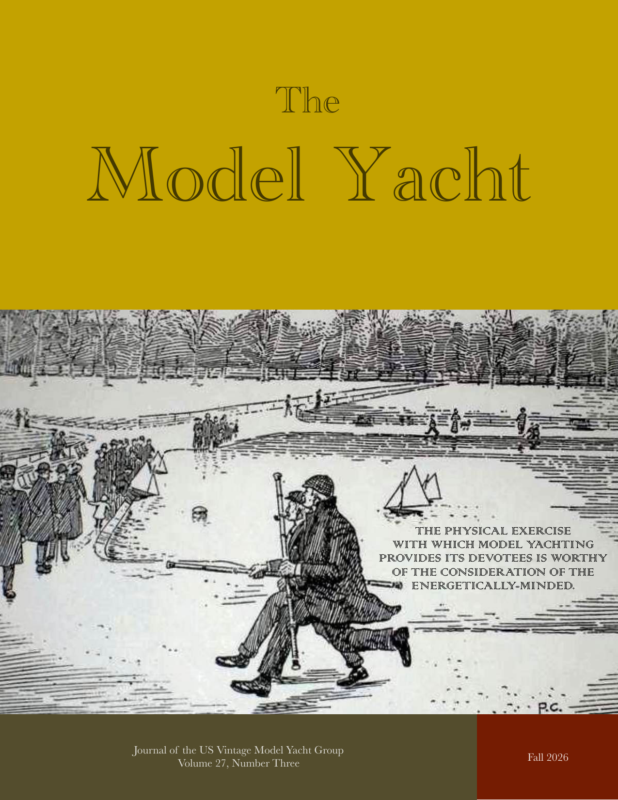
The Model Yacht is a published three times a year by the US Vintage Model Yacht Group
- The Layline. by John Y. Stoudt. The president recounts the weather challenges at the 2026 National Championship Regatta in Honey Brook, PA, including freesailing demonstrations, manufactured boats, a trunk sale, and the performance of the geopositioning buoys. He also introduces the Voices of Model Yachting podcast, featuring Rod Carr as its first guest, and invites clubs to host the 2027 national regatta.
- 2026 US VMYG National Championship Regatta Report. by Richard McOrmond. A report on the September 25–27 regatta hosted by the Chester Springs Model Yacht Club, with 29 skippers and 80 registered boats, describing racing conditions, class results, and ancillary events. The report recognizes volunteers and recipients of the Earl Boebert Craftsmanship and Marshall Croft Sportsmanship awards.
- Eight Bells for Standley Goodwin. by theMarblehead Model Yacht Club and TMY editorsl. A tribute to Standley Goodwin (1938–2026), who sailed at Redd’s Pond for more than 70 years and served as the American Model Yachting Association Marblehead class secretary for 46 years. The article remembers his sailing skill, distinctive personal style, and generosity in sharing his knowledge.
- Reconstructing a Lost Fitting: Artificial Intelligence and Real Insight. by Jonathan Kinghorn. The author investigates the history and unusual steering gear of Wasp, a large vintage yawl, and reconstructs a missing elastic-tension fitting from concentric marks on its deck. His research and 3D-printed reconstruction illustrate both the usefulness and unreliability of artificial intelligence in historical restoration.
- Discovering a Masterpiece: My Unexpected Journey into the World of Pond Yachts. by D.R. Friedkin. An estate-sale discovery of an 84-inch International A-class yacht leads the author to investigate a possible connection to William G. Bithell and his celebrated Ranger designs. Markings on the sails and mast step, distinctive fittings, and a spinnaker pole labeled Shalimar provide intriguing but inconclusive evidence of its provenance.
- The People of the US VMYG. by John Stoudt. The president recognizes the group’s many volunteers and describes their contributions to the journal, website, Digital Archive, boat rescues, regattas, class coordination, and other activities. He emphasizes the importance of volunteer participation, noting that roughly a quarter of the membership contributes time.
- Galileo STEM Academy Sailing Outreach: An Educational Journey of Learning, Discovery, and Mentoring New Model Yacht Students and Their Teacher. by Richard Murray. Volunteers from Idaho sailing organizations introduce students at Galileo STEM Academy to R/C sailing through the construction, rigging, and sailing of T37 model yachts. The program combines practical engineering, physics, electronics, and sailing instruction with mentorship and community support.
- Be Patient: Get a Good Finish the First Time. by John Stoudt. Practical guidance for obtaining a smooth spray-painted model yacht finish covers hull preparation, cleaning, priming, waterline masking, and the gradual application of paint in multiple coats. The author also discusses curing time, paint compatibility, and precautions against overspray and fumes.
- (CA) Designing and (3D) Printing a Pattern to Cast a V36 Ballast. by Joe Richmond. The author uses Onshape CAD software to design a ballast of the required weight for a Vintage 36 Scampi hull and 3D-prints a two-part pattern for sand casting. Photographs and drawings illustrate the process from calculating displacement and ballast mass through casting, finishing, and mounting the keel.
- Making an Early Bowsie. by John Stoudt. The third article in a series on restoring two gaff-rigged schooner display models presents an illustrated, step-by-step method for reproducing their early brass bowsies. It lists the necessary materials and tools and explains bending, soldering, and finishing the fittings.
- Barnacle: Sail Area Worksheet. A short notice introduces the new US VMYG online Sail Area Worksheet for calculating the area of triangular and four-sided sails.