- Title. Author. Summary

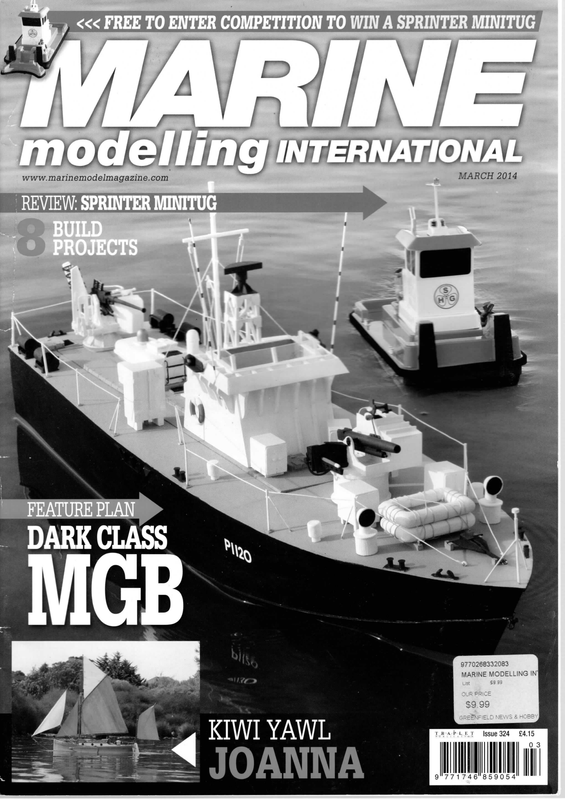
www.marinemodelmagazine.com hpi. Vu Li pd BD! INTERNATIOINZiL = MARCH 2014 TATE T 9770268332083 MARINE MODELLING IN’ KIWI YAWL 4) OANNA rRAPLET A — |gsue 324 £4.15
PI Ld i ~ THE POOLE YACHT THIS MODEL IS A RECONSTRUCTION BASED UPON THE HULL OF A MODEL FOUND DURING AN EXCAVATION AT POOLE AND COMES COMPLETE WITH A PLAN, MATERIALS LIST AND BUILDING INSTRUCTIONS AUTHOR: ALISTAIR ROACH ‘The Boys with Toy Boats’ by Thomas Bewick HISTORICAL EVIDENCE OF MODEL BOATS When one considers that Britain is supposed to have a rich about 300 years old. One pictorial reference we have of toy boats from about 250 years ago is a picture produced by the famous artist and engraver, Thomas Bewick (1753-1828). In his autobiography he describes f The replica of The Poole Yacht on the water by Veryan Heal, the then archaeologist from the National Maritime Museum, she thought that although the lines were crude, as might be expected from a toy carved from solid wood, the plan and profile views appear to relate to a fishing smack or yacht of the late 17th century. Her view was that it was probably meant to be a yacht as the small hole in the stern deck was almost certainly for a flagpole rather than a mast. She also thought that it was ‘from not later than the mid 18th century’ so it looks as if the toy boat in question is seafaring history, it is remarkable that so little evidence in the way of toy or model boats survives from our early history. Only one such model has been discovered during archaeological excavations whilst at least five have been discovered in Dublin, Ireland. There have been some other tantalising finds in the past, such as a number of tiny metal anchors found in the mud on the foreshore of the Thames. Although conjectural, it is thought that these may have come from wooden toy boats that were being sailed and lost in the river. Likewise, there are three miniature brass cannon, each about 7.5 cm in length, that were found by divers near a wreck site off the south coast of the Isle of Wight. These cannon can be seen at the Isle of Wight Shipwreck Centre but it is unknown whether they came from a model that sailed away from its owner or if they were from a model that was already on board a full sized vessel that sunk. The one model that we do know of is that found during waterfront excavations in Poole, Dorset in the early 1970s. The place where it was found is situated between the High Street and Fish (now Castle) Street. Evidence proved that there was ‘domestic occupation’ on this site from the 13th century until the present day. The pit that was excavated, and where the boat was discovered, appeared to have been used as a cesspit originally and then later as a rubbish pit from about 1630 until 1835. The model was examined Artist’s impression of Viking model boat based on 12th century Original Poole model boat hull 38 MARCH 2014. o_o find from Dublin (courtesy Jane Brayne) www.marinemodelmagazine.com EE UE QS LA Ln a a an nn
how he and his school friends played truant from school to sail model boats in the local stream. The picture he produced ‘The Boys with Toy Boats’ is based on his exploits. The scene shows the old castle of St. Nicholas’s Church, Newcastle in the distance with five boys busily engaged in sailing boats of various sizes and rigs in Colliers Close burn above Cherryburn. A MODERN REPLICA The original toy yacht, when found, had a broken and missing keel so it is difficult to say what sort of depth it may have extended to or whether a weight had been attached. As the hull and keel had been carved out of one piece of solid wood there may be a fair presumption that the keel was probably not particularly deep. The first thing that had to be done was to transpose the original archaeological drawings into a workable faired-up plan and profile that could be used to build from. This also had to include a conjectural keel shape and sail plan. Different hull shapes and rigs SECTION A-A SECTION B-B In an attempt to producea replica it was decided to copy the shape of the original main hull, as near as possible, but to slot a second piece of wood, representing the prow and keel, into the carved hull. This would make it a lot easier than carving everything from one solid piece of wood. Various hulls were made, some with shallow keels, some deeper and some weighted. The last one | tried used a keel ‘fin’ extension and this appeared to be the most stable and had better directional capabilities under sail. The rig of the original was obviously unknown. A spritsail rig was used as this tied in with the sail plan of some yachts used during the 17th — 18th centuries and also it is a simple rig to use when dealing with such a small scale. Initially sailing experiments were not that successful on any of the hulls that had been produced and it became apparent that the rig being used was not balanced in relation to the hull. | re-drilled a new mast hole further forward from the ‘original’ and set her off on the garden pond. Success — she went off as straight as an arrow. MATERIALS NEEDED TO BUILD A POOLE YACHT | SECTION B-B * An off-cut of knot-free pine, or similar wood, about 7 cm by 5 cm by 14 cm long. Another piece of timber or plywood about 5 mm thick is also needed for the keel — measuring about 14 cm by 6 cm (or 10 cm if making a keel with extension as one piece). * Approximately 40 cm in length of small diameter dowelling — 3 mm for the mainmast and bowsprit and 2 mm for the sprit. * Four small screw eyes and one small bowsie plus a piece of mild steel or brass about 8 cm by 5 cm weighing about 33 g. * Lightweight rigging cord, cotton sailcloth or similar, varnish or paint to suit, plus glue and dope if needed. CONSTRUCTION STAGES It should be noted at the outset that if you are cutting up the plan to use the various shapes it would be wise to make at least two copies before you begin as one shape on the plan overlaps the Ye scale @ other. STAGE 1 NEWMAST Trace or cut out the plan “FALSE KEEL and profile shape of the actual hull from the plan i.e. not including the keel. These shapes are transferred to your wooden block, which is SECTION A-A SECTION B-B Transfer hull and keel shapes to Various stages of new plan drawings based on archaeological find timber and cut out then sawn to a rough shape. Repeat this process with the keel shape but include up to www.marinemodelmagazine.com MARCH 2014 39
the ‘dash’ lines shown inside the hull profile and then transfer to your keel timber. N.B. the ‘false’ keel can be included in this shape if you wish or it can be slotted in at a later date by cutting out a section of the straight keel. STAGE 2 Mark a centre line on the bow, stern and base of the hull and make three saw cuts that relate to the ‘dash’ lines shown on the hull profile — this is to enable the keel to be slotted into the hull. If the saw blade is thinner than the keel two narrower cuts may be made and the section chiselled out. Finish carving Rigging detail Mark centre line and cut out and sanding both hull and groove for keel keel and glue together. The “We don’t stop playing because we grow old, metal keel plates can now be We grow old because we stop playing”. glued on the outside of the deep false keel or made up and glued into a slot cut out of the shallow one. George Bernard Shaw STAGE 3 Happy Sailing. Drill out the mast and bowsprit holes and one for the flagstaff if you wish. Note the new position of mast shown on plan. Cut dowelling mast and bowsprit and mount in hull. Paint or varnish as required. STAGE 4 Cut out sails — doubling the size of the template on the plans used ‘off-cuts’ from some old cotton sails but anything will do. Edges can be sealed with dope and sail clew with tape to reinforce them for attaching the rigging. Not extra material will be needed for the leading edge of the mai as it is wrapped around the mast in a loose fit — see photos. Cut a length of thin dowel for the sprit and epoxy each end to the relevant corners of the mainsail. Off she goes! Cut sails and dowelling for mast, bowsprit and sprit STAGE 5 Put screw eyes into deck and rig as per photograph. The rigging is as simple as it can be with only one line and one bowsie used. That’s it — let out the sheets for both sails so that they are at about 45 degrees. As this little boat is very basic it’s probably safe 4 to say it’s best just ‘reaching with the wind abeam’. She is certainly not a ‘foul weather’ model but more suited to you sitting in your deckchair by the garden pond with a zephyr of a breeze — a glass SCALE – om SECTION A-A SECTION B-B of your favourite tipple in one hand and a lightweight turning pole in The working plan. This plan is downloadable from the MMi the other. website: www.marinemodelmagazine.com 40 MARCH 2014. www.marinemodelmagazine.com