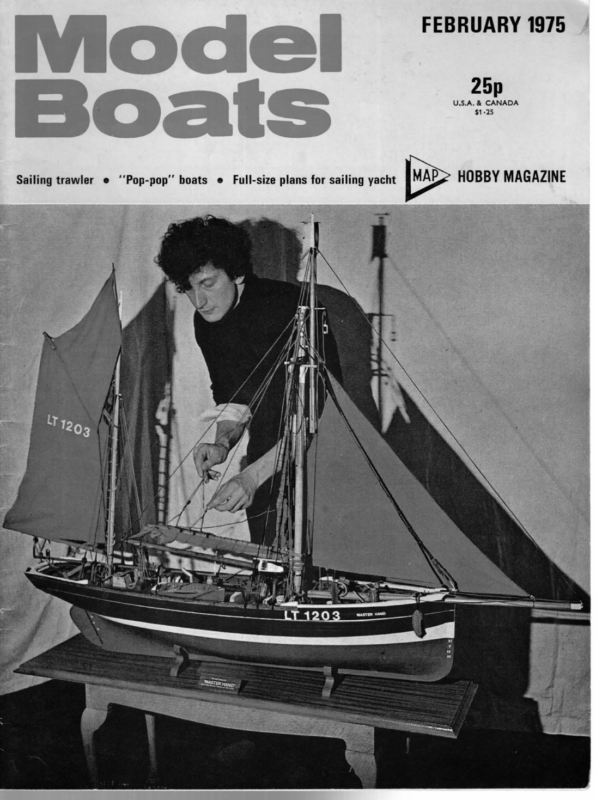
- Radio Sailing at Poole T. 1. Reece looks back over 1974 and not only describes the club’s activities but includes a lot of useful information for R/C yachtsmen
- SPLINTER We have had a number of requests to give wider circulation to this simple little yacht which first appeared in Meccano Magazine in 1971. Performance will surprise you. Designed by Vic Smeed FULL-SIZE PLANS OVERLEAF
- R/C YACHTING Notes from America by Frank De Soto and from Leeds and Bradford club by Tom Armour

FEBRU ARY 19 75 25p U.S.A. & CAN A $1 +25 DA HOBBY MAGAZINE
ill MODEL BOATS Rl =R2 = 1.8 ohm To be fitted where shown Radio Sailing at Poole T. 1. Reece looks back over 1974 and not only describes the club’s activities but includes a Fig. 1. Modification to MR servo lot of useful information for R/C yachtsmen oO’ club activities started long before the sailing season proper, because a crossbow had been fired at the club windows. Although the shutters had been given adequate protection against the odd stones, the crossbow bolts penetrated them and broke many panes of glass and so, apart from the repairs, it was necessary to reinforce the shutters against further vandalism. However, the advantage of a pleasantly furnished clubhouse together with boathouse at the waters edge more than compensates for the inconveniences caused by these delinquents. The unused petrol coupons left or lost at home are a reminder of earlier fears on attendance, but despite the increased fuel prices, we have done quite well, and the main purpose of this write-up is to append the results of our thirteen events throughout the season and to generalise on items of interest. Originally we had fifteen events scheduled, but the first of the season was cancelled as it was mistakenly understood that the water level would be too low. The fifteenth event, the Freeman Cup, was postponed after two abortive attempts to sail in gale force conditions, with a north-easter building up tremendous waves towards the clubhouse. Even then, the first attempt was only because of the arrival of a cameraman from Southern Television, so even though we did not race, we could at least enjoy seeing something of our efforts in a 10 second glimpse on the screen later that afternoon! The first two events were held racing with provisional amendments to the MYA rules but, generally, these changes tended to penalise good sailing and to encourage unfair sailing. By mutual agreement with Gosport MYC, further changes were introduced and these latter rules have been in use all season except for the RA National Championship which of course was sailed strictly to established MYA rules. These current changes allow boats to continue sailing under circumstances where they would have been disqualified under the previous rules, notably after collisions or coming ashore. The award of penalty points in lieu of disqualification is an effective deterrent to rule infringements and a second infringement of the same rule in the same race now leads to disqualification. Overall, these modifications have led to better standards of sailing and more enjoyment of the sport, and basically these latter considerations are the foundation of good yacht racing. During the 1973/74 winter, a new 10-rater design emerged, being the joint effort of Frank Walker and Roger Dehon, and several of these have been raced during the season, with varying degrees of success. With a LWL of 55 in., narrow beam and bulb keel, this design has remarkable acceleration and good planing charac- teristics on a rup. Because of the light weight, though, a drop in wind strength or losing way gives an equally rapid deceleration and, unlike the much heavier RA boats, it cannot be “coasted” round buoys. The one big disadvantage is that they are easily deflected off course by waves and hence they have had more success at Gosport than at Poole, where a fair amount of chop usually prevails. The significant measurements of this new design are overall length 66 in., LWL 55 in., displace72 ment 27 Ib., typical sail area 1360 sq. in. Our Commodore, Jack Gascoigne, has been racing one of these 10 raters all season but for various reasons has been unable to repeat the impeccable performances given in the past with his RA boat Jaquita. However, a season of predominantly rough weather is not the best introduction for a new design and more are being built this coming winter, so we look forward to further trials next year. Up to about two years ago, the majority of RA boats (Q class at the time), were equipped with mainly homemade analogue radio control using variable mark/space ration for proportional rudder control and an increase or decrease in the mean modulating frequency for progressive winch control. The servos were mainly to the designs by Bob Jeffries covered by previous articles. The past season has seen some radical changes with the greater use of digital radio control, including the use of aircraft type servos for direct control of the rudder. In some cases the existing servo travel was geared up or down to provide the required amount of travel/torque. In the writer’s outfit, a standard MR10 was modified electrically as in Fig. 1 to approximately double the servo travel and then directly linked to a partially balanced rudder. That a servo weighing some 0.25% of the weight of a typical RA class boat can survive a whole season without fault is a tribute to the manufacturers and any reduction in weight of radio gear is a bonus anyway. In many cases, a second aircraft type servo has been used to operate micro switches which in turn provide progressive control of the winch motor. In the writer’s case, an MR12 servo amp interfaced via a relay unit provides proportional winch control. Norman Grinter from Taunton has a proportional winch system based on a mechanical follower operated from the winch spindle which follows the standard aircraft servo output disc and this also has been perfectly satisfactory. The winch servos continue to reflect availability of suitable motors and gears and hence are pretty nondescript but nonetheless effective. Where Monoperm Super Special motors with Pile gears were used, the pressfit gears caused trouble and various solutions were found, including Araldite or pinning, the latter method having been adopted by Dr. Steve Rix who won the RA National event this year. Frank Walker, our most prolific producer of boats and fittings, has produced a very attractive winch servo design based on a perspex chassis and using precision gears which, although expensive, are beautifully made and well engineered. Several have been in use during the season but it must be emphasised that these are not for general sale. Rumours have it that Frank is producing an all singing and dancing combined rudder and winch servo unit as his next project. Only two completely new RA boats were introduced by club members during the year, these being Streaker, a mini RA design built by Roy Stevenson from Midsomer Norton, and Lady Bee, a conventional RA boat designed by Lance and built by Norman Grinter. Norman must have now beaten all attendance mileage records in
FEBRUARY 1975 Aerial travelling from Taunton to Poole for every event throughout the year. Incidentally, Norman was using a very natty rain cover on his Tx, consisting of a perspex panel with three holes in it and fitted as in Fig. 2. As already mentioned, several boats are now fitted with partially balanced rudders instead of the more normal skeg and rudder and quite frankly these give more manoeuvrability without any apparent lowering of lateral resistance which has always been claimed to be the main disadvantage. Certainly the writer’s RA boat, Giselle, can sail as close to the wind as any other and when nearing the wind strength limit for a particular suit of sails, the absence of a skeg definitely improves coming about. The other main difference in general fitting-out is the manner in which the jib boom is moun- ae” ! yf, the weakest part, having to take all the stress, but the disadvantage is that the jib flow remains constant irrespective of its angle to the centre line when, ideally, the flow should increase as the jib opens out. In B, it is possible to increase the flow in the leach as the jib opens out by adjusting angle “‘a’’ shown, although this pivot is normally at a fixed angle to the deck. In C, the angle ‘‘a’’ can be adjusted to vary the flow in the leach and the measurement ‘‘b’”’ will provide an increase in the flow at the foot as the jib opens whilst the kicking strap and outhaul will give a fixed amount of flow irrespective of the jib position. Jib flow can be affected by adjustment of the back stay and the tension in the main shrouds, although generally these affect the flow in the top half of the mainsail and naturally their effect is different when beating and running. It is very easy to describe the effect of an adjustment but it’s a different matter to say what degree of adjustment is required under given weather conditions, and the easy way out is to say that it all comes with experience. However, as with many subjects, it is true to say that if it looks right, it is right, and so the newcomer must learn by constantly comparing the trim and sail flow of different yachts in the same race until he can judge what is right. However, although a good windward performance is essential, successful yacht racing does not depend entirely on correct trim, as other factors need to be considered. 1. A good start is most important and one should aim at crossing the start line at full speed at the correct time and on the required tack to reach or head for the first mark. This sounds very simple, but so many times boats are left behind as a result of completely misjudging time and speed, and the ground so lost is very very difficult to make good. 2. 4 \ sii Transmitter ee \ \ \ 4 \\ q Perspex NN “y cover Neck Strap Fig. 2. ted to give the required adjustment to flow, and there are almost as many different styles as there are boats. The jib boom mounting is subject to more stress than any other fitting, although this may not be recognised if one is always sailing in sheltered waters. Nevertheless, when the force on a jib is sufficient to bend a = in. rod, there is obviously an enormous leverage being exerted upon it. Some of the different types in use are sketched in Fig. 3 and that shown in A is the simplest. The swivel eye is cape Pte | Rain Cover does not offset the advantage gained by keeping to a fixed line. 4. A good knowledge of the sailing rules can effect a tactical win and thus over-ride another skipper’s better knowledge of trimming a boat. Personally, there is more satisfaction to be gained from good sailing trim than tactical gains, although the latter are without doubt a very real part of the sport and good tactical manouvres are always appreciated, even if accompanied by gnashing of teeth! Up to the time of writing, we have still not held the Freeman Cup and so the events of the year can be re- viewed hoping for fairer weather to come. A total of 274 races have been held, including 32 for the Taplin Challenge Cup, 30 for the RA National Championship and 17 for the Laidlaw-Dickson Cup. These three events were two-day regattas with entrants from a wide area of the country, with the “National” being the highlight of the year. The Taplin Challenge Cup attracted sixteen entries and two schedules each having 16 races were sailed with five boats in each race. The cup was won by Brian Askell with Pele, after a sail-off against Dave Jones’ Dee Jay, both having scored 81 points out of 100 maximum. Roger Dehon with Mimi came third with 69 points. The RA National Championship had fifteen entries and despite a great deal of rain on the Saturday, two schedules of fifteen races each, also with five boats per race, were sailed. With a score of 82 points, the championship was won by Dr. Steve Rix and Serica, Brian Askell coming a close second with 80 points. Third and fourth prizes went respectively to Dee Jay and Giselle. The Laidlaw Dickson Cup attracted seventeen entries, the highest for the year, but with demon strength winds and almost non-stop rain, there was no racing at all on the Saturday and so Norman Hatfield chaired a lively and involved session on proposed changes to the RC rules. The final race result after Sunday’s seventeen races (continued on page 92) A yacht’s direction should be determined by the set of sails and not by the rudder, and in this sense the rudder should be considered as a brake because its ea will increase the forward resistance of the SWIVEL EYE ull. 3. Each leg between marks, or each leg of each tack, should be sailed in a straight line or, when beating, as near to the wind as possible. Since a boat’s natural direction may be altered by waves, it may be necessary to use the rudder a great deal to keep the boat on course and therefore close observation is essential to check that the braking effect of the rudder KICKING STRAP. ADJUSTMENT te b—ot KICKING STRAP
FEBRUARY 1975 SPLINTER We have had a number of requests to give wider circulation to this simple little yacht which first appeared in Meccano Magazine in 1971. Performance will surprise you. Designed by Vic Smeed FULL-SIZE PLANS OVERLEAF re model was designed after watching the performance of some small toy sailing boats which must have been quite a disappointment to their owners. Some toy boats are able to sail moderately well on some courses, but manufacturers cannot produce the type of sophistication needed for good performance at a price that would make the model attractive to undiscerning customers. A number of older model yachtsmen have also said that you can’t make a boat sail if it’s under about three feet long, which is the sort of statement that asks to be disproved! There are a couple of factors in small models which have to be taken into account. The first is the “‘cube law’. If you take a stable model yacht and halve its size, it will be half as long. Its sail area, however, will only be a quarter, as it is two dimensions (4 x 4) and its displacement will only be an eighth (4 x 4 x 4). Without going into a long explanation, this means that the model will be less stable and you cannot increase the lead weight because of the displacement limitations. A small yacht must therefore be different from a larger one in order to be stable. The second factor relates to pressure. We know that the pressure on the water surface is normal air pressure, which is the weight of the column of air above the area being considered. Below the surface the pressure increases by the weight of the column of water covering the area. Obviously, pressure on an inch or two below the surface is less than a foot or so down, so that the top “‘layer’’ of water is relatively easily disturbed. Resistance to sideways motion of, say, a yacht’s keel is therefore less, so that a shallow yacht will blow more rapidly sideways, or make more leeway. From this it is obvious that if we dispose the keel area deep and narrow we shall get a better grip on the water and the yacht will sail better. We can also put the permissible lead ballast right at the bottom so that it acts through a longer lever and the boat will therefore be more stable. While we are considering natural factors, we might also think of wind gradient. Because of friction, the bottom of the air moving across land or water is slowed up, so that the nearer the water, the less the wind is felt. Thus a small model needs tall sails to reach up into the faster moving air. Wind gradient, incidentally, can be felt with a glider or light aeroplane coming in to land, and is usually the reason why a model aeroplane heading It’s the spring term in schools and there could be no better class project than a fleet of these little yachts which are cheap and easy to make yet offer the opportunity of actual racing among themselves when completed, As an introduction to sailing for youngsters (or even adult beginners) the design has much to commend it.
a: HULL CENTRE CORE 3 LAMS. 1/16″ SPRUCE (CROSS GRAIN) CUT 2 CENTRE PLANKS TO FULL PROFILE (LESS FIN AND SKEG) FROM 1/2″ BALSA. MAST FROM 4 : 3/16″ DOWEL TAPERED TO 3/32″ LEAD IS SIX PIECES OF 3/64″ LEAD SHEET EPOXIED IN PLACE
\ =: ? RIPMAX 40 and 30 TOOTH GEARS SHIRRING ELASTIC } Oe. pl I : Yt | | EE = + : | 1 dy a | ql! a > BE LIFTED — Ti Mg, — ee ae — IN ee teem|| AFT GEAR CAN : RUDDER 3 LAMS 1/16″ | SPRUCE OUTER PLANKS 72″ SHEET TO THIS LINE _—— MAIN VANE FEATHER \ Riel pie LL i ee mil ad FINISHED ALL-UP WEIGHT SHOULD NOT EXCEED 64 ozs.
MODEL BOATS The completed hull ready for painting—hardly more than four or five hours’ work, into wind will glide smoothly in and then suddenly drop the last couple of feet. To stand the best chance of success, then, a small model yacht must have a deep and narrow fin keel with its ballast right at the bottom, and high aspect ratio sails. These are the most important points, but there are others, like keeping top weight low, which have been incorporated in this little design. How does it sail? Well, we were surprised and delighted at its speed and ability to move on the lightest trace of breeze, as well as its ability to point, which means sailing into the wind closely. Most large yachts can sail at 40 deg. or slightly less to the wind direction, and Splinter can match them pretty well. As befits what is in effect a miniature racing yacht, it incorporates a simple vane steering gear and the grandsounding “‘synchronous sheeting”, which means that one adjustment controls both sails and keeps them correctly set in relation to each other. How this works will be clear when we come to make it. Construction: There is very little weight to be saved in making a tiny model like this hollow, so the structure can be designed for strength and simplicity. It is necessary to make a strong and warp-free fin, and this is achieved by making the whole boat round a centre core of three laminations of =); in. spruce (it could be obeche if easier to buy). The centre lamination has the grain parallel with the top line of the deck, and those each side have it in line with the fin leading edge. The first step is to trace the complete outline on to a sheet of 44 in. spruce 3 in. wide and cut it out accurately. This can then be used to mark out the rest of the laminations; the photographs should make it clear. Cement the core laminations together (use balsa cement or Bostik clear adhesive) and leave to dry thoroughly on a completely flat surface with weights on top. While drying, trace the full hull outline (not the fin or skeg) twice on to 4 in. balsa and then the dotted line of the outer planks twice, and cut out the four pieces. There is no need to use hard balsa, since we already have the core for strength. Cement the four planks to the core, lining up the stern ends carefully, and leave under pressure to dry. When dry (and this means overnight, even with balsa cement) trace the plan view on to the block and fretsaw round it. The hull can now be carved and sanded to shape; trace the half-sections 1-5 on to postcard and cut out carefully, mark the section positions on the block, and offer the templates, sanding until they fit. Make sure the hull is symmetrical—this is more im- sand their faces clean. Glue together and to the base of the fin (three each side, of course) using epoxy resin and leave under pressure to cure. When dry, carve the lead to shape with a pen-knife (it’s quite easy) and file to a smooth bulb. Mix a little more epoxy and fillet the bulb to the fin, and again when cured, file and sand everything smooth, including the fin. The rudder is from three scraps of +4; in. spruce glued cross-grain and sanded to shape. If the leading edge of the centre piece is set a tiny bit back, it forms a seating for the wire or tube rudder stock. Drill carefully through the core with a +4 in. drill, then enlarge the hole to accept a length of brass tube which is a sloppy fit on the rudder stock. A tube which fits well will stick after a time, and it is essential that the rudder moves completely freely. If you use 18g bore tube for the rudder, its outside will probably be about 14g, so the trunk, or tube through the hull, will need to be 12g. bore. Epoxy the tubes in their places; note that through the hull is only a full 2 in. long, but the rudder stock is 2 in. Check that the hull tube is correctly placed with a wire etc. before the adhesive is set; the rudder must line up with the skeg. At this stage drill a 33 in. hole } in. deep for the mast, making sure it is vertical and in the right position. The hull can now be finally sanded and painted. If you use cellulose sanding sealer (3-4 coats) and then enamel paint, a nice finish will be achieved, but enamel will not key to cellulose and you cannot mask a waterline etc. without peeling off the paint with the masking tape, so use oil undercoat if you want a two-colour hull. Our procedure was to seal and paint the deck white and then draw on planks using Indian ink in ink compasses, using one leg of the compasses run along the deck edge to get curved planks. The centre king plank and “‘cover boards” (edge planks) were painted mauve, dried, and the deck varnished. The hull (sealed at the same time as the deck) was masked and a thin mauve waterline painted in. The masking was removed and the rest of the hull painted purple, (well, aubergine is the fashionable name for the colour) cutting up to the waterline and deck-edge free-hand. Not recommended if you haven’t a steady hand and a writer’s brush. The paint was mixed from mid-blue and red Humbrol enamels, and part was mixed with white to get the toning mauve shade. The mast is a length of 33 in. dowel planed and sanded to a taper, and the booms are } in. dowel. A thin brass wire (or if necessary, 24g piano wire) is cemented to each boom. The jib has a kink where shown and an eye at the aft end. The main has an eye to fit round the mast and a kink as shown. These “‘kinks” are important as regards position. portant than absolute accuracy with the templates, though carve exactly to them if you can. The fillets of the fin and skeg should be carefully streamlined and blended to the hull, using fine glass- paper wrapped round a piece of thick dowel or similar round object. Don’t at this stage sand the bottom of the fin, and leave the after edge of the skeg square. To avoid the necessity of casting a lead, buy a piece of sheet lead from a builders’ merchant or scrap yard. You only need a piece a full 1 in. long cut from the end of a 9 in. strip of the sort of lead used for flashings; it measures under 3 in. thick and is probably 18 swg. Trace the lead profile from the drawing and cut out. Use a paper pattern to mark six pieces on the lead and cut out with an old pair of scissors. The pieces as cut should weigh about 3 oz. or just under. Flatten them by gentle tapping or squeezing in a smooth-jaw vice, and We used a white polythene bag (from the butcher) for sails. Lay the polythene over the plan and cut the sails with a sharp blade, not scissors. The sails can be sewn to the mast and booms, but we used white plastic insulating tape. Cut a piece as long as the main boom 80
FEBRUARY 1975 and make a nick in its centre for the wire kink to poke through. Place the boom centrally on the tape, coax the tape round, lay the foot of the sail in place and press the tape together, trapping the sail between. Trim off surplus tape at the ends. Do the same with the mast, taking care not to overlap the tapes at the sail tack (front bottom corner). You may make a mess of it and have to cut another sail and try again; the secret is not to stretch either the tape or sail. When satisfied, firmly glue the mast in its hole, ensuring that it is upright from front and side, and leave to dry. Fix the jib to its boom, then cut a length of tape for its luff (fore edge) and lay flat. Lay a piece of strong thread along the centre of the tape, with a couple of knots in the thread at the bottom and a few inches spare at the top. Lay the sail in place and fold over the tape. The jib is hooked to an eye in the deck with an S hook bent from wire, or an oval of wire, or at a pinch by several long stitches of thread. When the mast is completely dry (and don’t hurry this bit) thread the loose jib thread through a needle, hook the jib in place, and sew round the mast, through the tape, at the jib hoist position, drawing the thread taut and knotting it off centrally on the mast. better if the jib is slightly looser than the main, but try to get them equal if possible. Fit a 40 tooth gear on to the rudder stock with its grub-screw and check that the rudder moves completely freely. Scrape away any paint and sand the stock to a polish until it does. Now find a brass nail or wire which fits the 30-tooth gear and drill a hole in the deck to glue the nail in. The gear teeth must mesh easily and you must be able to lift the smaller gear high enough to turn it and drop it back in engagement. Bend a wire and epoxy it to the small gear so that it misses the pivot but comes out radially, i.e. it would go straight across the middle of the gear if you hadn’t bent it to miss the pivot. Cut a vane feather from light 34 or + in. balsa and cement it to the wire. Make sure it is upright and also radial to the gear. Now tie a piece of shirring elastic (or other very thin elastic) to the large gear and make it off with very light tension to the base of main eye. This is just to bias the rudder very lightly to centre. Slacken the grub-screw and centralise both gear and rudder, then re-tighten the screw. You are now (at last!) ready to sail. Slide the sheet adjustment forward until the booms make an angle of hull, one beneath the jib eye, one beneath the main kink, and two along the hull side as drawn. Now find a conical plastic screw cap off a toothpaste or similar tube and make three holes through it, equi-spaced, using a hot pin. Thread one piece of thread through two of these holes and two pieces of thread through the third; knot the inside ends of these pieces so that they cannot pull rotate till the feather is straight down-wind, then drop it into re-engagement, as close as possible. Release the model, which will maintain a constant course relative to the wind. If the wind changes direction, so will the model. This is a beating course, and to go on the other tack all you do is lift the vane and re-engage it at the same angle on the opposite side. To reach (across wind) ease the sails to 45 deg. or so and set the vane out to one side; always point the model where you want it to go then line the vane up with the wind. To run, ease the sheets so that the booms are at 90 deg. to the hull and the vane feather will then be pointing forward. Try minor adjustments to the sail setting to get the best out of the boat. The original model showed itself able to hold the same Four more screw-eyes must now be screwed into the out. Tie the ends of the single thread to the two screweyes on the side of the deck so that the thread is tight; the cap should slide backwards and forwards on this line, and stay put when left. If it slips easily, force a piece of rubber from an eraser inside the cap. Slide the cap right aft and poke the two free threads through the centre deck-eyes, one through the main eye and the other through the one beneath the jib. Tie to the mainboom kink and the jib boom eye so that both booms are held central. Touch glue on all the knots and cut off the spare ends. Now when you slide the cap forward, both booms will be freed off the same amount, and since the tying points are equidistant from the pivot points, both booms will always have the same angle. If you cannot get both sails equally taut, it is about 15-20 deg. to the hull centre line and hold the model at about 40-45 deg. to the wind. Lift the vane and course as a Marblehead (though naturally not as fast) and ran the full length of Fleetwood lake in choppy conditions, remaining under control at all times. The design has been used as a school project, with 30 or 40 pupils building one each and having a lot of fun racing each other, and it is mainly because of requests from schools that we are giving wider circulation to the model. Views of the completed model which should help with the deck layout and the steering gear, originally evolved by Geoff Draper and capable of teaching the basics of vane gear operation,
R/C YACHTING Notes from America by Frank De Soto and from Leeds and Bradford club by Tom Armour U.S. R/C Yachting HE Eastern Division RM Championship of the Model Yacht Racing Association of America (MYRAA) was held on August 18th at Millpond, Port Washington, New York. The event was sponsored by the Millpond MYC. Of the seven clubs which comprise the Eastern Division, three were represented (Millpond, Salisbury, Central Park). The field consisted of 10 yachts which had to be separated to form two fleets of five yachts each because SIDE STAYS 4 FRONT VIEW SIDE STAYS ROTATING MAST (2″ AL. T’) | ict “\ jumper STAYS © 75″ 63″ LUFF NOT TO SCALE | te | “ = RS | | & | | | WISHBONE BOOM \ Man a ] The winner, Ed Wagner, won every one of his races in very convincing fashion. His yacht carried a very high rig which was perfect for the existing conditions. Ed has a reputation as a fine skipper so the combination was unbeatable on this day. What might be considered an oddity was Steve Van Ness with his unique una-rigged, highly modified Stollery White Rabbit, with a wishbone yet. He did quite well, recording two seconds, one third, and one first place finish. He commented that he hada little difficulty finding the correct mast position. To this O.0.D.’s recollection it has always been a disadvantage to break down a yacht for transportation and refitting at the site where the race is being held. These are not the only disadvantages but only make it that much more creditable a performance when a visiting skipper and yacht carry off top honours. The sportsmanship shown by the skippers was much appreciated. Only two protests were made which did not bog down the racing and enabled a sufficient number of races to be completed in order to make the event official. 1 E. Wagner Skipper Club 2 L.Goodrich CentralPark 6? 3 4 A. Strickland S. Van Ness Millpond Central Park 82? 9 Millpond Pts 3 OOM } 1975) —— lateness of the day. Pos. WISHBONE I of radio frequency problems. The wind was from the Southwest and fluky, ranging from 3-5 miles per hour, gusting to 7-10. A total of five races was scheduled, once around a triangular course for each race. The O.O.D. terminated the event after four races for each fleet because of unsuitable wind and the 15″ KICKING STRAP ——_> UNA RIG AS USED 1973/4 = 3 | \ | Sat le ROTATING MAST —=—___ 1975 “BALANCED” VERSION Design Ballantyne/ Arrow 6 Ballantyne/ Arrow 6 Levy Mod Stollery/ White Rabbit Pictures on this page taken at the Millpond, Port Washington, New York. Note the una rig in the top photo, described in text.
FEBRUARY 1975 5 F, Frey Salisbury 6 N. McIntosh CentralPark 7 J. Tucker S. Urbaniak Central Park Millpond B. Vega 8 Central Park 113 Mod Witty/ Wasp 14 — Stollery/ March Hare 16 Unknown 16 ~—Ballantyne/ 16 Arrow 6 MacDonald/ China Boy Central Park (withdrew Witty/ without Bambi prejudice) J. Ruiz The following info on the Blue Meany Una-rig has been provided by designer/builder Steve Van Ness: All 800 sq. in. are put into one tall wing-shaped sail. Dimensions: 63 in. luff, 15 in. foot, 10 in. head. A flat wishbone boom is used and parallel to it, at the head of the sail, a flat wishbone gaff. Mast height is 75 in. and triangle above the gaff is not used for sail area … eliminating the inefficient top triangle of conventional sails. The rig used in photo has the top triangle but its value is very questionable. The purpose of the wishbone spars is to achieve some “endplate” effect, preventing wind from escaping at the head and foot of the sail. Stays are arranged to keep boom and gaff quite fixed and rigid. Double jumper stays go from the foot of the mast to its head. A stay then goes from the masthead to the gaff outhaul, the boom outhaul, and via the kicking strap to the foot of the mast. Stresses flow around the full “circle” of stays. They are kept under high tension, with mast, gaff and boom acting as compression members. Result: twist at the head of the sail is virtually eliminated and the sail itself is under no tension except from the wind. The entire assembly of mast, gaff, boom and sail rotates on the deck as a unit. The hull is a Stollery White Rabbit in glass fibre. The keel was dropped 2 in. for added stiffness with the tall rig. At the same time, it was redesigned to put the centre of lateral resistance further aft. The opinion here is that many Ms would balance better in different wind strengths if their sailplans were moved further aft. The idea is to put the centre of effort directly over the widest beam of the boat. Blue Meany’s novel rig proved very fast and efficient to windward in winds up to 20 knots, about as strong a gust as most inland ponds get. Downwind performance was super in moderate winds. With no jib to be “‘shaded”’, all 800 sq. in. are working at all times. Running in strong winds, with all sail on one side of the boat, the rig is unbalanced enough to strain the control capability of vane and rudder. With radio control, a large “spade” rudder solves the problem. However, a vane does not provide the “muscle” of a good servo. At first this rig got much attention from club Measurers and skippers. Since there have been no protests (official that is) it appears that everyone is satisfied that it fits M Class rules completely. It has been very successful, but apparently the tradition factor being what it is, there hasn’t been any rush to duplicate or further develop this type rig by other skippers. With radio, this boat and rig won the first MYRAA National RM Championship (1974) and Central Park Club’s “Total Points for Season” first place in 1973 and 1974. With vane, the same combination won two of the club’s trophy races. For 1975, two boats at least will be trying out a new, developed version designed to balance the rig when running, as sketched. Winning skipper at Leeds and Bradford, Colin Thompson, inspects the nicely built Genie christened Nutall. Note the rudder position. Black Monk by Eric RADIO CONTROL COMES TO LEEDS AND BRADFORD. MRYC Sunday November 10th EEDS and Bradford held a demonstration radio control race open to all] classes, although only two were represented. Fleetwood M.Y.C. had kindly offered to organize the event and duly arrived complete with boats, buoys, scoresheets and an O.0.D. with knowledge of the rules. A cold blustery day greeted competitors (real Yorkshire weather), but there was still a large attendance. A big effort by the club to publicise this first radio control event seen at Bradford was rewarded by this large attendance, a number coming from as far afield as Middlesbrough, Stockton and Cleethorpes, to either spectate or compete in the event. Even Yorkshire TV turned up for the first time ever. The day turned out to be a great success and I am sure the club will gain enough members to build up a successful radio section. The race Leeds and Bradford club was able to supply one of its better blustery Westerlies (through the factories). The gusts did cause a few problems, but the wind wasn’t bad. Five boats came from Fleetwood, two were entered from the host club, and one each came from Cleveland and Cleethorpes. The racing started at 12 noon and progressed up to dinner. Two laps of the course were being sailed but this was shortened to one lap after dinner. Eight of the nine boats were Marbleheads and the other boat was an A eae. A penalty of thirty seconds per lap was given to the A. An anti-clockwise course was being sailed, as sketched.
Whoops! Honey Il, the Klug design, travelling at high speed, but direction …? Centre, the course used, and bottom, the winning boat sailing one of the Marbleheads. Perhaps 30 seconds per lap was not a fair handicap, in view of an A boat’s ability to punch along in gusty conditions? Scoring used for the racing was 1 for a win, 2 for 2nd, 3 for 3rd, 4 for 4th, 5 for hitting another yacht, and 1 for touching a buoy. (Photos by Keith Armour). At dinner the scores stood like this:— Freebooter 2 pts 2 sails Sherrie Womble 1 pt 5 pts 1 sail 2 sails Endora 4 pts 1 sail During dinner, competitors let spectators have a sail with their boats, which must encourage new members; it was obvious most people were itching to have a go! Sailing continued after dinner with only one lap of the course being sailed now, and soon the first round 80 YARDS was completed. The leader at this stage was Colin Thompson with the A boat, but he was closely pursued by Derek Priestley, George Burgess and Bob Asken, all from Fleetwood. The rest of the race was completed, but Sid Ward had to drop out halfway through with radio trouble. Racing had finished at about four o’clock. The race was two-thirds complete, and the winner turned out to be Colin Thompson with his boat, Freebooter. Colin has recently joined Leeds and Bradford. He won, even with his penalty start! Second, coming from nowhere, was the other Leeds and Bradford boat, Jimpy, entered by Mr. Rose in his first ever race. (I thought you were coming to show us how it was done, Derek?). Third was Sherrie, sailed by Bob Asken, who was leading ““M” through most of the race until he had a bad patch and dropped second place to Jimpy. Fourth was Derek, who, after swopping boats halfway through, (because of radio trouble) and borrowing a Clockwork Orange’s 3rd suit main, did quite well. Joint fifth were Beta and Honey II, the latter being a very interesting boat, very manoeuvrable and quick, but over-canvassed in the gusts. This boat was the German kit boat, Klug. Seventh was Eric Nutall from the Cleveland club, with Black Monk, also in his first race. The boat, a Genie, was beautifully finished, the paintwork was marvellous. The boat looked quite slippy at times. Eighth came Endora, sailed by Bill Windsor from the Fleetwood club. So concluded a really great day, well attended. I am sure all at Leeds and Bradford would like to thank all involved, also a special mention must be made to the Fleetwood club, for organizing and running the demonstration. Mrs. Atkinson and Mrs. Maskell must also be men- tioned, for their sterling efforts in keeping plentiful supplies of hot soup going in the canteen. Thanks, too, to Robert and Wizzy, for selling the raffle tickets. RESULTS Position Ist 2nd 3rd 4th Sth Sth 7th 8th 9th Boat Freebooter Jimpy Sherrie Womble Beta Honey II Black Monk Endora Joanne Skipper Operator Colin Thompson 4 “sails” T. B. Rose Bob Asken Derek Priestley 14 11 1 11 17 George Burgess Albert ? Eric Nutall Bill Windsor Sid Ward 14 15 Retired 90 8 “sails” Class and Club 12 20 21 23 29 29 A M M M M M 41 M Fleetwood 40 Leeds and Bradford Leeds and Bradford Fleetwood Fleetwood Fleetwood Cleethorpes M Cleveland M Fleetwood
MODEL BOATS joint regattas held at the Charlton Lake, which were with the firm co-operation of the Andover Angling Assn. The public were not invited to the first of these, which was held last year, but on the second occasion, when it was easier to supervise public attendance, many people had a very enjoyable day out. The display at the town river by the Model Boat Club attracted considerable interest during the Carnival and this activity was only possible by a great deal of effort the river of weeds and erecting a dam to raise the water level. Sundry other fetes and exhibitions have been attended by the association. A number of the clubs involved have no junior mem- bers, as there is not much point in discussing the theory of sailing or model yacht control to youngsters if they have no opportunity to put the theory into practice, and the Association is determined to continue in its efforts to bring to fruition the development of the water in existence in Andover so that it may be enjoyed by the members of the town who so desire. There are a number of ideas within the Association which they believe could enable the cost of such development to be kept to a minimum, and which they would be very happy to propose if the council so desires. Such proposals invariably require some discussion, and the officers of the association would be available at any time for such an occasion. FIGHTING FLEETS (continued from page 83) Armament: by the joint membership of the Association, in clearing patched up in the Falkland Islands before making her way home to Britain. She was repaired and modernised at Devonport Dockyard, in the course of which she received new twin 4 in. mounts in place of the singles, had tripod masts fitted, and had her bridge enlarged. Her AA armament was supplemented and the 8 in. guns given increased elevation. Following this refit she Aircraft Complement: Ajax Devonport Dockyard 1928-1931 Machinery: 80,000 HP = 32 knots ee Because of the consistently bad weather conditions, these three regattas were lifted out of the gloom by the traditionally excellent buffet lunches and other refreshments provided by our good ladies and all who have visited Poole will appreciate their efforts despite the absence of mod cons. The first, second, third and fourth places for each event are listed in the table and next year we hope to see more new names appearing in the honours list. Our 1975 race programme follows and next year we April Marguerite Cup Jenny May Robert Cup Giselle May Marguerite Cup June Taplin Challenge Cup September Hogg Challenge Cup June July July August August September October November SWARA PELE Giselle Freeman Cup e WALKER ASKE LL LADY BEE N. GRINTER SERICA Fourth — 80 Mimi Lady Bee Pele 78 Suki* S. RIX *10 RATER. Giselle Pele Giselle Pele Pele Dee Jay Pele 84 Swara 87 L.THOMPSON Pele Dee Jay 100 ANDREA C. POULTON Huntress Swara 84 82 94 97 94 92 Pele JENNY Third Lady Bee 81 Swara 550 Second Jenny Pele Bravery Cup Two aircraft, 1 catapult and so justified yet another long trip to Poole. % Marks 81 81 Mimi Serica Mimi Mimi Mimi Pele four 3 pdr.; eight 21 in. TT Brian’s first season with Poole Model Yacht Club but his previous experience in racing full size boats obviously gives him an advantage and this is clearly shown in the results for the year. Norman Grinter was a close third Mimi Queens Cup R.A. Nationals Holland Jones Cup Marguerite Cup Coronation Cup Laidlaw-Dickson Cup 6,985 tons hope to provide more information on developments in all areas of the sport, but in the meantime, having placed 1169 boats into the water and removed them, with an average weight of 55 lb. or so, we look forward to a few months to recuperate from the effort of shifting 57 tons of boats during the season… ! STOP PRESS The Freeman Cup was held on 10th November and after a sail off between Frank Walker with Swara and Brian Askell with Pele, the cup went to Pele, This is Norman Hatfield’s beautiful yacht Aubade by two points. First Swara 72,000 HP = 324 knots Eight 6 in.; eight 4 in. AA; Both ships should be painted light grey, four parts Humbrol flat white to one part flat black. Corticene decks were light brown (Humbrol No. 26) while “‘Semtex’? decks were usually dark grey (Humbrol No. 27 or HN 2). Weather decks and bridge were planked. Waterline was black. Steel deck forward on Ajax can be painted hull colour or black. Next month: Part III, Conclusion, featuring HMS Cumberland. R/C YACHTS AT POOLE (continued from page 73) resulted in yet another sail off between Pele and Dee Jay, with Pele again winning, both scoring 46 out of 50 maximum. Third place went to Giselle, just pipping Event Gist Cup Machinery: Armament: Complement: 8,400 tons Date 1974 April Vickers-Armstrong, Barrow, 1933-1935 Aircraft: Plate were as follows :— Exeter Displacement: Two aircraft, two catapults 600 Built: Displacement: was sent out to the Indian Ocean and was on convoy duty there when the war with Japan started in December 1941. She was sunk in the course of the futile Allied attempts to hold the Dutch East Indies against the advancing Japanese on March Ist, 1942, in the Java Sea. Ajax and Achilles served through the war. The former was transferred to the Indian Navy as Delhi in 1948, while Achilles was scrapped in 1949. The particulars of Exeter and Ajax at the time of the Battle of the River Built: Six 8 in.; four 4 in. AA; four 3 pdr.; six 21 in. TT Mimi Pele Dee Jay Swara Swara Giselle Giselle Andrea Jenny Swara pa Swara Lady Bee R. DEHON J. GASCOIGNE PREEBOOTER C. THOMPSON Lady Bee Pele Freebooter Suki* Giselle Lady Bee Andrea Swara Aubade Streaker Pele Lady Bee Jenny GISELLE DEEJAY AUBADE The overall winner of the Marguerite Cup for the year was MIMI. 92 TT. REECE D.JONES N. HATFIELD