
- IN THE TIDEWAY
- PLAYAWAY An attractive and proved 36in. Restricted class yacht which is simple to build and sail BY CHRIS JACKSON
- International R/C Yacht Championships at Gosport
- A SIMPLE TELLTALE A PLUS FOR R/C RACING By Larry Goodrich, Trustee, Central Park M.Y.C., U.S.A.
- The construction of a glass fibre sailing model of a possible full-size ketch-rigged cruiser Part Two BY JOHN GIFFORD

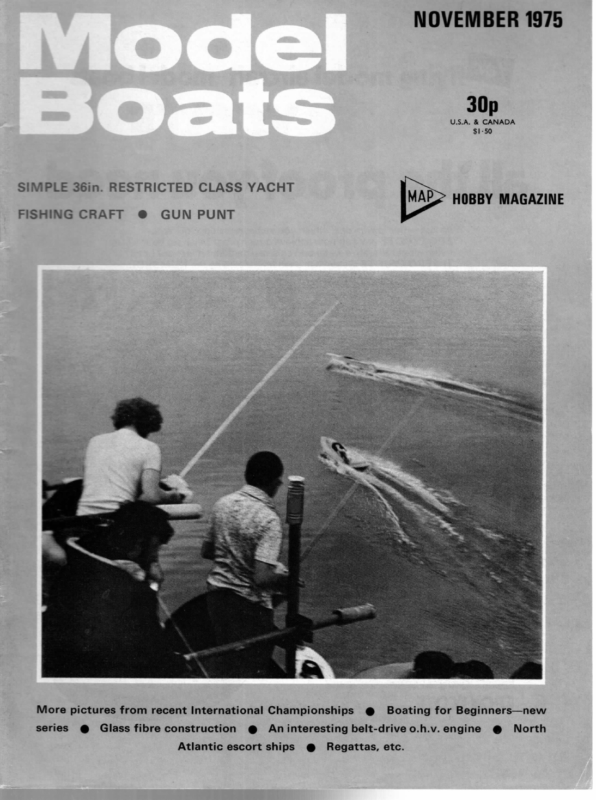
NOVEMBER 1975 30p U.S.A. & CANADA $1-50 SIMPLE 36in. RESTRICTED CLASS YACHT FISHING CRAFT @ HOBBY MAGAZINE GUN PUNT More pictures from recent International Championships series @ Glass fibre construction @ @ Boating for Beginners—new Aninteresting belt-drive o.h.v.engine Atlantic escort ships @ Regattas, etc. @ North
NOVEMBER A VERY SUCCESSFUL season, helped enormously by IN THE TIDEWAY the weather (though it would have been outstanding even with poor conditions throughout) has thrown up two major points, both concerning numbers. The first, which has not yet caused major difficulties, is in radio yachting, where some organisers are beginning to worry that entries next year will be at a level which reduces the amount of sailing possible for each skipper. This seems very probable, although actual time “‘in action’’ compares very favourably with vane sailing so far. If a radio skipper gets only six races in in a day’s sailing, the average race length is at least 7 minutes, so 42 mins actual sailing occurs for each skipper. In a vane race with a similar total entry (we’re thinking of about 30 boats) a beat and a run would probably take a total of not more than 5 mins. for each pair and it would be surprising, with this sort of fleet, if more than 7 or 8 heats could be got through, giving 35-40 mins. actual sailing for each skipper. So even coming down to six races apiece would mean that radio skippers are still likely to get as much time on the water as yachtsmen have been used to having for years. crunches happen, but to happen through sheer inexperience is a waste of a lot of money and time. So the idea has occurred to quite a few modellers that the time has come to do something before it gets out of hand, as next year will be even worse than this year. Action NOW must be taken by clubs and organising bodies to avoid further damage to property in general. Suggestion for comment. If a grading system is involved it must be easy to implement, as organisers have enough on their plates as it is. The more one thinks of it the more problems raise their heads. If organisers have to take into account two classes of driver, that means segregating and virtually having two regattas in one. However, let it be appreciated that something has to be done and that it will require some effort, or the problem will get a lot worse as time goes by. There are rules (moral) already in existence that organisers use, but so far in my modelling experience have never been applied. I refer to Dangerous Driving, or Hazardous Driving. If much stricter control and observation were applied I am sure it would have some effect. Let’s face it, in the South we have virtually eliminated the problem of hitting rescue boats; no argument, if you hit it, whether it’s your fault or not, it has been accepted that you are OUT. We even had a case recently where a boat was hit and dived UNDER the rescue boat, and popped up engine dead, underneath the rescue boat, but it was still “you hit the rescue boat”’ so you are OFF THE WATER. This seems to me to be the easiest way of overcoming the problem. A firm rule “If you hit another boat, you are disqualified at once. If you hazard another boat by ERRATIC driving you are disqualified.” The last item may have to be discretionary but if it is applied modellers will soon get to know what they can and cannot get away with.” There can never, however, be a feeling of complete satisfaction if a race is not run right through so that every boat has sailed every other, so for this reason there are grounds for limiting entries, and we’d like to put our penn’orth in for discussion. More people play golf than sail yachts, and golf works very well on a system of handicapping. To introduce a similar idea (“race open to 12 handicap and above” ?) might mean too much work, but a 3-grade system could be possible. Club members would start in grade C and all would have a card recording their achievements in official races, signed by the O.O.D. or club secretary each time. Six placings in the first 3 (or top 25 % ?) would move them up to grade B, and six ditto would move them again to grade A. Regattas could specify any or all grades, the numbers of regattas for each grade adjusting themselves according to entry or demand. In this way a skipper would be forced to work his way up and we might see, for example, a future Championship open to Grade A skippers only. There is general agreement that something will need to be done, and soon. Any other ideas? This is not an attempt to create an elite clique—in fact it would help avoid any such thing. It would involve comp. cards and a tiny bit of red tape, but it does seem a simple way of throwing the onus of qualifying on skippers, without reducing their chances of racing, while keeping entries at a manageable level. The second area in which problems are arising is multiracing for power boats. Here, where variable wind strength is less important, it is not so essential for every boat to race very other, but it is common for 130-140 would-be entrants to apply for a race which can only cope with 60-70 boats. It is also possible for experts to be put out by “‘learner drivers” who, while they have to get experience, should not really dive into the deep end. Would not some similar sort of official grading work here? Some thoughts not totally removed from this were received from an enthusiast multi-racer who wrote to us as follows: “This year probably more than any other has seen a dramatic rise in engine and boat performances, which we all appreciate. However, it has raised a problem that is becoming more and more apparent. Something akin to a learner driver suddenly being presented with an Aston Martin. We have the situation where a modeller wanting the best is now able to get his hands on an engine and boat that, to put it mildly, can be very dangerous if mishandled. Witness the recent regatta at Egham and the pathetic sight at the end of the day with three rescue boats lying very limp and deflated at the pondside, and these were very expensive boats as well. To say nothing of the damage that can happen to other modellers’ boats. We all appreciate that 1975 M.Y.A. A.G.M. The A.G.M. of the Model Yachting Association will be held at 11.30 on December 6th at Regent Street Polytechnic, just north of Oxford Circus tube station. Silver Jubilee Next month marks the 25th anniversary of Model Maker & Model Boats, which will be celebrated by the inclusion of a free full-size plan for the attractive Vickers Vedette modern warship plus extra pages, all at no extra cost. Make sure of your copy by placing an order with your newsagent or model shop! Last of the year? Oldham M.B.C. are to hold a 50 minute multi-race Regatta on Alexandra Park Lake, Oldham on the 16th November, 1975. Pre-entry 50p & S.A.E. to Mr. E. Wells, **Model Plastics & Electronics’, 31 Princess Street, Glossop, Derbyshire. Classes: up to 6.55 cc & over 6.55 ccs. All frequencies, (including splits.) Help Cdr. H. Malleson, R.N. (Retd.) of The Observatory, Brightling, Robertsbridge, Sussex TN32 5HLis anxious to trace any photographs or drawings of the 45ft. steam Admiral’s Barge of the 1914-30 period. There were about 15 of these boats in use in squadrons and at bases after the °14-“18 war. Any leads would be greatly appreciated. 569
= PLAYAWAY An attractive and proved 36in. Restricted class yacht which is simple to build and sail BY CHRIS JACKSON Photographs of the model in action, under the name Anval, in this year’s 36R Championship show it in reduced rig, near boat in the top picture and sailing against clubmate Chris Dicks, below. pak kth who has sailed a model yacht built to MYA class rules at a public pond soon realises that there are quite a few modellers who fancy having a go at a similar boat, but are put off for three main reasons: (1) Even a Marblehead is a bit too big for many people to attempt as a first boat. (2) Most published plans consist only of a set of lines, with no further information on building. (3) The modern racing boat uses advanced techniques using GRP, Tufnol, etc, which deter the modeller used to building with the minimum of tools on the proverbial ‘kitchen table’. WhenI decided to draw up the plans for a boat to race in the 36R class I realised it was the ideal size for a compromise between an all-out racing boat and one likely to appeal to the casual modeller, and was also just big enough for good performance with radio control on rudder only, or, with a light winch, full control. The original has now completed two seasons racing and has performed reliably and been quick in a range of conditions. Although built from balsa, except for the fin keel, it is still sound despite receiving its share of bumps on the concrete surrounding its home water, Clapham. The editor has seen the boat sailing on several occasions and has asked me to draw upa set of plans suitable for publication. I have therefore laid out the usual side and deck views together with full size outlines of the main sections, which will, I hope, enable anyone who has built a few simple models to have a go. The sail plan has been ‘lifted’ from the MAP plan Square One together with the lead pattern and as many of these boats have been built since the design was published, contact with a local club may producea pattern for the lead to save one of the major problems for the newcomer holding up the job. With the publication of Roy Griffin’s book Model Yacht Construction at the modest price of £1.50, it seems that almost every alternative method of making hulls and fittings has been covered, and I see no point in repeating his excellent work. I strongly recommend reading this book if you intend building this boat as a first model. The following notes are intended to indicate the simplest way to complete the model using nothing more lethal than a fretsaw. More experienced modellers will have their own ideas. Before starting to build Decide if you want to sail using a vane or radio, or a bit of both. The skeg and rudder shown will be suitable for all three possibilities, but most radio-only boats eventually use a ‘spade’ rudder, and I have shown one in outline. The original hull weighed 2lbs. finished and the rig 11b. Add to this 7lbs. of lead and you have a reserve (or radio weight) of 2lbs. to stay within the MYA rule of 12lb. max. Hull construction using }in. balsa planking 1. Trace on to thin paper the outline of each former, allowing 4in. for planking and a slot up the centre line jsin. wide. Former 3 shows the typical arrangement. Apply to in. sheet balsa (medium grade) and cut out carefully to shape. Trace bow piece full size. 570
NOVEMBER 2. Repeat the exercise for the entire side view, using +#;in. sheet, cutting a slot from the deck-edge down to half-way, +in. wide. 3. You can now assemble these pieces, eggbox fashion, and place upside down on a flat building board. 4. Cut notches to allow the inwales (2 laminations of +s;in. spruce) to be fitted in place. There is no curve in the deck line (sheer) on the plan, to allow the careful line up of all these parts dry, using temporary pins, and care here will decide the final shape of the hull. The formers will slope backwards slightly, but this doesn’t matter. 5. When satisfied with fit and equal shape on both sides, glue into place using balsa cement. 6. Reinforce behind bow piece with two layers of in. sheet taken from scrap offcuts (allowing +in. rebate). 7. Now plank the entire hull with medium or hard tin. balsa strips, maximum width 3in. You should find you can just use a standard 36in. length, if you are careful when trimming the ends. 8. Sand hull carefully and check that nowhere is it more than 9in. wide. If it is, it will not be allowed a certificate, so start again! 9. You can now toughen the balsa skin, using either tissue and dope, or very thin fibreglass tissue and resin. The original was in fact merely painted direct onto the wood, but I would not recommend this, as the bow section is too easily scratched to show bare wood, which soon soaks up water. 10. Now cut out the fin shape in #in. ply, and the skeg, if you are fitting one, in #in. ply. Chop out slots in the 1975 hull and glue these into place, using a waterproof glue, e.g. Cascamite or epoxy resin. Reinforce the area round the fin with bandage soaked in glue to a distance of 2ins. all round. 11. Check the weight at this stage, and if necessary remove the central bits of the formers and outline. Sand down and apply several coats of dope to waterproof the inside. 12. Reinforce the areas where fittings will go, particularly the bow, where the jib fitting screws onto the deck, and also where the shrouds fit. 13. Apply cork bumper at bow, made from offcuts from a wall tile, and a transom block of balsa. Ensure you do not exceed 36ins. overall length. 14. The original deck was 1mm ply, stuck on in one piece, using epoxy resin. Many modellers will want to cut in a small curve to avoid the straight sheerline, and you can mark this with masking tape before cutting away the inwales. About tin. at section 5 is the amount I used, but if you don’t fancy this tricky job, don’t worry, it doesn’t make it go faster, it just looks prettier. Don’t forget to give the deck two coats of dope or varnish on the underneath before fixing in position, otherwise it will absorb any water that gets into the hull, and some always does. 15. Now paint the hull using any brand you fancy. I use one-can polyurethane which is entirely suitable. Fittings I don’t propose to detail all the fittings, which are in any case copied from the Shepherd-Stollery boats, typified by Full-size copies of the drawing below are available, reference MM1208, price 75p inc. VAT and post, from Model Maker Plans Service, P.O. Box 35, Hemel Hempstead, Herts HPI IEE. See text for notes on fitting details, vane, etc. —«PLAYAWAY a The Model Maker Plans Service RIG1 i) a [ = 4 — = , ——— ee RIG.3 TRANSOM ] 2 SPICE en CONSTRUCTION DETAM re nl a, aoa TA _ —_— ] Dan —* St. | f / \ QS Ses CHIME N é = — 4] 1 \ RIG 2 10 es Ews 1 2 ) ~ 4 5 Gre 7 8 9 10 = MM 1208
MODEL BOATS the fitting sheet published when the Square One design water than shown by the waterline on the plan. Check this with everything in position, and also weigh the complete boat. It must not exceed 12lbs. Initial trials should be with the rudder held central. Set the sails at about 15° to the centre line and sail her towards the wind. Ideally she will continue steadily at about 45° off the wind. If she comes up into the wind and stops, move the mast forward. If she falls away, move the mast back. When you have correct trim on one tack, repeat came out. I suggest study of Mr Griffin’s book here is particularly valuable. One or two points where my boat is different are as follows: 1. The mast is stepped on deck, with a locating pin engaging in a series of alternate holes. 2. Temporary shrouds of thread are fitted whilst trials are sailed to establish mast position. Then 1 make up for the other, which will show you if your hull and fin have been built symmetrically. This is just as important for radio sailing as for vane, and time spent getting this right will be repaid with sensitive response to course permanent ones using stainless steel wire (as used for fishing line) and do without turnbuckles. 3. I don’t use a Tufnol radial jib fitting, as I found a simple hook to a jib-rack gave enough control without the binding problems of the potentially more efficient radial fitting. 4. If you are fitting a vane, there is ample room for the linkage behind the rudder, but fit some hardwood blocks inside the transom to take the mounting screws. corrections and the ability to sail ‘hands-off’ the button. Materials required 2 sheets 36 x 3 x + (soft) 6 sheets 36 x3 x4 (medium) 1 piece 3 ply 12 x 9 (fin) 1 piece # ply 9 x 6 (skeg & rudder) I mast/booms % dural tube. 6ft. required. 1 sheet Imm ply. 36 <9. plus balsa cement, epoxy glue, tissue, paint etc. Sailing the boat It is very important that the boat floats level, or slightly down by the stern, say }in., and that it is no deeper in the Message from the Model Power Boat Association President I AM receiving a continuous stream of letters, phone calls and personal comments from all I see at regattas since Welwyn GC, congratulating the MPBA on putting on such a well organised (weather included) European Championships. Those who have never been to one before are kicking themselves at having missed the previous ones and are making threatening noises that they will be attending those in the future. To those and only those who are serious about attending the next European Championships in 1977 at Ternopol, USSR, particularly those in the North and Midlands, please let me have names and numbers so that I could enquire how, why, where and how much to get there. It is possible we may be able to arrange a complete aircraft of our own. I would like to officially take this opportunity to thank all those who helped to make Naviga °75 the success it El Presidente himself on one of the invaluable on-site telephones at Welwyn. Figure behind is Walter Steiner, Naviga vice-president and President of the West German association, Nauticus. know if they had done or were doing work for another official. So much for the grumbling — we all know who deserves a ‘piece’ of the Silver I was presented with. We still have some of the Souvenirs left. If there is was. It was noticed that a gold medal was given to Jim King as the organiser, a silver to myself as President and a bronze to Gerry Colbeck. The gold and bronze could not have gone to more deserving people — the hours previous to, during and for weeks afterwards that Jim and Gerry have put into this event are beyond all compre- anyone wishing one or more of these the prices are as follows: Ladies’ SS Pendant .. SS Key Chain SS Ashtray . Patch Badges. . Ball Pens a Les Windscreen or Toolbox Sticker 22 Je hension. As for the silver, I said I would accept this on the condition that it was on behalf of all the other members of the MPBA who put in such hard work to make the championships the success it was. There are numerous people one could name who put their hearts and souls into the work required, but this would fill the magazine. Nevertheless, there is one who all who came in contact with him know, the hours this man put in were fantastic, most of us wonder why his wife has not divorced him as he was out all day, the evenings and sometimes until 3 and 4 o’clock in the morning fixing people up, particularly those who had not bothered to book previously with accommodation — you have already guessed — it is Chris Cornell. In my estimation Chris is the personality of the year. There is one little disappointment which I would like to air. While there was a large number of members of the MPBA attending, there was a surprising number of them who offered no help and said that they had “‘only come to watch’’. There were others who will profess to have never been asked; this is rather a weak one as no official would Programme e. af iy 65p 65p 80p 25p 7p sf 10p ls 5p MPBA Emblem Embroidered Tie 0 # BESO The Stainless Steel items, pens and patch badges all have the Naviga Emblem with Welwyn Garden City 1975 on them. Orders accompanied by approximate return postage should be addressed to Frank Dyball (Officer Dibble), 64 Moorcroft Drive, Bradford, West Yorkshire BD4 6NJ. There will be some discount for bulk buying, such as for your club, so that these can be sold at your regatta and the profit go to your club. MayI finish with a resounding thank you to Jim King and his team for a most enjoyable week. Frank Bradbury Manchester 572 President — M.P.B.A
Left column, top, part of the boat park with Japanese, Canadian, German, French and British Ms ght. Tall man is Frank Parsons talking to Canadian K. Kendall. Centre, light and slim is Jigejag (1. Grainger, Warrington); behind, a spectator reinforces his eyes with his fingers at the finish of Mickey Taker. Bottom, rough weather might have upset some boats, judging by the exposed gear in the bottom of this Canadian boat. Top right, one of ‘those boats’, Lennart Akesson’s winning RIOR. Centre, first time we’ve seen two carried like this! Note control ‘lollipops’. Bottom, max. beam well aft on French boat, also on quite a few others. 578
NOVEMBER 1975 International R/C Yacht Championships at Gosport TOP POSITIONS, RM Seats (49 STARTERS) Skipper L. Akesson Country Sweden *T. Kato Japan *K. Kendall J. Dodd Canada UK J. Clark *D. Waugh UK UK J. Ball J. Cleave B. Sansom N. Charman Canada acht Don’t Touch Comedy of Errors Soryu UK USA Knut Tic Tac Toe UK Red Hot “6 76 76 64 64 Aeolian Teacher’s Pet 62 62 Editor’s photographs TOP POSITIONS R 10R CLASS (33 STARTERS) 72 70 Concordia LT Archaeopteryx (Possible score 80) More of the ts. 80 Skipper L. Akesson Country Sweden Yacht Look Ahead *T. Kato Japan Hiryu D. Buxton *J. Cleave 63 L. Thompson R. Dehon UK UK UK UK Pts. 118 Huntress Knut 108 108 Hercules Mimi 104 101 (Possible score 120) 104 *These positions after sail off. Below, top left, lots of jib on Van Zyl’s Andeon South African Cracker. Centre, P. Meskill’s Evll (USA) sported a natty deck and one of relatively few pocket luff sails. Bottom, Banned on the Run by J. Dowling (Gosport) was one of the more unusual I0Rs present; behind is John Cleave’s 22in. draught Knut which ran out of water once or twice. Right, top, wooden version of Chris Dick’s Illusion, beautifully built by A. R. Norman (Birkenhead) and with such touches as nicads built into ballast bulb, rechargeable through socket in deck. Centre, Norm Perkins of Canada gets a lift from countryman Dennis Eason, IMYRU R/C Secretary for ‘Rest of World’ Canadians are dead keen—some sail regularly three times a week. Bottom, a strong contender had there beena concours d’elegance would have been the wood-planked Mickey Taker, by M. Jackson (Warrington), the glossy finish of which attracted a lot of attention. 579
E E E MODEL BOATS A SIMPLE TELLTALE CENTRAL PARK M.Y.C. TELLTALE A PLUS FOR R/C RACING By Larry Goodrich, Trustee, Central Park M.Y.C., U.S.A. GLUE OR LIGHT TAPE slowly through a draught-free room with the telltale in your hand and see it immediately show the apparent wind of your motion. COPPER 6 Learning to use the telltale is quite simple if you keep several things in mind. (1) Unlike the flag on your club- house pole, the telltale is mounted on a boat which is in 1/8" STYROFOAM LEAVE WHITE ON ONE SIDE — LIGHTEST BRIGHT PAINT ON OTHER SIDE | E— COPPER TUBE - LOOSE FIT BEVEL TOP & GLUE TO ROD —~1/16 " S.S.ROD - DRILL MAST TOP FOR SNUG FIT TOTAL WEIGHT = 1/20Z MAX Ae ALLY all dinghies and full-sized yachts carry some sort of wind direction devices, but relatively few R/C skippers as yet are using them on their model yachts. Since Niel and I were given masthead telltales (Zepherace from England about $5.00) several years ago, we have not entered a race without one. Using these telltales, Niel and I enjoyed a substantial advantage in the tricky airs of Central Park but on/y until the other skippers began to watch ours and then make their own. The diagram shows a simple design developed by CPMYC members and can be made in less than an hour from very inexpensive materials you probably already have. Since a telltale can substantially improve your R/C racing performance, it should be well worth at least a try. A good masthead telltale will show the precise wind direction at the point where your boat is and so it is quite helpful to you on the shore, where the wind is likely to be quite different. In shifty winds, it may give youa little advance warning of a shift and allow you to adjust your sail trim faster than others who do not notice the shift until it begins to act on the sails. By keeping an eye on the angle of the telltale in relation to the angle of attack of your sails, you can avoid sailing too far off the wind or too high on the wind when working to windward — a factor which is particularly important when the boat is relatively far away from you and you begin having trouble reading the wind from the sails. With a little practice, you will also be able to spot changes in wind strength, even when the water is absolutely smooth or the water is so choppy it is hard to read the puffs from the water. There are all sorts of designs which seem to work well and the materials and the dimensions are not critical at all so long as you keep the telltale feather-light, friction free on the pivot and large enough to read from a good distance. For the pennant, we use styrofoam salvaged from a supermarket meat tray, which is a little fragile but also very easy to replace. Some use a piece of plastic garbage bag for the pennant or to fashion a windsock, but in that case it is necessary to use some light wire as a frame. The counterbalance is made from light copper wire soldered to the pivot tube. The counterbalance is then wrapped with solder wire to get the final balance. When you are finished, you should be able to walk very motion most of the time. Since the boat moves through air, on an absolutely calm day if you push your boat out, the telltale will indicate the direction the boat is moving through the dead air. Now add a little wind and the boat will sail, but unless the wind direction is exactly the same as the direction of the boat, the telltale will not show the frue wind direction but the apparent wind direction, which is the result of the true wind and the motion of your boat through it. (2) Thus, the telltale will indicate the true wind direction on/y when your boat is sailing directly downwind or is not moving at all. In working downwind, the telltale is helpful in deciding when to jibe and when and how to trim on the run. (3) On all other points of sailing, you want to set your sail trim to the apparent wind and, as luck would have it, that is precisely what your telltale will show. In light airs you cannot sail as close to the wind (or foot as fast) as you can in the heavier airs, and this will be reflected in the fact that your telltale in light airs will tend to point more toward the true wind and there will be a relatively large angle between the line of the telltale and the line of your main sail. As the wind and boat speed pick up, you will see that angle diminish; but the telltale will always point fractionally higher than the angle of attack of your sails. With a little practice, this will all become second nature to you and you will not even be aware that you are keeping an eye on the telltale, a good deal of the time, as part of your total racing input. Even experienced skippers get tricked by the telltale sometimes and forget that, most of the time, the telltale does not indicate the true wind. Here is a typical trap. The wind is coming straight down the pond and you are tacking to windward up the pond. The wind is stronger down the centre of the pond. You tack from one shore and have a pretty good point. When you hit the centre with the stronger wind you can point higher and you think to yourself I have a nice lift and will go all the way to the other side and be well to windward since I am on the favoured tack. When you get over to the other side, you will find that you did not get a lift (a wind shift in your favour) but have been tricked by the stronger wind in the centre into thinking you had a lift. Now, way off the centre line of the course, you are very vulnerable to a real wind shift against you. Of course, you can make this same mistake without a telltale; but it can help to fool you, if you forget temporarily that it does not show the true wind direction upwind. If there is one absolute in model yacht racing, vane or R/C, it is that the winner in keen competition is likely to be the one who pays the closest attention to a whole series of details which add up to a winning combination. Ignore a few of the details (a rough bottom, a slightly off-centre rudder post or a sloppy fit to a sail) and you are bound to be beaten by the skipper who does not carry those handicaps. A telltale will not make your boat go faster — in fact it represents a slight drag and a little extra weight at the worst possible place — but to my mind it does represent one of those details you cannot ignore in stiff competition, unless you are one of the rare breed who can race from the shore equally well without one. 580
MODEL Ny a The construction of a glass fibre sailing model of a possible full-size ketch-rigged cruiser Part Two BY JOHN GIFFORD AST month’s article finished with a set of moulds but no sign of a boat. Let us now remedy this. Making the deck is, of course, a doddle. Just like making the mould only very thin and inside out. The hull being a two part mould is more tricky; it goes like this. The two halves are laminated separately, taking care that the flange where the halves join is not quite reached and ensuring that all air is excluded, especially from the corner of the gunwale, see fig. 1. The practice of trimming stray glass and resin from the joint faces before bolting the mould up is not recommended, as this also trims away the release wax from the mould and causes stiction and rapid damage to mould and moulding. Those pondering the source of my intimate knowledge of these pitfalls would do better not to ask but if anyone fancies growing geraniums in a yacht shaped pot I think I can help. I digress. With due caution we have produced two fine boat halves, port and starboard. Let’s stick them together. Having bolted the mould together a strip of gel coat is brushed along the join and allowed to harden. This is the good bit, you laminate a strip of glass over the join right along the boat, fin and skeg included. Can’t be done, they said, and in the case of the skeg they were quite right. They were wrong about the fin but only just. See fig. 2. The problem, however, remains. A bifurcated skeg will slow the boat and destroy the steering completely. The problem was solved by the use of ‘grolly’, an evil gunge made by mixing resin with loose glass fibres. The skeg is full of it, and at a slight cost in surplus weight effectively stuck. After a suitable curing period the parts are ever so gently prised from the moulds and there we are. At this stage the boat is about as rigid as an eclair and steps must be taken to correct this. These steps consist of a pair of bulkheads beneath the masts, extra thickness in strategic areas and four straps of GRP to feed the wringing strains from the ballast keel into the structure as a whole. The straps run from the root of the keel fore and aft at 45 degrees around the bilge and up the bulkheads (fig. 3). The rudder stock was also fitted at this stage. It consists of a prop shaft assembly from a power boat with the thrust tube cut short and the shaft epoxied into the rudder which is of wood. The tube is glassed into the hull at the root of the skeg and to a deck beam crossing the hull at that oint. r Weighty matters must now be considered, to wit the twenty-five pounds of lead which fill the fin. Exactly fill it, for its volume was calculated to fit, and came out right for a wonder. After much worry it was decided to cast the 588 lead into the fin directly. I figured that the threat of a bonfire was outweighed by a nice dense keel in one piece instead of a load of bits held together by glue. Tests with scrap GRP established that if the lead was only just molten and was poured in small doses the thing was possible though open to error. Other precautions were therefore taken, a lining of thin lead sheet for the fin and floating the boat in water for the entire operation. Thus lined the GRP was protected from charring and the water provided a heat sink to promote rapid cooling. It works just fine but you must not drop a pot of molten lead into the water, the result is spectacular and very dangerous. Chainplates next, they are strips of stainless steel glassed inside the hull with the business end emerging through slots cut in the gunnel. We now have an object like that in photo one, which is tucked in a convenient corner while the deck is dealt with. The deck is moulded with two plinths on which to. locate the cabin tops, which are in fact hatch covers, so first we cut out the tops of them giving us hatches to cover and find that the deck has lost what little stiffness it possessed. Next step, strips of wood round the hole edges to correct the fault, more wood under the mast steps for the compression loads, and a large stainless plate for the forestay. Sturdy one that, because forestays can pull very hard indeed, Attachments for the running rigging are provided in the deck in the form of 4BA threaded sockets made by glassing nuts in suitable locations. Drill a hole for the rudder stock and there we are. Photo 2 illustrates. Now for the sad tale of the marriage of hull to deck. A classic example of the avoidable blunder. I trust others will profit from my folly. It’s a dead cert I won’t do it again, anyway. The idea was to laminate a strip of GRP round the edge of deck and gunnel flange and then, while it was still wet, place deck on hull lidwise, end of story. Not however so. One, the stiffening had slightly warped the deck so that it no longer fitted as well as it might and, two, I had over-catalysed the resin so that as I was wondering what to do about problem one the goo all started to go off on me. Go on, laugh, I deserve it. The appalling result can be seen in photo three, a quivering mass of string, aerolaccy, wooden wedges and little lead weights with a boat in the middle somewhere. Cair Andros will carry a wavy sheerline to her grave as a result of this fiasco and is unlikely to forgive me. With the benefit of hindsight the answers are easy. Deck distortion is eliminated by stiffening in the mould and masking tape would have held deck and hull together continuously,.
NOVEMBER lt isn’t usually possible 1973 to print photographs in the order in which they are referred to in the text. Thus heading picture opposite is photo 4 in text, showing cleaned-up hull/deck with models (plugs) for cabin etc. in place. Photos I, 2 and 3 appear left to right below; right is another view of photo 3 stage which shows more of the hull underside. avoiding the ripples now present. In catastrophe is wisdom found. When the hangover subsided attention was turned to the deck layout in which field the counsel of Val Derret, whose dream of yachting luxury got this project off the ground, was particularly valuable. Between us we kicked | “AIR IN CORNERS MOULD out an arrangement that was practical for the model and possible full size. Sadly the wheel of fashion turns so fast in Ocean racing these days that we are already outdated. This season the kiddies are wearing flush decks and multiple cockpits, but you can’t have those on a model, always full of ’oggin, so we stick to one, and a small one at that. The cockpit, coamings and companion way are incorporated into the main cabin top and the after cabin is a simple lid. Models for the cabins were made from available rubbish on a spare deck to ensure some sort of fit and avoid damaging the good one. The models are shown in photo 4. Moulds were made from these and GRP copies produced as for the big bits. As the deck plinths taper at the same angle as the cabin sides, pulling the lids onto rubber channel round the hatch edges should seal everything up tight. I hope. Fitting out and rig next month along with a vane gear, which makes a change at least and might even work, you never know. LAMINATE SPOILS FINISH GELCOAT GELCOAT TO FILL SURFACE JOIN i 2 MOULD PREVENT ANDROS ( 3 GLASS LOAD LO | f HOLES TO _ NR SN SPREADERS —SSX_\“~ LEAD GLASSED OVER 4 Lae ia STRAY FIBRES MOULD HALVES ee as GLASSED “& | MATING OF CAIR We, CENTRELINE , FLANGE OF << .fo ASSIST BONDING
NOVEMBER 1975 A first-class start at Fleetwood on August 31; start buoy is hidden behind fourth boat. Leader is Kalamari. Centre shows same race at second buoy, Joanne in lead, and bottom, close finish with Joanne winning. being our only radio trouble of the event and was resolved by a pit reshuffle. I would like to close by thanking all those who came, most of whom seemed to enjoy themselves, and especially thank the following: John Cundell for the fuel checks. David Harvey for the electric scrutineering. Alec Midwinter for PA assistance and noise monitoring. Margaret Greedy for her usual efficient job in race control. Lastly our MPBA President, Frank Bradbury for stepping in at the last minute to present the trophies, a job of course he more than excels at. — I.B. RESULTS Electric — up to 2-5 KLG D. Harvey WT 18 63-5 54-4 44:3 41-2 D. Sims A. Shaw F. May J. Cundell COUT NB 87 KF CM 161 Spark Ignition J. Podlaski J. Faux MC 5 MC 14 46 43 C, Firman BP 1 16 G. Purchase BR 100 I. Boyle J. Pallett P. Firman SV 030 SV 026 BP 2 37-6 42:3 9 4 2 Class 1 J. Fagan J. Melville B. Isard W. O’Gara J. Bristow F. Carr ML 4 CM 220 CM 116 CO 22 KF SV 027 63:3 57:3 55°5 52-4 49-4 49-1 Class 2 J. Stidwill F. Carr J. Melville B. Isard ML 81 SU 027 CM 220 CM 116 71-2 65 — 60 feet 65 — 10 feet 65 D. Foster H. Callow L 106 TNT 61-3 [52 CM 179 KY 6 67:5 60-4 58-2 J. Tilson J. Bright OD 22 PM 30 58 56:1 J. Cundell CM 161 Two open races have been held, both events being well 59-4 Class 3 R. Brown I. Folkson J. Clarke 58-1 R/C Yacht Racing at Fleetwood 1975 Once more a racing season nears its end. Readers of Model Boats may be interested in the progress made at Fleetwood during the second season of radio controlled yacht racing. After the first spectacular leap forward in 1974, increase in membership has been steady, though there is no doubt that the present economic situation is having an effect, both on recruitment of new members and on the numbers of skippers racing in the Shield Races held on Saturdays. The attendance at the races has averaged 10 boats per meeting. Our membership now numbers around 30 in the R/C Yacht Section. Weatherwise, the R/C races have been run in what will go down in the records as the best summer since 1947. Winds have varied from light to moderate, mainly from the north sector of the lake, with rain occurring at one race meeting which lasted for about 20 minutes, a far cry from that memorable ‘M’ class World Championship week. A member, on duty at the local power station, recorded winds of a steady 60mph during the evening of the Tuesday of that week, with a gust at 8.30 pm of 85mph. A very satisfactory aspect of progress in 1975 is that most skippers appear to be solving the problems of R/C breakdowns; the norm now is to start and finish races, with maybe one withdrawal (usually due to sail winch trouble) a very gratifying state of affairs. attended. The last race, held on 31st August, gave warning of what may be expected in the number of entries ‘n future races. When the line was drawn a total of 25 had entered, one skipper arrived too late, one skipper withdrew, leaving a total of 24 boats to compete for the four prizes on offer. It appears likely that next year clubs holding open events may expect entries exceeding 30 boats, which will prove a headache for the race officials and a little frustration for skippers, facing the prospect of a long day waiting to sail in fewer races. The results of the 31st August open event are appended to this report. The boats were varied in design and all skippers except for one young man are showing the benefit of continuous racing. Starts were very good indeed, with sometimes six boats crossing the start line very close together. Some of the lessons learned at Gosport seem to have been absorbed. Skippers are still failing to call for overlap when a vital stage of the race is approaching. The only way to learn when to call overlap is, apparently, to sail against experienced skippers in the Southern District. One feature of the event stands out, in the first appearance of a new skipper to R/C yachting named Barry Jackson, the son of that veteran in model aircraft, Charlie Jackson. After a poor start Barry began to show that a lot of experience in the control of a model aircraft is of benefit when applied to yachting. A better knowledge of the racing rules will undoubtedly bring Barrie into the reckoning as a formidable skipper in the future. Of interest in the finishing order, to be noted, is that Ist, 3rd and 4th skippers were all sailing boats to the Seahorse design (please note I have no commercial interest in the firm marketing the Seahorse model). The youngest skipper, probably the youngest ever, was Gordon Ander- 599
il MODEL BOATS Place 1 2 3 4 5 6 7 8 9 10 11 12 Name of Yacht Joanne Clevelander Kalamari Quick Brew Orinoco Honey II Power Boat Nettlerash Ormesby Boy Red Devil Katalino Luneda 13 VI 14 Endora 15 Black Monk 16 Womble 16 OSV1 16 Trio 19 Seaview 19 Mai Li 21 Dauntless 22 Aquarius IT 23 Yellow Bird 24 Kango *Skippers under 14 years old. Skipper S. Ward L. Anderson B. Jackson R. Askew D. Priestley Mrs I. Windsor A. Clegg G. Anderson* Club Fleetwood Cleveland District Design Seahorse Designer S. Kay Bolton District Fleetwood Fleetwood Fleetwood Seahorse Pterodacty] Seahorse S. Kay S. Kay Pterodactyl Cleveland District Tameside Bewitched Loop To Bolton District GH1 BLI Birkenhead Illusion B. Helas E, Nuttall Bolton District Fleetwood Cleveland Seahorse Bewitched Genie B. Priest J. Lewis B. Priest S. Witty S. Kay B. Priest V. Smeed E. Kenyon A. Youd N. Clegg* W. Windsor M. Walker Fleetwood Fleetwood Fleetwood Fleetwood Fleetwood Seahorse Skippy S. Kay S. Witty GH1 BLI Dauntless M. Walker W. Winstanley M. Butler* Fleetwood Fleetwood Loop To Longbow Mrs Anderson R. Mackarel Cleveland District Fleetwood Bewitched Longbow Klug J. Lewis S. Witty 6 races sailed, 6 boats per race, 1 heat completed. son, aged 8 years, who sailed a Bewitched, was talked round the course by Dad and Mum and managed to put up a creditable performance. Bill Winstanley suffered from mysterious radio interference, and never got going. improvement individuals had made on their previous best performances with good scores by Arthur Shaw, John Hall and Robert Smith, the only Midlander to gain a place. After the presentation of trophies the F3V winner, Mr W. Thompson, thanked the organising club and the Judges, who had included John Cundell and Arthur Armitage for most of the day. It was gracefully done and greatly appreciated. Footnote Skippers returning from Gosport brought back comments made by various competitors regarding the overwhelming performance of the Swedish M&10R boats, implying that had a real wind been experienced, the result would have been very different. I had the privilege of handling and F3V Senior I W. Thompson examining the ‘M’ hull and fittings at Fleetwood before the R/C Championships. The hull was light but very strong and the CB, CLR, CG and CE were all placed behind the 25 inch centre line. The boat when sailed at Fleetwood in very choppy conditions proved to be quite fast on the beat, but with the main weight aft of midships was inclined to slap. On a reach and run the performance was to say the least, astounding, the reaches were of electrifying standards. Probably the model is the only one in the world which would give Roger and Bloodaxe a real fight, so no one was really disgraced, merely outclassed. The model design is 5 years old and I understand a new design is contemplated, so watch out — G.B. 2, 3 4 5 6 a 8 9 10 II 12 13 14 15S L. Senior M. Young F. Gill J. Hall A. C. Shaw B. Colley J. Cundell A. Bosworth D. Woolley D. Evans C. Senior F. Goff J. May 16 G. Bradwell 17 R. Thompson 18 A. A, Shaw F3V Junior 1 P. Palmer 2 R. Palmer National Pilot Finals, Red House Park, West Bromwich, 20th July Conditions for the event were near perfect and the only hitch occurred when the light breeze changed direction and caused a small amount of weed to drift across between the bank and the course. The hold up was brief. The tighter spacing of the corner gates has made clear rounds scarcer and only 10 competitors managed 14 faultless rounds between them. Only one of these was a junior, Robert Smith of Leicester, but this was good enough for only a 3rd place against the more experienced Palmer brothers. In the Senior events J. Bennett had four clear rounds but had to concede first place in both by narrow margins to W. Thompson in F3V and L. Senior in F3E, who each had two clear rounds. In F3V Messrs Bennet and Thompson both produced their best scores in their last runs in best championship style, and a similar thing happened in F3E when Leslie Senior, 139-4 with his third run, set his stance even more firmly and produced the winning score with his last round. John Bennett’s third run proved to be his best and in his last round he failed to get on the tramlines that had seemed to exist for him on his other rounds. So Northern members took first and third places in both senior events while the Southern Area, in the person of Peter Palmer, took both firsts in the junior events. Midlands members could take some satisfaction from the J. Bennett 3 4 5 6 ff R. Smith R. Hutchinson M. McGlade M. Lister M. Hillman 8 J. Palmer F3E Senior 1 L. Senior 2 J. Bennett 3 D. Woolley 4 A. C. Shaw 5 B. Peacock 6 M. Young 7 J. May 8 J. Appleton 9 J. Cundell 10 A.A. Shaw 11 A. Bosworth F3E Junior I P. Palmer 2 M. McGlade 3 R. Palmer N S N N N M. M M Ss N N M N M S M S M S S M N N M 140-8 140-6 139-0 136-6 136-4 134-8 133-2 131-6 130-8 129-6 125-4 121-0 113-6 113-0 106-4 94-6 83-6 F.S. 136-2 135.4 135-2 secs secs secs secs secs secs 61-1 secs 42:4 secs 42-8 secs 65-3 secs 62-4 secs 55-4 secs 68-2 secs 72-7 secs 72-0 secs 54-6 secs 58-8 secs 73-1 63-4 57-0 85-0 106-8 81-2 secs 120-2 N S N M 139-8 139-4 138-4 136-6 Ss N 50-3 46:7 58-0 76:2 63-9 72-2 133-4 128-6 126-0 M M 45-6 secs 46:9 secs 136-0 secs secs secs secs 74-4 secs 51-3 53-2 58-5 67-6 70-0 46-2 66-0 74-0 62-1 63-4 secs secs secs secs secs secs secs secs secs secs S S 3 M N 132-6 132-8 131-2 128-6 125-4 125-2 64-5 secs S N N) 133-4 133-2 133-2 64-7 secs 69:8 secs 74-2 secs National Petrol Championship, Heaton Park, Manchester, 13th July 1975 Although the weather forecast said ‘warm and dry’, at 10.30 am the sky was overcast, and whilst not cold, gave the impression that anything could be expected. At 11.00 am Jan Podlaski started the event with his modified Rocket IT, only to get weeded up on the first run. A meeting (Continued on page 594) 600