- ROUND the REGATTAS Early season events.
- MODEL YACHT DESIGN by CHARLES ROBERTSON, B.sc., NAV. ARCH. Concluding Part Five
- LOGBOOK Yachting Jottings from our M.Y.A. Correspondent

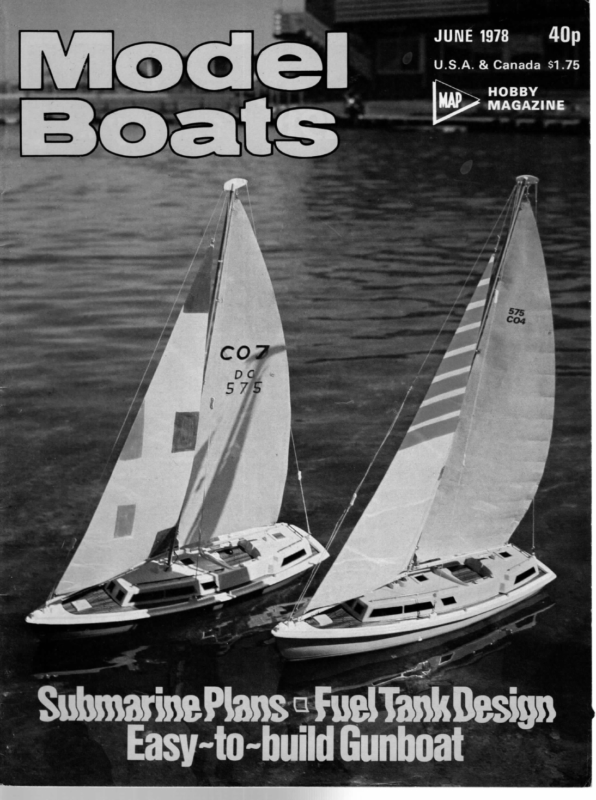
JUNE 1978 40p U.S.A. & Canada $1.75 HOBBY MAGAZINE Sulwsarine Plans «Fuel Tank Design : sy-to-build Gunboat
350 Model Boats ROUND 1786 REGATTA Early season events penalty for John, and meant that he didn‘t qualify for a sail-off against winner Dave Townshend. Very noticeable among the entries was the large number of Trappers, mostly from Danson. This beautiful boat performed very well in the gusty conditions, and some skippers even risked high-top suits with success. For once, Tony Abel’s Moonraker design was very much in the minority; even Tony was sailing a new ‘Challenger’ from Nylet. Norman Curtis was sailing a new boat; an unnamed design from Chris Dicks in ominous black called Frolic. John Curtis sailed the only Pickaxe, ‘Pickwick’, trouble. but had to retire from two races with servo Dave Townshend was a worthy winner, although I was naturally sorry that Woodley could do no better than Alan Oxlade’s seventh; congratulations to all winners and runners-up, many thanks to Jim Wilde and all the co-opted judges, and of course to all competitors for their good nature. Margaret Curtis presented the prizes, including a trophy of a handsome ship’s wheel with inset barometer, to be returned to the competition next year. One other thing—would someone else like to volunteer for scoring next year? You get, totally free, a pen that writes under water. 2nd April was Gerry Hurrell’s Vega design Tiptoe. Photo by C. C. William. Woodley. RM Open Meeting—19th March, 1978 From a purely personal viewpoint, this meeting was a triumph of physical endurance. Imagine, as I’m sure you can, a lake surrounded by tall trees, beneath a glowering March sky; and add a fitful, gusty wind blowing from approximately south—west. Sprinkle with increasingly frequent rain squalls, and you have an idea of the scene. For most of the time, I was keeping the score-board for the meeting. There was a tent, of course; but since it faced directly into the wind and rain on its open side, its value was more psychological than practical. Every piece of paper rapidly began to revert to the grey, soggy pulp from which it originally sprang; and you’ll have to take my word for it that the scores are as presented in the table below, since all written records haye been at least partially obliterated. The day began well: O.0.D. Jim Wilde forgot to put his clocks forward the night before, and arrived breakfastless and ill-clad for the weather, after being summoned by bells at the last minute. There is no Concours d’Elegance at this meeting; but my own experience indicates that a smart boat often belongs to a caring skipper; so I like to look around the boat park to see the standards of workmanship. This year, on the whole, the boats were looking good. Neat fittings, careful lining, attractive lettering, and undamaged paintwork showed that a lot of work had gone into many yachts; and more practically, the majority were rigged correctly. Later, my theory was proved again; one radio failure and one dismasting were the sum total of control failures. The radio failure was interesting; it occurred when a mystery transmission on orange frequency caused havoc with Woodley member Les Allan’s winch and rudder. Frequency monitors agreed that ‘someone was on orange ; but it wasn’t near the lake. Luckily it stopped later; and it was put down to ‘a nut with a model Results Pos. Owner 1. 2. 3. offered open house to all lady visitors whose fur coats and hairdos were in danger; for the men, a local hostelry served the same purpose. John Cleave reported great interest from the barmaids concerning his waders: ‘Show us how far up they go, duckie’, was one comment. Vic Cooney, belonging to a different generation, was not so lucky: he was merely asked if he’d caught anything yet. As last year’s winner, Vic was under some pressure. He sailed the same boat, Moonraker Lulu, but with less success. John Cleave, on the other hand, gained second place once more with Knut, although only after a long dispute over a collision with Chris Dicks had resulted in a Design Name Danson Trapper Lady M. P. Freeman Danson Trapper Boots 4. C.Dicks 5. A. Owens New Forest Ghibli Knut Clapham Danson — Trapper 10. T.Fuller 11. \.N. Oxlade JS M. Peppiatt 13. \D. Belding R. Belding New Forest Woodley Clapham New Forest New Forest Trapper Nookie Bear II Seahorse Ultrasonick Aeolus (mod.)Betagen Squiblet Condor 3 Seahorse Santoy 15. Woodley Pickaxe J J. Overton 7. R.Taylor 25. 26. R.Seager J. Fincham 27. 28. 29. 30. 31. T. Croxson Laps 80 78 64 D. Thompson ae Eastbourne — Silver Ship Trophy — 10R — 12th March A rather dull morning greeted competitors from London, the M.Y.S.A., Hove and Brighton, and the home club for the start of the Eastbourne Chamber of Commerce Trophy ‘“‘The Silver Ship’’. Sailing commenced with a close beat out, and a spinnaker run back, but the wind veered slowly to a reach. Lunch break was taken with just over half the event completed with several boats in contention, but the previous two years winner Des Daly in the lead. Sailing resumed after lunch with the wind still changeable and it was noticeable that 13 year old Michael Humber, though not quite winning, was causing quite a few flutters among the top skippers, only narrowly losing to one of the older boats in the race. After an exciting finish the trophy went to the London Model Yacht Club with Krakatoa winning the last 5 heats. Thanks were extended to Mr and Mrs Sylvester for excellent club house refreshments, to R. Godfrey O.0.D. and to the attractive young lady visitor from Hove who stepped in so ably to keep the score, the home club’s officers being depleted by illness. Results Pos. Design 1. 1838 Krakatoa 2. 1989 Restinga 3. 1851 Hiccup wh * 6. 7 JS 1846 Black Opal 1741 1991 1980 1774 Madelaine Bonfire McNim Benoulis Baby Owner J. Wheildon M. Goncalves D. Daly M. Connell P, Humber T. Gurr F. Slater M. Humber Club London Model Yacht Club London Model Yacht Club Hove and Brighton Danson Eastbourne e Model Yacht Sailing Assn. Model Yacht Sailing Assn. Eastbourne N. Sylvester
Model Boats 354 MODEL YACHT DESIGN Concluding Part Five by CHARLES ROBERTSON, B.sc., NAV. ARCH. 3), EXAMINE 8 TVS. Cos cnt +a. ~ . Y1=(b+a)cosoc. ‘pb Is Constant. And We Lift ‘A’ 7) et elf Sine=F b}.°. (b+ a)Sina. yl From The Shear Plan At The Appropnate 3 Section. 4) FIND DISTANCE ‘C’ c-g-(d+ f). .. C=g -(e-w) cos x – (b+ a)sinoc (A). “.C=9 – (a+ fF). V 5). y2= 4lalxlegn For a Parabola) /¢ “\\.RP LWL. 2 ie 4 —jaF ys Ys x , if Subst:(1) into (b). Mor the parabolas up to the approximate deck height, to give me some basis with which to work from when constructing sy Riys=4‘a’x ax — ——{b) fe CAO a ai vary this value if he so wishes (for the sake of balance, are not conducive with hull balance. (I normally continue \ \ 2 body plan. We continue this procedure for Stations 1 to 9. It is usual for the ‘a’ value for the parabola for section 10 (transom) to be the same as that for section 9 (it is substituted into equation 3, to give the location along the parabolic axis, note a= 0), but it is up to the designer to flattening the stern wave, etc.). The fore end, section 0, is decided upon by the designer, a low ‘a’ value to give a full bow, a high value for a fine entrance. We now have a fully faired body plan (as long as the LWL and the sheer plan curves which we drew were both fair), with topsides which \ For Point Sy7=4a(c+x)—– (a) Let us now examine what formula we have developed. In order to construct a parabola, we require the value of ‘a’ in the equation y? = 4‘a’x. A formula for ‘a’ [y,2—y.2/4c] has been developed: i= [b+a] cosa, where we know Jb, the angle a, and read (a) off the sheer plan. Y2—=T[e—w] sina, where we calculate [b/tan a] or measure e, and read (W) off the LWL plan. C—g—[d+/f], where g can be calculated [b/sin a] or measured. Hence we can calculate the a value of the parabola which will cut the LWL at the desired width (W) and will have the correct body depth (a). If we again examine the equation: y,? = 4‘a’[x-+c], we now know the value of ‘a’ which we have calculated, the value of y, = (b+) cos a, so that we can find [x+c] = y1?/4‘a’ =[(b+a) cos a]?/4‘a’. . . (3). If we add this distance (x+c) to the value of f, [(b+a) sina], we arrive at the distance the origin of the parabola (Z) is from the centre line of the body plan (V). Weare now able to position the parabolic section correctly in relation to the body plan centre line. Having calculated the formula for the correct parabola at the section under consideration, and its placing, we now proceed to draw on this parabola (or use the ones which we have already constructed), which is then positioned with its origin at the correct position on the inclined parabolic axis underneath the body plan grid. (The WL width will then correspond with that on the LWL plan. And the same will apply for the body depth). It is then traced onto the hay? the topsides). Hull Balance If the design is to be of the balanced type, as our marblehead will be, it is the best policy first to draw out a main diagonal. In our case it is easy, as we have already built our hull around it: the inclined parabolic axis, so that all that is necessary is to plot the distance each section’s parabola origin (Z) is from the body plan centre line (V) along the main diagonal opposite the corresponding section shown on the waterline plan. This will result in a fair curve. LWL. ee ait.) Sa cig MAIN i} OQYAGONAL 2V=5 4 in. end 11 0 NOTE. ZV: c+f+x. WATERLINE PLAN. Heeled centre of buoyancy calculations are then carried out upon the tentative body sections to determine the movement of the centre of buoyancy, which will generally be aft. Should this be the case, then the in-wedges aft will need reducing and those forward, increasing (or vice versa should the C of B move forward). On no account should
MAIN DIAGONAL: i ie ap 5. me LWL. 104.0 the out-wedges, or any of the body below the LWL be altered (this is already fair and correct, and suitable topsides can be developed around it). To increase the inwedges forward, we just increase the fullness of the main diagonal forward, and redraw the body sections to correspond, and do the reverse aft to decrease the aft in-wedges. ©] 10 — 9 (h PLOTTED FOR EACH SECTION) 5 x Ad MAIN DIAGONAL (WL PLOTTED FOR EACH SECTION) Lwy on SHEER PLAN. ‘3 WATERLINE PLAN. DECREASED < FULLNESS AFT . TOPSIDES CONT: ABOVE LWL FOR THE PRESENT. snp! a7 AGONAL. INCREASE EULLNESSFORWARD, D As soon as we have achieved an acceptable movement of the C of B, we can commence with the completion of the fairing of the hull (topsides). I usually attach a great deal of importance to the main diagonal during the fairing operation. I plot this diagonal on the waterline plan and the sheer plan (in its correct plane). It gives the designer more points upon the plans to fair, and enables the b- Pn. PARABOLIC AXIS (MAIN DIAGONAL). a=24-5ip. AREA =7-84iNs. sq. Segara of the midship section to appear throughout the BELOW LWL. hull. iL My,Ny egy) MIDSHIP__SECTION. SECTION 4 5. WIDTH FOR LWL. PLAN (WL) LWL. HIGHT FOR SHEER PLAN(h) a=|2:07 SECTION 5 (For Example) A id I am tabling below the calculations for one section of the marblehead design, and next month I hope to complete this series of articles with this design (Outlaw) completed, and some of the thinking which has gone into its conception. Ist. SECTION DERIVED FROM (4) SUPERIMPOSED UPON BODY CALCULATION PLAN. Work Sheet 5: Parabolic Arc Design Technique Design: Outlaw Angle oc =28; Cos oc =0-8829 Sin oc =0-4695 Tan oc =0-5317 b=2in Parabola ‘a’=1-0 e= 5b =3-7615 g= Tan oc b =4-2599 Sin oc ee én? Sec- | line | Draught|y, =(b+a)| v2 =(e—w) |f=(b+a)| d=(e—w) c= a= |*re= lx+e+/ tion | Width re "cos o * sin oc sin o cos 0 g—(dt+f)|y2=y?| yw | =ZV (W) 4 5 6 4-46 4-80 4-75 2-07 2°15 1-98 3-5934 3-6640 ...0°3279 ...0°4876 1-9109 1-9484 ...0°6167 ...0°9169 2:9657 3-2284 4c 4‘a° 1-08 1-02 2:99 3:29 4-90 5-24 a’ ... value of parabola for each section. ZV .., distance origin is along parabolic axis from centre line (length of main diagonal): Notes: (1) The calculated value for ‘a’ is slightly higher than the parabola ‘a’ value which was used to draw section 5. This is due to the points of intersection (and probably the drawing of the parabola) not being exact. The reader can leave this value, as if he takes the trouble to plot another parabola with the ‘a’ value = 1-02, he will see that there is no appreciable difference between the two. (2) If there are negative signs appearing, no mistake has been made and the formula will nevertheless work. 6
Model Boats 356 LOGBOOK Yachting jottings from our M.Y.A. Correspondent stop the members from very active participation in Association affairs. What is done is that a club will runa District event etc., by providing the manpower, at an available or more suitable water so that they are most certainly contributing. This reader asks if the MYA wants to know about groups who are sailing but have not yet formed a club, and would it give advice and support before affiliation? The answer must be most certainly yes; if the District Committee covering the area knows of a group, it will be only too keen to arrange for a visit by an experienced skipper or official who will want to see how he can help. Help may range from simple advice to arranging a mass visit from Pictured at Southgate club’s recent Pugwash Trophy for 36R yachts, are from right to left, Foreg, | of 2 Goslings, | of 5 Krispies and Roger Cole’s (Guildford club) g.r.p. Tuppeny Rocket. 4 is always amazing that people who have never been in touch with the MYA can form impressions, which can develop into misconceptions and fixations, out of thin air, as it were. Presumably other amateur bodies experience the same sort of thing, yet the people involved in ‘“‘administration” are usually involved because of their own enthusiasm and thus are only too pleased to help enquirers who show intelligent interest. How does an interested party get in touch? Well, in general, a public library can provide addresses of local clubs and/or national officials, but in the case of modelling, an SAE to the editor of the appropriate magazine is an easy way to obtain an address. If your interest is boats, you obviously know that a magazine exists, since you are reading it. All this arises from a reader who races yachts in company with others on a water of which they have only limited use, and as a result wonders whether there is any point in formalising themselves into a club. He goes on — “‘One gets the impression that a club without a suitable water and therefore not in a position to take a share of fixtures in future years would not be welcome if it approached the MYA. This is not unreasonable since the members of an organisation must normally contribute something in exchange for any benefits they may receive, but it leads toa chicken and egg situation where the lack of backing of a national organisation weakens the case when negotiating for water, while the lack of water inhibits joining the national organisation.” Now there’s a classic case of whole edifice being built from an impression which is erroneously based and which a chat with any club official, or a letter to the secretary, would have dispelled in short order. The MYA Constitution states that its first object is “to encourage, recognise, and promote model yachting in all its branches” and the requirements laid down for a club to be affiliated is simply that it should be composed of not less than six members. At one time it was stipulated that a club must have a regular progamme of racing, but a couple of events held annually would satisfy this condition. There are some well-known clubs whose home waters are very much restricted, either to winter months only, or simply by virtue of topographical (botanical ?) conditions — Guildford and Danson, to name a couple — but it doesn’t or to an established club. There are a dozen recently formed clubs who will testify to the interest and encouragement shown to them in this way. Finally, this reader asks, who should be contacted? “One hears dreadful rumours of a club which tried for many months before it succeeded in raising contact with the MYA.” Oh, dear. Clearly the MYA Hon. Sec. is the first choice, even if he is only asked to forward the letter to the appropriate official, and his address appears from time to time in these pages and is in most books including yachts published in the last four or five years. Or the editor or this correspondent will forward a letter. The MYA sec. is conscientious and hard-working and does it in his spare time; no letter goes unacknowledged. Council meets three times a year, so there can be a delay in a final answer if it is matter needing to be dealt with by the full Executive, but, really, no success in raising contact for many months? Where do these rumours come from? * * * * British skippers would be made very welcome at an International RM Regatta to be held by the Model Club of Creteil, 10km. out in the south-east suburbs of Paris, on June 17/18. Unfortunately the invitation arrived too late for the May issue, and the closing date for entries is May 30, but there is time to get a letter off to Mons. G. Souchard, 5 Rue Viet Esc. 5, 94.000 Creteil, France. The regatta is sponsored by the Federation Francaise de Voile and will be sailed under IMYRU rules, i.e. the rules used by the MYA up till this season. See later notes on Creteil. Clapham MYC is now sailing vane and R/C Marbleheads on a 50/50 basis throughout the year, with occasional 36R vane races too. New members are welcome; the sub. is a modest £4 per year, and the Hon. Sec. is M. Peppiatt, 6 Merton Mansions, 57 Tooting High St., S.W.17, ’phone 01-672 6980. Clapham member Dick Seager was intrigued by Mike Hopkins’ time limit comments in the April issue. Dick is a newcomer to radio, though an experienced vane skipper, and says he has seen situations where all competitors would have scored zero had there been a time limit from the start gun, and even so only the second place boat scraping over the line within the time limit. While sympathising with beginners in such conditions, Dick points out that even old hands suffer. If a light-weather yacht were to be designed with the object of getting round sufficiently ahead to prevent others scoring, thus balancing out points lost in stronger wind, it would surely be penalising it if points were awarded out
357 June 1978 of time? And it could happen that a particular boat flies round in a gale, while others unable to beat or track in the wind strength are out of time. Should he be penalised? Dick has participated in three open RM races and says the most frightening part is the start, with yachts going in all directions, then driving for the line. Instead of the good starts he thought he would get, he has been luffed or sandwiched into bad starts with penalties, which is much more likely to put a newcomer off. In vane racing, if one’s single opponent is disqualified, it is still necessary to complete the course, no matter how long it takes, to earn the points. Also on vane, Dick mentions the occasions when the OOD has stopped or delayed racing through lack of wind, which penalises the lightweather boats. Certain conditions suit certain boats, and none should be penalised because of the conditions. Help newcomers with advice on trims and tactics for all conditions (who didn’t appreciate it when they were beginners ?) but leave the time limit rule, which is good and right. Southgate’s Pugwash Trophy, the unofficial 36R team event, was sailed on March 19 and, says the OOD, was more wash than Pug. Racing was halted at about 4.30 after 12 heats, one contributory factor being the imminent disintegration of the soggy score sheet. It certainly rained! Nine teams took part, including three from the small Welwyn club; many of the 18 boats were regulars, the winners being to Chris Dicks’ Realistic design, but there were five Krispies (the cornflake packet boat) a pair of which tied for second and one, sailed by Manuel Goncalves (his second boat and second season) alternated throughout for top-scoring individual. Finishing order was 1, Danson (A. Larraman 41, R. Griffin 46). Equal 2, Clapham (J. Gilmour 38, R. Dicks 37) and London (M. Goncalves 45, A. Gurr 30). 4, Guildford (A. Austin 30, R. Cole 42), 5, Welwyn A (R. Hatfield 35, A. Whiteley 36). 6, Southgate (A. Taylor 18, S. Taylor 23). 7, MYSA (A. Martin 21, T. Martin 12). 8, Welwyn B (L. White 14, T. Whiteley 15). 9, Welwyn C (S. Sawyer 5, D. Sawyer 7). There was more wind than usual for this race, but the surroundings at Broomfield Park tend to produce some unusual shifts and eddies. Despite the wet weather, an enjoyable meeting. On at the same time, as well as the Woodley RM event reported elsewhere, was the Dinghy Exhibition at Pickett’s Lock, where the MYA had a stand and gave demonstra- tions with RMs in the small swimming pool. This exhibition gives the MYA enormous publicity where it can do a lot of good, but gets very little support from members. This year it was basically Roger Stollery plus Basildon club members, and at times it was difficult to man the stand, and demonstrate sailing, so few helpers came along. A New Year resolution for 1979 might be to lend a hand with this worthwhile exercise. Roger had his new RM Pick Axe there, and if you thought you’d seen everything, wait till you see this. The entire rig rotates about the mast on a long boom which carries on its fore end the jib boom, so that when the mainsail is out to port the jib boom pivot is out to starboard — it looks weird, but it works. And that’s only one innovation! Only recently received was a report from Ashton DRCMYC on a trip made to Creteil (see above) for the club’s first-ever international last Oct 1/2. Graham May (Tameside), Barry Jackson, and Barry Axon (Ashton) left at 6.30 am on the Friday and after a rough hovercraft crossing and the surprise of paying £3-75 toll on the Calais-Paris motorway, arrived in Paris past Charles de Gaulle airport, seeing a French Concorde. Emile Servella, one of the French entries in the British RM Nationals last year, took them home and fed them, then escorted them to their hotel (£3.25 per night b & b). There were 52 entrants (6 Belgian, 2 Swiss, 1 German, Two more contenders beat away at the Pugwash Trophy team event. 1 Canadian, the British trio, and the rest French) and racing began in pouring rain at 10.30, though by lunch the sun was out. In between races the time was devoted to digesting the French rules and getting used to a countdown in French. All skippers had four races by 6.30 (Jackson 2X1, 1x2, 1x3, Axon 1x1, 1X2, 2x4, May 1 x1, 1x2, 13, and 1 <4) and then it was a rush to change for a large banquet, with red wine flowing freely . . . At the lake by 9.30 Sun.. with hangover, to find the same weather, rain which stopped by 2pm and left a light wind. Sailing finished around 5.30 and a TV crew was filming for an hour. Final places were Jackson 4th, May 17th, Axon 25th, and when Barry Jackson collected his cup (cups down to 6th) he surprised everyone with a speech in French. The prizegiving was at the Town Hall, overlooking the lake. From there it was to Emile’s house for a large meal and a review of the day over champagne and red wine. The friendliness and hospitality throughout were tremendous, even to the point of having a guide to lead them to the motorway on Monday morning. A super week-end, the experience alone making it well worth the trip. American enthusiast Ben Hogensen was interested in the comments on 36R yachts in the January issue. The American 36in. rule limits sail area to 600 sq.ins. but beam and draught are not controlled, but Ben’s latest is 36in. 0.a., 33.75 w.l., 8in. draught, 3in. freeboard, 9in. beam, displaces 11.5lbs. and has 8lbs. of ballast, i.e., it fits our 36R rule and 70% of its displacement is ballast. He sees no advantage in this size for ultra-lights with 15-18in. draught, and mentions a Dumas sail control unit in kit form for $38 which weighs 80z. and has a transit time of 5 secs. This unit runs off the same supply as the receiver (5 small nicads) and allows a radio weight of 16o0zs. or little more. With this sort of (continued on page 359)