- MODEL YACHT DESIGN By CHARLES ROBERTSON Part Seven presents the calculations appertaining to the Outlaw Marblehead design, published in July.
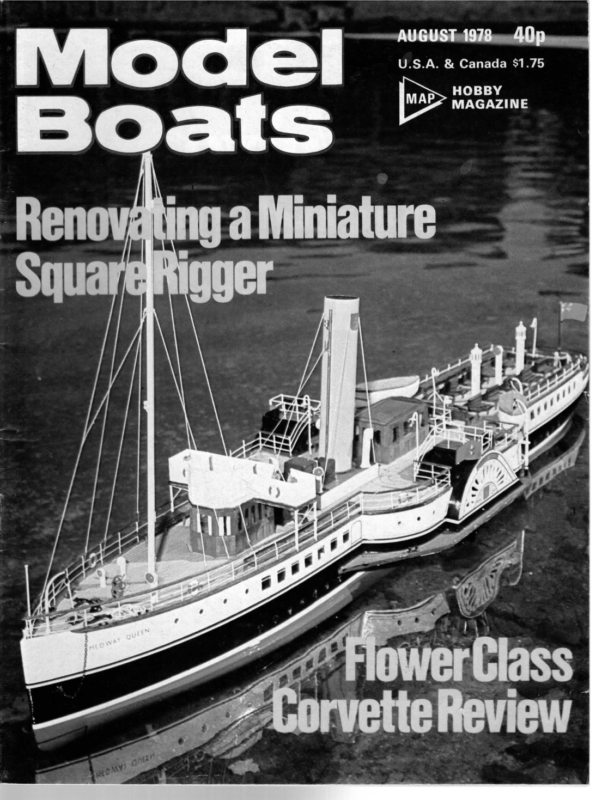
- WILL MOWLL concludes the five-part series on his fine paddlesteamer, with an account of THE WRECK OF THE SIRIUS
- LOGBOOK Yachting Jottings from our M.LY.A. Correspondent
- ROUND the REGATTAS.

© bs U.S.A. & Canada $1.75 maB> Mabey Renovdlling a Miniature Squan5
the company was heavily involved, being literally on the doorstep of the main arena of sea warfare in the North Atlantic, with large convoys being assembled at the Eastern US ports. In addition to running their own fleet, the Moran Co was assigned 49 tugs by the US Government, V-4 tugs of 1,600 tons and 195ft long and tower dredgers, barges, drydocks and all manner of floating equipment pushed into service due to the exigencies of war, as well as saving torpedoed ships and carrying out salvage; even having ships in tow being torpedoed, crossing and re-crossing the Atlantic and Pacific Oceans many times, losing two tugs with the loss of 14 out of a crew of 18 on one tug, and beh oad i of the tripod mast; welded construction is clearly visibie. brokerage business at 14 South Street. In 1860 he was 27 years old, having been in the USA for ten years. In those days New York was teeming with ships and the famous clippers Flying Cloud, Lightning and Young America were fighting a losing battle with the coming of steam power. Samuel Cunard had already been operating a transatlantic service for 20 years, and the time was ripe to set up a towing company to take advantage of the many opportunities opening up, and his enterprise prospered accordingly. The Civil War between the States broke out in the early days of the company, and several of their tugs were taken by the military in 1898 to serve as despatch runners between Florida and the US fleet in Cuban waters, and the tugs in New York were occupied, handling troop transports and supply ships. In World War I some of the tugs were sold to the British Admiralty, and naturally during the Second World War MODEL YACHT DESIGN a total of 1,153 tows were accomplished during the war, many being far from the sheltered waters normally around New York. As a reservist, Edmont Moran returned to the Navy, and became deputy to Vice- Admiral Land in charge of the small vessel programme, and his experience was of great value during the planning and operation of the huge effort required to put the Allied Forces ashore at D-Day, and the even more critical phase following when the build up of supplies was necessary to support the beachhead. The company has made its greatest expansion since the end of the war, and more efficient and higher powered tugs have come into service. It took 12 tugs to berth the Normandie and Queen Mary in the thirties, but five tugs can berth comparable ships today. Several specialist companies exist under the Moran umbrella, Seaboard Shipping Co, the bulk liquid transport affiliate, and Curtis Bay Towing Co. In addition to normal towing operations the Moran tugs undertake salvage duties when necessary, and it is of interest that they operate under ordinary agreement, ae do not rely on salvage law or traditional Lloyds orm. It is obvious that the company intends to carry on its long and successful history with the introduction of new and efficient tugs, and probably as important, the recruitment and retention of loyal and skilful crews. I would like to acknowledge the kind help given by Mr Jeff Blinn, manager, public relations, for drawings, photos of the Heide Moran and copies of house magazine Towline where the tug was featured after entry into service, who answered my questions with promptness and interest. CALCULATION OF AREA ey | BELOW LWL.(RST) By CHARLES ROBERTSON Part Seven presents the calculations ap- pertaining to the Outlaw Marblehead design, published in July. 1). AREA OF PARABOLA ZRST- 2/3 BASExPERPHEIGHT Page 423, displacement in text and plan should be 16.6lbs, not 14.8lbs. Also, sail plan dimensions should be as follows: B2 B3 B4 &y2=4ax i y5 =213(x+c)yt Errata to Part Six Jib 38.6 x 14.8 Sail Area 675.6 32.6 x 13.8 26.6 x 12.6 539.9 407.6 QAREA OF A\ONI=y, [d=Jid+c..J=y2(deo) AREA OFA OPR-1/2 y2 xd “AREA OF PRNiz SON -AOPR e . AREA AONI-12dec)x y> (dec) 1 ya (d+c)é : =I2(y2 (d+c)2)-12 yd =1l2y2 (d<+2de+c<-d) 3) AREA OF PARABOLA ZRP=2— 2/3(x) 1 z 4) AREA OF NST=1/2axa tana: 2a%tana ZRP+ARFAa NST =A3 (x+c)y; -(ty adcr+cs) td 3xyo +H2attana di.
465 August 1978 Work Sheet 3a: Complete Hull (New Design) Upright A 2xA=B C BxC=D E DxE=F Station 4 Area Total Area S.M. Ff (Volume) Lever Ft’ (Movement) 0 1 2 0 0-69 2°53 4-88 6:93 0 1-38 5:06 9-76 13-86 1 4 2 4 2 0 5:52 10-12 39-04 27°72 5 4 3 2 1 0 22-08 30:36 78-08 27:72 5 8-09 16-18 4 64:72 0 LXfp= 158-24 6 7:52 15-04 11-44 4 45-76 2, 91-52 8 9 10 3-34 1-13 0 6:68 2°26 0 2 4 1 13-36 9-64 0 3 4 5 40-08 36°16 0 3 4 7 5°72 2 30-08 1 30-08 Xf= 245-36 Length of LWL (L)=S0in. Section Spacing h= Sin. Xfa = 197-84 Volume Displacement =ifxh=V 3 V=245-36 x 5=408-93in.* Position of LCB=Xfa—