- NERKA 36/600 KISUTCH Marblehead KETA 10 Rater Designed by R. B. Sterne This month describes early development work.
- Logbook Model Yachting Association News.

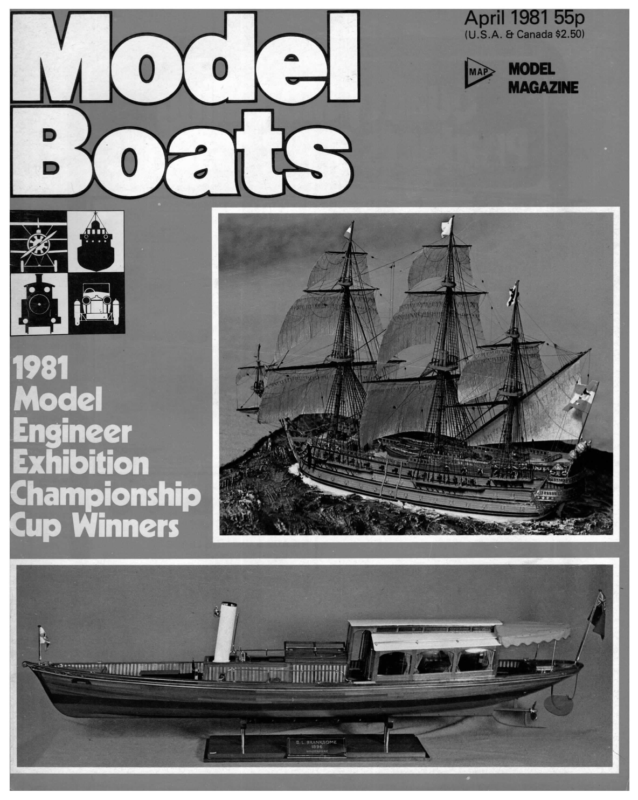
Engineer Exhibition | Championship | =. up Winners
Presenting plans for the Sail 80 World Championship winning Marblehead, Kisutch and its derivatives — . 2s 36/600 Marblehead Designed by R. B. Sterne issue — Nerka 10 Rater KISUTCH 50-800 _DecK RB. Sterve The Model Maker. Plans Service This month describes early development work. May = Se ae Seas a ae DiS = a = —~MM1315 Plans for Kisutch are available from Model Boats Plans Service, PO Box 35, Bridge Street, Hemel Hempstead, Herts. HP1 1EE. Plan and elevation are drawn half full size, sailing rigs 1/10th full size with full size body lines. Quote plan M1315 when ordering, price code F £2.40 plus 35p postage and packing (UK). THE purpose of this project was to develop a series of three model yachts, one each to the 36/600 class, the Marblehead class, and the 10R class, possessing a family similarity, and using up to date technology. This series of articles was written over a period ot two years, and should be read in its entirety before building these boats. | have left them basically unedited so that one can get an idea of how things change. There will therefore be contradictions, and some ideas that seem out of date now may appear in the earlier articles. Hopefully, by the time you get to the epilogue, you will 206 have a better understanding of some of the factors involved in this project, and the scope of it. Having worked with Bill Van Dieren on the design of Kokanee, and having designed the Sockeye 36/600, which is a scaled down Kokanee, and the Tyee 70R, a 57in LWL 171!b double ender, and having sailed all three for some time, | decided that some improvements could be made. Both the Sockeye and Kokanee had a terrific tendency to dive on a run, with the tall rig fitted, if the winds exceeded about 10 knots, although this has been largely eliminated by increasing the freeboard forward to 4in on both designs. The /yee, however, had no such tendency, actually it had tremendous lift in the bow, partly due to the forward overhang, but largely due to the shape of the hull, which although still using circular arcs, gradually became ‘V’eed’ forward, in order to work in the overhangs. This was done by simply moving the centre of the circles off the centreline of the hull. The result was a bow much like that of Draper’s Sa//plane M, an excellent planing hull, with exceptional lift forward. However, due to the fineness aft, MODEL BOATS
head, but have a poorer ratio of sail area to the Tyee had a tendency to squat when planing. The criteria that the new designs had to wetted surface, ability would meet were as follows: factors were considered, and a great many 1. The displacement would be in the light- Robertson in his drawings of Out/aw. Using of them suggested that 58in would be about right, so knowing that, | finished the the method above, it is possible to design a drawing at that length, giving a 10 Rater desired. weight category, as the wavemaking resist- ance is directly proportional to displacement. 2. The wetted area of the Marblehead version would not exceed that of Kokanee. and the suffer. light weather Actually, several called Keta, with the following specs; LOA boat of this type to any size and proportions Now that | had the designs for the hulls, | 70in, LWL 58in, beam 9.5in, angle of entry had to figure out the appendages. During 101°, prismatic 0.523, centre of effort near the design of the Kokanee, Sockeye, Tyee series, | had decided to use a fin with an aspect ratio of 3, (ie length three times average chord), and a thickness/chord 3. The angle of entry for the Marblehead and 10 Rater was to be in the neighbourhood of 10°, with the 36/600 as narrow as possible, to reduce bow wave formation. station 5, and displacement 15’, lbs. The design names, by the way, are from West 4. The beam of all three designs was not to means exceed 10ins. Salmon. 5. The prismatic coefficient (in common with Kokanee) was to be between 0.52 and that of a displacement hull, the lower waterlines are definitely of the planing variety, an effect also mentioned by Mr. Coast Canadian Indian names for various Salmon; Nerka Coho, means Sockeye, and Keta Kisutch ratio of 10%. | decided that since these fins Chum worked so well, and so that | would be able means to eliminate them as a variable in the new For those of you interested in the method of developing these hull lines. | will give a 0.53, as there is a plateau in the resistance designs, | would use them again. The Marblehead fin is 48sq.in., 12in long, 5in brief curve at this value for a large range of the at the hull, and 3in at the lead, with the desired displacement of the hull body (not speeds at which we sail. trailing edge vertical. The fin is placed so including any appendages) and the LWL. that the area in front and behind the centre Calculate the approximate maximum beam of buoyancy is equal, producing a boat that is very manoeuvrable. The fin was simply 6. The Centre of Buoyancy, and the Centre of Lateral Resistance were to be moved aft, in order to move the rig aft, to reduce diving, and to improve planing ability. 7. The hull was to have as much excess description. First, determine the from the following formula: Beane Phos eel (Ibs) x 370 scaled up to 62sq-in. for the 10R, (1314 in deep), and down to 32sq.in. for the 36/600 (93, in deep). This gave drafts of 14 in for the ends LWL (in) Next, draw an arc for the rocker of the immediately above the waterline, to pre- hull, on the profile view, having it pass vent diving, and squatting. through the ends of the LWL, and being ‘/, 8. The ballast ratio was to exceed 50%. of the beam below the LWL at station 5, and borrowed from the earlier series, as was buoyancy as possible in the From previous experience, it became obvious that the displacements would have to be about 9’/, Ibs for the 36/600, 13 lbs for the M, and 16lbs for the 10R to meet criteria 1. The circle could be employed in the sections to reduce wetted area, and by using the bow sections from 7yee, and a series of concentric circles aft, a basic body plan was obtained. After much changing of sheet, rocker, LWL, beam, and depth, the Marblehead version, Kisutch, was obtained, with the following dimensions; LOA 50¥,in plus /%in bumper, LWL 48in, beam 91, in, angle of entry 101°, prismatic 0.522, centre of effort near station 5, and wetted area 2% less than Kokanee at the same displacement of 13lb. As you can see from the body plan, there is a large amount of excess buoyancy just above the LWL both fore and aft. During my calculations, | became aware that if the sections were respaced to provide a 36in LOA, 34in LWL, that the 13lb Marblehead became the 9’/,Ib 36/600 | was after also, with an entry angle of 4/,°, andall other specs remaining the same. The design was called Nerka. The transition to 10 Rater seemed a bit more difficult. First, how to work in the overhangs desired, and secondly the old question of what LWL to use. As it turned out, the overhangs were easy; in the stern, | simply continued the concentric afterbody above the waterline for one more station, and in the bow, | simply redrew the sheer curve one station longer, and modified the sections accordingly. After numerous calculations, | found that if this 10R was built shorter than a 58in LWL, it would have superior light weather performance to Kisutch, but not be as stiff, and if built longer, it would be stiffer than the Marble- April 1981 Nerka, 16, in for the Kisutch, and 18in for the Keta. The rudder design was likewise set these points out on the body plan. The the centre for the aft sections (6 through 10 or rudder are two/thirds of the dimensions of T) is % beam above the rocker at station 6. the fin, with the exception of the thickness, Draw the plan view of the sheer, using an which arc from the point of maximum beam at ness/chord ratio of position. All the dimensions of the is the same. This gives a thick- 15%, and rudder area of station 6 to the desired width of bumper at 14, 21, and 27sqin all with an A.R. of 3. station A. Draw the centre line of the deck Both the fin and rudder have been given in profile, and set these points out on the taper body plan. 25in approximates the ideal elliptical loading, radius, set out the heights of the sheer on without reducing the tip chord to zero. The Using a template of a ratios of 60%, a figure which the body plan, where the deck intersects rudder is placed so that its pivotis at station the sheer line of the hull. Join the points just determined for each station with their 9, and passes through the centre of the top, parallel with the trailing edge, and vertical, corresponding giving about a 35/65 balance. points along the rocker, bisect this line and erect a perpendicular. The shape of the leads has been changed Where this line intersects the height of the since the earlier series and | have opted for a longer thinner lead, with an 18% thick- sheer is the centre of radius for that section. See Fig. 1. ltisnowa simple matter ness/length ratio instead of the 25% used to set out the entire body plan, using acom- in Kokanee, etc. with the lower frontal area pass only. Once this is done, the water- hopefully making up for the slight increase lines, in wetted area. buttocks, and diagonals may be drawn, and all will be fair curves. It is interesting to note that although the LWL is The sailplan for the Marblehead does not have the common 80in luff top rig, although one could be used for very light conditions. | have chosen, instead, a 73in luff, which is usable up to about 12kt, winds, which covers about 90% of the winds we sail in. The low rig, with a 59in luff is usable up to about 20 kts and | have sailed my Kisutch with the storm suit, a in luff, 44 (00 sqin rig in winds of up to 30 knots. The general proportions of just over 40% of the area in the jib are common toall three boats, and | feel that this 40/60 ratio is just about optimum for any R/C yacht. The actual dimensions were chosen to give a line of symmetry to the sailplan, and to allow both the 79in and 65in masts to be cut from one 12ft length of ’%in diameter x 0.035in wall 6061-T6 aluminium tubing. Likewise, the 78in and 66in masts of the 207
10 Rater Keta. | have found this to be an excellent mast material for any class of boat up to the 10R, if ithas anycriticism, it would be that in the longer lengths, it is a bit too flexible fore and aft. The rigs of Nerka and Keta are both masthead rigs, where the luff of the jib is 90% of the luff of the main. This gives a very efficient slot, without making the aspect ratio of the jib so high that the chord at the top is too narrow to work properly. The size of these rigs are again designed to allow them to be carried up to about 12 knots of wind. Although the 36/600 rule allows any number of 600sqin rigs to be used during a regatta, our club has opted to use a 10R type of rule, where only one measured suit is allowed, and any other rigs must have a smaller profile. The storm suit of Nerka reflects this attempt to help reduce the cost in this excellent class. Incidentally, we also restrict the yachts in the 36/600 class to two channel radio — rudder and sheets only, again in the interests of costs. If | might just take a minute to mention this 36/600 class, | would like to suggest that if, as | read in a past issue of Mode/ Boats, the R36R class is not well supported, that the IMYRU might well consider adopting the AMYA’s 36/600 rule. There are almost 7OO boats registered in North America in this class, and the rules are very simple. LOA 36in max. sail area 600sq in maximum and virtually no other restrictions. There were even multihulls racing, although they have now been given their own class, and so the 36/600 class is a monohull class again. It was mentioned in Model Boats that the IMYRU should consider trading unrestricted sail area and restricted draft, for restricted sail area and unrestricted draft, and | wholly support the idea. However, the Yin beam restriction is not necessary, and would only serve to keep the class separate from the largest 36in R/C class in the world — the 36/600’s. If you like the idea ofa workable, fast 36in R/C yacht, build a Nerka and you might just raise a few eyebrows. Then maybe the rules will be changed, and the smallest class in R/C yachting will really grow. As an interesting sidelight to these three designs, they all have the same ratio of wetted surface to sail area, the same sail area/weight ratio, the same stiffness, and of course, almost identical sections, the only difference being the overhangs in the 10R. It appears that once a good design is found in one class, that by shrinking or stretching the distance between stations, you can produce a good design in the other classes, at least between 36/600, Marblehead, and 10 Rater. | believe that the Seahorse has been stretched into the 70A Seaking, and the very successful American Marblehead Magic Dragon has shrunk toa 36/600, by just this process. (To be continued) 208 IAN FOLKSON discusses R/C hydroplane anatomy INCE my last article | have received several letters and numerous ques- tions regarding hydros. One every interest- ing letter from Glynn Guest deals with the problems of the turning circles of hydros, this is one of the most common questions | am asked, and before | discuss a few of the points that have been raised | would like to clarify my feelings on the reasons we in England should run hydros. So far throughout the model boat world the hydro is the fastest of all boats, and to achieve this high speed something has to be sacrified; in my opinion the turning circle of a hydro is one of the least important factors when trying to achieve high speeds down a straight line time trial. This form of competition is at the moment the sort we are running in this country. Now the next form of competition which we must aim towards is American style heat racing; let me state now this is nothing like multi-racing as we know it in this country, the speeds are much higher for heat racing than in multi-racing, also the oval heat racing course is driven in only one direction, so a hydro only needs to turn to the right. | must now clarify one point, a hydro can turn quite tight, as a matter of fact mine turns tighter the faster it travels. The main factor as | see it is that when you put ina very tight turn the speed of the hydro must drop, and this is going to cause the propeller to come off the plane. | will explain in more detail. A hydroplane propeller is a surface piercing prop, that is only one blade atanytimeis touching the water and this is what causes the long rooster tail you see at the rear ofa hydro or any boat running a surface propeller. Because of the way a surface prop works a much larger prop can be used than on a normal boat with an underwater type, so consequently if you slow a hydro dowr enough to turn very tight the prop drops of the plane, the whole thing is in the wate! and the strain usually is enough to stop the engine. This is another reason why wher you launch a hydro you have to throw quite hard to give the boat some forward motior to bring the propeller onto the surface. | would like to add at this point, there is nc way we are going torun hydros on the lake: we use for multi-racing, indeed many o these lakes have now become too small fo the new breed of 15cc continental type boats. One of these new 15cc boats cal travel at 40mph and turn relatively sharply now take a hydro at 6Omph or evel 70/80mph, the problem is not how to tur! the thing sharply, itis getting a long enoug| run to build up to the speed in a straigh line. If you try this on an average lake yo MODEL BOAT
three clubs, when it must be put to the A.G.M. One new club affiliation was approved, Nantwich M.B.C., sec. Mrs. B. Jackson, 2 Hellath Wen, Nantwich, Cheshire CW5 7BB (027063925). Final 1981 regatta dates and venues are: A Class Fleetwood M Leeds & Bradford May 2-4 10r Aug. 1-7 Hove & Brighton 6m Sept. 26/27 Bourneville June 7 36r Clapham April 4/5 Sept. 20 Little Portugal Gasport A Team Leeds & Bradford July 4/5 M Team Birmingham April 18/19 Oct. 3/4 RA Class Birmingham RM New Forest May 23-25 R10R Leicester Sept. 12/13 Champions Cup New Forest Oct. 17/18 Fleetwood June 20/21 Model Maker Trophy THE January meeting of the M.Y.A. Council arrangements for the 1982 Marblehead Jubilee started with a brief silence as a gesture of respect regatta for Ms and RMs; sailing will start on May to ex-Council member and Vice Chairman Fred 30 and continue till June 4. Shackleton, who died on January 1st aged 94. Fred, who was a member of Y.M.6m.0.A. and Norfolk and Norwich clubs, sailed an A boat com- Also on the subject of regattas, there was some discussion on the deteriorating standard of behaviour of some competitors in failing to arrive petitively until almost 80, and retained a keen at races, arriving very late, or withdrawing while interest in yachts to the end. the race is still in progress, without adequate Matters arising from the minutes of the previous meeting took a fair amount of time and reasons or without making sufficient effort to advise race officials. Organising and running a included a report by the Chairman on the situa- race involves quite a lot of work, and much more tion in regard to the possibility of some small can grant from the Sports Council. A working party schedules at the last minute etc; if competitors report are going to become too casual and lacking in – is awaited, commissioned be caused by the necessity to reshuffle to review criteria for the award of grants to recognised common bodies and with, apparently, specific mention of voluntary officials have decided not to bother to modelling bodies. (Latest news — report is now arrange races. Most of them would rather be sail- published, it is understood, and there reference to modelling bodies. Ho hum!) is courtesy, they may find that the no ing, anyway. It was agreed that, while existing Eric Nuttall, R/C Secretary, is nearing completion of a Race Management Guide, setting out established and approved practices in running both vane and radio races. A limited number of faith, they should be tightened up and stiffer copies will be produced for English clubs, with a few extra which will be available (£2 per copy was suggested) should any other country’s national body wish to purchase a copy. There was some regatta news. The 1981 R10R Entries are required a minimum of four weeks previous to event. sailing rules cover many such breaches of good penalties introduced for offenders. The Sailing Rules and General Rating Regulations will, there- fore, be overhauled during this year; like many other rules, they have been in existence for some years, with occasional modifications and additions, and need an update to bring them into line with sailing in the ‘80s. Following a disappointing response to a call for Mention might just be made in time of the London Dinghy Exhibition at Picketts Lock, London N9, on March 21/22. The M.Y.A. will have a stand there and will be demonstrating radio sailing in the small swimming pool, probably using Mickey Finns. Overseas News Model yachtsmen in New Zealand are hoping for sponsorship from an airline to send a com- petitor to the next World RM Championship at Dunkerque in 1982. South American interest continues to grow. Alvenir de Carvalho writes from Brazil, where he founded a club in Brasilia a year ago which now has 15 sailing members, some with two orthree boats (all R/C) and half a dozen power enthusiasts. At least three other clubs have since been formed and the First Annual Brasilia Regatta drew 42 people from three states for a two-day meeting covering both sail and power. Shortage of written material, RM plansetc. plusa hard currency shortage which restricts remittances being sent abroad are keenly felt, so rather Championship is being run by Leicester club on Sept. 12/13 and they have asked (as entitled) for volunteers to an entry closing date six weeks in advance, so 0.0.D.’s rota, a list of people capable of officiating send them to boost model yachting in this fast- at a vane or radio race, or both, has been drawn developing up, with more than 70 names included. These Bazerra de Carvalho, SQS 303 Bloco E Apto 506, entries for this event close on August 1. New Forest, who are running the 1981 RM Championships May 23-25, have negotiated part sponsorship by the Midland Bank (bravo both club and bank). The club draws attention to a special condition regarding their water at Kingfisher Country Club — skippers and officials must stay put in the compoun4, i.e. it is not possible for them to walk along the bank to follow the yachts. Previous heavy-entry races there have not produced problems as a result of this limitation. It was also reported that Fleetwood club are pressing on with have their names placed on an people will not be approached for their consent to since most would accept if asked toruna race, but address is Alvenir 70336 Brazilia DF, Brazil. Project Acorn The six designers producing 1/10 scale 12m something should go wrong, there is the feeling designs for test purposes connected with the next ‘Well, which America’s Cup challenge have, it is understood, undoubtedly adds to confidence! On this subject, sorted out which approach each will make and you asked — | didn’t offer’ it was also reiterated that paying an O.0.D.’s have started getting their ideas down on paper. At expenses was this scale the minimum waterline is 52.8insothe not established M.Y.A. practice and that, while a club organising a race could do boats will not be dissimilar in size to A boats, al- so though they will carry more sail in light airs. The if they wished, the expense could not be business will finally be sorted out. As promised, as soonas| return | will broadcast the latest news on these championships. Also at the same time should be The would not want to ‘push themselves forward’; if ideal weight of wind for trials would be 5 knots, There was a fair amount of routine, unexciting you read these words, late March, | will be attending a meeting in Magdeburg when the situation country. be placed on a rota. This seems good psychology, passed on to the Association funds. Propwash (from opposite) than throw magazines, plans etc. away why not to be got through, including some and this would only ruffle the surface of a small lake, which is why large lakes with a long enough I.M.Y.R.U. matters and a proposal to make an fetch alteration to the Constitution which will come up being sought. to develop reasonable wave height are for voting at the A.G.M. at the end of the year It already seems clear that some of the con- (which will, incidentally, be held in Manchester). cepts which will be incorporated in some of the Basically, models will startle the full-size world, although some confusion has arisen as to news regarding travel etc. to the 1981 Champion- Council’s right to veto an undesirable or poorly- model yachtsmen will find little unusual about ships in Magdeburg. Unfortunately it may not be worded proposal, some people feeling that the many of them. It will be fascinating to see the possible to have this published in the May issue because of copy date requirements but infor- combined experience of Council members should relative performances of the new designs against be used to weed out potential time-wasters and Lionheart and Australia; at this size, one would be mation will be circulated and | will try and write a general round up of what is happening on the others confident that they will be outsailed fairly con- should be put to the A.G.M. irrespective. The new vincingly. Naviga front for June Model Boats if not before. proposal is to the effect that Council can quash a certain that model yachting will be taken a good Jim King proposal unless it is put forward by a minimum of deal more seriously as a result of the exercise. April 1981 holding the opinion that all proposals Whatever the outcome, it seems 217