- CURVED AIR Model Yachting New from Russell Potts
- Building ‘Australia II’Roger Parmenter builds a model of the boat that broke the Americans’ hold on the Cup
- TEST BENCH Tony Abel Model Racing Yachts
- Yachts Rule OK? A practical introduction to the International Yacht Racing Rules – by Nick Weall

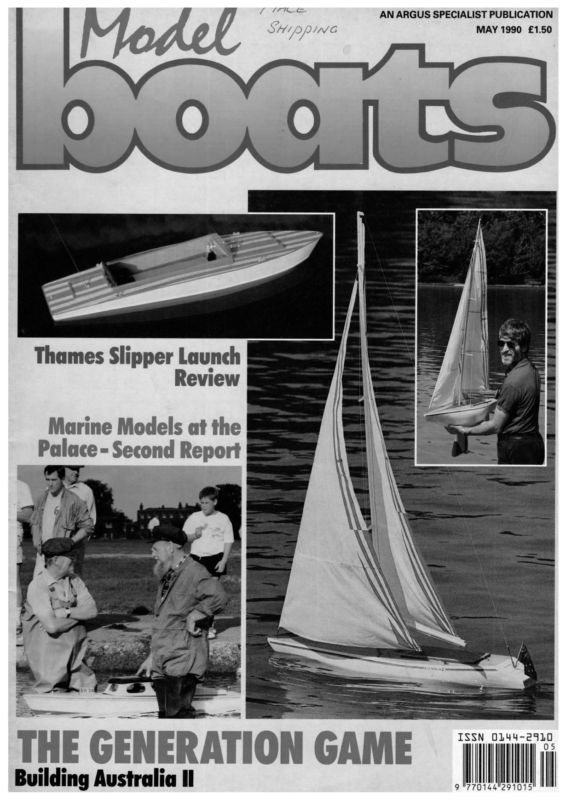
a AN ARGUS SPECIALIST PUBLICATION SADPING 4 MAY 1990 £1.50 7 Thames Slipper Launch Review Marine Models at the Palace – Second Report di e Building Australia Il oe 014 0 | 144°291015
Goh WEm ARR MYA News At the January meeting of the MYA Council several important decisions were taken. 1-metre class recognition As foreshadowed in this column, (you see all the news here first!) the IYRU 1-metre class was granted national recognition. There is evidence that the boats are at present being registered at a faster rate than Marbleheads and the class has comfortably met the minimum criteria for recognition. There are 60 boats formally registered and as many again have requested the allocation of numbers. Not all of these will complete the registration process, but there are clearly some more in the pipeline and the numbers will get a boost once there is seen to be a continuing competitive circuit for them. Nearly all the boats registered so far conform to the IYRU Rule and Council agreed that though the MYA 1-m class will be allowed to run concurrently with the IYRU class, it will lapse at the end of 1991, at which point all boats will be expected to conform to the IYRU Rule. 1-metre class National Championship In line with this recognition, the 2 day Eastern District meeting for the class arranged for 22/23 September at Brentwood has been upgraded to a full National Championship, for which the MYA will be providing a trophy for the winner and for the best junior (under 16 at the end of the meeting). MAY 1990 6-metres and vane 10-raters: The IYRU has decided to withdraw international recognition from these classes on the grounds that their numbers are too few and confined to too small a proportion of the member nations to justify international administration. This may well be the right decision in the context of the wider international picture. The 6-m has no significant following outside the UK and has never really had such a following. With hindsight, its recognition as an international class in the late 1930’s looks to have been unjustified from the outset. Only one international meeting was ever held other than those between England and Scotland. The vane 10-rater has again never had much of a following outside these islands and even here the number in commission is very small. . The MYA has decided that there is no reason to follow the IYRU lead in this matter and both classes will retain their national recognition. This is a sensible decision which will allow both classes to continue almost exactly as they have been doing of late and will, I hope, give the right signal to those who are trying to get radio competition in the 6-m class off the ground. The Nationals arranged for last year failed by a small distance to attract sufficient entries to be recognised as a full national meeting, but those who attended had a good competition. For the future there are quite ambitious plans for this year. Radio 6-m races As well as a National Championship for the radio 6-m, in September at Dovecote, Rod Carr’s Pocohontas on the stand at Seattle Exhibition. The Choppa in action with the smallest of its three rigs. there is a short series of match race meetings sponsored by another model boat publication and circulating round clubs in the Midlands. The first will be at Staffs & Cheshire on 20 May. For further details of these events and how to participate in a match race series even if you don’t havea radio 6-m, phone Bill Green on 021 705 4478. Another opportunity to see Radio 6’s in action will be at the National Exhibition Centre at Birmingham on May 26 and 27, where two separate one day races are being run in conjunction with the Model Show that is taking place there on May 24-28. The MYA will have a stand in the Exhibition and the racing will take place on the lake in the grounds of the NEC. 13
Mike Ewart has further details. You can ring him on 0525 240 049. From the Outside Looking In This is the first time for several years that I have read a set of MYA Minutes and other papers that I haven’t written and it’s a strange sensation to be on the receiving end of the communications chain. When I was producing the paperback, I hope that I succeeded in keeping in mind the needs and interests of the readers (mainly club secretaries) and the members who depended on them for news of what was going on. All organisations like the MYA have acommunication problem and there’s a limit to how much can be done from the centre. However good and interesting you make the paper you send out to clubs, it does no good if the club secretary reads it and puts it away without telling the members of his club what’s in would most appropriately offer a crate of brown ale? Answers on the back of a postage stamp please. IYRU News Negotiations to turn the IMYRU into the Model Yacht Racing Division of [YYRU (New acronym IYRU-MYRD) are about complete and the new Constitution will be put to national authorities for approval by a postal vote. The MYA and Scotland One important local consequence of this change arises from the fact that LYRU constitution allows the recognition of only one authority within each national entity. This means that the IMYRU’s slightly anomalous seperate recognition of Future International Competition The existing basis of the IMYRU constitution will operate for the forthcoming World Championships at Fleetwood in August and there will be separate Scottish and English teams; b the new selection procedures will have t be operating fairly swiftly, as there is t« a European RM event in Finland in 199 MYA procedure would be for places to b allocated on the Ranking List at the en: 1990, so the Scots need to be incorporat somehow during the course of the curre year. The next RM World’s may be in Latir America for the first time. Brazil have made a tentative bid to host a World Championship in 1994. On a slightly different level, a it. Going to the Dogs? It’s commonplace that most of us think that organisations start to go to the dogs as soon as we leave them. I have to say that a careful inspection of the first set of papers produced by the new administration at the MYA reveals no evidence of this and a number of ideas that make me think “Why didn’t we do that when I was there?” One particular instance is the introduction of an occasional newsletter for club Measurers which will be produced by the Technical Secretary to keep them up to date with developments in the Rating Rules and to give them the encouragement that many of them seem to need to get the measurement process and the completion of certificates right. It’s just as much work to do it wrong as it to do it right and it eventually makes more work for someone else if there are errors in the certificate or a boat is found to be out of rating. Comparison of hull forms, rudders and rigs on two radio versions of Roger Stollery’s Choppa. Champagne Challenge for Radio 10-R The details of this competition, first mooted at the MYA’s AGM last December, have been settled by David Coode, who is organising the whole show. 10 races have been designated from the calendar of events. They will range geographically from Plymouth to Birkenhead and will be starting on 15 April at Gosport. Competitors’ best six scores will be aggregated to determine an overall winner, who will win a case of champagne. Lesser amounts to the runners up and single bottles to the winners of each individual race. Two bottles to the designer of the best placed boat of British design. Further details from David on 048 632 246. It will be interesting to see whether this imaginative concept in sponsorship will attract skippers away from other classes or turn into a benefit for the small group who sail R10-r as their standard boat. If we do see skippers changing class, perhaps other classes will be forced into signing up for deals with other purveyors of popular beverages to retain their following. If the 10-r is the champagne class of model yachting, which class 14 Scotland on the one hand and the MYA, representing the rest of the UK, on the other will have to end. The MYA has approached the Scots offering to discuss a number of alternatives, ranging from a merely formal umbrella organisation to stand between the two existing national associations and IYRU to a full blooded union. Whatever arrangement is come to will have to determined very largely by the Scots, who have on paper the most to lose. Short of forcing full independence for Scotland through Parliament in the next few months, the MYA and the SMYA will have to find a way of operating together. But whatever the final solution turns out to be, a way will have to be found of selecting UK entrants to [YRU World and regional events. This will probably involve extending the ranking list system and the ranking races to take in Scotland. As some of the most active competitive sailors in Scotland are in Peterhead, some miles north of Aberdeen, there are going to be logistic problems, but, given goodwill, these should not be insuperable. The French have to cope with much bigger problems of distance and seem to manage to run their “Classement des Coureurs” on a satisfactory basis. suggestion has been put to [YRU that there should be a European “Grand Pri circuit for RM skippers. If it happens th would be something on the lines of the MYA’s Ranking Races, but extended ov most, if not all, of the European membe nations of [YRU-MYRD. It may not become fully practical for UK based skippers until the Channel Tunnel is of if it ever is. The shambles that high powered international consortia are making of this opportunity to show wh. the paladins of modern industrial management can do with a major construction project suggests that, whe the RM World’s are over, they should a: the three men and a dog who are puttin that show on the road to get hold of the Channel and make something happen. Vintage: An Unknown Mast Craftsman Last month I wrote a little about the models built as 12-metres to the International Rule of 1907. This was in context of a boat that had come to light the Wirral that looked as if it should be one of the earliest surviving 12’s. Since then, I have come across what amount: a substantial book on model yacht MODEL BOA
construction, distributed across a series of articles that appeared (very gradually) in Yachting Monthly between the years 1910 and 1913. They are written by a man called H Hardy Simpson, (or Hardey Simpson, it varies from article to article). It is the earliest full discussion of the refined techniques of construction associated with the “invention of modern model yachting” that took place in the years immediately before 1914. It pre-dates the “Daniels” (1913) edition of the Percival Marshall handbook, but deals with a style of building and sailing that is of similar quality. There is quite a detective story attached to these articles, because they immediately raise the question of who Hardy Simpson was, where he had learnt to build to such high standards and where he did his sailing, for they show that he was part of a group of skippers who took their sailing seriously and had reached high levels of competitive skill. When I started to read them, I was totally ignorant of anything about this man except what could be gleaned from the content of the articles themselves. They showed that he was a ready designer, but perhaps not a very expert one; there are lines plans for two or three 12-m and a 10-r, all very typical of the most advanced design styles of the day, but later he describes how quite heroic alterations were made to both the profile and the body form of one of the 12-m, which had clearly proved unsatisfactory in practice. There is unfortunately no discussion of his design theory or the means by which he arrived at his designs, so we can’t judge whether his boats look up to date because he was at the sharp edge of design or because he had seen other men’s designs. wires from the inwhales to the keel; this is a technique borrowed from the ultra light weight construction of the full size racing canoes and other small racing centreboarders of the period, such as those designed and built by Linton Hope. His planking was typically 1/12 of an inch before he faired the form and he comments that you can use thinner planks but then would need to use more ribs and also, to ensure watertight seams, to line the inside of the hull with calico varnished on, which adds rather more weight than is that I have not seen described elsewhere and must reflect a different tradition from the London based sailing of nearly all other writers on model yachting of the period and earlier. Interestingly, although he illustrates Braine gear and discusses the use with it of a gybing line, which no other source mentions in this context, he does not refer to it by name: it seems hardly possible that so knowledgeable a skipper would not have heard of George Braine. So far as I have got in ploughing A murky photo in which the rig and sheeting arrangements stand out. saved. He’d obviously tried it both ways. All this is in the context of saving two or three ounces on a boat with a total displacement of close on 30 pounds. For his planked 12-m he gives detailed weight tables which total about 7 pounds for the finished boat excluding the lead ballast. This compares very favourably with the best practice of builders in the 1930’s who had the benefit of much better adhesives which reduced the quantity of fastenings needed to hold the boat together. He assumes that all spars, not just the mast, will be hollow. Decks also were planed and sanded down to 1/12, or “if you have the skill and Hatch-based radio in the author’s version. He was clearly a very competent builder of model yachts with a long experience, particularly in plank on frame styles. He the patience to give two days work to it”, built up, off the boat and over a base board, with a calico backing, using individual planks, all swept and tapered. This, he says, will produce a deck that is of equal weight to a 1/8 solid pine deck, but better looking and much more resistant to splitting. If damaged, it is also much gives very complete instructions for carved models from a single block, as well as “bread and butter” techniques. When it comes to plank on frame, he offers a range of options as to method depending on the type of hull form to be built. His plank building techniques were closer to full size practice than those of most writers on model construction, for instance Bill Daniels. In particular, he planked his hulls right out to the counter and did not use a counter fashion-piece, as did nearly all other model yacht builders. I concluded that he had experience of the planking of full size boats, but that when he came to build models, he was able to adjust his ideas to minimum weight concepts. His level of skill was high and he put great effort into reducing the structure weight so far as was consistent with adequate strength. The framing was supported in part by a series of straining MAY 1990 Roger Stollery’s internal R/C small hands! installation — for through the bound volumes there has been no article on sailmaking nor one on actual sailing techniques; but I suspect they will turn up in the next volume or two. Some of the early articles were illustrated with photos of models sailing on what is almost certainly the Princess of Wales pond at Blackheath, but there is no other evidence to connect Simpson with London. Similar photos were used by Yachting Monthly to illustrate a wide range of model yachting Author’s hatch based installation. easier to repair. I must have a go at this some time when I have a week to spare. I know that when a craftsman says “a couple of days” it will take me a week, if I can manage to do it at all. He was a practical model yachtsman, with long experience of sailing in competition. His discussion of the various types of automatic steering gears and the additional tweaking lines that could be used with them covers many types of gear items and I think they must have been part of the graphics department’s stock in trade. The boats in the photos are not at all like the ones Simpson describes building. Along the way I found other material which he had contributed to the magazine, on a series of designs to the (full size) Conway Sailing Club’s Restricted class of day racing keelboats. Three of them are illustrated, one for his own use, two for other club members. He seems to have been a keen full size sailor and amateur designer. 15
rather higher than was common among London clubs. The 10-r is a very extreme example of the hard bilged “skimming dish” style, with almost totally flat floors and a early in the centre and, when the Model Yacht Racing Association started in 1911, very quickly became the Northern Area of MYRA. I should love to believe that we had discovered a new nest of model yachtsmen of high quality in Llandudno, displacement of only 9.75lbs. This is an 16 ae l ZA Later, a letter on another subject is dated from Deganwy, which is just across the river from Conway and close to Llandudno. Could he have sailed his models there? It looks very likely, were it not for the fact that he refers to the light winds that prevail on the water where he usually sails. That can hardly be a man who sails regularly on a sea shore lake on the west coast of Britain. If he was a Llandudno sailor it would suggest that, among the group he sailed with, model building and sailing had reached levels of sophistication which the toffee-nosed members of the London MYC believed were not to be found outside their own club. These is no record of a Llandudno club in the 1908 Model Yacht Club Guide and Directory, but this may mean no more than that the club didn’t choose to reply to the enquiries of the young and over enthusiastic George Colman Green who put the Guide together. In sober truth, it seems much more likely that Simpson was a Merseyside businessman who had a holiday home in Deganwy, which he used as a base for his sailing with the Conway SC; in that case the light wind lake he used would almost certainly be that in Central Park Wallasey, the home of the fearsomely sophisticated Wirral club and the centre of the Northern Model Yacht Racing Union. This grouping of Merseyside and Lancashire clubs was founded some time Set ee gear before insertion. Ze Roger’s R/C The designs by H Hardy Simpson reproduced are for a 12-metre and for a 10 rater. The 12 is very typical of the style of models to the Rule in the early years of its existence, though the displacement is SN even more extreme shape than Bill Daniels’ XPDNC of 1905-6; the profile shows Daniels’ influence in the use of a fully developed fin and skeg in the style that is associated with Braine steering gear and, as we are gradually learning, but I have to confess it is rather unlikely. MODEL BOATS
with other styles of automatic steering of the pre-1914 period. So far I have found no sail plans, but I am sure that they will be along later and fairly sure that they will be conventional for the period in being based on “Solent Rig” high peaked gaff mains and small single headsails. Heirlooms for the Future Now for those of you who prefer to take in information in the form of pictures, two different approaches to the creation of boats that will become family heirlooms. There are two reasons why old models survive in families long after they have ceased to be sailed and often after their original owners have died. One is characterised by remarks like “No I never sailed it, I don’t know anything about model yachts; it belonged to my father and it was too beautiful to throw away.” The other is the battered toy boat that survives like the bald and much loved teddy bear intended as a work of art and craftsmanship that will be its own justification if the boat proves to be uncompetitive against the carbon fibre monsters of the current breed. The photo shows the boat on exhibition at a model exposition in Seattle, where it won a second prize. You will see that in deference to its competitive aims, the skeg and rudder of the original has been replaced by a modern style of spade rudder to suit radio control. Otherwise the form of the boat is unchanged. This is a boat that goes straight into the “too good to throw away” category. Even if she turns out to be a dog and useless in competition, I can’t imagine Rod or his heirs and assigns ever thinking that she’s not worth her houseroom. The other photos are of a sample of my own work; this is a bid for the “bald teddy” style of immortality. Some time ago I wrote about Roger Stollery’s Choppa design for small children. This is a design 10-rater design by Simpson 19170. Very extreme skimming dish of only 9.75 pounds displacement. patch to give a little more space. I decided to make my radio installation a miniaturised version of my own standard approach, with the two servos hanging off a 0.8mm ply hatch made just big enough to take them. This meant that the rudder connection and the swinging arm sheeting arrangements were both above deck which is where I thought they should be, given the tiny spaces inside and the size of my fingers. The battery was made up specially to fit the curve of the bottom of the boat, otherwise the depth was insufficient to take the servos. The receiver fitted across the boat between the forward end of the servos and the mast tube. The base or coaming to give a level surface for the hatch to bear on was built up with Plastic Padding by swathing the hatch in polythene, fitting it in place and slathering Plastic Padding into the gaps. It made a surprisingly quick and neat job, though you need to mask off all the area of the hull where you don’t want the Padding to stick. The coaming was then painted black to match the hull. Everything was painted black, which looks nice on the water, but has not produced the most revealing photos. The hatch is retained by sticky tape and has given no trouble on the few occasions it has been sailed so far. The performance of the original version, which I had sailed briefly, suggested some improvements which can be seen in the photo. They include a larger rudder, achieved by asking Roger to leave the flash on when he moulded the hull. Conversely the substantial flash round the hull joint, which tends to give unnecessary lateral area and a straight line tendency to the boat’s performance, was reduced to a minimum. The rudder installation was made with ball and socket connectors so as to eliminate all slop in the action. This ensured that all the servo movement went classic in its own right and will certainly survive in a number of families. I mentioned that when Roger’s son Peter, for whom the original free sailing Choppa had been designed, reached the grand old age of four a radio version had been devised for him. I thought this such a good idea as a follow up to the free sailing version that my grandson had for Xmas at the age of two and a bit that I asked Roger to make me a hull on which I could confect a radio installation. simply because it encapsulates so many childhood memories that to part with it would be like losing a limb. You don’t get quotations with these because if their owners are still capable of speech they only want to say, “No, I’m keeping it.” The first photo this month is such an instant heirloom. It is an M to the 1935 Pocohontas design by Bill Daniels, his first M design. It was built by Rod Carr in Seattle and is intended to be used competitively in a pretty serious inter club league in the Pacific North West. It is also MAY 1990 To assist with the job, Roger alsolent me the original, now retired by Peter in favour of very competitive radio M’s, to see how he had done it. The first thing that struck me was that Roger’s extremely neat radio tray which clips between the mast tube and the rudder tube, on the lines of the Yotbrick installation for larger boats, was too small and fiddly for me to make and fit without dangerously affecting my blood pressure. I’m convinced that the original was made by getting Peter to put his four year old hands inside, where I can barely get my fingers. In the photo you can see how the radio installation is offset to pass the arm carrying the receiver forward of the mast and leaving space for the battery to fit in alongside the servos; this stops the radio tray from slopping about inside the boat. The installation is just a touch deeper than the hull and the hatch has to be a stick down polythene into the rudder and that steering was more positive than.on the original. The sail plan of the original was very modest and I though it safe to increase the top suit considerably. As can be seen, the proportions of the main and jib have been changed and this proved to be over cooking the idea. The balance had changed and I have since fitted an even larger masthead jib to bring the CE back to the right place. The mast and swing boom are more lightly constructed than Roger’s and this may prove to bea mistake when the boat comes into the hands of the grandson for whom it is intended. There are other minor changes in style including sliders on the mast to allow some adjustment of the forestry tension, which in a swing rig is the main trimming adjustment. The boat has a respectable performance even under its smaller suits of sails and can be manoeuvred easily to complete all the evolutions that can be expected of a radio controlled sailing craft. It should make an excellent teaching aid when we get to the pondside with its intended owner. Whether it will ever qualify for the “bald teddy” accolade may depend on whether grandpa can bring himself to let it go. Contact addresses MYA Matters: Ian Taylor, 115 Mayfield Avenue, London N12 9HY. Tel: 01 446 1625. Vintage Group and Old Boat Queries: Russell Potts, 8 Sherard Road, London SE9 6EP, Tel: 01 850 6805. 17
Roger Parmenter builds a model of the boat that broke the Americans’ hold on the Cup hilst I was making H.M.S. Victory in 1983 (featured Radio Control Boat Modeller January/February 1987), I became very interested in the 12 metre yachts for the Americas Cup in which Victory 83 was Britain’s entry. I planned to make this particular 12 metre (for obvious reasons), but when Australia II beat the Americans for the first time in 132 years to take the Cup, the historical value alone changed my mind, let alone the “Special Keel” innovation. I work in Lloyd’s in Lime Street, and used Lloyd’s Register to get the dimensions, and scaled down to a size suitable for transportation. The dimensions are, the hull 3ft. long by 7’Ains. at the widest beam, the draught is 13ins. to the bottom of the keel, the mast stands 4ft. 2ins. above the deck (4ins. shorter than scale, but does not look out of proportion). The Hull The keelson (internally) is of 6mm marine ply and of in. at the deepest tapering down to a in. at Bow and Stern, and follows the profile of the Hull. The frames are of Yin. ordinary ply with centres removed leaving in. at the top and sides, and sufficient for slot to take the keelson at the base. The bow and stern are of shaped pine and the rounded underneath of the stern infront of the rudder is also shaped pine stuck to the keelson and to the last frame of the main hull. The hull itself had to be as light as possible so as much weight could go on to the keel in order to avert a capsize, so I used 1mm mahogany veneer, and I used a metal keel plate cut to shape which was passed into the centre of the keelson in position. This slots into three of the frames, the centre one of which I had to cut through the middle and it is bolted into place through the keelson. Once the hull was then completed I covered it inside and out with a sheet of finishing fibre glass. After it proved watertight in the bath I used pints of water, filling the hull until it came down to the water line, a pint of water weighing 2lozs x number of pints gives you total weight when finished to achieve the water line. I deduct from this figure, the weight of radio equipment, batteries, mast rigging, sails, fittings etc. and deduct a further “lb and make up the lead portion of the keel by the difference. After making up two wooden moulds of the starboard and port sections including the wing, I cast the lead sections and 20 A lovely curved sail setting in a slight breeze. found I was about “lb light. These two sections are bolted to each other through the keel plate and the remainder of keel is made up to the hull by three pieces of wood frame to size, and shaped at the bow and stern of the keel, and veneer again laid over and into it, leaving the keel hollow above the lead. Into the two forward hollows I laid an extra “lb lead which of course is held in place by the internal frame and external veneer. The keel is then covered by fibre glass (as the hull) up to and overlapping the hull which also stops the lead from being bent, which is very important especially in respect of the wings. The pressure which the keel exerts on the hull is taken therefore by the three frames and the keelson with no problem to the hull despite it’s thinness. The deck is 4%in. marine ply, with planking laid over it. Prior to planking I laid a further strip of lin. fibre glass sheet all round the hull to the top of the deck to seal it from water. The planking was laid on only after the final coat of paint had been applied (after filling and rubbing down was completed). For your interest I used fix and grout as a filler, because it is MODEL BOATS
very light and is very hard, and also rubs down very smooth like glass, and I sealed each filling with an undercoat. The final coats of which there were three were arctic white enamel. A sufficient rectangular hole was left in the deck (for the crew stations which allows me easy access to the radio gear), and this is sealed by a box which slots into this hole built up on slots of wood forming a watertight seal, yet allows very easy withdrawal. Sheeting I have devised a system to sheet the genoa jib from port to starboard around the mast by using a Mini Pile Motor geared down to a scale speed, with a reverse polarizer (resistor) giving both directional capability for as long or as short a movement as I wish. This is worked by an ordinary servo, and for fixing of the motor and coils for sheet lines see diagram. It works excellently and one day I will put the same system into H.M.S. Victory, which will enable me to set the spars on her to as great an angle as I wish. Another problem that I had to overcome was how to fix the mainsail to the mast without rings which of course would spoil the look entirely. I took a length of conduit cable, 2in. wide and cut the third section entirely from it and removed the remaining wires. This left me approximately in. to play around with. I first glued the length as required to the mast and to the boom and then used minute brass pins at every inch, thus securing it to the mast and boom; this of course after mast (had been bent) and boom painted ready to be placed in position. When the sails were finished (including dyeing of pattern and lettering and numbering), I used squash racket nylon in the mainsail sewed around to hold it in place against the leading edge and bottom edge of the seam, and they just slotted into the conduit cable section perfectly (the inner wire section). I sewed through the conduit cable and seam, locking the sail in place. So I have the sail in place permanently without losing the line of the mast, or rings spoiling the effect either. The conduit cable was white of course but MAY 1990 after fixing was given a coat of paint as well. The mast itself is made of ramin shaped by hand prior to bending. The struts for the shrouds are of pine and slots were cut in the mast to size, and a piece of thin brass passes through the mast into the strut each side thus clearly holding the strut as well as strengthening them. The same thing was used to fix the mast head section firmly to the top of the mast. The shrouds and stays are of waxed whipping twine, the fore stay being of thicker bore than the shrouds or back stay, as it has to take the genoa gib. With a mast as high as this one needs obviously to be able to remove same from the hull for transportation so the shrouds and stays are screwed into the deck. All the ends are tied to small fishing swivels to alleviate kinking as are the sheet lines, and the shrouds and stay lines clip into small bore lin. long brass flat headed bolts (with gin. hole in the head); used in “Aircraft Linkage” systems. The drum for the sheet lines for the genoa is made of three old pennies, fixed to a brass spindle which passes through the deck and is connected to the Mini Pile motor spindle. If I have to get the motor out at any time (once I have separated the drum from the motor) I only have to undo two screws to slide it out of it’s housing and can lay it upon the deck easily with plenty of play in the wires to work on it with ease. All the transfer work is hand painted, which along the hull is “in. high, and on the transom ‘in. in regard to her club membership. Her overall height amounts to 5ft. 7ins. from base of keel to top of mast. Her maiden voyage was a great success, and she performs just like the original, commanding the attention of spectators, 21
and close scrutiny of other model sailors. She is very responsive to the controls and she tacks or wears around completely within a 6in. turning circle. Those who design and build your own models from scratch, won’t need me to tell you what a tremendous sense of achievement one has when everything works out as you hope it will, and the pleasure one feels as your work of art heels to the wind and cuts the water like a knife. I look forward to the many hours of pleasure which she will give me in the future. Mini Pile Motor Fixture lin. Square. Marx 3:1 — 360:1 Prior to permanent fixture of deck or deck base 4 Pieces of Wood ‘4in. Thick A) %in. width x length as required – Must be high enough to be glued to frame chosen top and bottom centrally. B) lin. width x length as required – Must be high enough to take Motor length without wires being pressed into the base of Rad. Control Section Base (Wood). C) Two pieces 1’4in. wide x same length of (B) – Draw line top to bottom in. from the end on each. 1. Drill hole wide enough to pass small screw through in centre of (B) 2/3rds of the way up from bottom and countersink also so that screwhead is level with surface. Glue B to C along lines leaving an open ended cube Lin. square (see Figure 1). 2. When dry, place in position centrally to A in hull and screw into place standing on base of R.C. Section. 3. Place Mini Pile motor into place at height required and mark facing edges at height of corner bolts on motor. Withdraw both motor and unscrew 22 holder, mark with line at place of marks but with set square to ensure perfectly straight and opposite each other (See Figure 2). Make sure there is at least an lin. between under side of deck and top of spindle of motor. With a thin saw blade (good hack saw) cut across both edges to a depth of ‘in. to %in. . Replace holder into position and glue base on all three edges and rescrew into place. Temporarily fix deck in place, put ink or paint onto top of Motor Spindle and offer motor into the holder and move up to touch the underside of deck and hold firm to make a good mark on underside of deck. You will need a piece of brass, bore same as Motor Spindle to form the drum for the sheet lines. I used three old pennies. Make the brass section an inch longer than you need. You also need a length of brass tube to exact diameter of the bore of brass spindle. Now file away end of brass and Motor Spindle to about in. at each end to halfway through the bore. Remove deck and drill hole through for brass tube at centre of mark. Fix tube by drilling two pieces of wood of same thickness at deck planking and fit above and below the deck with tube through it. Glue down. Replace deck, pass spindle through it and hand place motor in fixture and line up by overlapping the two spindles. Leave until dry, and withdraw brass spindle and motor. . Cut two pieces of Alloy strip, “in. x Yin. In one piece drill two holes at width of motor bolt holes. Place in line lying flat on one edge of the motor to the edge and bolt through joining it to the motor (See Figure 3). Replace motor into holder and slide alloy into saw cuts. With the second piece of alloy strip drill two holes to line up with centre of edges of motor holder. This then screws across facing Above left, crew’s quarters ~ box as lid over the radio equipment. Top right. radio gear —_—_ Above, the 12 Metre’s beautiful edge of motor thus sealing it firmly into place. (See Figure 4). You only need to unscrew this plate (after separating the spindles) to remove the motor at any time you need to. To clamp the two ends of the spindles securely use a brass ring of same diameter with a feeler screw, key tightened. My only other piece of advice is that the edge of the motor nearest to the stern should be no more than %in. from the leading edge of the hole in the deck for Radio Control fixing and maintenance etc. The motor must be geared down in speed and it is worth having it geared down 300-1, and then adjusting it upwards by removing unwanted gear sections and adjusting them until you have the speed you want when sail sheet lines are run onto the drum prior to fixing the jib. It is easier to judge the speed by line held in the hand than by the speed of the drum alone. The Drum Components that I used: 1 small split pin,. 3 old George V pennies, 3 brass rings with feeler screws in the side, strip of round bore alloy ,in. Take the three pennies, mark centre on one and place all three together absolutely true on top of each other in a vice or workmate. Drill hole through all three of same bore as brass spindle. Place brass spindle into position without motor in place slotting two spindles together. Mark the point where spindle leaves the tube (above the deck) and drill a ¥,,in. hole in the spindle. Place the split pin through hole and bend edges back around the MODEL BOATS
spindle as far as they go. Place first penny onto spindle and if it doesn’t drop to split pin, push it down to it. Take brass ring with feeler screw drop down to penny and screw tight, second and third penny likewise, making sure pushed down tightly. Place last feeler ring on top, press down very tightly and screw feeler screw as tight as you can by pressure using pliers to the key. Saw off excess spindle and file down smooth. Pennies should not be able to revolve around spindle. Place bottom spindle into vice up to the split pin. Drill in. hole ¥,,in. from edge of top ring through all three pennies and insert ‘/,,in. bore and tap top end to burr and then take drum out of vice. Saw away excess from the underneath and burr again, tapping away excess with a hammer and file and you then have the spindle within the @ = Aircraft brass linkage screw with hole, screwed to height of port and Figure 6 Layout on deck M = Mast with strip of Plasticard stuck 3in. up from deck level (Thin Plasticard). S = Outer Shrouds with alloy tube to 4in. to ease travel of sheets and jib. S = Inner Shrouds not involved. I starboard coils. As drum revolves line is paid out from port coil and taken up by starboard coil and vice versa. You can sheet jib tight or loose as you wish. Jib travels port to starboard and vice versa around mast. 1%” ‘ ALLOY STRIP ALLOY STRIP |Cv wa | Ze Cal | 8 fe) ¥ drums to tie the sheet lines to. (Figure 5). Q| 6 | TOP VIEW 4 oF RS e TOP VIEW FRONT VIEW Fig. 3 io Fig. 1 WHITE PLASTICARD PLASTICARD TAKES BASHING FROM SWIVELS S = SHROUD T P 0R s T – S 0 A OF SHEET TRAVEL “ CREW 0 QUARTER BOX TO ; GET INTO : RADIO ALLOY &°SHROUD WITH © = OUTER TUBE FOR EASE T GEAR. 8 cue SHEET SWIVEL CUPPED ONTO JIB LIFTS OUT. THROUGH EYERING. SWIVEL CLIPPED INTO RING OF JIB SWIVEL FROM BOTH STARBOARD & PORT SHEETS. (SEE ABOVE) SHEETS FAIRLY ‘TIGHT THE WIND DRAWS JIB DECK AND OPPOSITE SHEET IS TIGHTENED EVEN MORE GIVING PLAY TO SHEET IN USE. WIND DRIVES JIB PAST THE MAST AS SHEET GOES THROUGH. TRANSOM Fig. 6 MAY 1990 \ a; 23
Tony Abel Model Racing Yachts have announced the Cygnet // 1 from France with Tony’s own fitt- Metre, with a new hull, lead bulb ings, mast and sails. The price is and a new rudder compared to the £138.40 including VAT. old model. The yacht features a The Swing Rig Osprey kit fea- through deck mast which simplifies sail changing, and the kit tures a glass fibre hull,-a carbon includes alloy mast and booms and The kit comes complete with all fittings, including the lead bulb, everything required to complete the yacht except glue and R/C gear. The cost is £134.95 including VAT. The Firecracker fibre mast and Mylar No. 1 sail suit. retailing at £204.25. Tony Abel Racing Yachts are at Highnoon, is another 1 Metre, but a wooden kit imported Swing Rig RM Osprey. Salisbury Petersfinger SP5 3BY. Road, Telephone 0722 24677. : 1 Metre Cygnet I. REAR MBAR 1 Metre Firecracker. SSSsssss PEP ip & 11th year of service to 0789 292385 the hobby N THE LEFT IS A SUMMARY OF OUR RANGE – OVER SEVENTY SUPERBLY FINISHED BRONZE & ALUMINIUM PROPS FOR ALL APPLICATIONS. Your only Port of Call for those rare collector’s models and cheapest bargains OUR CA TALOGUE GIVES THE FULL STORY! PLEASE SEND £1.50 TO: PROP SHOP, 40A PERCY STREET STRATFORD-ON-AVON CV37 6SL 42 Celebrating cour PROPELLERS SEE US AT THE N.E.C. MODEL SHOW THURS. 24th MAY — MON. 28th MAY ’90 Amongst the 1000’s of painted models stocked are:- Andes, Britanic, Calshot Spit, Cassard, HMS Cleopatra, Cunard Countess, Doric, Deep Water 1, Empress of Australia, Empress of France, HMS Good Hope, Naldera, Orcades Il, America, Andania, HMS Ark Royal, Atlantis, Australian Venture, Bochum, Canterbury, Caronia, Carpathia, Capetown Castle, Cap San Diego, Ca Palmas, Centaur, Chanquinola, Dunkerque, Eugenio “C”, Gloucester Castle, Great Eastern, HMS Hood, Fis Illustrious, USS lowa, Jervis Bay, Kansas, L’Antlantique, HMS Lion, Lusitania, Matsu, Mauretania | & Il, Mikasa, Monte Rosa, Nestor, Nieuw Amsterdam, Norway, Normandie, Prinz Bandouin, Odessa, Oldenburg, Olympic, Paris, Port Jackson, Seven Seas, Song of America, Standart, QEII, Queen Elizabeth, Queen of Bermuda, Reina Del Pacifico, HMS Renown, Retvizan, HMS Revenge, Sissoi Weliki, Southern Cross, Southampton Castle, City of Port Elizabeth France, Sovereign of the Seas, Suffren, HMS Superb, Surcouf, Suzuya, Svenja, HMS Swift, Titanic, Viribus Unitis, Waverley, Von Der Tann and other warships from 1872 to date. Please send 110 x 220mm SAE + £1 in stamps for many. illustrated lists of ships + shows Kindly mention Model Boats when replying to advertisements ra = DAVID VANNER sa, Fca 104 STANWELL ROAD PENARTH, CF6 2LP. TEL: (0222) 701030 MODEL BOATS
A practical introduction to the International Yacht Racing Rules – by Nick Weall his is the first of a series of articles which sets out to introduce the novice Radio Controlled Model Yachter not only to the use of the International Yacht Racing Rules, but to do so in a gentle progressive way coupled to the practical application of the rules from a tactical point of view. There will also be a lot of information supplied on simply how to race and how to tune up your yacht to get the best from it. The series will take the novice skipper through all the stages of sailing around an Olympic Type Course. Each article covering one stage at a time: the start, the first windward leg, rounding the windward mark, the reaching legs and the wing mark, the leeward mark and the second upwind leg, rounding the windward mark again, the run, the leeward mark and the final beat to the finish. Then we shall cover the whole course again, introducing the rules in greater depth and expanding upon tactical ideas. Finally, we shall cover the whole course, yet again investigating more obscure aspects of the rules and even more tactical ideas. We will also interview some of the top skippers in the sport to see what they can tell us. Correspondence will be encouraged, each issue, on aspects previously covered and we will be glad to offer an opinion on your incidents which are described in sufficient detail, from a rules point of view and as to what suitable avoiding action should have been executed at the time. The whole series will concentrate solely upon racing, boat speed and rules. Peripheral matters will be touched upon if they will lead to a better understanding of yacht racing. The author of this series is a keen Radio Controlled Marblehead Skipper who most certainly does not know it all, but on the other hand, he sees a definite need for publication of such a series and is certainly well able to write the first two levels. By which time his knowledge should have been expanded enough to complete the third level with help from the experts. He sails in a lot of open events and all Ranking Races plus of course National and District Events. He has never won a major event yet, but is usually reasonably placed and has won a few opens. At club level he tends to dominate events and is now withdrawing from such events to let others have a turn. His 56 The author with the Open Challenge Trophy from the Eastbourne Club won by Nick in 1989; this Trophy commonly known as The Silver Ship is probably the most interestingly designed trophy in the sport. First awarded in 1929 to F C Tansley of Hove, the name of Chris Dicks appears seven times from 1963 to 1988. The author’s yacht was a Hush Hush designed by Graham Bantock, built by lan Cole, sails by P J Wiles and rigs by Tony Abel. Photo: Portsmouth Printing and Publishing Ltd. fiancée, Lindsey Kirk also goes around the Country with him sailing and should be encouragement for women. It is a sport at which there is equal opportunity and we would all welcome more women into the sport. The most important point to try and get across in the whole series is that radio controlled model yacht racing is fun. It is a point that escapes us at times, especially at top events, but there really is a tremendous amount of enjoyment to be had out of this sport/hobby. There are some terrific people in the sport and everyone is very friendly and prepared to share their experience if you only ask. Racing model yachts is not just about winning. It is marvellous how model yacht racing provides endless challenges and pleasure. Within each race of a fleet of yachts, there will be little private races going on, of yachts near to each other trying to outdo one another – the results of which, as they battle to the finish line, are just as exciting to the participants as the win was to the whole race winner. It is also just as satisfying to witness some new tactic employed against you, which gains your opponent a place, as it is to do the same against someone else. In fact, myself, I am happiest when I am out there racing against someone or some people that are better than me and trying my hardest to beat them. I always need that next hurdle to jump and radio controlled model yacht racing can keep on MODEL BOATS
providing new levels to try and climb for most of us. So, remember, whether you are at the back of the fleet (as most novices will be) or up near the front, there is plenty of satisfaction to be won. However, the first two or three times you try racing are likely to be nerve wracking experiences, this is something most of us have to go through as you enter each new level of racing, but it does pass as you get used to it all. I don’t think it ever will go away entirely at major events and I suspect you need to be a bit keyed up to get the best from yourself. But if the old knees are knocking and the heart pounding, it is difficult and mistakes tend to happen if you are too tense, but don’t worry, it will go in time. Rule C. Fair Sailing. A yacht, her owner and crew shall compete only by sailing, using their speed and skill, and, except in team racing, by individual effort, in compliance with the rules and in accordance with recognised principles of fair play and sportsmanship. A yacht may be penalised under this rule only in the case of a clear cut violation of the above principles and only when no other rule applies, except rule 75, Gross Infringement of Rules or Misconduct. Rule D. Accepting Penalties. A yacht that has infringed a rule shall either retire promptly or accept an alternative penalty when so prescribed in the sailing instructions. Sorry about throwing that at you so early in the series, but I hope that it goes towards showing that the Rules are all about fairness and safety. In fact, it goes some of the way to answering the question “Why have Rules?” Rules, in fact, have evolved from the basic rules of the road at sea. They, in turn, evolved to make sailing at sea safer and, it can be seen, had some regard to put the obligation to take avoiding action upon the ship that would be least inconvenienced by taking the avoiding action. Thus a ship sailing off the wind would give way to a ship beating hard to windward. Obviously as regards Port Tack giving way to Starboard, it was four years. Thus we have evolved a finely tuned set of racing rules that, above all, are concerned with safety and fairness, covering all known situations or incidents. It is not necessary to know the rules parrot fashion, indeed, as we shall show, it is only necessary to have a very basic knowledge of a few of the rules to start racing in safety. As your racing continues, your knowledge of the rules will develop slowly by experience and, hopefully, by reading these articles. That is the sensible way to learn the rules and the skills of racing. It is exactly how this series of articles is set out to help you. Another important point is that there is little point in knowing the rules if you cannot appreciate the tactical advantages they offer, both for defensive and attacking sailing. This is quite legitimate use of the rules and anyone who thinks that you can win races just with good boat speed is quite wrong. Boat speed has an important part to play, but tactics and rules more so. One last question I want to answer before we progress to the race course is… Why race? As we wrote before, it is a lot of fun and it is the best way of developing the optimum boat speed from your yacht. It presents an on-going challenge to satisfy all levels. Peter Wiles’ yacht which shares the same last two numbers as the author’s, rounds the mark, Peter’s sails are red, yellow, blue and white! Photo: Lindsey Kirk. So I hope by now that we are agreed that there are few better things to do at the weekend than indulge in some ozone friendly, pollutionfree model yacht racing and if the sun is out and a breeze blowing, so much the better. The thing that puts most potential yacht racers off is that they have built a yacht and got the hang of making the thing go. They have probably indulged in a little friendly racing against another yacht or two and they would like a bash at more serious racing, but. . . the thought of all those rules! The 1989-92 International Yacht Racing Rules range from Rule 1 to 78.7. Before you faint or decide to take up Vane Sailing instead, relax. The main body of rules that you need to know for racing on the water are known as*‘part four, rules 31 to 46 inclusive. You’ll need to read the other rules some time – they are there for many reasons – some of which we’ll cover in the more advanced stages – but you don’t need to remember them. Besides, the whole point of this series is to ease you into the rules gently, so let’s start. Fundamentals Firstly, as a radio controlled model yachter, you do need to remember the fundamental rules C and D. MAY 1990 A second or two before the start in rough winds at Cotswold and no one is very well positioned. It is very difficult to get it right in strong winds. 88 is fairly well placed and if | recall correctly, won the race. Photo: Lindsey Kirk. originally necessary to nominate one or other of the two tacks as having priority and Starboard won the toss. Thus, in any situation where ships were close to each other, they knew not only what action‘to take themselves, but also what action, if any, the other ship would take. During the nineteenth century, when yacht racing began along modern lines, clubs formed their own rules based on the rules of the road at sea. By the late nineteenth century The Yacht Racing Association had been formed and all the separate clubs’ rules unified into one set of rules. The early twentieth century saw the beginnings of International Racing and by 1959 the International Rules became the World’s authority. The International Yacht Racing Rules are revised every four years after the Olympic Games. In addition to the International Yacht Racing Rules, the I.Y.R.U. publishes interpretations, that is, decisions that have been made by appeal hearings of the member nations. New cases are published each year and all cases are updated to the latest rules every Compared to full-sized racing, it offers the advantage of keeping dry unless it is raining or you fall in the water, (it happens!); you get many more races packed into a day, which means you develop your skills more quickly. Also, it has the advantage that if you really do something stupid in a race, you can soon forget it as you partake in more races. Whereas in full-size racing you might have to think about that mistake all week until the next race. Racing to the full-sized rules provides an easy way to develop a good knowledge of the Racing Rules. Finally, the cost of model racing is much less, even for state of the art boats, than full-sized yachts and dinghies. Before Racing When sailing at a club or entering any radio controlled model yacht race you must check before turning on your transmitter with the race organisers as to which frequencies are available or which frequency you have been allocated. If you 57
Wing mark. Average wind direction . ~