- CURVED AIR Russell Potts on MYA news, Australian craftsmanship, and old boats
- Rules to Win Nick Weall rounds up the first ten articles and looks forward to helping you win club races

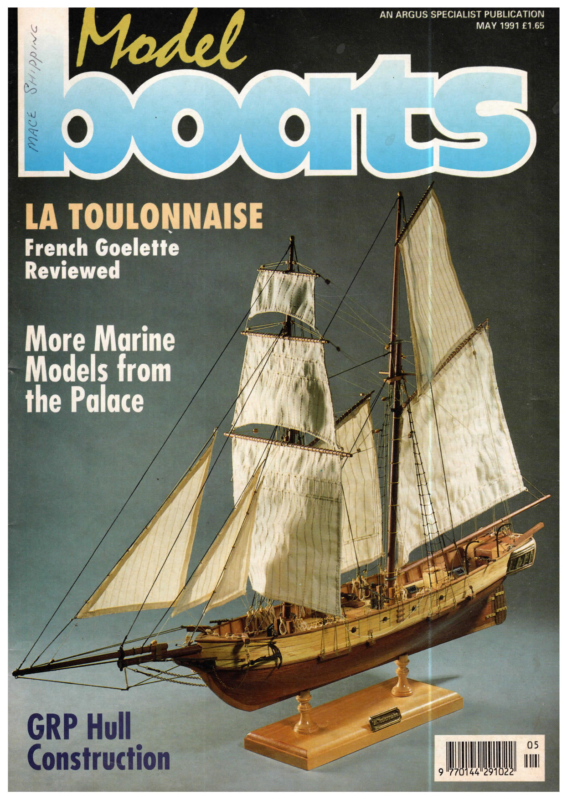
AN ARGUS SPECIALIST PUBLICATION MAY 1991 £1.65 TOULONNAISE French Goelette Reviewed More Marine ua a Models from AINNY i
Russell Potts on MYA news, Australian craftsmanship, and old boats Racing Rules Appendix as a formal part of the International Yacht Racing Rules (IYRR) 1998-92. [YRU have published it as a Supplement to the IYRR. It changes its number to be Appendix 16 instead of 15. The new format IYRR is available from the MYA’s Supplies Officer, David Hackwood. Scotland TYRU has a “one National Authority” policy which means that the anomalous separate representation of Scotland and England in the IMYRU has had to end. This has caused some regret on both sides of the Border and in Scotland there has been a degree of bitterness on the part of some individuals. The MYA had opened negotiations with the Scottish MYA on the way in which such a change could best be prerrs A scale sailing model of Columbia, Herreshoff’s America’s Cup Defender of 1899. Scratch built by Rod Clack 1982. Definitely a light weather boat in model form. Photo: Rod Clack. MYA News It’s some time since I referred to the doings of the MYA and IYRU-MYRD. Now that I am no longer MYA Secretary, it is more difficult to get news into this column in time for it to be sufficiently up to date to be worth while, and MB now has two other contributors who are going to want to discuss at least some of the issues arising. Despite all this, there are some items of sufficient lasting importance to be worth covering, even a little after the event. This is a round-up of some items from the MYA AGM, the Permanent Committee meeting in January and the January Council oe: or ng ~ ag + Fi soe ers le model of a cutter yacht; scratch built 1984. Poto: Rod Clack. Restoration of brigantine Le Dieu Soleil. Model originated in Tasmania probably as long ago as 1830. Hull has been deepened to give suficient displacement which shows she was designed as a sailing model. Photo: Rod Clack. meeting of the MYA ft Tease Pad sprit : Scratch built model of the first yacht registered in Hobson’s Bay YC. The original boat dated from1888; Rod’s model was made for the club centenary in 1988. Photo: Rod Clack. Another AC boat. This is a contempary model of something approximating to one of the later Shamrocks. Rod restored this one for Lipton’s Tea pe use in commercial promotions. Photo: Rod lack. Rules The first visible sign of the incorporation of IMYRU as the Model Yacht Racing Division of IYRU, apart from the change of letterhead, has been the addition of the RC 44 managed, offering a wide range of possibilities, but making clear that if agreement could not be reached the MYA would feel bound to apply for recognition as the sole National Authority for the UK, if only to preserve access to international competition for MYA members. The exclusion of the MYA would also be gravely damaging to MYRD, as England still provides a disproportionate share of MYRD’s administrative and executive personnel. In the event the negotiations A scale model of lone, R Melbourne YC. Originally built in 1893, restored 1990. Photo: Rod Clack. MODEL BOATS
Another view of the Australian ‘A’ class Nationals winner for 1991, Flash Floozy. Photo: Rod Clack. Ranking List race in the District during the course of the year. How this situation will develop within Scotland remains to be seen, but given the small proportion of model yachtsmen, in Scotland as elsewhere, who are interested in competition outside their own club the chances of the Scottish MYA having a continuing existence for several years to come must be good. Whether it is the best solution for the long term health of model And after restoration. Photo: Rod Clack. contain no information on the substance of the proposals that were being discussed. Nothing came of these negotiations and it was some time after the war that the Scots, still seeking direct entry to the YM Cup competition, applied for and received the separate recognition from IMYRU that has now come up against the conventions of the Radio ‘A’ Flash Floozy, winner of the Australian Nationals 1991. Photo: Rod Clack. TYRU. with Scotland seem to have come to grief when the MYA’s AGM declined to approve a formal change of title to “UK MYA”. The Scottish MYA then decided to break off negotiations and to go it alone outside MYRD. I think this is a great pity, as the opportunity to bring the two nations together in a stronger union will not present itself in the same way again. The Scots feel, possibly with some justice, that their sensibilities as the senior National Authority and as a small nation very conscious of their differences from and their perceived dominance by the UK, were not sufficiently considered by MYRD and by the MYA Nonetheless, their decision not to unite with the MYA is regrettable and cannot be good for the health of model yachting north of the Border. In our hobbies as elsewhere in the world the strong do what they can and the weak suffer what they must. The immediate reaction of the more active competitive clubs in Scotland has been to apply for direct affiliation to the MYA and for the formation of a Scottish District. So far, two clubs, Buchanness and Levenhall, have been affiliated to the MYA and the District has been established. Arrangements will be made to hold a MAY 1991 Before restoration shot of schooner model. Photo: Rod Clack. yachting in Scotland is another question. The situation now parallels that which obtained in the 1920’s and 1930’s when the MYA, with far less authority than now, claimed to represent model yachting in the whole of the UK and indeed in the Empire as well. The SMYA existed in parallel, but with a proportion of Scottish clubs affiliated to both Associations. There were disputes with the Scots in the early years of the Yachting Monthly Cup over the terms on which their entries were to be accepted for the British Empire event that served as eliminator for the YM Cup competition itself. The fact that the Scots had been represented on the committee which drew up the conditions did not mollify them. In reports of MYA meetings of the day there are a succession of references to discussions with the Scots on the relationship between the two Associations, which however In passing, it is worth noting that with magnificent inconsistency, the IMYRU had pursued a “one authority” convention in respect of all other member nations for many years and that protracted negotiations were needed in the USA, with IMYRU acting as midwife, before the relationship between the AMYA and its predecessor, MYRRA, could be resolved to permit the USA to affiliate to IMYRU. I refuse to speculate on why this should have been the case. Permanent Committee Judges Among the matters settled at the MYRD PC meeting were the institution of formal designation of Judges for radio racing. These will be at international, national and local level and titles will be awarded by MYRD. So far there are no proposals for formal means of qualifying, let alone training, for these onerous positions. We shouldn’t be too upset about this as the RYA has been nominating judges for full size sailing for years without having any means of training them, but it is the next logical step if we want to achieve the consistency of standard that must be the object of formal MYRD qualification. 45
Naviga have been broken off. I don’t know the whole of the story on this one, but it seems that Naviga were resistant to the idea of accepting IYRU as the sole worlds body controlling model yachting. This does look like cutting off the nose to spite the face and, given the organisational and financial problems that Naviga must be facing in the immediate future, will probably result in leakage from Naviga to MYRD by various routes. Several west European nations have two national bodies, one for MYRD and one for Naviga and their relative strengths must be affected by the failure of the merger talks. Similarly in those countries where at present there is only a Naviga linked body the yachtsmen must be looking at the option of secession News has become editor of our opposition, Marine Modelling. As a result MYN has ceased publication. While it’s understandable that Chris doesn’t want to spend his evenings doing what he does during the day, the exchange of the only specialist model yachting journal in the world, and a good one at that, for just another general model boat magazine is a poor bargain for the dedicated model yachtsmen. Chris has also given up his post as press and publicity man for MYRD and a decision about his replacement is still awaited. and affiliation to MYRD. RM Worlds A series of photos of a scratch built model of a ‘couta boat’. The scale is 1:6. Though these originated as local small fishing craft, | think they must have been later adapted for racing, like the Shetland boats. Photo: Rod Clack. Match racing The Racing Rules Committee will be looking at the nted for a common set of Rules for match racing. This is largely sparked by the interest in match racing of radio 6-m in England. In a parallel move the MYA has said that it will be pleased to recognise a formal match racing championship if one is organised. Bill Green will no doubt keep us all up to date with these developments. . The next RM World Championship will be held in September 1992 in the USA at a site in Flushing Meadow, New York. AMYA’s bid was preferred to one from South Africa because the Worlds have been to S Africa before. Let’s hope this will be a means for plugging AMYA more effectively into the MYRD organisation, as I get an impression at the moment that they are a somewhat semi-detached member, with a degree of ambivalence about their relationship to the world body. Because under the AMYA constitution all Rule matters are in the hands of Class Owners Associations, they are still tying themselves in knots over whether and how to adopt the MYRD tightening up of the EC-12 One Design Rule, despite the fact that no existing boat is ruled out by the changes. Given the shambles the EC-12 Rule had become under the old dispensation, it’s hard to see any reason but chauvinism and “not invented here” for rejecting the attempt to make the class what it was intended to be. Model Yachting News Most of you will have realised that Chris Jackson, who used to produce the subscription quarterly Model Yachting The ‘couta’ is possibly the Melborne equivalent of the Sydney Harbour skiffs in their earlier days. MYA Vice Presidents I raise this subject not to report that Peter Maskell and I were elected to these honorary posts at the MYA AGM, but to discuss the concerns that were expressed that because the turnover of senior MYA officials is higher than it has been in the past (it’s the stresses of high office that take their toll) and the Vice Presidents live to a very great age, the administration of the MYA to look (not to be) very top heavy. Council are looking at the possibility of Honorary Life Membership, which could be awarded to those who have deserved well of the Association. A particularly attractive aspect of this would be that the award would be available to recognise those who have laboured long and hard at club level without perhaps ever holding office at RCRS90 The Radio Control Racing System was considered, as were some proposals for small amendments to its operation. It was decided that no change should be made until further experience had been gained of its operation in a wide range of national level. competition. Yes, I know that MYRD call it “Remote Control”, but I regard this as a The Lewis Collection peculiar aberration, given that every You will have seen adverts and brief mentions of John Lewis’s collection of mainly model yacht drawings, A Manual of Yacht Designs. I have delayed writing about it until I had had time to absorb the riches it provides. It is a superb record of John’s achievement over nearly forty years. There are many pleasures to be had just from looking at the drawings as aesthetic objects, from observing the steady and remotely controlled boat uses radio and that if a new system ever does come along the nitpickers at MYRD will want to call it something different and have a different set ofRules to control it. Any suggestions © for what it might be? I rather favour the idea of “voice control”, like shepherds and sheepdogs, though the sight of a score of skippers standing in a group, each howling instructions and encouragements to his boat is a bit daunting. Perhaps “thought control” would be easier on the ear? Naviga 46 Another ‘couta boat’ model to a slightly different design on the water. Photo: Rod Clack. amending the Constitution to create an Photo: Rod Clack. In a move that in some ways parallels the stand off between the MYA and the Scottish MYA, the negotiations between MYRD and the model yachting elements of – The size of this model is apparent from this shot. As can be seen from the photo at the top of the page, the sail area is large for a working boat. Photo: Rod Clack. subtle development of his ideas, and from seeing some previously unpublished sets of lines, including some very recent designs for the 6-metre class. As a historian the sheer convenience of having so many of John’s drawings together in one place is alone worth the price. MODEL BOATS
lift. He writes that he believes that there are others in the area who are interested in this type of scale modelling but he has not been able to contact them. I am therefore publishing his address in the hope that by means of an 12,000 mile return journey, Rod may find someone round the corner to swap ideas with. Rod Clack, 17 Howell Street, Moorabbin 3189, Victoria, Australia. A New Old Boat Following up what I wrote about Prospero, The bare hull of Tony Harwood’s schooner, seen finished at the bottom of this page. Photo: Tony Harwood. A scale sailing model of a small fishing craft, dating from late in the 19th century. Photo: Russell Potts. Tony Harwood has sent me photos of a schooner he has built relatively recently. The hull design comes from a 10-rater by E W Hobbs, published in his revision of Grosvenor’s Model Yachts and Boats of 1923. The original drawing is only a few inches long, but it was blown up on a photocopier to give a hull 36 inches overall, . displacing about 7 pounds. The 10 rater would have been rather less than twice as long and the D would have been in the region of 17 or 18 pounds, and with a simple gaff sloop rig. The schooner rig that has been used is a close crib from Prospero, but with simple jib headed topsails. There is radio control of the rudder and the sheets of the main and foresails; the headsails have only a bowsie adjustment to the sheets. This avoids a lot of the sheeting problems associated with radio control of a schooner which has a lot of sheets to wind in and out and is very unlikely to have conveniently arranged take off points to facilitate synchronous sheeting. The boat obviously looks good and I’m told she sails well, being both fast and close winded, if a bit tender with her topsails up. She can also be free sailed using a simple reverse tiller steering gear. The book is large landscape format, 190odd pages and is available from John at 4 Monument Lane, Rednal, Birmingham B45 9QQ. The price is £27 plus £2.50 postage. Australian Craftsmanship I recently had a letter from Rod Clack in Melbourne which among many other things, contained some photos of boats, he has built or restored over the years. Some of these are modern competitive class boats such as the “A” boat designed and developed by a syndicate of five in Melbourne. Rod won the recent Australian Nationals with this boat and another version with rather more displacement came fourth, despite having trouble with the rig on the second day of the event. Rod works as a special effects technician in television and has a high level of skill. Rather unusually for a competitive skipper, he also builds very fine scale models of local full size yachts and styles of fishing craft from the days when fishermen still used sail. He has also made a number of restorations of old models of various types that have been brought to him for a face Tony Harwood’s 36in overall schooner. Photo: Tony Harwood. Scale Sail of the Past Finally this month a couple of shots of a scale model of what I take to be a small fishing boat, possibly one of the many types that worked in the Thames Estuary in the last century. The date of the model is not known, but it is probably contemporary with the period of the original, say the latter part of the last century. As shown the model is in need of some tender loving care, but the basic quality of the work is very high. Though very near to true scale in many respects the model was intended to sail, as is shown by the substantial lead insert in the keel and the use of simple tied off sheets to the head. She would need to be retrimmed on each tack, as would her full size counterpart, but should give a reasonable performance on the water. I doubt if we shall ever know as she is an heirloom in a family that were associated with towing and lighterage on the Thames for a very long period. They also have a couple of very well built model yachts dating from the early years of this century, constructed by the great grandfather of the present owner. It is thought that he may have bought or commissioned the present model, better and differently built than the model yachts, which I may beable to squeeze in next time. Contact Addresses MYA Matters, Ian Taylor, 115 Mayfield Avenue, London N12 9HY. Tel: 081 448 1825; Vintage Group, Old Boat Queries, Curved Air Press, Russell Potts, 8 Sherard Road, London SE9 6EP. Tel: 081 850 6805. MAY 1991 47
wonder how many of you are heartily relieved that our first race is over? I wonder how many of you think the whole series is a waste of space and who needs rules anyway? I hope not too many, although of course I realise that this series cannot hope to please all of those who for one reason or another sail model yachts using radio Heading, a few rave soul s at Woodley 1990 Ranking race take the port tack to break | f the fleet control. I realise for example that 575 and 590 Skippers are not very interested in the International Yacht Racing Rules, but they ought to be interested in the tactics I set out to gain places during a race. The tactics employed at the start ought to be of interest. The tuning hints might be of interest and so on. The ending of the first race heralds the end of the first series and with it goes most of the heavy block quotes from the book of rules. We have set out the ground rules and in future articles I shall expect that readers intérested enough to be casting their eyes over my articles will have immediate access to one of the several rule books widely available. The emphasis from now on is going to be on winning whilst accepting in the next series that winning can mean different things to different people. Perhaps improvement would be a better description. If as a direct result of reading these articles and applying one or two suggestions that suit you, you manage to beat the yacht and Skipper that formerly had always been beating you then that is a concrete step along the way to winning outright races. The next series concentrates on trying to help you win club races. What I have in mind by club races is literally internal races open to club members only. These races are very different, in my opinion and experience, to open races where Skippers from other clubs come along to the host club to do battle. Club races offer you a fairly protected environment where it should be fairly easy for you to soon recognise the pecking order and the various skills displayed by the racing members. Existing club members in turn recognise even quicker the skills of the new member and adjust their sailing when close to the newcomer accordingly. For example it is easy to spot the complete novice and a wise racing club member gives the novice’s boat lots of room on the water. Club members will, if asked, give their help and advice to the novice newcomer. Most people within the Radio Controlled Model Yachting fraternity realise that we desperately need more people within our sport and will go out of their way to offer all manner of help and support. We usually find that anyone who gives our sport a week or two of hands on experience is hooked. It really is a wonderful hobby/sport with enough challenges to satisfy the most demanding. There are plenty of levels within the sport 54 ihe Nick Weall rounds up the first ten articles and looks forward to helping you win club races to satisfy most tastes. Not everyone has the ambition to try to become National Champion. There is plenty of satisfaction to be gained from doing what the vast majority of Model Yachtsmen do and that is sailing or racing at their own club with perhaps the odd visit to a neighbouring club. I certainly enjoyed enormously the Below, modified Cygnet Il One metre for comparison with new Magpie from Tony Abel see “An Abel Winch”. Photo: T Abel. first two or three years of my Model Yacht Racing, simply sailing all the time at Gosport. Club Racing Gosport club has possibly the best water facilities in the Country and I feel I was very lucky to be living within twenty miles of Gosport. Every week I would be there dying to have another go. During those years I gradually got to understand the basics of the rules that we have been covering in the first series. I tried to find books to read to help me improve. It proved impossible to find one book that was able to give me much help. The best I could find was little bits in a number of different books. That is because perhaps at that stage I wanted pretty basic advice. These days of course I’m still looking at various books and building up a library. It still is the case though that you need to pick out little bits from here and there. I hope that by the time I’ve finished the three series planned, I shall have made it a bit easier for Model Yachtsmen to come to grips with Radio Controlled Yacht Racing at all levels. I shall also at the end of the series give a list of all the books I have referred to, both to help readers wanting to investigate any aspects of sailing further and to give due credit to those worthy people whose efforts in the past to put pen to paper helped me to acquire my knowledge and to develop my experience. There is after all nothing very new in sailing, except the modern benefits of high tech materials. You dream up some new rig or gizmo and it is odds on that the Victorians or before had taken it up and then forgotten it. Man after all has been harnessing the power of the wind for many MODEL BOATS
Direction of wind. POINTS OF SAILING centuries to provide motion in boats, controlled with varying degrees of success. Before we start the intermediate series I think it should be of help if we take the time in this article to review everything Head to wind either in irons(with no way on) or passing through head to wind whilst tacking. that we have covered to date and perhaps to enlarge on one or two points. Update The first thing any novice wants to know is how to make the thing go. After all the first thing we want to do with a new toy is get it out and use it. It is just the same with a model yacht. You assemble it, put all the electrics in, connect everything up, check it all works and then off to the water. In it goes and wonder of wonders off it moves as the wind catches the sails. Usually very soon however it stops moving and drifts around for a while whilst we struggle to get our pride and joy to move again. Let’s suppose that you have never sailed before and have never built and flown model aircraft either. You realise of course that it is the sails that provide the power to shift the yacht along but that is about it.If you have never had occasion to use the power of the wind before you are in for a few surprises. I don’t suppose too many of us gave the wind too much thought other than being something that varied in strength from day to day and occasionally blows trees down or worse. In reality as we all soon find out it swings around all over the place some times and rarely blows from a steady direction, preferring instead to swing some degrees each side of a mean direction. Its strength can go up and down like a yo-yo. You learn that the wind can be Close hauled Close hauled “ on port tack. on starboard tack. > Reaching on star. .: we » Broard reaching on star. fi Reaching on , port. oe ae eee aay a f/f Broad reaching | on port Moving boom through this arc from one tack to another is called gybing. Running on Port Running on Starboard. Racing Ultras at Southampton rounding the leeward marker. to terms with tacking; that is changing the side the wind blows onto the sails. Just to remind you a yacht is ona starboard tack as shown in diagram 1 on the left hand side of the diagram in the 8, 9 and 10 o’clock positions, plus the righthand three o’clock position. The yacht is on port tack in the opposite positions. The yacht at the twelve o’clock position is head to wind, and it retains the tack it was on before going head to wind until it passes through head to wind and onto its new tack. Once as a complete novice you can manage to sail through all points of the wind, it is a good idea to practice tacking blowing in different directions over very localised areas. The wind on your cheek may not be blowing from exactly the same direction on your yacht’s sails that are only a few yards away. Winds and angles Having got a rough idea as to where the wind is coming from the poor old newcomer then has to work out at what angle the sails should be set to the wind. Thus we arrive at our first refresher diagram that simply shows to points of sail that a modern yacht can obtain forward motion from. You can immediately see that there is MAY 1991 an area roughly forty five degrees or so each side of the direction that the wind is coming from where the yacht cannot sail into. A yacht cannot sail directly into wind; if you think about it, it is obvious. If you are relying on the wind to have an effect on the yacht’s sails to push it forward, you are not likely to have much success if the wind is rushing evenly past each side of the sail. All that happens is the sails flap or flutter about and the yacht gradually falls backwards and away to one side or the other of the wind’s direction. We call that getting into irons and it is the most time wasting problem to the novice as he comes and gybing. A good way to do this is to keep sailing around a buoy trying to keep the boat moving all the time. Since in your early racing career you are going to be doing lots of penalty turns you might as well learn how to execute them well at the same time as perfecting your tacking and gybing techniques. Basic Tacking We did cover basic tacking techniques during the first series. The main points to observe are smoothness of the tack and to ensure that you actually have good boat speed before commencing to tack. In moderate windsI find it best to execute a fairly gentle turn up to and just beyond head to wind. This helps to retain the boat speed that the boat has. I then turn a little more quickly onto the new heading or even just beyond the new heading letting, the 55
sails out just a touch. As the yacht picks up speed again sheet the sails back in and harden up to your optimum close hauled course. If your yacht is set up correctly it should in fact assume the correct close hauled course, once the sails are fully sheeted in, without any assistance from the rudder. So if you have to steer your yacht to hold it on a close hauled course on both tacks you need to alter the balance of the yacht. One way of doing this is as follows. If the yacht, when left alone, is always falling off the wind having been set on a close hauled course on both tacks, then move the rig back towards the stern. This can be achieved by moving the mast position or by moving the jib or by just racking the mast further back. All will have the effect of moving the centre of effort further back. Moving the fin forward would have the inability to tack the thing as well! So it does pay to keep a good eye on wind strength! Tacking in heavier winds demands a different approach. approaching the bow of the yacht immediately prior to tacking. You need a wave that is approaching from the current windward side of the bow to help push you same effect although in this case you are moving the centre of resistance forward. In Heavy Weather round; you most definitely do not want a wave to be approaching from the leeward (Resistance to leeward movement.) If on the other hand the yacht tends to screw up into wind if left to its own devices on both tacks then do the opposite, move the centre of effort forward or the centre of resistance back. You’ll notice I was very careful to As mentioned above if you have too much sail area up for the wind’s strength tacking can become impossible. Should you find yourself in the position where you are unable to tack do consider the option of yacht in whisper light winds is forward motion. It is critical to retain that motion true and symmetrical! Wind Effects advantage, but if your yacht screws too much up into wind then you are going to lose speed if you are turning the rudder in the opposite direction to compensate. It is better to sheet out a little to let some of the pressure of the wind off the sails; you will probably increase the boat speed by doing so also. If the wind continues in its new strength you need to consider changing down the sail area. Besides the yacht becoming difficult to control the other indicators that suggest changing down are the angle of heel whilst close hauled and the amount the bow buries itself whilst on the run. Other skippers changing down is a very useful indicator to the novice as well! There is no advantage in carrying more sail than required to move your yacht through the water at its optimum speed relative to the winds. The only possible area of advantage is in acceleration of the boat up to maximum speed. That small advantage is more than lost through the loss of motive power whilst beating owing to the angle of heel which might quite possibly be coupled to excessive leeway, burying the bow completely below water whilst on the run, capsizing, waving the rudder in the air whilst on the run and the 56 And in Light Needless to say very light winds also require a different approach. The most valuable thing you possess as a racing emphasis that you ensure that the yacht is behaving the same on both tacks before altering the balance of the boat. That is because if it is only happening on one tack that it screws up into wind, it is odds on that on the other tack it is falling off or sailing steady. In that case the problem is likely to simply be one on centring the rudder correctly. If you still have a problem after all that has been checked, then start checking out the set of the keel fin vertically and in line from bow to stern. Then check the mast for a symmetrical trim and lastly check that the hull is in fact You should also bear in mind that different strengths of wind will effect the behaviour of your yacht differently too. As the wind increases it usually has the effect of moving the centre of effort back in the sails, resulting in more tendency to screw up to wind. In moderation this can be an side of your bow because you will find it very difficult to tack through that. The other approach is to get on top of a wave and then tack. Peter Stollery’s Pit Stop copes well with heavy weather at the RM Worlds. gybing instead. It is far better to execute a quick gybe than continue to struggle time after time attempting to tack. Sooner or later a real hazard will appear and you will need to change the direction of your yacht a bit sharpish or face disaster. Be careful when gybing not to sheet out too far, because as the main goes across the wind will slam it onto the new setting quite violently. On a full sized vessel you have to be very careful in such conditions to doa fully controlled gybe or face losing the mast or boom! Anyway there is a much easier way available most of the time. Firstly ensure that you have good boat speed. If necessary bear off a little whilst easing out the sheets at the same time, then slam the boat across to the new tack as quickly as possible, bear off again to regain speed and then slowly sheet in and assume a close hauled course again. Even if you do not have to bear off to gain speed before tacking it is a good idea to sheet out a little just as you commence the tack. Also do keep an eye on the waves even at the expense of sailing in the wrong direction. If there are yachts lying around in the water going nowhere do be very sure that you really do want to tack before attempting it. It may well be the case that you have crossed the layline to the next buoy, but there is always more than one way to get to the buoy and are you sure that the section of water you are planning to tack across to actually has any wind passing over it. In very light winds there can be wacking great holes all over the place. Try not to sail into one just because it is between you and the next buoy. Anyway that is something that comes with experience. The actual tacking manoeuvre can be taught. It has to be oh so gentle that it is untrue. The slightest of rudder movement and ghost the yacht across and well beyond the normal close hauled course. The biggest worry you now have is to get the sails across, and if you have not previously set your yacht up for very light winds, you could have a problem. Everything needs to be extremely light or extremely loose. You need more twist in your sails than usual and you need less tension in your jib stay. Everything must be so free and easy to swing across, and the material in the jib must be free enough to pop across and fill when on the new tack. You may not believe this, but it is often the case that the jib and even the main do not shift from their belly out position of one tack to the opposite belly out tack of the new tack, even though the booms have swung across. It is rather frustrating to be standing on the bank watching your yacht slowly be overtaken by others that have had the luck or skill to get sails across and full and drawing! The other thing that happens in very light winds of course is that the centre of effort moves forwards from its usual position (set up for Force 3 to 4 say), and this creates problems too. I first came across it, I think, when my yacht, my well behaved and well balanced yacht, simply would not sail to windward MODEL BOATS
“Possibly the only time you’ll see a racing “RM” dropping its ‘spinny”. Racing Ultras at Southampton. D.B.S. seems to be in trouble as her main swings across putting her on port tack whilst “RM” remains on starboard! very well in very light winds. If you tacked it, it would continue to turn on round after you wanted it to stop and assume its new course, so you had to turn completely around again and have another go. The centre of effort of course had moved forward and had the effect of making the yacht want to bear off all the time. So you need to either move the centre of effort backwards or slacken up the jib to lose the amount of power in the jib. To summarise on tacking and balancing a yacht: remember that different wind strengths will make your yacht behave differently as may different sized sails. Set your yacht up to be well behaved in the prevailing conditions at your club, and make a note of those settings or better still mark them with paint on the deck. Then remember to adjust when conditions change. Remember to change your tacking techniques to suit the wind strength also. (In the excitement of racing all of this goes out of the window time after time, but in the end some of it might become well ingrained. I’m sure even now after many years of racing, I still on occasions forget myself and execute a quick slam tack instead of a nice and easy controlled tack.) Sail Setting Now not surprisingly the other thing that varies with wind strength is the actual setting of the sails, besides the size. The correct size is the most important thing and as I have mentioned before the actual setting of the sails is open to all sorts of different interpretations, and I believe that the best course of action open to the novice is trial and error. It is of course very helpful for the novice to have a point of reference about which to start though. On a swing rig the setting of the jib boom in relation to the main boom is an easy can assure you that it is a complete waste of time. All you get is a completely uncontrollable rig without any balance to it what so ever. That is because the variation of air pressure from one side of the sail to the other is practically zero, thus the sail tends to behave like a sail in irons. Put a bit of belly in the sail and all of a sudden you have a stable sail that you can put all of your weight against and zoom off across depowering an over sized rig. The amount of belly a sail needs is obviously in relation to its size. Proportionally they all need about the same section, but as the foot area « The same principle apply to us, even in the strongest winds. If you wish to be out there you need sails that provide, controllable motive power. So whilst in very strong winds you need tight rigging, you most certainly need some belly in both sails. You might need a little more twist in the sails than usual too. If you do not have very small sets of sails you will need even more twist in the sails simply as a way of glider’s wing at its central point. There seems to be quite a wide area of tolerance around this point which is why I suggest you experiment a little. The cord shape of the sail is of course only one part of setting lengthens so the measurement between the boom and the belly increases. I guess I’m usually looking to make a shape that has the fullest part of the belly about a third of the way back from the leading edge of the sail, and I’m looking to make a shape that is quite like the cross section of a model the waves. MAST CRANE up a sail. In the Twist The next obvious thing to get right is the amount of twist in the main, but before you = le ig ! JIB STAY BACK STAY (DOWN TO STERN HULL EYE) 7 LUFF__-»| LEECH LEECH OR ROACH tuning to some degree. On a conventional rig the main, when close hauled, should be around 5 degrees off the centre line of bow to stern and the jib boom must be further out than the main by five of ten degrees. The belly of the jib and main must never be drawn tight and flat. There are some skippers who think that in heavy winds you should sail having flat or LUFF tight sails. I disagree, a sail must have some shape to it in order for it to become a controllable airfoil and provide motive LIFTING STRAP CLEW power to the yacht. skills over some years – (wind Force 10 and above). Out of curiosity I have tried a very flat sail section in those conditions and I HEADBOARD JIB UPLIFTER UPHAUL matter – it needs to be somewhere between five and ten degrees off the main boom line. Article 5 in the Sept 90 issue covered I used to do a lot of windsurfing and in very heavy winds once I had developed my UPHAUL 4 OUTHAUL TAC FOOT OF MAINSAIL | MAIN BOOM ; Aoeck ceverA DOWN of St. ICKING STRAP WN’ CLEW ‘“—JIB BOOM OUTHAUL COMPRESSION STRUT MAST TUBE MOVABLE PIVOT POINTS ; FIXING POINT TO HOLD DOWN FORWARD SUPPORT BOOM MAY 1991 DIAGRAM 8 STAYLESS CONVENTIONAL TYPE OF RIG y
can do that you must ensure that the mast has the correct shape to follow the luff of the main. The sail maker will either have cut your sails to suit a straight mast or one that has a certain amount of bend in it. You need to bend the mast to suit the sail if necessary. How? Well the first bit of string that comes to mind is the back stay; whether your rig is conventional or swing you need a back stay to control mast shape. The tension in the jib stay will also effect the shape of the mast so be careful, as tension in the kicking strap can also distort the mast lower down too. So get that mast to the right shape and now let’s look for some twist in the main. What is twist? Well it is the amount the leech of the sail (the back edge) twists away from its anchor position at its clew (bottom corner of sail at the back) as it rises up towards the top of the mast and its headboard, (top corner of the sail). On a Marblehead’s tall suit (around 80 to 85 inches high) I would be looking for no more than two inches twist from top to bottom. The twist in the jib should parallel the twist in the main through the lower three quarters and twist away slightly more through the top quarter of the jib’s leech. It is important that both sails set with a smooth surface all over as wrinkles not only look bad but they disturb the flow of the wind over the sail’s surfaces. Twist in the main should be adjusted by use of the kicking strap or compression strut. Other adjustments that can effect twist in the main are tension in the outhaul or uphaul. Tension in the downhaul can help to remove wrinkle in the front section of the main. It is possible that too much tension in the jib forestay can remove twist in the main. You should always check that any alterations to the forestay, backstay and jib stay have not in turn altered twist setting etc. Twist in the jib is mainly introduced or controlled by the lifting strap. By Example When starting out as a novice do not be afraid to copy other people’s settings. Look at how other models in your new club have their sails set and don’t be nervous of asking for help. The worst that can happen is that you will receive more advice than you can cope with. Not all of the advice you receive will be of much help, as there are plenty of people sailing models that have been sailing them for years and still, in my opinion, have serious misconceptions as to what is necessary to get the best out of their own yacht, let alone anyone else’s yacht. But what the hell? They mean well and sooner or later you will learn to sort the wheat from the chaff. To tell you the truth, if you can get both main and jib working well together there is as I said above a wide tolerance in settings, and whilst there may be minute advantages to be gained by the very fine tuning it is at best only going to result in a minor advantage that may not show itself over the length of course we usually race over. If you really want returns on your investment study tactics and strategy. If you know where you want to be and how to get there at any given time you will gain far more than the person who has simply got good boat speed, without good starting and racing skills. 58 Light weather at Fleetwood. New Zealand’s Robert Wattam and America’s Jon Elmaleh seem to lead, although Jon appears to have the best boat speed! Look at his wake. Reliability The last point we need remember before racing considerations come into play is reliability. It is no good winning a few early races in a meeting if your boat lets you down with three races to go! If you are intent on winning a meeting you cannot afford to miss more races than there are discards. Your objective is to be totally reliable and not miss any races through gear failure. I’m afraid however that we all suffer on occasions from some gear failure or other. Most race meetings use a system of discards. For example if there are eight races you may be allowed to discard your worst result. This is system used in full sized racing as well and it does compensate you over genuine mishaps such as picking up weed or gear failure. It is possible to a large extend to protect yourself against gear failure. Regular inspection of all lines, for example, should catch fraying line in time to replace it before racing, rather than discovering the problem in the middle of a race as a sail crumples up or the winch line snaps. Having a reliable attachment system of winch lines to booms is necessary as is a reasonably waterproof boat. Always have some waterproof sticky tape available together with spare sticky deck covers, if used. Never use a sticky deck cover twice unless sailing in very light winds. Remember to check inbetween each race for any water taken on and drain it off. Keep an eye on your yacht as it sails, and if you notice it getting low in the water, bring it in as quickly as possible rather than see it sink in the middle of the lake. (A fairly rare occurrence I am glad to write.) The Electrics The area that is most likely to let you down is the radio/electrics. Water is the first enemy whether salty or fresh. No electrical system enjoys water that I know of. Servos tend to kick hard over in one direction and stay there as their innards get wet. Receivers can produce the same symptoms. Winches tend to start hunting in and out or just to run continually in one direction only. Loss of control over a distance usually turns out to be a ranging problem; either the transmitter is down on power or its aerial is loose. On the receiver it is usually because the aerial has got the dreaded black wire disease where the wire is slowly corroding. Black wire disease hits the servo and the winch as well. Black wire disease is easily prevented by simply replacing all wiring at least every other season. Water problems are best avoided. Seal all servos and winches by smearing Evostick all over screws, holes,sealing lines and entry points for cables. Receivers and batteries should be in a waterproof plastic pot, which has had all exit and entry points for cables sealed with silicone sealer. The threaded lid of the pot should have a continuous thread with Vaseline smeared round it for extra sealing power. Batteries should be regularly replaced. Rechargeable nicad cells seem to have a life of four or five years maximum, after which their ability to hold a charge diminishes. It is up to you as to whether you wish to find that out in the middle of a race or simply replace them before they have reached the end of their productive life. On the subject of batteries have enough sets to last all day with plenty to spare. I use a pack of six nicads to last four races only. I therefore have four fully charged sets with me for each day’s racing plus one or two spares. Have enough chargers to enable you to keep your batteries charged according to your level of racing. If you are entering two day events, you need to be able to recharge all batteries including the transmitter batteries over one night. Battery wires get the dreaded black wire disease as well, so check them once a year. The plugs connecting batteries to winches/ receivers etc., also suffer from corrosion, so protect them with a dab of Vaseline as well. Screws mounting servos and winches can corrode; keep an eye on them. The screws fixing the winch drum and servo arm can work loose, so keep an eye on them as well. Doing all of these things cuts down on the number of things that can ruin your day’s racing. If you are the sort of person who doesn’t mind loosing the odd race through gear failure, then take no notice of the above and simply wait for something to give up and then replace it; it might be cheaper. I’m afraid for me though, it would spoil my enjoyment of the day’s racing. I don’t mind not winning at all, but I do like to know that I have put up a good fight and that I was simply beaten by better Skippers. Ready to Race Once we have attended to all of the above and are happy with our ability to tack, gybe and turn circles quickly, we are ready to race. If you have read all of my previous articles you are more than ready to race. If you can remember more than ten percent of the points I was making and the rules I was listing you’ve got a good chance of not coming last. We will finalise this summary in next month’s article. MODEL BOATS
A Finnish Summer? Now for those racing enthusiasts wondering where to spend a week in August watching the best of Europe battle it out in the Radio Marblehead Class Finland is the host country. The dates are the 11/16th August, with the actual racing commencing on the 12th.The location is Hango, on the southwest tip of Finland, west of Helsinki. It is more or less due east of Stockholm from whence a ferry can be taken to Abo in Finland. Hango is then a short drive south from Abo. The actual water being used is a course laid in the actual harbour of Hango, albeit they are going to section off a portion of the water with a floating barrier strung between a yacht mooring jetty and a pierhead. It makes you think how lucky we are in this country to have the wonderful facilities of purpose built lakes at places such as Gosport, Fleetwood and Birkenhead, amongst many other slightly smaller sized man-made yachting lakes. Marianne Ericsson is going to be the Race Officer and that should guarantee a well run event. She was the Chairperson of the protest committee at the 1990 Worlds and is a very experienced skipper and official. They are planning for an entry total of 64 yachts, six each from France, Germany, Italy, Switzerland and the U.K. five each from Finland and Monaco, four each from Austria and Norway, two each from Belgium, Denmark, Holland, Ireland, Portugal and Spain. [YRU – MYRD member nations outside of Europe, and prospective new European [LYRU-MYRD member countries may apply for a maximum of two places per nation. Thus we might be lucky enough to see one or two entries from Canada and America and other far flung nations. It will be interesting to see if any of the near Eastern Bloc countries make an entry or two as prospective new European [YRUMYRD members. It will be a long and expensive trip for any support of our team to travel, but it could be a very interesting trip, both as‘an introduction to Scandinavia and in Canadian Alan Gardener can adjust anything that moves on his Marblehead by radio. Here you can see his kicking strap arrangment with tension applied. particular to Finland, a place I doubt too many of us have visited. The telephone number of the Hanko Tourist Office is 91182239 the Country code for Finland is 358. The exchange rate is around 7FIW/£. A guest house near the course is offering a special price of 100FIM per night as a guide. No doubt camping somewhere near to the town is available. Mooring of course for your full sized yacht is provided next to the course at the visitors yacht jetty! An Abel Winch I have just received my winch back from Tony Abel. I send it to him each winter to have it checked over and the wiring replaced, if necessary to protect me against the dreaded black wire. Tony tells me that despite several soakings the inside of the winch was in perfect working order. That is something I have come to expect from Tony’s winches. I sent back to him one year a winch that had been completely immersed in the salty brine of Gosport’s lake and there was not a thing wrong with it! Tony has a full range of winches these days and they are well worth considering. At the same time Tony has sent me a photo or two of his new one metre boat, which are reproduced here. Called the Magpie it was on show at the Model Engineer Exhibition recently. It is based on Ospreys in the fleet had a very good turn of speed. It was very hard to shake them off. I suspect in the right hands the design has potential. Thus I am very interested in having a go before too long with Tony’s new one metre boat. Local results with it are encouraging and Tony feels that it should do better than his very successful Cygnet marks one and two! The new Magpie has an adjustable mast position with half an and on the Continent. Cover will be extended to include transit to and from the Continent, and whilst in EEC Countries, provided that the craft are personally accompanied at all times. There is a policy excess of £50.00 for hull damage and £25.00 for all other claims. Collision or damage following electrical failure will be covered. Cover will extend to include “Wind Vane” sailed craft, subject to a maximum of two being sailed at any one time. Vintage Craft can also be covered. The policy also includes third party indemnities up to £1,000,000 for any one accident. The premiums are reasonable. A yearly payment of £22.00 provides cover up to £600.00, £33.00 up to a £1,000, £44.00 up to £1,500 and £66.00 up to £3,000.00 Anyone that has a model worth more than £3,000 can get cover for 2.2% per annum of A close up of the Magpie, Tony Abel’s new one metre design based on his “RM” Osprey design. Photo: T Abel. inch of travel; it uses the same system as the Cygnet of having the booms and mast foot common to all rigs with the mast simply slotting on a stub over the top of the main boom structure. Thus you can use all of your existing Cygnet rigs if you have them. The hull comes in just under the weight limit, so a couple of ounces of ballast are required. The hull, including goose neck and booms is available at around £100.00. For £155.00 a set of sails (working rig) and mast are included. As usual that adds up to Insurance Some months ago I mentioned that Roger Neave of the Cotswold Sailing Club had spent some considerable time setting up an insurance scheme for our beloved model yachts. This scheme is now up and running. Whilst at home yourTMmodel yacht and bits are no doubt covered by your household policy, once you take it away from your home cover is most likely lost. Roger has arranged that you can now, if you wish, provide special cover for your model and rigs through the insurance brokers D.B.Insurance Brokers Ltd and the underwriters Navigators and General. The new policy covers loss or damage to your model yacht whilst ashore, afloat or in transit. There are no deductions on the amount of cover paid out when meeting a claim except where sails are over three years old, when a 33.3% deduction will be made. MAY 1991 store, house or vehicle both within the U.K. Tony’s Marblehead design Osprey. In my opinion the Osprey certainly deserves serious attention, I noticed that the couple of times I sailed at Gosport last year the remarkable value. And here with the tension off. Theft of craft and equipment is covered following violent and forceful entry into a the value covered. All enquiries should be addressed to Roger Neave. Telephone: daytime 0242 525252 or evenings 0242 511497. His address is 32, Hollis Gardens, Up Hatherley, Cheltenham, Glos. GL51 6JQ Yachts and equipment do get stolen and it is nice to now have the opportunity to insure against that eventuality. Damage most definitely does occur both during racing and friendly sailing. Yachts do occasionally sink and it can be an expensive business. When the gales last year blew off the roof of the Gosport Club’s boat shed quite a lot of yachts suffered damage. Club insurance only covered £100.00 per boat! Most hulls alone are worth more than that these days! MYA Year Book For those of you that are not aware of it the new 1991 MYA year book is out. It costs a whole £1.50 and contains a full list of all the race meetings that are open to outsiders for this year. It also contains details of all the affiliated clubs with contact names and telephone numbers, plus useful bits and pieces of general information. They may be purchased from David Hackwood of 10, Grangewood, Coulby Newham, Middlesbrough. TS8 ORT. Enclose a S.A.E. (A5 size) and a cheque for £1.50 drawn in favour of the MYA. You will find it money well spent. 59