- small YACHTS – MIKE KEMP brings his respected yachting column from R/C Boat Modeller

a 22° Se . – a = BS sas = Zzenge Oagte Arm ste % aur Ie vA = Som + oS a ne F ; as ¢ Ez: & e a2 HO
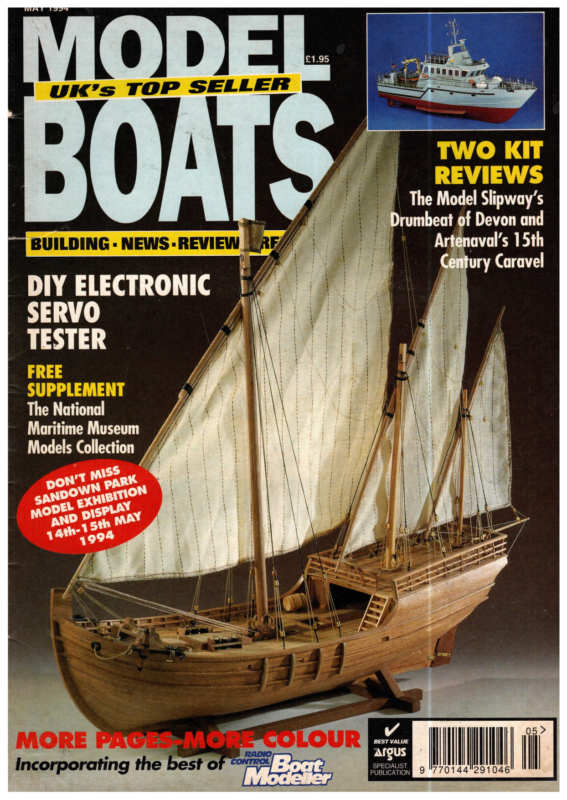
BIGGER! We are not going to waste a lot of the extra space and colour in this new, enlarged and improved look Model Boats by telling you what you can easily find out for yourselves by turning the pages! However we would like to take just a few lines to firstly welcome new readers who have made the switch from sister magazine Radio Control Boat Modeller – we intend to integrate some of the best features from RCBM into Model Boats – for example in this issue we have R/C Yachting, a DIY Electronic Construction Project and an extra Kit Review, the Drumbeat of Devon. The R/C Yachting column will alternate with a new yachting column, Yacht Lines, starting in June, from the Model Yachting Association’s new Publicity and Promotions Officer. Secondly, we would emphasise to regular MB readers that this integration will not be at the expense of MB ‘normal’ material. In order to assimilate the best from RCBM, the editorial pagination of the magazine has been increased by 8 pages. To further increase our capacity, initially, all the Association oriented material, that is MultiMatters, Roostertail, Straight Running, Hydro Topics, Scale Scene, Small Yachts and Yacht THE BEST Lines, will be printed using a slightly smaller type size; thus maintaining the content. If any readers have difficulty with this, please let us know and we will revue the decision as appropriate. The most striking improvement is of course the increase in colour content – from our recent 10 pages to a whopping 24 pages! – more than twice as much. Previously, every month, we agonised over which excellent colour photographs would have to be relegated to a black and white world – nowa much larger proportion will be in natural colour. And just to get this first issue off with a flourish, you should have found the 24 page colour supplement about the National Maritime Museums Models Collection – this the first part of an exciting new partnership with the Museum which will continue over the Summer months. And all this has been achieved with only a modest increase in price. So, all in, a fantastic 96 pages of model boating material – more than enough to keep you reading until June issue – on sale 13 May. Remember, All you need for the entire hobby can be found within the pages of MODEL BOATS – the FIRST monthly and still the BEST! AT LAST – A MODEL BOATING MAGAZINE COVERING THE ENTIRE HOBBY! Model Yachting Welwyn Garden City Hydro Date Change To avoid a clash with Victoria Club’s 90th Anniversary Regatta, the Welwyn Garden City Society of Model Engineers have moved their Hydroplane Regatta from 5 Juneto 3 July. Blackburn & District MBC Reformed A group of model boat builders have reformed Blackburn and District Model Boat Club, after regaining permission from Blackburn Council to use Queens Park boating lake. The interests of the club are scale, steam, sail and fast electrics. Sorry I.C. are not allowed on the lake as Queens Park is a nature reserve. The club will be affiliating to the MPBA. Disabled members are welcome as a number of members are disabled and access to the park and lake is very good. Summer sailing times are Wednesday nights from 6.30pm and Sunday mornings, 10.00am to 1.00pm. Please contact John Fawcett, Tel: 0254 663390 for further details. Grays Thurrock MBC Exhibition The club will be holding their fourth annual exhibition at the Thameside Complex, Orsett Road, Grays Thurrock, Essex from 3 to 7 May 1994. This event has been very successful in previous years with model boats of all types on display. For further details ring Mrs I. Harrington on 0375 378383. MODEL BOATS MAY 1994 MYA Racing Calendar,‘May 1994 Association lst Press Release Ist The Council of the Model Yachting Association have set themselves the goal of doubling their membership by the year 2000. To achieve this and to fulfil the Association’s responsibility to encourage and promote the sport, the Council are pleased to announce having co-opted Anthony Corbett as Publicity & Promotion Officer. Anthony is both a keen sailor and active R/C-yacht skipper and ‘has brought to the MYA a number of proposals that try to address not only development of the sport through competition, but more importantly as a fun activity that should appeal to modellers and sailors alike. The good news is that the MYA are now in a position to address the requirements of the numerous people who prefer less competitively oriented classes. Providing the Clubs support the proposal, it is intended to develop and promote a “Division” for the modeller and recreational sailor who is more interested in sailing one of the many semi-scale kits already available in the market place. Already involved in the process of organising a number of events intended to appeal to both modellers and sailors, Anthony would like to hear from any manufacturer, distributor, builder, sail maker etc., who would like assistance in running promotional events or being registered with the MYA and its many members. ABoat South Western Ranking Race Peck 36 Class Midland District Champs lst | Marblehead 1st | Marblehead ist 1st 2nd Broadlands Trophy Broads M’ket Bosworth Rum Trophy Six Metre Cleveland Marine Modelling Match (3) _— Lee Valley 1 Metre 1 Metre Gwynne Bowl-5HourRelay Solarkraft Cup = Eastbourne Platt Fields _ 8th 8th ABoat 10 Rater Wyre Trophy Open event 15th 15th 10 Rater Marblehead South Western District Champs. Woodspring — TCup : Birkenhead — 15th 1 Metre Metre Trophy 2lst Vintage Group 22nd 1Metre 7/8 Marblehead Scottish District Ranking Roce Edinburgh 14/15 Six Metre 15th 1 Metre 22nd Marblehead 22nd 36 Class 22nd Marblehead 22nd Marblehead Fleetwood— Yeovil . MYA National Championship _ Gipping Valley. Gosport _ Isis Trophy – Banbury Gane Solent (Setley) Hatfield Trophy Chelmsford Met & Southern Championship Guildford — Yorkshire Cash RegisterCup Leeds TomGrant Trophy Poole Openevent — Bournville _ 28/30 Marblehead MYA National Championship Eastbourne- 29th Six Metre Marine Modelling Match (4) _ Clapham ~The cee fixtures cover radio controlled events oe For etuite “: vane steering events or more about the clubsin your area, telephone _ lan Taylor, the MYA Information Officer on 081446 1625 (between _ 14.00 and 21.00hrs). If you wish to be registered or just wish to know more about the MYA and what the association can do for you, please write (in the first instance) to: Anthony Corbett, 59 Esher Road, Hersham Surrey KT12 4LW. The MYA administers seven yacht classes and represents 80 sailing clubs around the country. Except for their costs, these small yachts are as demanding as any dinghy or “full-sized” racer, with a standard of competition that surprises even the most compe- tent of skippers. For the modeller, there is the appeal of being able to design, build and sail something created from-his own resources. For those interested in model yachts but who missed the MYA stand at the 94 Exhibition at Crystal Palace on 5/6 March, go along to one of the competitions listed in the table above being held during May.
small ee uk gee Top, one man and his MIKE KEMP boat. And our first pic isn’t even an R/C model! brings his respected Have you seen this man on Clapham Common? yachting column from R/C Skippers competing in Clapham Club events Boat Modeller must have seen this chap sailing his tiny Sreesailing boats while they were tuning up. Don’t be fooled, ‘Dev’ knows the wind conditions there like the back of his hand; he should do —he started sailing there in 1936! elcome to my little bit! Perhaps I should say how pleased I am to be reappearing in print in this new version of Model Boats: our Editor suggested I should do an introductory piece to open up my first regular contribution to this magazine. For just over eight years I Right, another man and his boat. A far cry from Fiji; that island’s Visitors’ Bureaux Chief Mark Steel borrowed this Jazz to make some occasional rapid progress during the Fiji Trophy at Setley on one cold February day. The bitter conditions must have dulled his equatorial senses a bit Sor his was a lowly final place. 42 have been writing in the sadly now defunct Radio Control Boat Modeller and have gathered a small band of regular readers, many of whom feed back directly to me when we meet at competitions or by writing. I hope you have all followed me to these pages and will continue to let me know what you think and offer suggestions and snippets of information. For many of you who are ‘meeting’ me for the first time perhaps I should tell you a little about myself. Iam an engineer who moved across into the training world retaining a keen interest in things mechanical and electronic. I first got into model making whenI was at school ‘n’ years ago with Yend plastic kits, free flight rubber powered model aircraft, and chuck gliders. Whilst the latter flew quite well, the former did not, and I quite rapidly moved to model boats with free ‘flight’ electric power and a particular favourite – minuscule Jetex powered hydroplanes: small computer-mouse sized craft that would travel the length of the old Harpenden common pond and part way back on one burn! Soon after starting work I became involved with end scale slot cars and was an early member of the Vauxhall motors club. Then there followed a period ‘in the wilderness’ until I built a 575 yacht and became hooked on model yacht sailing: it was the success of that yacht that got me into this magazine when our Editor suggested that tell everyone how my yacht seemed to go faster than everyone else’s. Thus my writing career was born. Since then I have moved on to sail Radio Marbleheads, managing to squeeze into one World and three European Championship events with varying degrees of success but always finding lots to write about whilst enjoying the sailing. I built one of the first TYRU One Metre yachts to be registered, indeed I was the MYA class registrar during those formative years of what has become the most popular beginner’s yacht. I am now looking forward to having a go at the first World Championship for that class and intend to bring a report of it to these pages later in the year. My other yacht is a Radio 6 Metre, a beautiful class which has been rescued from obscurity to become another surprisingly popular type of yacht now frequently used for Match Racing under radio control as well as vane steering. Through all of this I have been fortunate enough to build up a wide range of friends and acquaintances who provide me with bits and pieces to weave into this text. With your and the editor’s permission I intend to carry on MODEL BOATS MAY 1994
my ramblings in these pages: sometimes serious reporting, sometimes attempting to be amusing, always endeavouring to be informative to the beginner and expert alike, and occasionally a little controversial. The new League Season The new league season actually startedin November last year – not a lot of people knew that! Who is setting the pace this season? Will Fleetwood do the double again? At the time of writing this we have had the results of three Radio League meetings announced, two at Swanley and one at Brentwood; which could account for the slight southern bias in the results so far. The following is the first of what I hope to be able to make a regular summary of the top of the league. Left, the MYA Information Officer, alias Model Engineer Exhibition Model Yachters were poorly served at this Ae year’s Model Engineer Exhibition. Bill Sykes did his bit again by proving that yachts can be beautiful to behold and competitive in the racing arena. His ‘Caprice’, the first 6 Metre from Bill in a long while, gained a silver medal but was not really displayed to advantage. For a change his yacht was centre stand and close enough for the viewers to be able to observe the superb standard of model engineering in the fittings of this very competitive racing yacht. If one peered through the end of the stand it was possible to see how fair are the planks which form the hull. What was lacking was that touch to get the sails to set properly instead of just hanging there with the jib on one tack and no real shape in the main sail. When will these people learn that just a little tilt will let the sails adopt a working shape and make the whole boat ‘come alive’? The large waterline model of a yacht elsewhere on the same stand demonstrated this well – but was not determined by those who set up the stand. Displayed as a loan model was another example of Bill’s handiwork. This time something that should eventually drive the scale sailors wild. Apparently close to completion up to deck level and obviously destined to be a working model, witnessed by the rudder servo just visible, this is going to be a magnificent craft. It is a scale model of ‘Johanna Lucretia’, a gaff rigged schooner originally built in Belgium but now owned by a Dutchman. The prototype is some 21.5 metres overall and Bill is building at ¥oth scale. MODEL BOATS MAY 1994 Colour is subtly introduced by using yellow pine for the hull planking and cedar for the bulwarks which also contrasts nicely with the sycamore used to plank the deck. Bill’s engineering is just visible in the pulleys built into the woodwork in readiness for rigging around the bowsprit. Ever practical Bill claims to have made a few changes to allow the yacht to be rigged and packed away quickly but these are not yet in evidence. To me this model was just oozing quality: I have a feeling that I was not alone judging from the comments I overheard from others as I was making notes and taking photos. Is this another medal winner? Look out for this one on the water sometime in the future. Despite a hint at the AGM last December that someone might step in to mastermind the MYA stand it was withdrawn at the last moment. This ended up being great news for the Scale Sailing Association who came out of the resulting space reshuffle particularly well with a large walk-in stand. The price? Having to spend the duration of the show fending questions that would have been answered by the army of volunteers who normally man the MYA stand. For an organisation pledged to achieve 2000 by 2000 this was not a good start to ’94. In these sort of matters absence rarely makes the heart grow fonder. There are a lot of prospective model yachters who went away from the show un-tempted and a lot of existing model yachters who went away from the show without their up to date information on what will be happening during the coming year. The show is normally the prime source of MYA handbooks for many who have a less than effective internal club distribution system – the informative presence at shows like this should not be underestimated. There are a lot of us who are unable to devote all of our time to organising and manning such a presence: but there must surely be some model yachtsman out there with both the time and the will to take on this vital role. The evidence does not suggest that everyone is devoting all their time to sailing. Could this be another indication of the amazing apathy demonstrated by the pitiful representation at recent Annual General Meetings. Lord Vulture, AKA Ian Taylor, appeared at Clapham with Chinkara, a yacht designed, built and borrowed from the new Secretary to the Council, Henry Farley. Below, another beautiful yachtfrom Bill Sykes at the Model Engineer Exhibition; Johanna Lucretia, the part finished schooner. Those dark wood struts at the inboard end of the bowsprit each have a tiny pulley inset ready for rigging. 43
Got that sinkingfeeling? Brian Wiles had it during the Tess Cup at Clapham. He managed to get out in the rescue boat quick enough to prevent a trip to the bottom after a deck patch lifted. Right, while namesake Peter was sailing French Kiss, Brian Wiles was giving his new Detriche Stellar ‘French Bread’ an airing. Quite different in shape it could be tricky to establish the better of the two. The Multihull Scene Not too many people know this: but while we in the mono-hulled world have been fretting over the development of the One Metre rule and resurrecting the 6 Metre class the multi- hulled world have been steadily ‘getting their act together’. World is almost the operative word because there is almost universal agreement to race multi-hulls in one of two distinct classes: the Mini 40 and the Two Metre rules. In a future issue we shall focus on these rules and what is happening in the UK in particular. Got that sinking feeling? A happening during one our recent Sunday morning club meetings reminded me of a little piece I wrote some time back that I thought might be of use if regenerated and regurgitated: especially for beginners. It was blowing sufficiently hard for One Metres to be flying around in their number two suits and for some reasonable waves to be generated even on the water between our Two Islands. One of our number who is now the proud owner ofa fairly well known stripy planked yacht had finally made it to the water. This chap deserves a medal for the perseverance he has shown in repeatedly turning up on a Sunday morning only to have something break or go wrong. The latest change involved replacing the winch making it possible for him at last to join in. Towards the end of our first race he appeared to be having some difficulty manoeuvring with the yacht even nose-diving when on a not particularly close beat. Suddenly the nose did not pop back up again: instead it continued to proceed downwards the yacht was sinking! Immediately both he and I stood still and fixed our eyes on the spot of water where we last saw it. Meanwhile, efforts were set in motion to get our rubber dinghy into the water, have two buoyancy aided crew installed and equipped with a long pole tipped with a rubber ball. After two such teams had made fruitless attempts to locate the vanished craft another plan had been hatched on the shore. A reel of braided dacron had been fitted with two weights some distance apart and either end walked around the bank: the boat was to take the weighted section well out into the lake and drop it. The shore party then began to slowly trawl for the boat. Not long after this had been commenced there was a shout of “I’ve got something” and the two fishermen drew their ends together and gently pulled them towards the bank. Sometime later the mast head appeared above the water and the boat crew could join in to gently raise the water filled hull. This is an operation not to be rushed as it is very easy to do considerable damage trying to lift it completely clear when full: the water must be drained as the hull is taken out of the lake. The first operation is to remove the battery power and commence water removal from the radio. Some of the magic water removal fluid available from industrial suppliers such as RS Components and Farnell is invaluable for this and can quite successfully have a radio back in working order within minutes of removing from the lake. What causes such heart stopping incidents? How can they be prevented? The reason for such a non-collision related sinking is usually the failure of a self adhesive patch. Such patches must be applied to a dry, smooth, surface so applying a patch at the lakeside is a risky business. In my opinion one should never re-use a Fablon or similar plastic film patch. Some of the more expensive self adhesive sail fabric patches do seem to be able to be re-used but I suspect even they work better when applied in the dry to a smooth, dry, surface. Some types of plastic film, those intended for use in bathroom type environments, are slightly more robust than normal and seem to have a heat curing adhesive which responds favourably to application of a hair dryer. I clean the base surface with white spirit which I have found removes any traces of adhesive film left behind when an old patch is removed. If the target surface can stand it acetone can also be used and will probably make a better job of removing traces of grease as well. The patch is applied by taping down one edge to hold it in place and then peeling the backing paper off and gently pressing down the patch as the paper is peeled away. Once the patch is in place I burnish it into position with a finger or thumbnail, ensuring that any small air bubbles are squeezed out. If at all possible I carry out this operation in the house after allowing the boat hull to come up to ambient temperature. Damaged related sinkings are not unknown, indeed my only actual sinking so far was caused by a port and starboard incident on a start line which split the hull as well as the deck patch. Fortunately the split was on the port side and the racing course was predominantly port tack so the sinking didn’t happen until the end of the running leg. This gives a clue to the limited ‘survival’ sailing tactics if one realises that a patch has gone: try to keep the hole as far above the water as possible! What can be done to protect that valuable radio gear from water? In my sinking no water got at any of the gear. Both the rudder servo and the winch were sufficiently watertight and the radio/battery pot resisted water entry long MODEL BOATS 44 MAY 1994
-—- back of the car; removed the number two suit from its bag and held it in the ‘installation’ position: it was then I noticed that something enough to allow rescue without penetration. Not only was the top sealed with a smear of petroleum jelly but the cable entry hole was sealed with silicone mastic. These days I use a slightly less robust pot, in the interests of light weight, so the crucial radio components – receiver and batteries – have their own antipenetration protection, courtesy of the local chemist shop! It’s safer sailing all the way, a tip I picked up from American Marblehead Champion John Elmaleh. Finnish Champion on the loose! Many will have heard of Christian Lindholm, certainly his name has been mentioned in these pages before in reports of various European and World Championship events. This year the British Radio sailing fraternity should watch out for Christian is based in the UK for a while and will be looking around for some events to compete in. He is currently the Finnish RM. Champion and could prove to be serious competition for the current MYA RM. hot-shots: it looks as if Guildford have successfully recruited Christian and he is currently 6th in our Radio League! Fiji in the New Forest – the Fiji Trophy Organised at the instigation of Sedgemoor One Metre expert Brian Wiles, this event moved around the Southern countryside until it settled on Setley – home of the New Forest club. It was to celebrate the visit to this country of Mark Steele; poet, artist, publicist, Director of the Fiji Visitors Bureaux, and sponsoring driving force behind much of the One Metre activity in New Zealand. Sunday 13th February was a frosty morning as some twenty odd competitors gathered in the dry parts of a flooded Setley Lake car park. A brisk, number two suit, South Easterly wind made the day feel even colder particularly affecting any exposed parts. Mark was fitted out with a suitable pair of green West Country wellies, especially imported by Brian Wiles and presented with an orange Jazz to sail. MODEL BOATS MAY 1994 Racing was like a blast from the past as we were conducted through an eight boat fleet, ten race schedule. None of this promotionrelegation stuff just a regular now you’re on, now you’re off, now you are observing system with each race being clearly called up with individual observers being allocated to line duty; scores being called as the yachts crossed the finish line. A little antiquated by today’s general standards but extremely smooth and effective, giving everyone a total of nine races during a relatively short day interspersed with sufficient time for inter-race conversation and – later in the day – some lighthearted banter with others on the water. The actual sailing was typical One Metre with a variety of race winners and the usual, make a mistake and you’re in trouble situations arising. There were many close finishes and not too many on the water incidents to worry about. As might be predicted local skipper Peter Wiles, sailing Brian Wiles’ well proven ‘French Kiss’, demonstrated that he was the one to beat during this meeting. Brian was giving his new yacht ‘French Bread’ an outing against some hot opposition to try and ascertain which of the two Detriche designs he would prefer – the Fe-Fe or the Stellar. There did not appear to be much between them, except that Peter seemed to be in front of Brian more often than the other way around. Tim Baker was sailing another Stellar, a moulded one this time, which had incredible boat speed on a beat in its number two suit but at times disastrously short of pace in its number one suit. Local man Tony Abel was was missing. A crucial part of the yacht was still in the workshop some 130 miles away: I was without the main boom, gooseneck and stub-mast assembly. ‘Ci’ would not be sailing today. Tony leapt to the rescue and thrust his transmitter into my hands, with the excuse that he was likely to drop out early and would prefer to retire to the warmth of his car during the day. This premature bit of brain fade presented me with an unexpected chance to test drive this ‘beginners’ yacht that rarely finds its way into the hands of those contesting at ranking level. The placing of lan Copsey’s Above left, Tango, the light airs design from Graham Bantock built and sailed by Keith Skipper didn’t seem particularly at ease in the No. 1 or 2 suit wind during Clapham’s Tess Cup. Above, nattily dressed Peter Wiles salliesforth to win the Fiji Trophy with Brian Wiles’ Fe-Fe called ‘French Kiss’. yacht and the one I sailed against the Wiles’ and that of Tim Baker, I think, presents a pretty good case for this latest version of an excellent value-for-money yacht. Whenever I have had the opportunity to try out one of these yachts whilst helping new-comers tune their craft during the likes of Primrose Valley I have been impressed. ] am now even more convinced of the competitiveness of this design: it’s as good as most of the others about and, I suspect, better than many. My lesson? Stick a check list on the top of my toolbox – as long as I remember the toolbox and read the list I should arrive with all the necessary kit! Next.time The latest League News, report on the Tess Cup and the first One Metre Ranking Race of the season, a look at the new catalogues and those ‘Experimental Give-Rules’. represented by two prototypes of the recently introduced Cygnet III; one being sailed into third place by club commodore Ian Copsey, the other eventually taking joint fourth place in my hands – what, I hear you cry, about that nice new Gopher Gold of yours? The question leads me into another of those “I learned from that” anecdotes. I had intended to give ‘Ci’ an outing against some known ‘good’ yachts at this meeting – especially in front of another New Zealand representative. I extracted the yacht from the 45