- How it Started – It is 30 years since Model Maker magazine ‘turned’ itself into Model Boats magazine. Then Editor, VIC SMEED, looks back small YACHTS – More racing – it’s what summer is for! reports on a couple of major events as well as the latest on the league championship MIKE KEMP

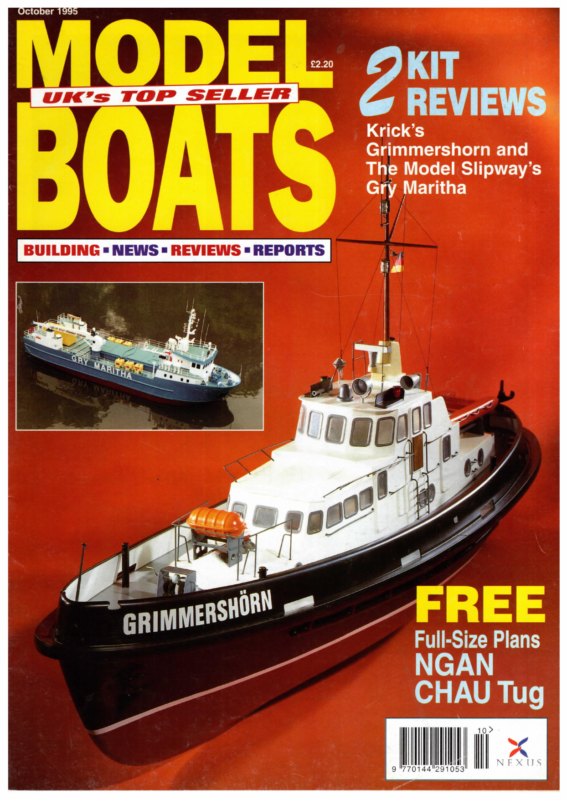
October 199 KIT REVIEWS Krick’s Grimmershorn and The Model Slipway’s Gry Maritha . / / a oF: Full-Size Plans NGAN CHAU Tug | til 10> a 291053
‘Model Ships and Power Boats’ edited by Edward Bowness, ran from 1948 until around 1958 when it was incorporated into ‘Model Engineer’. It How it Started tended to concentrate It is 30 years since Model Maker magazine ‘turned’ itself on period ships. The two covers we show here from 1951 and 1952 RETROSPECTIVE into Model Boats magazine. Then Editor, depict the Bournville VIC SMEED, looks back Regatta, basically straight running prototypes; and H.R.H. A The Duke of Edinburgh Percival Marshail, inspecting a model of H.M.S. Magpie which was presented to the Duke at the opening of the 1952 Model Engineer Exhibition. Wonder where that model is now. ‘Model Maker’ magazine makes the subtle move to ‘Model plans for the 30in Cachalot, destined to become a very popular design on the racing circuits in the late sixties and seventies. Artist Laurie Bagley created the painting and his talents were used on a number of covers during that period. H nowadays, when the chain which led ard as it may seem to believe to the present-day Model Boats was initiated, there was virtually nothing generally available to would-be builders. In the 1930s a small magazine for model sailing enthusiasts, (started in 1928) expanded to take in a bit of power boating (The Model Yachtsman and Marine Modeller) but ceased in 1939, making only a very brief, low-key appearance after World War 2. Percival Marshall’s Model Engineer carried occasional material, often hydroplane and model steam plant or pétrol engine notes, from 1898 till around 1965, and the company’s marine publication, tending to concentrate on period ships, appeared for several _ FREE! Inside—f for fas¢ racing 34 PUBLICATION could use their engines in these. When paper quotas were increased as the war ended Russell produced a small magazine, Model Cars, SHILLING ONE DECEMBER 1952 edited by Geoffrey Deason, and a second, Model Mechanic, edited by Laurie Sparey, no doubt inspired by the continuing success of the oldestablished Model Engineer. Unfortunately neither proved viable and ultimately the two were combined to form Model Maker, the editor-elect being Sparey. However, Sparey changed his mind and only the first issue carried his name; subsequently co-editor Geoffrey Deason and Dickie Laidlaw-Dickson took over. The new venture did slightly better than its components, but still had to be supported by Aeromodeller, the only other magazine produced by the company, Model Aeronautical Press Ltd., which was still running on momentum generated during World War 2, when the need for aircraft recognition etc., had boosted its circulation years after the war under the title Model to its highest ever. Ships and Power Boats, edited by Edward Russell set up a number of small Bowness, until finally incorporated into companies, e.g. Harborough Publishing, Model Engineer in, from memory, around Dagra, Masco, Russon Cars, and of course 1958. Eaton Bray Model Sportsdrome, but found A very few plans were offered, notably the himself rather overstretched and eventually Harold Underhill designs sold mostly unable to pay the magazine distributors, through Bassett-Lowke, who also supplied Argus. Ironically, he had to transfer ready-to-run launches, some electric motors ownership of the two magazines and the and steam units, a few fittings and some infant Plans Service to Argus to clear his rudimentary kits. There were one or two debt; Argus wanted to concentrate the offices individuals producing finished in London but when it became clear that this model yachts plus a few fittings, would bring about the loss of virtually all key sails, etc., and isolated model shops personnel, compromised on Watford. Russell usually catering for purely local ceased to be associated with M.A.P. Ltd., needs. (Model Aeronautical Press Ltd.) and at this There were also one or two famous time the writer was invited to join the staff. names – Stevens Model Dockyard, At first Model Maker was something of a Stuart-Turner, Bonds, Clyde Model general magazine, covering model railways, Dockyard etc., – but few places for model engineering, cable and i.c. rail cars, them to advertise and, in any event, yachts, power boats, buildings and sundry they tended to cater for engineeringodd subjects such as, for example, the type modellers rather than the kitchen Coronation Coach, and drawings of full-size table variety. There were designs anD POWER BOATS Garcke, Chairman of Boats’ in September MARSHALL MODEL SHIPS and Mr Kenneth 1965. Items included PER CIVAL ult.size Plans 30 in. Po wer moda bog l ‘Cac ha log published in various magazines etc., but few of these were practical, though some in Practical Mechanics were at least possible. Hobbies Ltd. produced drawings and wood-packs which were a lot of work and not always very good designs. In general, the would-be boat owner would settle for a clockwork metalhulled toy-type model as sold by Bowmans, Hornby, etc. In the mid-30s an engineer named D A Russell acquired Aevomodeller magazine, it is said in lieu of fees for article he had written. Commercial petrol engines for models were becoming available but soon, with the outbreak of war, their use in aircraft was banned. However, there was a following for model cars (often rubber or clockwork powered) and petrol enthusiasts cars. Gradually the subjects attracting most reader interest became identifiable, from correspondence, conversations with modellers at various meetings and demand for such full-size drawings as were made available through Plans Service. While the magazine’s emphasis was towards a somewhat technical approach, it became obvious that there was considerable demand for simple, straightforward material requiring less in the way of workshop equipment. Interest in cars, always cyclical, was diminishing, there were three established model railway magazines and model buildings as an on-going hobby had a limited following. Occasional articles could be justified, but not regular amounts of space. In the early 1950s the major new area of MODEL BOATS OCTOBER 95
for (and ultimately by) Graupner, though probably the origins of these and other products have been lost in the mists of time. While continuing with regular additions of boats and ship models to the plans range, during 1955/6 electric rail racing cars were developed in conjunction with the Southport model club, eventually being changed from rail to slot following a great deal of experimentation with tracks built in the office. Slot racing became a major hobby for several years, culminating in the first national championships on the 80ft Clarendon Circuit built by M.M. staff in the redundant synagogue sited in the grounds of the Watford offices. So popular had it become that the old Model Cars title had been incorporated on the . magazine cover (MODEL interest was radio control and enthusiasts usually first thought of aircraft. However, home-built equipment was often fairly heavy and early commercial gear sometimes not always 100% reliable, not really ideal characteristics for a flying model. Cars suffered from a lack of scale-type wheels and tyres, plus the complications of transmission. However, small engines, mostly diesels at first, were flooding on to the market for aircraft use and could fairly simply be adapted for water-cooling and flywheel running, making power boats the obvious alternative to aircraft. Most equipment was single-channel carrier wave, intended to trigger a rubber-powered escapement giving sequential control of, usually, just the rudder; clockwork escapements soon appeared, followed by electric substitutes often called ‘actuators’, much more suitable for boats, even though it was usually necessary to employ a sequential keying technique. Another point in favour of boats was that momentarily forgetting the sequence and sending the wrong signal rarely resulted in disaster, whereas an aircraft could be written off by such a lapse! There was thus a very strong indication that model boats for radio control could be a developing hobby, but there were few aids to potential builders. The post-war reemergence of Marine Modeller was shortlived and Model Ships & Power Boats tended to concentrate on period ships and sailing craft generally, with some scale steamship and motor vessel content, mostly of an advanced nature. The Model Power Boat Association was flatly not interested in radio control and the model trade was only just beginning to realise that a new market was opening up. There was the International Radio Control Model Society, but the emphasis there was on the radio aspects. It is fair to say that Model Maker fostered the growing interest in model boating, not only from the radio point of view, from late 1953 onward, while continuing to provide a varied diet of other modelling material. In those days it was possible to experiment and develop ideas to a practical level and several manufacturers, (not only in Britain) asked regularly for suggestions for items which they might be able to produce; examples are the Ripmax range of plastic gears and pulleys and the early range of propellers produced MODEL BOATS OCTOBER 95 R and Model Cars) and, when radio cars began to look a commercial possibility, Model Cars was separated into an individual magazine, edited at first by Alec Gee. This left the parent magazine with a preponderance of model boating material and it therefore seemed reasonable to emphasise this by changing the title to MODEL MAKER and Model Boats, with the intention of gradually changing the balance to Model Maker and MODEL BOATS. However, the slow change envisaged was overtaken by events when M.A.P. Ltd. bought the Percival Marshall titles in 1965. Workshop and steam locomotive articles could shift to Model Engineer, small railway material to Model Railway News; general or off-beat modelling articles had gradually faded away as the age of specialisation had advanced, so effectively model boats formed the only content. Thus on the September 1965 issue the (MODEL BOATS’ appeared for the first time. These were not the only changes in 1965, since our Watford offices had been compulsorily purchased to make a car park Moyal Navy ‘s Unsung He roes techniques have been immense, particularly in the last 15 years. Up till then printing was by the hot metal letterpress method, which limited the number of pictures (on economic grounds) but gave reproduction quality unrealised until recently by litho printing. Initially the editorial staff developed and printed their own photos or ‘designed’ their own pages, while articles were sent in typescript for hot metal setting. Now an art department lays out the pages and the text matter is all handled on the computer. Litho offers more layout scope and is relatively less expensive, but still lacks the crispness obtainable with letterpress. The editor also has to be able to use a computer… was Editor from 1960 until 1977 and here he is in January 1974 preparing the yacht Genie, which was to become one of our most successful plans. Above: Another logo design change, perhaps not for the better this one!, from a mid 1980s cover, May 1985. The and the company moved to Hemel Hempstead. With the acquisition of the Marshall titles, the then chairman felt that ‘Model Aeronautical Press’ was a slightly inaccurate title and the company name became ‘Model and Allied model reflects the move towards quality scale kits utilising white metal cast fittings – this is Calder Craft’s Joffre tug. BEENROSE Publications Ltd.’ to retain the ‘M.A.P’ initials which were known world-wide. Subsequently Argus Press Ltd. was disposed of by its parent company, B.E.T., but the M.A.P. name was retained until a further change of ownership to Nexus in 1994. Far left: Vic Smeed BUILDING – | — i – MEPORTS “REVIEWS modern stern trawler MORE PAGES! Little change of staff has occurred over the years. Editorial staff were Laurie Sparey (briefly), Geoffrey Deason (briefly), Dickie Laidlaw-Dickson, Vic Smeed, Alec Gee and John Cundell. Passing staff members have included Peter Rushbrooke, Dave Rothwell and, during school/university breaks, Philip Connolly (on a casual basis!) but for most of its life the editorial side has been a one-man band, certainly since about 1970. Changes in production COLOUR! And so into the 90s with the recent May 1995 cover. R/C scale is very predominant and WUE the variety and quality of kits available today would have been considered almost unbelievable back in those early days. This Maintenance Vessel reviewed one is The Model Slipway’s Tsekoa II. 35
A mixture of No.1 and 2 rigs as the wind comes up at Portishead. It’s strange, but that lake looks big from this shot. Those moulded Metrick Magicks are getting everywhere: this pale blue version was sailed into seventeenth place by Mike Harris. Fred Ivory, you sure started More racing – it’s what summer is for! reports on a couple of major events as well as the latest on the league championship something when you produced drawings for this design! Peter Maskell’s accident Peter Maskell has featured in this column before, first as one time Chairman of the MYA, then as Champion in the A class with one or other of those incredible Bill Sykes award winning yachts. As I write this I have heard of Peter’s somewhat disastrous involvement in an accident while on his motorcycle. I have little definite information as to his condition except to say that it sounds pretty serious, starting off in the intensive care department of a hospital in Leeds and progressing to regaining consciousness. His injuries are likely to keep him away from sailing for a while so lam sure you will all join me in wishing him and his family well and hope for a speedy recovery. League – Radio It’s puzzle time. Another One Metre sees the light of day; it is to Nigel Gilson’s ‘Dann-3’ design and is planked all around. Who is this new recruit to the One Metre fleet proudly holding his hull? No prizes for guessing! More next time. In the Radio League the scoring system was changed for this season in an effort to even out the scoring and take some of the emphasis away from the big multi-day meetings. So far the new arrangements would appear to be successful; one of the clubs that has, in the past, had a consistent attendance at the small ‘away’ meetings but not really been adequately recognised now sits right at the top with a really significant lead. Guildford have consolidated their position by having one or two members represent the club in just about all the classes sailed in this country even though Guildford remains a hot bed of Radio Marblehead development. Birkenhead have put on a spurt to climb from tenth to sixth and Sedgemoor have overtaken. Market Bosworth by some twenty five points. Solent, not known to be a club in the thick of league competition in previous years manage to hold on to their tenth place. In the individual radio competition Graham Bantock has climbed up to second overall by virtue of his success in the 6 Metre Radio Nationals. Graham is closely followed by Robert Brown who has also overtaken Gordon Sears; Robert also had a reasonable couple of days sailing 6 Metres. Chris Harris and Brian Wiles have maintained their positions and Richard Rowan has used his excellent finish in the Radio 6 Metre Nationals to overtake Nick Weall. Meanwhile Mark Dennis has slipped somewhat but remains in the top ten, though he may bounce back again if he has a good finish in the Eastern District Radio Marblehead championship. The points differences at this stage in the individual league championship are very close with less than 1.5 points between Graham and Robert while Gordon Sears only leads Chris Harris by a tenth of a point! With both of them sailing in the same classes and in the same district there is every prospect of some close racing between those two for the rest of the season. Top Ten Radio Clubs 1st 2nd 3rd 4th 5th 6th 7th 8th 9th 10th Club Score Birkenhead Edinburgh Sedgemoor Market Bosworth Solent 366.9 356:5 GOLF 308.7 265.5 Guildford Chelmsford Woodspring Bournville Leicestershire 1,016.2 790.3 713.9 492.8 391.8 Top Ten Radio Individuals 1st 2nd 3rd 4th 5th 6th 7th 8th 9th 10th Skipper Anthony Corbett Graham Bantock Robert Brown Gordon Sears Chris Harris Brian Wiles Richard Rowan Nick Weall Mark Dennis Keith Skipper Score 168.8 148.6 147.3 142.4 142.3 139.9 139.7 137.3 130.8 130.2 MODEL BOATS OCTOBER 95
League – Vane Above left: You’ve seen This month we have a mid-season report on the Vane League. Although there are fewer events and fewer competitors spread the boat before, but the stand is new. This Swinging’ and pivotting among fewer clubs competition is no less boat stand can help fierce than in its Remote Controlled partner. The reigning champion club is firmly on top again being chased, but not yet challenged, by Bournville. I am unable to give a ‘top ten’ list in the club competition because there have yet to be ten clubs represented in the series. trimming and tuning ifyou know what you are looking for. Nigel Gilson created this one. Above: Out of the In the individual championship there is the unfortunate situation of Peter Maskell currently leading: there can be no doubt that water, we can get a better look at the lines of Gordon McGuire’s this will change due to his temporary lay-off in hospital, Other familiar names are close behind him and are almost certain to Stiletto design – in this case it is Brian Wile’s overtake him before the end of the season. yacht perched on one of The scores published here were frozen before the A week at Fleetwood so can be Nigel Gilson’s new stands. expected to change significantly by midAugust. The Gordon McGuire’s ‘Stiletto’ design in the Top Vane Clubs 1st 2nd 3rd 4th 5th Club Fleetwood Bournville Gosport Birkenhead Birmingham 6th Newcastle 7th Leeds & Bradford Clapham 8th 9th Lee Valley hands of Brian Wiles. Score One of the slimmer One 768.2 389.2 233.2 173 Metres it is proving to be a first time competitive design from this newcomer to model 96.9 yachting. 49.9 47.5 42 Local man David 27 Taylor sailing his Imictation’ named Top Ten Vane Individuals Skipper Score 1st Peter Maskell 2nd 3rd 4th S Bell Graham Wyeth Derek Priestley 120.3 118.8 6th S Wyeth 112.9 5th 7th 8th 9th 10th Peter Whiteside Ken Roberts Martin Roberts Martin Mickleburgh Bill Green ‘Quicksilver’ (51) leads Paul Jones’ Parasite’ as they charge up the beat 133 126 during a No. 2 suit race, 113.2 89.5 83.5 80 65 Radio 6 Metre National Championship Two radio National Championships went north of the ‘border’ this year: circumstances prevented me getting to either so I am indebted to ‘local man’ Nigel Fordyce who was intimately involved in the running of the second for the material for this report. The Radio 6 Metre National Championship was held at Levenhall Links Road, Musselburgh, Edinburgh over the weekend 1-2 July 1995. In late 1994, Bill Green, chairman of the 6 Metre Owner’s Association, had asked the Scots if they would hold the event, and although two other major meetings had already been scheduled for north of the border in 1995, the Edinburgh RYC agreed MODEL BOATS OCTOBER 95 to take on this additional championship. Along with the Midlands, around Birmingham, Scotland has long been a spiritual home of the Six Metre class. Lately the class, particularly the radio section, has been expanding in Scotland and this event would provide a good opportunity for the Scottish boats to compete in an event which had usually been held much further South. It would also demonstrate whether developments had progressed in different directions as a result of the North/South divide. The beginning of July saw the gradual breakdown of the high pressure area which had dominated the UK for two weeks, with heat wave temperatures and falling water levels. Wind flow patterns were still erratic however, and the forecasters were suggesting the north easterlies of the previous week would make way for westerlies. At this point seventeen 6 metres arrived in Edinburgh for the championship. Questions to be answered included whether the all-conquering Renaissances would maintain their record, whether the Scottish 67
Above: Vic Cooney, these days almost the sole representative of the Woodley Club seen ‘on the circuit’, sails this rather colourful Tony Abel Magpie with varying degrees of Success. Above right: Deck layout on Keith Skipper’s ‘Red Wine’ by G.B. showing the latest Sails Etc., main boom section and a cunning mast control screw jack. It was almost an old style ‘Le Mans’ start during the South West District Ranking Race. If you were sharp. and boats, including three Dolphins, could mount a challenge, and whether the home built minute lunch break was decreed, with ‘comfort breaks’ an additional luxury (or boats could at least split the Renaissances hopefully, not too literally! In addition what was this ‘secret’ weapon which remained under wraps in the back of Alan Bright’s car. perhaps necessity). At the end of the day, amid brilliant blue skies and hot sunshine, Graham Bantock led, followed by Phil Playle and Richard Rowan, with Keith Skipper in fourth place, also brave it was sometimes The Racing possible to get away on Under Race Officer Alastair Law and his team, racing got under way on Saturday, right on time, with a seeding race in two heats using EORS 1995. One of these provided a shock for the gathered mass; the ‘secret weapon’ set off to a clear win in the hands of Alan Bright who was buoyed up by this and his performance a couple of weeks earlier in the Match Racing Championship. ‘Mehala’ struck again! Graham Bantock took the other and started on a two day route to the championship, though it was not to be as easy as many expected. After Graham had also won the first heat race, it looked even more as if he was on to a runaway win, but then things became harder as others got their eye in. Phil Playle, sailing Ian Cole’s Renaissance ‘Transition’ won a few races with Richard Rowan, sailing Alastair Law’s recently acquired Renaissance ‘Evening Star’ tucked in behind with a string of high finishes. As the Olympic style course was re-laid from time to time to accommodate the port tack. shifting wind, sometimes giving a port hand course, sometimes starboard, the boats were tacking away from the skippers out into the middle of the pond, resulting in numerous frantic calls as most of the fleet arrived in a mass at the windward mark. Despite their favoured conditions prevailing, the Dolphins failed to break through to the front of the fleet, too many of the best skippers had their hands on Renaissances! The protest committee, drawn from the competitors, had a quiet day but had one boat against boat hearing and the Race Officer dealt with another request for redress. With the number of races mounting quite quickly, despite the light wind, a 45 68 sailing a borrowed boat – yet another Renaissance ‘Manx Maid’ from deepest Suffolk. Sunday morning brought more wind, now from the west, and also a bit of a chill. With a completely different course but still Olympic style, Graham Bantock, despite further wins, still did not stamp his authority entirely on the fleet. In particular, Richard Rowan, who normally sails a Dolphin, (as well as a Marblehead and a One Metre), really got going and notched up four firsts on the trot, bringing him within striking distance of the lead. Meantime Phil Playle was busily guiding ‘Transition’ into a succession of second and third places and John Taylor notched up a win with his new boat ‘Optimum’. There was one further protest committee hearing and another request for redress; it was becoming clear that Graham Bantock’s successful claim for redress the day before was going to prove crucial in the overall result. It was very close at the top, and with two discards looking likely, the outcome of the championship was going to go right to the very end. Everything depended on the last and eighteenth race. A final course adjustment was required, a general recall made, and with excitement mounting the seconds ticked away for the last start of the day. Graham Bantock made a perfect starboard tack start at the port end of the line, tacked and was away, with Richard Rowan in hot pursuit. Graham was not to be denied and kept Richard behind him all the way, to win overall with 27.8 points to Richard’s 31.2. The Yachts The newest yacht on display was John Taylor’s own design ‘Optimum’, astonishingly in the water for the first time, having received its sails from Martin Roberts the day before the championship started. This yacht, built by Ken Jones, clearly shared its parentage with John’s A class design. To some observers it appears to have a bow similar to that of the International Star Class, raced in the Olympic Games. John did extremely well to finish sixth, including his one first place early on Sunday. This was the prototype of the design and a mould is reported to have been taken from it for production. The original has been bought by Robert Rooney of the Paisley MYC, who was himself competing in a Dolphin. Otherwise only Robert Brown’s superbly finished Renaissance could really be considered a new boat. Six Metres are solidly constructed and last well in addition to being pretty evenly matched in performance. It was noticeable that there was very little place changing offwind and that the boats were tuned for windward performance. This evenly matched performance probably surprised many who were witnessing one of the first meetings of the ‘North’ versus the ‘South’. Another aspect of a meeting like this that some would like to stop is the infrequent emergence of yachts that would not normally be seen in the hands of skippers who would not normally be sailing ‘Sixes’. That yachts developed in relative isolation, albeit to the same designs, should be able to race closely with one another is surely a tribute to the class rule. Long may it continue, even if it does undergo a re-write in the not too distant future and the words describing the yacht shape change. I am given to understand that those who did find their way to Edinburgh for this weekend had a thoroughly good time in spite of the requirements to navigate some fairly heavy boulders and the odd shopping trolley strewn around the shallower edges of the lake. They were also able to live with the need to carefully park attendant vehicles in such a way as to form a protective shield to prevent four wheel drive ‘joy-riders’ from MODEL BOATS OCTOBER 95
impossibly short time; another car from ‘Mr Plod’ (77) in the Birmingham brought Vic Bellerson and Peter Salt who, having firnily caught the Radio ‘Bug’ seemed destined to remain hands ofAnthony Corbett and ‘Manx Maid’ (51) sailed by trapped in the car by a pile of sail rigs down his side. Slowly the sea front was filled with Keith Skipper cross on starboard ahead of the very convenient grassy area adjacent to the lake. Brawn’ oe appear on the lake as the buoy handlingseam gently moved about the lake in their almost silent electric outboard powered inflatable dropping markers in what seemed from Edinburgh by cars and familiar faces who decamped onto Icarus’ (84), Robert It was not long before yachts started to appropriate positions. The organising team arrived in earnest and soon a queue was Renaissance. Photos Nigel Fordyce. John Taylor’s prototype ‘Optimum’ sailed well. It reportedly shows its family resemblance to formed to hand in certificates and part with entry fees – all very orderly. Martin Roberts was one of the last to appear – so what’s new – taking the more or less direct route down the bank into the boat park. The weather for the whole day was fine, indeed it was sunny enough to cause the ert ; his A’ class and weighs =“ at 29lbs, carrying a similar sail area to Renaissance. NF photo. inevitable skin colour change; I wondered why traffic was stopping as I stood by the side of a road on Monday! There was a good breeze that we were assured would drop as the tide turned, that was one thing the Race Officer John Carroll got wrong. If anything the wind increased through most of the day and towards the end of the meeting most were in number two suits although some did return to the taller rigs for the last race or so. Another thing the Race Officer didn’t quite get right was the course, for the first few races anyway. Tempers got just a little frayed as the field of 47 tried to come to terms with the course initially set which actually had three different leeward marks to be visited during each heat. Two of them doubled as start marks, resplendent with little flags – but no stripes so it was difficult to see whether anyone actually hit them, assuming they remembered to round them anyway – which a number didn’t! An example of how things could, and did, crashing over the usual wooden barriers and on to the resting yachts. Scottish organisation and hospitality more than made the One Metre fleet fighting out the South West District One Metre Ranking Race. This was a good time to arrive, the pick of the parking spots were still vacant, the air up for these minor distractions. This was a cracking good championship, sailed in excellent spirit, with no technical or other hiccups. Some of the race team had made a 400 mile round trip to help out; with such enthusiasm from skippers, race team and spectators, the 6 Metre class is in good was fresh and pleasing, and there were some early starters sailing 505 and Fireball dinghies along the coast adjacent to the deep * heart. Let us hope that who ever hosts the 1996 MYA 6 Metre National Championship will be able to entice as many Scots south to it as ‘Southerners’ went north for this event. Skipper 1st Club Graham Bantock 2nd Chelmsford Richard Rowan Edinburgh 3rd 4th oth Phil Playle Keith Skipper Nigel Gilson Chelmsford Gipping Valley Gipping Valley South West One Metre Ranking Race A quarter past eight on a Sunday morning in July was a very pleasant time to look out from the sea front at Portishead, just south of Bristol. I had allowed myself plenty of time to travel there and had a remarkably good journey via Oxford, Swindon, and the M4: I had even managed to miss the early morning crush as hordes descended on Silverstone for the British Grand Prix. By the side of the lake a small group of Woodspring club members were attaching small orange buoys to a rope to be stretched across the lake. In this way they would divide it into two ‘equal’ parts, one for the rowing boats the other for MODEL BOATS OCTOBER 95 gentlemanly thing after winning one heat but failed to complete the obstacle course during the re-run of one heat. During the aborted heat Chris had been leading around the correct course but had been marked as finishing during his penultimate rounding of the second leeward mark which was also one water channel along which was passing the occasional ferry and car transporter – end of the finish line on the next circuit, Instead of correcting their mistake, the finish in to Bristol docks. Soon, others started to was heard by some of the field but not others amazingly close to the shoreline on their way arrive from further afield; a pair from Doncaster, claiming to have done the diagonal journey across England in an and Chris studiously avoided the risk of being marked as finisher one lap early but also avoided rounding Yacht Design Renaissance Renaissance 27.8 Renaissance B12 Evening Star Transition Manx Maid J-Sann 4 Renaissance Renaissance Force 6 (Mod) _line judges made some announcement, which and the heat descended into a shambles. The Race Officer then decided it should be re-run Top Five Radio Six Metres Place go wrong involved Chris Jackson who did the Total Score 35.5 Tac (ewe the finish mark, when it was alsoa mark of the course – if you see what I mean! Despite Chris’s misfortune something good came out of this affair and shortly after The ‘A’ heat gets away Sarioard woull ay ; to be ie fatere’ tack. Mike Harris has ‘Night = Viston’ (51) in clean air while Graham Bantock (53) is squeezing up John Taylor (21) and Keith Skipper (81) Nien © “eanwhile Technd Rowan takes Evening Star’ (68) aisSurther —_ down the line. NF photo.
How the champion sets his sails. ‘Renaissance’ shown from a different angle clearly shows how the mainsail is rigged. NF photo. this fiasco we were informed of a course change to a rather more conventional triangle and sausage, making use of just one leeward mark – the starboard end start mark which was nowa striped buoy and a little clearer for some to see. There were those, however, who also managed to miss even the stripy buoys – but the observers always seemed to be looking in another direction, or had lost their voices! Yet another source of dissatisfaction for those who saw these infringements but felt powerless to do anything about it. Chris Dicks was proving once again that he is tops and can project his Metrick Magick around any course much better than the multitude of clones which seem to be coming out of that mould in the Midlands. Mark Dicks had a quiet but effective day to take second place with his wooden Crossbow, just as effective a One Metre but not yet copied. Another Chris Dicks design was sailed into third place by Martin Roberts who also had some trips to the lower heats but managed to climb out again. The first Bantock design was John Cleave’s Red Wine named ‘One Over the Eight’ and genuinely carrying the number nine ahead of the man himself. Graham was sailing a red Rhythm in this meeting and appeared to be having a few teething and tuning problems but showed that it just is not necessary to have the very latest ‘high-tech’ One Metre to get a place in such a prestigious event. The high speed chase across country seemed to have had its effect on Paul Jones and his Parasite who could only find his way into twelfth place despite having ‘slayed’ the fleet in the north shortly before this regatta. Local man David Taylor was using the meeting as a tuning session for a new top rig and was probably distracted by his discussions with Nigel Gilson regarding the possible emergence of Nigel’s Dann-3 One Metre design in moulded form; maybe even to be followed by a partial kitting of the slim craft. With no race scheduled to be started after 4.30pm in deference to those of us who were having to fight our way out of the south west the regatta ended pretty well on time on completion of race six. There were those who were complaining that this had been a Grey skies and a stiff breeze keep the coats on, though Phil Playle has his shorts ready for the sun! It’s all eyes on the boats though ‘cos the racing is close. NF photo. long way to come for only six races: on the other hand there were those who had participated in far more than six actual sessions on the water. The races had been quite lengthy affairs with quite a reasonable on-the-water time, even if some of the earlier ones had been more like treasure hunts. Forty-seven entries is quite a lot to handle on a smallish lake in one day, particularly when the protest committee has to sit and make smoke – which they had to do on two or three lengthy occasions. I have no doubt there will be those (including one vociferous correspondent to this magazine) who will read this last paragraph with glee and jump upon it as yet another confirmation that we should abandon the set of rules most of us strive to observe when racing so we would then not be faced with the need for protest hearings. To do so would be to sink into sailing anarchy where those who miss marks and blindly bump into their colleagues could, and would, do so with impunity. If all were to behave like absolute gentlemen we would still need the racing rules to determine who should do what when two or more yachts meet on a collision course. The only difference would be that those involved would probably both go off and ‘do a turn’; in many cases that it precisely what does happen as both parties consider that maybe they were in the wrong. I will get down off the soap box now and return to the South West District Ranking Race. Portishead lake proved to two people that they just do not have what it takes to walk on water – yours truly proved this shortly after my last start of the day. Fortunately there seems to be a step running around the edge just under water which caught me before I disappeared into the murky depths. The shock of suddenly having a different perspective on the proceedings and the Port Vs Starboard collision which ensued – I was on Port when I stepped in – secured my finish in a lowly fleet for the day; these was no way I could climb into a promotion position after that. Strangely, the squelching around the lake edge didn’t seem too uncomfortable or maybe I was concentrating more on the performance of the yacht to notice. Portishead is a public recreation area and the pathway around the lake is quite clearly a public right-of-way. Thus skippers guiding their yachts around the course not only had to negotiate each other; they had to find their way around, through, but rarely over, members of the public who were fascinated by the sight. I hope that they gained a favourable impression of the general behaviour of model yachts-people from this meeting. Oh, it wasn’t such a good journey home there were too many folks trying to get away from Silverstone and the British Grand Prix, I hope they had as good a day as we did. Nigel Gilson and is much more reasonably priced than the others that have been seen from time to time. At around eighteen pounds, plus more if you want it posted I would imagine, it represents pretty good value being made from a mixture of stainless steel, bronze and galvanised steel parts. It will accommodate 36 inch Restricted, One Metre and Marblehead designs and probably Ten Raters as well. It has the usual pointed end for thrusting into the ground, though not the pneumatic drive necessary to penetrate some of our local grassland, and a small wedge of metal that serves as a pedal to aid insertion and a vane to prevent unwanted turning around in the softer earth. The vertical pivot is machined from bronze and carries the stainless steel pin on which the swinging fork is carried. The stand comes in two parts and becomes very handy, not only for parking the yacht between races but for tuning of the rig in a close to ‘on the water’ attitude. Nigel tells me he has developed a version for a 6 Metre yacht where the craft is carried in a cradle rather than a fork. I am trying to imagine what the moments are like on the stake in the ground, particularly if ‘Mehala’ were placed on the stand in a soggy bit of land at the side of Bournville for instance! Once you have your boat stand you really need something to put on it. David Taylor is slowly building up his following of customers for his own ‘Imictation’ design which has been available from him for some time now. It comes in various states of completion from a set of mouldings, complete with moulded in fin box and rudder tube through to a ‘pick it up and throw it in’ ready-to-go yacht. For further details on this contact David, he is currently in the MYA handbook as secretary of the Woodspring club or see below. Contacts For yachts from the South West: David Taylor, 103 The Downs, Portishead, Bristol, BS20 8BE. For stands from the East: Nigel Gilson, 16 Willowcroft Road, Ipswich, Suffolk, IP1 6BS. Next Time Bits and Boats As part of the inevitable trading in ideas and much more that takes place at such gatherings there emerged yet another swinging yacht stand. This one comes from Another National Championship will have passed, just, and I plan to be there. Also the 6 Metres will have been at it again and we should be thinking of those early Christmas presents! Top Five One Metre ‘Rankers’ in the South West Design Designer Place Skipper Club 1st 2nd 3rd 4th 5th 70 Chris Dicks Mark Dicks Martin Roberts John Cleave Graham Bantock Clapham Clapham Birkenhead Ryde Chelmsford Metrick Magick Chris Dicks Widget Chris Dicks Crossbow Red Wine Rhythm Mark Dicks Graham Bantock Graham Bantock MODEL BOATS OCTOBER 95