- Title. Author. Summary

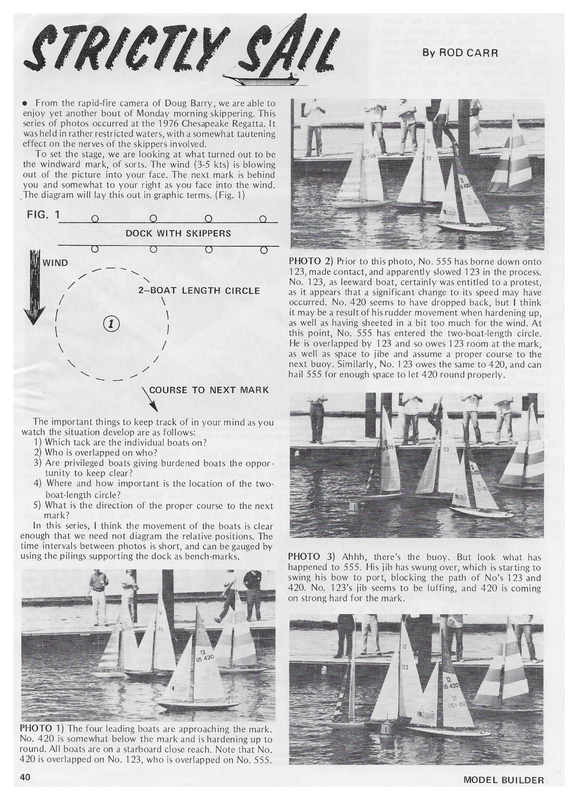
By @ ROD CARR From the rapid-fire camera of Doug Barry, we are able to enjoy yet another bout of Monday morning skippering. This series of photos occurred at the 1976 Chesapeake Regatta. It was held in rather restricted waters, with a somewhat tautening effect on the nerves of the skippers involved. To set the stage, we are looking at what turned out to be the windward mark, of sorts. The wind (3-5 kts) is blowing out of the picture into your face. The next mark is behind you and somewhat to your right as you face into the wind. The diagram will lay this out in graphic terms. (Fig. 1) FIG,1. ae O O° O DOCK WITH SKIPPERS fe a 0 (e} 0 Po i. 2—BOAT LENGTH CIRCLE \ \ (1) i PHOTO 2) Prior to this photo, No. 555 has borne down onto 123, made contact, and apparently slowed 123 in the process. No. 123, as leeward boat, certainly was entitled to a protest, as it appears that a significant change to its speed may have occurred. No. 420 seems to have dropped back, but | think it may be a result of his rudder movement when hardening up, as well as having sheeted in a bit too much for the wind. At this point, No. 555 has entered the two-boat-length circle. He is overlapped by 123 and so owes 123 room at the mark, as well as space to jibe and assume a proper course to the next buoy. Similarly, No. 123 owes the same to 420, and can ~ J hail 555 for enough space to let 420 round properly. COURSE TO NEXT MARK The important things to keep track of in your mind as you watch the situation develop are as follows: 1) Which tack are the individual boats on? 2) Who is overlapped on who? 3) Are privileged boats giving burdened boats the oppor- LA : ee ia | : tunity to keep clear? 4) Where and how important is the location of the twodoat-length circle? 5) What is the direction of the proper course to the next mark? In this series, | think the movement of the boats is clear enough that we need not diagram the relative positions. The time intervals between photos is short, and can be gauged by using the pilings supporting the dock as bench-marks. PHOTO happened swing his 420. No. on strong 3) Ahhh, there’s the buoy. But look what has to 555. His jib has swung over, which is starting to bow to port, blocking the path of No’s 123 and 123’s jib seems to be luffing, and 420 is coming hard for the mark. PHOTO 1) The four leading boats are approaching the mark. No. 420 is somewhat below the mark and is hardening up to round. All boats are on a starboard close reach. Note that No. 420 is overlapped on No. 123, who is overlapped on No. 555. 40 MODEL BUILDER
PHOTO 4) No. 555 has had the misfortune to jibe (probably unintentionally) onto port tack. It may be that boat speed would preventhim from avoiding 123, but avoid him he must. No. 420 looks like he has enough room to round, if he will only slack his sheets and fall off. The only move that 123 can make is to give hard left rudder, which will reduce the door that 420 is entitled to. No. 123 is caught between a rock and a hard place, but can blame the whole thing on 555. PHOTO 7) No. 130 elects to take advantage of clear air and jibes onto port tack. No. 420 is still sailing closehauled. No. 123 has been jibed, probably by stray air off the sails of the other boats. The outboard end of his main boom may be touching 420. However, he is back on starboard, and as such, becomes the OneNO: 2555: privileged boat with respect to the actions PHOTO 5) The collision between 555 and 123 has apparently slowed 123 even further. No. 420 has not yet slacked her “ * – | ) sheets and is having trouble bearing off as she rounds. East Coast 12-meter skippers seem particularly resistant to aiding their steering with sail trim in my experience. No. 555 is moving a bit better, probably using momentum transferred from 123 at their last touching. Score No. 555 with Plus 4, No. 123 with 0. At this point, we can put some blame on 420, since she is required to assume a proper course to the next mark immediately upon rounding. By remaining close hauled, she is carrying 123 up in violation of that precept. The f Monday Morning Race Committee awards 2 points to No. 420. | Coming up fast from the rear is No. 130. Note how well started are her sheets, in contrast to 420, who is on the same heading. SCORE: No. 555 = 4, No. 420 = 2. PHOTO 8) No. 555’s boat speed carries him out in front, and No. 123 is still recovering from the push his main boom got from 420. Considering that 123 was jibed unintentionally, | have to assume that 420 was not given opportunity to keep clear, and hence should not be penalized for the contact. We see that 420 has finally slacked her sheets and comes out of the mess a good deal worse off than she went in. . . foul (i.e., 2 points, and 3rd in line, rather than first). No. 123 dropped from 2nd to 4th, but stayed out of foul- trouble. No. 130 is smelling like a rose, now in 2nd, and showing what keeping clear of a mess can do for you on a light-air day. No. 555 went from 3rd to 1st, but managed to pick up 4 foul points. If he goes on to finish in front, his heat score will be 5-3/4, where it would have been only 3, if he had been willing to bide his time and round cleanly. Oh, the wages of sin!! | would like to again thank Doug Barry for sharing this most illustrative series with us. The chance to take a “‘happening” like this and dissect it bit by bit is really worthwhile. We only get the opportunity because a few people in the sport take the time to contribute to its improvement. When was the last time you turned off your transmitter and sat on the race committee, or put out the buoys, or worked up the heat lists and the scoring sheet? a EG PHOTO 6) All three of the lead boats have not jibed onto port tack. At this point, No. 130 is still on starboard, and if infected with the killer instinct, should have politely bellowed at all of them, and forced them all off to starboard before assuming his course to the next mark. Note that No. 420 is still close hauled, effectively blanketing No. 123’s jib, which has fallen flat. Regardless of his past sins, No. 555 has become the leeward boat in the pack and can assume luffing rights over those above him who are on the same tack. AUGUST 1977 Next month, we’ll return to the boats themselves and scamper about the deck for a discussion of deck-mounted fittings. ‘Till then, remember to send in your AMYA dues to the Secretary, 2709 So. Federal Highway, Delray Beach, Florida 33444. And remember, that model yachting is a group sport, to which each member of the group owes some of his or her time and effort for growth and maintenance. I’ll field questions, and accept suggestions, photos, and gripes for a stamped, self-addressed envelope to Rod Carr, 7608 Gresham St., Springfield, Virginia. 22151. @ 41